



CUATROCREM 1 mg/10 mg /0.5 Mg/10 Mg Crema

Revisión de receta online
Un médico revisará tu caso y determinará si la prescripción es médicamente apropiada.

Habla con un médico sobre este medicamento
Comenta tus síntomas y las opciones de tratamiento en una consulta online.



Cómo usar CUATROCREM CREMA
Contenido del prospecto
- Introducción
- Qué es Cuatrocrem crema y para qué se utiliza
- Qué necesita saber antes de empezar a usar Cuatrocrem crema
- Cómo usar Cuatrocrem crema
- Posibles efectos adversos
- Conservación de Cuatrocrem crema
- Contenido del envase e información adicional
Introducción
Prospecto : información para el usuario
Cuatrocrem crema
Lea todo el prospecto detenidamente antes de empezar a usar este medicamento porque contiene nformación importante para usted.
- Conserve este prospecto, ya que puede tener que volver a leerlo.
- Si tiene alguna duda, consulte a su médico o farmacéutico.
- Este medicamento se le ha recetado solamente a usted y no debe dárselo a otras personas aunque tengan los mismos síntomas que usted, ya que puede perjudicarles.
- Si experimenta efectos adversos consulte a su médico o farmaceutico, incluso si se trata de efectos adversos que no aparecenen este prospecto, informe a su médico o farmacéutico. Ver sección 4.
Contenido del prospecto:
- Qué es Cuatrocrem crema y para qué se utiliza
- Qué necesita saber antes de empezar a usar Cuatrocrem crema
- Cómo usar Cuatrocrem crema
- Posibles efectos adversos
- Conservación de Cuatrocrem crema
- Contenido del envase e información adicional
1. Qué es Cuatrocrem crema y para qué se utiliza
Es una combinación de un antiinflamatorio (un corticoide), un antibiótico aminoglucósido y dos agentes antifúngicos para administración en la piel.
Los antibióticos se utilizan para tratar infecciones bacterianas y no sirven para tratar infecciones víricas como la gripe o el catarro. Es importante que siga las instrucciones relativas a la dosis, el intervalo de administración y la duración del tratamiento indicadas por su médico. No guarde ni reutilice este medicamento. Si una vez finalizado el tratamiento le sobra antibiótico, devuélvalo a la farmacia para su correcta eliminación. No debe tirar los medicamentos por el desagüe ni a la basura. |
Está indicado en el tratamiento local de manifestaciones inflamatorias de la dermatosis (afecciones en la piel) que responden a los corticosteroides en casos complicados con infección mixta causada por microorganismos sensibles a los componentes del medicamento.

¿No estás seguro de si este medicamento es adecuado para ti?
Comenta tus síntomas y tratamiento con un médico online.
2. Qué necesita saber antes de empezar a usar Cuatrocrem crema
No use Cuatrocrem crema
- si es alérgico (a betametasona u otros corticoides, gentamicina u otros antibióticos, aminoglucósidos, clioquinol, tolnaftato, al yodo o a alguno de los demás componentes este medicamento (incluidos en la seccion 6).
- si padece tuberculosis, sífilis o infecciones por virus (por ejemplo, herpes o varicela)
- en áreas de piel afectadas por rosácea (inflamación con enrojecimiento de la piel en la cara) o en una inflamación alrededor de la boca (dermatitis perioral)
- en enfermedades cutáneas con adelgazamiento de la piel (atrofia)
- en áreas de piel que muestren una reacción vacunal, es decir enrojecimiento o inflamación después de la vacuna
- en los ojos o en heridas profundas
- en niños menores de 2 años.
Advertencias y precauciones
Consulte a su médico o farmacéutico antes de empezar a usar Cuatrocrem crema.
- No se debe aplicar la crema en amplias zonas del cuerpo ni durante periodos prolongados.
- No debe aplicarse la crema con vendajes o materiales impermeables al aire, ni en los pliegues de la piel, como la ingle o las axilas.
- Si aparece alguna reacción de hipersensibilidad con el uso de Cuatrocrem crema, debe suspender el tratamiento y le deberán indicar la terapia adecuada.
- Se han descrito reacciones alérgicas cruzadas con antibióticos del tipo aminoglucósidos.
- Los efectos adversos descritos con el uso de corticoides, incluyendo una alteración de las glándulas suprarrenales, pueden producirse también con el uso cutáneo por absorción al interior del cuerpo del principio activo, especialmente si se tratan zonas amplias, en tratamientos prolongados y en niños.
- Con el uso del segundo componente de este medicamento, la gentamicina, también se pueden producir reacciones adversas propias del uso interno, especialmente con uso excesivo y en presencia de heridas en la piel.
- El uso prolongado de antibióticos tópicos como gentamicina puede dar lugar ocasionalmente a una proliferación de organismos no sensibles. En estos casos deberá suspender el tratamiento con Cuatrocrem y consultar al médico.
- El clioquinol usado con oclusión puede producir aumento de los niveles de yodo en
- sangre.
- Este medicamento puede manchar ligeramente la ropa y la piel por su contenido en clioquinol.
- Cuatrocrem crema no debe entrar en contacto con los ojos, la boca, heridas abiertas o mucosas (por ejemplo, el área genital).
- Si utiliza este medicamento para enfermedades distintas de aquellas para las que ha sido recetado, puede enmascarar los síntomas y dificultar el diagnóstico y tratamiento correctos.
- Interferencias con pruebas analíticas: Si le van a realizar alguna prueba diagnóstica (incluidos análisis de sangre, orina, pruebas cutáneas que utilizan alergenos, etc...) comunique al médico que está usando este medicamento, ya que puede alterar los resultados.
- La absorción del clioquinol puede interferir con las pruebas de la función tiroidea y la prueba de cloruro férrico para la fenilcetonuria puede mostrar resultado falso positivo
- Póngase en contacto con su médico si presenta visión borrosa u otras alteraciones visuales.
Niños
No se recomienda el uso de este medicamento en niños menores de 12 años.
En niños es más probable que el corticoide pase al cuerpo a través de la piel y tener efectos adversos en otras áreas del cuerpo que en los pacientes adultos.
En niños tratados con corticoides tópicos se ha comunicado la alteración de las glándulas suprarrenales, que produce la aparición de síntomas como obesidad (síndrome de Cushing), retraso en el crecimiento, etc.
Otros medicamentos y Cuatrocrem Crema
Informe a su médico o farmacéutico si está utilizando o ha utilizado recientemente o pudiera
tener que utilzar cualquier otro medicamento.
No se conocen interacciones de Cuatrocrem crema con otros medicamentos.
Embarazo, lactancia y fertilidad
Si está embarazada o en período de lactancia, cree que podría estar embarazada o tiene intención de quedarse embarazada, consulte a su médico o farmacéutico antes de utilizar este
medicamento.
Embarazo
Como norma general, durante el primer trimestre de embarazo no debe aplicarse la crema.
No se usará Cuatrocrem crema durante el embarazo a menos que su médico considere que el potencial beneficio de su uso justifica el potencial riesgo para el feto.
Las mujeres embarazadas o que planeen quedarse embarazadas no deben utilizar Cuatrocrem crema en amplias zonas de la piel, en períodos de tiempo prolongados, ni utilizar vendajes oclusivos.
Lactancia
No aplique Cuatrocrem crema en las mamas durante la lactancia; no ponga al niño en contacto con áreas tratadas.
No use este medicamento en zonas amplias de la piel, en períodos de tiempo prolongados ni con vendajes oclusivos.
Conducción y uso de máquinas
El tratamiento con Cuatrocrem crema no afecta a la capacidad para conducir o utilizar máquinas.
Cuatrocrem crema contiene alcohol cetoestearílico y clorocresol
Este medicamento puede producir reacciones locales en la piel (como dermatitis de contacto) porque contiene alcohol cetoestearílico.
Este medicamento puede producir reacciones alérgicas porque contiene clorocresol.
3. Cómo usar Cuatrocrem crema
Siga exactamente las instrucciones de administración de este medicamentoa indicadas por su médico.En caso de duda consulte de nuevo a su médico o farmacéutico.
La dosis recomendadaes:
Adultos y pacientes mayores de 12 años
Aplicar una fina capa de Cuatrocrem crema en toda el área afectada 2 veces al día, por la mañana y por la noche.
La duración del tratamiento no debe exceder de una o dos semanas. Si utiliza el medicamento para alguna afección en la cara, el tratamiento debe ser lo más corto posible, como máximo una semana.
En los casos de tinea pedis(pie de atleta), puede ser necesario un tratamiento más prolongado (de 2 a 4 semanas), pero si en 3 semanas no observa una mejoría, consulte a su médico.
Uso en niños
Cuatrocrem crema está contraindicado en niños menores de 2 años y no está recomendada para menores de 12 años de edad.
Uso cutáneo.
La crema se debe aplicar con un suave masaje en capa fina en toda la zona afectada, previamente limpiada con cuidado.
Si usa más Cuatrocrem crema del que debe
El empleo excesivo de los corticoides tópicos (sobredosis repetidas o mal uso) puede producir efectos adversos (vea el apartado 4).
Una sola sobredosis de gentamicina no se espera que produzca síntomas. El empleo excesivo o prolongado de antibióticos de uso tópico puede provocar una proliferación en las lesiones de hongos o bacterias no sensibles.
Si pasa al cuerpo, el tolnaftato es farmacológicamente inactivo.
El clioquinol raramente produce yodismo y su uso prolongado puede producir sobrecrecimiento de organismos no sensibles.
El tratamiento de la sobredosis es sintomático. Los síntomas agudos del empleo excesivo de corticoides son por lo general reversibles. En los casos de toxicidad crónica, se aconseja que los corticoides sean retirados paulatinamente y si se produce proliferación de microorganismos no sensibles, se debe interrumpir el tratamiento con Cuatrocrem y aplicar la terapia adecuada.
En caso de sobredosis o ingestión accidental, consulte inmediatamente a su médico o farmacéutico o acuda a un centro médico, o llame al Servicio de Información Toxicológica, teléfono: 91 562 04 20, indicando el medicamento y la cantidad ingerida.
Si olvidó usar Cuatrocrem crema
No aplique una dosis doble para compensar las dosis olvidadas.
Aplique la dosis tan pronto como sea posible y luego continue con su tratamiento habitual.
Si tiene cualquier otra duda sobre el uso de este medicamento, pregunte a su médico o farmacéutico.

¿Has empezado a tomar el medicamento y tienes preguntas?
Comenta tus síntomas y tratamiento con un médico online.
4. Posibles efectos adversos
Al igual que todos los medicamentos, este medicamento puede producir efectos adversos, aunque no todas las personas los sufran.
Se han notificado los siguientes efectos adversos, ocasionalmente, con el uso de Cuatrocrem crema: eritema (enrojecimiento), prurito y cambios en el color de la piel.
Se han notificado rash (erupción), irritación e hipersensibilidad con el uso en la piel de gentamicina sulfato, clioquinol y raramente con tolnaftato.
Podría producirse aumento de los niveles de yodo unido a proteínas con el uso en zonas extensas o heridas de la piel y/o con vendaje oclusivo.
Se han comunicado las siguientes reacciones con el uso de los corticosteroides tópicos, especialmente tras su aplicación prolongada, en áreas extensas, con vendajes o materiales oclusivos, y/o en niños:
- Adelgazamiento de la piel (atrofia)
- Sequedad de la piel
- Picor o quemazón
- Maceración (ablandamiento de la piel por humedad)
- Enrojecimiento (eritema)
- Aparición de manchas rojas
- Hematomas
- Inflamación del folículos pilosos (foliculitis)
- Estrías cutáneas
- Aparición de pequeñas ampollas
- Acné
- Reacción alérgica de la piel (dermatitis de contacto)
- Infecciones
- Visión borrosa (con frecuencia no conocida).
Los efectos adversos pueden ocurrir no sólo en el área tratada, sino también en áreas completamente distintas del cuerpo, lo que ocurre si el principio activo pasa al cuerpo a través de la piel.
Esto, por ejemplo, puede aumentar la presión en el ojo (glaucoma) o podría producir una afección caracterizada por cara redondeada, acumulación de grasa, retraso en la cicatrización, síntomas psiquiátricos, etc. (síndrome de Cushing); aumento de la presión en el cráneo, aumento de los niveles de azúcar en sangre (hiperglucemia), aumento de la tensión arterial, retención de líquidos (edema), alteraciones del tiroides (hipertiroidismo), cataratas, aumento del vello, inflamación específica de la piel alrededor del labio superior y en la barbilla (dermatitis perioral), cambios en la coloración de la piel, parestesia (una sensación anormal de la piel, tal como entumecimiento, hormigueo, punzadas o ardor en la piel)
Comunicación de efectos adversos
Si experimenta cualquier tipo de efecto adverso, consulte a su médico, farmacéutico o enfermero, incluso si se trata de posibles efectos adversos que no aparecen en este prospecto. También puede comunicarlos directamente a través del Sistema Español de Farmacovigilancia de medicamentos de Uso Humano: https://www.notificaram.es.
Mediante la comunicación de efectos adversos usted puede contribuir a proporcionar más información sobre la seguridad de este medicamento.
5. Conservación de Cuatrocrem crema
Mantener este medicamento fuera de la vista y del alcance de los niños.
No utilice este medicamento después de la fecha de caducidad que aparece en el envase después de CAD. La fecha de caducidad es el último día del mes que se indica.
Conservar por debajo de 25ºC.
Los medicamentos no se deben tirar por los desagües ni a la basura. Deposite los envases y los medicamentos que no necesita en el Punto SIGRE de la farmacia. En caso de duda pregunte a su farmacéutico cómo deshacerse de los envases y de los medicamentos que ya no necesita. De esta forma ayudará a proteger el medio ambiente.
6. Contenido del envase e información adicional
Composición de Cuatrocrem crema
- Los principios activos son betametasona (como valerato), gentamicina (como sulfato), clioquinol y tolnaftato.
- Cada g de crema contiene 0,5 mg de betametasona (0,05%) (que corresponde a 0,61 mg de valerato de betametasona), 1 mg de gentamicina (0,1%), 10 mg de tolnaftato (1%) y 10 mg de clioquinol (1%).
- Los demás componentes son: clorocresol, éter cetoestearílico del macrogol, alcohol cetoestearílico, vaselina blanca, parafina líquida, dihidrogenofosfato de sodio dihidrato y agua purificada.
Aspecto del producto y contenido del envase
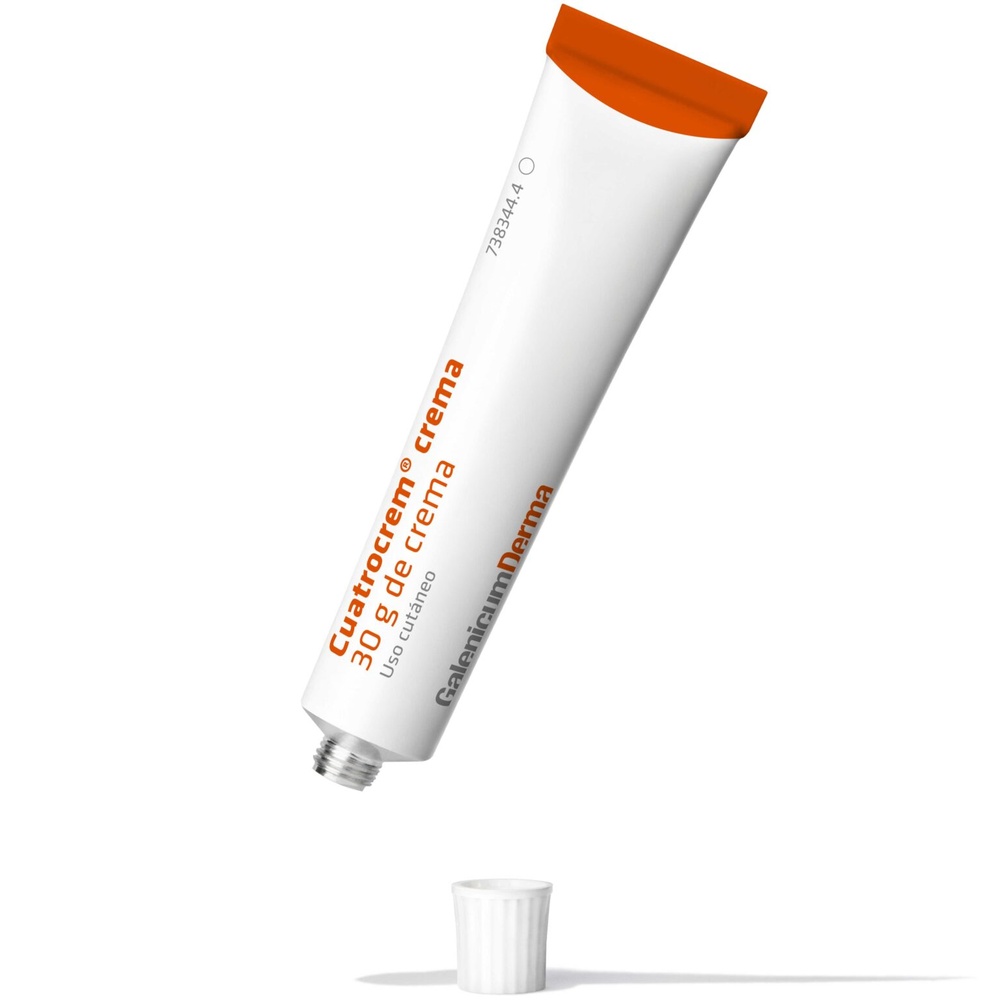
Cuatrocrem crema es una crema de color blanco y tacto suave.
Se presenta en tubos con 15 y 30 g de crema.
Titular de la autorización de comercialización y responsable de la fabricación
Titular de la autorización de comercialización:
Galenicum Derma, S.L.U.
Ctra N-1, Km 36
28750 San Agustin del Guadalix (Madrid)España
Responsable de la fabricación:
SAG Manufacturing S.L.U.
Crta. N-I, Km 36
28750 San Agustin del Guadalix (Madrid)España
Fecha de la última revision de este prospecto: Abril 2019.
La información detallada de este medicamento está disponible en la página Web de la Agencia Española de Medicamentos y Productos Sanitarios (AEMPS) http://www.aemps.gob.es/
- País de registro
- Forma farmacéuticaCREMA, 1 mg; 10 mg; 0,5 mg; 10 mg
- Código ATCD07XC01
- Principio activo
- Requiere recetaSí
- Fabricante
- ComposiciónCETOESTEARILICO, ALCOHOL (72 mg mg), CLOROCRESOL (1 mg mg), DIHIDROGENOFOSFATO DE SODIO DIHIDRATO (3,39 mg mg)
- Esta información es de carácter general y no sustituye la consulta con un profesional sanitario.
- Alternativas a CUATROCREM CREMAForma farmacéutica: CREMA, -Principio activo: betametasonaFabricante: Faes Farma S.A.Requiere recetaForma farmacéutica: POMADA, 0,64 mg ;30 mgPrincipio activo: betametasonaFabricante: Organon Salud S.L.Requiere recetaForma farmacéutica: LIQUIDO USO TOPICO, 0.5 mg/g + 20 mg/gPrincipio activo: betametasonaFabricante: Mibe Pharma Espana S.L.Requiere receta
Médicos online para CUATROCREM CREMA
Comenta la dosis, los posibles efectos secundarios, interacciones, contraindicaciones o la revisión de receta de CUATROCREM CREMA, sujeto a valoración médica y a la normativa local.



Obtén una receta de CUATROCREM CREMA online
Rellena un formulario de 2 minutos
Cuéntanos tus síntomas, historial y el medicamento que necesitas.
Elige un médico o nosotros te asignamos uno
Escoge un especialista o te conectamos con el próximo médico disponible.
El médico revisa tu caso
Normalmente en 30 minutos. Puede hacerte preguntas adicionales por chat.
Recógela en cualquier farmacia
Receta electrónica enviada a tu correo, válida en toda España.
Preguntas frecuentes
CUATROCREM CREMA requiere receta en España. Puedes confirmarlo con un médico online según tu caso.
El principio activo de CUATROCREM CREMA es betametasona. Esta información ayuda a identificar medicamentos con la misma composición pero con diferentes nombres comerciales.
CUATROCREM CREMA es fabricado por Galenicum Derma S.L.U.. La marca y el envase pueden variar según el distribuidor.
Los Médicos de familia, Psiquiatras, Dermatólogos, Cardiólogos, Endocrinólogos, Gastroenterólogos, Neumólogos, Nefrólogos, Reumatólogos, Hematólogos, Infectólogos, Alergólogos, Geriatras, Pediatras, Oncólogos pueden valorar la prescripción de CUATROCREM CREMA cuando esté clínicamente indicado. Puedes reservar una videoconsulta para comentar tu caso y las opciones de tratamiento.
España cuenta con una infraestructura sanitaria bien desarrollada en ciudades principales como Madrid, Barcelona, Valencia y Sevilla. Las farmacias están ampliamente disponibles y operan bajo estrictas regulaciones, garantizando el acceso a medicamentos con receta.
Puedes comprar CUATROCREM CREMA en Madrid, Barcelona, Sevilla o Valencia en cualquier farmacia local con una receta válida.
Para obtener una receta, puedes utilizar Oladoctor:
Otros medicamentos con el mismo principio activo (betametasona) incluyen ALERGICAL 0,5 mg/ 0,1mg/g CREMA, DIPROSALIC POMADA, SYRACERIN 0,5 MG/G + 20 MG/G SOLUCION CUTANEA. Pueden tener diferentes nombres comerciales o formulaciones, pero contienen el mismo componente terapéutico. Consulta siempre con un médico antes de cambiar o iniciar un nuevo medicamento.
