


Cozaar 50 mg comprimidos recubiertos con película

Revisión de receta online
Un médico revisará tu caso y determinará si la prescripción es médicamente apropiada.

Habla con un médico sobre este medicamento
Comenta tus síntomas y las opciones de tratamiento en una consulta online.



Cómo usar COZAAR 50 mg COMPRIMIDOS RECUBIERTOS CON PELICULA
Contenido del prospecto
- Introducción
- Qué es Cozaar y para qué se utiliza
- Qué necesita saber antes de empezar a tomar Cozaar
- Cómo tomar Cozaar
- Posibles efectos adversos
- Conservación de Cozaar
- Contenido del envase e información adicional
Introducción
Prospecto: información para el usuario
COZAAR 12,5mg INICIO comprimidos recubiertos con película
COZAAR 50mg comprimidos recubiertos con película
COZAAR 100mg comprimidos recubiertos con película
losartán potásico
Lea todo el prospecto detenidamente antes de empezar a tomar este medicamento, porque contiene información importante para usted.
- Conserve este prospecto, ya que puede tener que volver a leerlo.
- Si tiene alguna duda, consulte a su médico, farmacéutico o enfermero.
- Este medicamento se le ha recetado solamente a usted, y no debe dárselo a otras personas aunque tengan los mismos síntomas que usted, ya que puede perjudicarles.
- Si experimenta efectos adversos, consulte a su médico, farmacéutico o enfermero, incluso si se trata de efectos adversos que no aparecen en este prospecto. Ver sección 4.
Contenido del prospecto
- Qué es Cozaar y para qué se utiliza
- Qué necesita saber antes de empezar a tomar Cozaar
- Cómo tomar Cozaar
- Posibles efectos adversos
- Conservación de Cozaar
- Contenido del envase e información adicional
1. Qué es Cozaar y para qué se utiliza
Losartán (Cozaar) pertenece a un grupo de medicamentos denominados antagonistas de los receptores de la angiotensina II. La angiotensina II es una sustancia producida en el cuerpo que se une a unos receptores presentes en los vasos sanguíneos, provocando que éstos se estrechen. Esto provoca un aumento de la presión arterial. Losartán impide la unión de la angiotensina II a estos receptores, lo que origina que los vasos sanguíneos se relajen, lo que a su vez disminuye la presión arterial. Losartán disminuye el empeoramiento de la función renal en pacientes con presión arterial alta y diabetes tipo 2.
Cozaar se utiliza
- para tratar a pacientes con presión arterial elevada (hipertensión) en adultos y en niños y adolescentes de 6 a 18 años.
- para proteger el riñón en pacientes hipertensos con diabetes tipo 2 con análisis clínicos que indican insuficiencia renal y proteinuria ≥ 0,5 g al día (una enfermedad en la que la orina contiene una cantidad anormal de proteínas).
- para tratar pacientes con insuficiencia cardiaca crónica, cuando su médico considera que el tratamiento con medicamentos específicos, llamados inhibidores de la enzima convertidora de angiotensina (inhibidores de la ECA, medicamentos utilizados para disminuir la presión arterial elevada) no son adecuados. Si su insuficiencia cardiaca ha sido estabilizada con un inhibidor de la ECA, no se debe cambiar a losartán.
- en pacientes con la presión arterial elevada y aumento del grosor del ventrículo izquierdo del corazón, Cozaar ha demostrado que disminuye el riesgo de ictus (“indicación LIFE”).

¿No estás seguro de si este medicamento es adecuado para ti?
Comenta tus síntomas y tratamiento con un médico online.
2. Qué necesita saber antes de empezar a tomar Cozaar
No tome Cozaar
- si es alérgico al losartán o a alguno de los demás componentes de este medicamento (incluidos en la sección 6),
- si está embarazada de más de 3 meses (También es mejor evitar Cozaar al principio del embarazo - ver Embarazo),
- si la función de su hígado está seriamente dañada,
- si tiene diabetes o insuficiencia renal y le están tratando con un medicamento para bajar la presión arterial que contiene aliskirén.
Advertencias y precauciones
Consulte a su médico, farmacéutico o enfermero antes de empezar a tomar Cozaar.
Debe informar al médico si cree que está embarazada (o pudiera estarlo). No se recomienda Cozaar al principio del embarazo, y no se debe tomar si está embarazada de más de 3 meses, ya que puede causar graves daños a su bebé si se utiliza en esta etapa (ver sección “Embarazo”).
Es importante que informe a su médico antes de tomar Cozaar:
- si ha tenido antecedentes de angioedema (hinchazón de la cara, labios, lengua y/o garganta) (ver también sección 4 “Posibles efectos adversos”),
- si tiene vómitos excesivos o diarrea, que provoquen una pérdida excesiva de fluido y/o sal de su cuerpo,
- si está tomando diuréticos (medicamentos que aumentan la cantidad de agua que pasa por sus riñones) o si sigue una dieta con restricción de sal que provoque una pérdida excesiva de líquidos y sal en su cuerpo (ver sección 3 “Posología en grupos de pacientes especiales”),
- si sabe que tiene estrechamiento o bloqueo de los vasos sanguíneos que van a sus riñones o si ha sufrido recientemente un trasplante de riñón,
- si su función hepática está alterada (ver secciones 2 “No tome Cozaar” y 3 “Posología en grupos de pacientes especiales”),
- si tiene insuficiencia cardiaca con o sin insuficiencia renal o arritmias cardiacas concomitantes potencialmente mortales. Es necesario prestar atención especial cuando esté siendo tratado al mismo tiempo con un betabloqueante,
- si tiene problemas en las válvulas de su corazón o en el músculo del corazón,
- si tiene una cardiopatía coronaria (causada por un flujo sanguíneo reducido en los vasos sanguíneos del corazón) o una enfermedad cerebrovascular (causada por una reducida circulación de la sangre en el cerebro),
- si tiene hiperaldosteronismo primario (un síndrome asociado con una elevada secreción de la hormona aldosterona por la glándula suprarrenal debido a una alteración de esta glándula),
- si está tomando alguno de los siguientes medicamentos utilizados para tratar la presión arterial alta:
- un inhibidor de la enzima convertidora de angiotensina (IECA) (por ejemplo enalapril, lisinopril, ramipril), en concreto si sufre problemas renales relacionados con la diabetes
- aliskirén.
Puede que su médico le controle la función renal, la presión arterial y los niveles de electrolitos en la sangre (por ejemplo, potasio), a intervalos regulares.
Ver también la información bajo el encabezado “No tome Cozaar”.
- si está tomando otros medicamentos que puedan aumentar el potasio sérico (ver sección 2 “Toma de Cozaar con otros medicamentos”).
Consulte a su médico si presenta dolor abdominal, náuseas, vómitos o diarrea después de tomar Cozaar. Su médico decidirá si continuar con el tratamiento. No deje de tomar Cozaar por su cuenta.
Niños y adolescentes
Cozaar se ha estudiado en niños. Para más información, hable con su médico.
No se recomienda Cozaar para su uso en niños que tienen problemas de riñón o de hígado, ya que hay limitados datos disponibles en estos grupos de pacientes. No se recomienda Cozaar para su uso en niños menores de 6 años, ya que no se ha demostrado que funcione en este grupo de edad.
Otros medicamentosy Cozaar
Informe a su médico o farmacéutico si está tomando, ha tomado recientemente o pudiera tener que tomar cualquier otro medicamento.
Informe a su médico si está tomando suplementos de potasio, sustitutos de la sal que contengan potasio o medicamentos ahorradores de potasio como ciertos diuréticos (amilorida, triamtereno, espironolactona) u otros medicamentos que puedan aumentar el potasio sérico (p. ej. heparina, medicamentos que contengan trimetoprim), ya que no se recomienda la combinación con Cozaar.
Mientras esté en tratamiento con Cozaar, tenga especial precaución si toma alguno de los siguientes medicamentos:
- otros medicamentos que disminuyen la presión arterial, ya que pueden producir una reducción adicional de la presión arterial. La presión arterial también se puede disminuir por algunos de los siguientes medicamentos/clase de medicamentos: antidepresivos tricíclicos, antipsicóticos, baclofeno, amifostina,
- medicamentos antiinflamatorios no esteroideos, como indometacina, incluidos inhibidores de la COX-2 (medicamentos que reducen la inflamación y que se pueden utilizar para aliviar el dolor), ya que pueden disminuir el efecto reductor de la presión arterial que produce losartán.
Puede que su médico deba modificar su dosis y/o tomar otras precauciones:
Si está tomando un inhibidor de la enzima convertidora de angiotensina (IECA) o aliskirén (ver también la información bajo los encabezados “No tome Cozaar” y “Advertencias y precauciones”).
Si su función renal está alterada, el uso concomitante de estos medicamentos puede dar lugar a un empeoramiento de la función renal.
Los medicamentos que contienen litio no se deben tomar en combinación con losartán sin que su médico realice una supervisión cercana. Puede ser adecuado tomar medidas de precaución especiales (p. ej análisis de sangre).
Toma de Cozaar con alimentos y bebidas
Cozaar se puede tomar con o sin alimentos.
Se debe evitar el zumo de pomelo mientras se toma Cozaar.
Embarazo y lactancia
Embarazo
Debe informar al médico si cree que está embarazada (o pudiera estarlo). Normalmente, su médico le aconsejará que deje de tomar Cozaar antes de quedarse embarazada o tan pronto como sepa que está embarazada y le aconsejará tomar otro medicamento en vez de Cozaar. No se recomienda Cozaar al principio del embarazo, y no se debe tomar si está embarazada de más de 3 meses, ya que puede causar graves daños a su bebé si se utiliza a partir del tercer mes del embarazo.
Lactancia
Informe a su médico si está en periodo de lactancia o está a punto de empezar la lactancia. No se recomienda Cozaar a madres que estén en periodo de lactancia y su médico puede elegir otro tratamiento si usted desea continuar la lactancia. Especialmente si su hijo es un recién nacido o nació prematuro.
Consulte a su médico o farmacéutico antes de utilizar este medicamento.
Conducción y uso de máquinas
No se han realizado estudios de los efectos sobre la capacidad para conducir y utilizar máquinas.
Es poco probable que Cozaar afecte a su capacidad para conducir o utilizar máquinas. Sin embargo, como muchos medicamentos utilizados para tratar la presión arterial alta, losartán puede provocar mareos o somnolencia en algunas personas. Si experimenta mareos o somnolencia, consulte con su médico antes de realizar dichas actividades.
Cozaar contiene lactosa
Este medicamento contiene lactosa. Si su médico le ha indicado que padece una intolerancia a ciertos azúcares, consulte con él antes de tomar este medicamento.
3. Cómo tomar Cozaar
Siga exactamente las instrucciones de administración de este medicamento indicadas por su médico o farmacéutico. En caso de duda, consulte de nuevo a su médico o farmacéutico. Su médico decidirá la dosis adecuada de Cozaar, dependiendo de su estado y de si está tomando otros medicamentos. Es importante seguir tomando Cozaar mientras se lo prescriba su médico para mantener un control constante de la presión arterial.
Pacientes adultos con presión arterial alta
Normalmente el tratamiento empieza con 50 mg de losartán (un comprimido de Cozaar 50 mg) una vez al día. El máximo efecto reductor de la presión arterial se debe alcanzar a las 3-6 semanas de empezar el tratamiento. Después, en algunos pacientes, la dosis se puede aumentar hasta 100 mg de losartán (2 comprimidos de Cozaar 50 mg o un comprimido de Cozaar 100 mg) una vez al día.
Si estima que la acción de losartán es demasiado fuerte o débil, informe a su médico o farmacéutico.
Uso en niños y adolescentes
Niños menores de 6 años
No se recomienda Cozaar para su uso en niños menores de 6 años, ya que no se ha demostrado que funcione en este grupo de edad.
Niños con edades entre 6‑18 años
La dosis de inicio recomendada en pacientes que pesan entre 20 y 50 kg es 0,7 mg de losartán por kg de peso, administrada una vez al día (hasta 25 mg de Cozaar). El médico puede aumentar la dosis si la presión arterial no está controlada.
Otra(s) forma(s) farmacéutica(s) de este medicamento puede(n) ser más adecuadas para los niños; pregunte a su médico o farmacéutico.
Pacientes adultos con presión arterial elevada y diabetes tipo 2
Normalmente el tratamiento empieza con 50 mg de losartán (un comprimido de Cozaar 50 mg) una vez al día. Después, la dosis se puede aumentar a 100 mg de losartán (dos comprimidos de Cozaar 50 mg o un comprimido de Cozaar 100 mg) una vez al día dependiendo de la respuesta de su presión arterial.
Losartán se puede administrar junto con otros medicamentos que reducen la presión arterial (p. ej. diuréticos, antagonistas del calcio, alfa o beta bloqueantes y medicamentos de acción central), así como con insulina y otros medicamentos frecuentemente utilizados para disminuir el nivel de glucosa en la sangre (p. ej., sulfonilureas, glitazonas e inhibidores de la glucosidasa).
Pacientes adultos con insuficiencia cardiaca
Normalmente el tratamiento empieza con 12,5 mg de losartán (un comprimido de Cozaar 12,5 mg INICIO) una vez al día. Normalmente, la dosis se debe aumentar de forma gradual, semanalmente (es decir, 12,5 mg al día durante la primera semana, 25 mg al día durante la segunda semana, 50 mg al día durante la tercera semana, 100 mg al día durante la cuarta semana, 150 mg al día durante la quinta semana), hasta una dosis de mantenimiento determinada por su médico. Se puede usar una dosis máxima de 150 mg de losartán (por ejemplo, tres comprimidos de Cozaar 50 mg o un comprimido de Cozaar 100 mg y otro de Cozaar 50 mg) una vez al día.
En el tratamiento de la insuficiencia cardiaca, losartán normalmente se combina con un diurético (medicamento que aumenta la cantidad de agua que pasa por sus riñones) y/o digitálicos (medicamento que ayuda a que su corazón sea más fuerte y más eficiente) y/o un betabloqueante.
Posología en grupos de pacientes especiales
El médico puede recomendar una dosis menor, especialmente al empezar el tratamiento en ciertos pacientes, como aquellos tratados con diuréticos a dosis altas, en pacientes con insuficiencia hepática o en pacientes mayores de 75 años. No se recomienda el uso de losartán en pacientes con insuficiencia hepática grave (ver sección “No tome Cozaar”).
Administración
Los comprimidos se deben tragar enteros con un vaso de agua. Debe intentar tomar su dosis diaria aproximadamente a la misma hora cada día. Es importante que siga tomando Cozaar hasta que su médico le diga lo contrario.
Si toma más Cozaar del que debe
Si accidentalmente toma demasiados comprimidos, contacte con su médico inmediatamente. Los síntomas de sobredosis son presión arterial baja, aumento del ritmo cardiaco, y posiblemente disminución del ritmo cardiaco.
También puede llamar al Servicio de Información Toxicológica. Teléfono: (91) 562 04 20, indicando el medicamento y la cantidad tomada. Se recomendará llevar el envase y el prospecto del medicamento al profesional sanitario.
Si olvidó tomar Cozaar
Si accidentalmente olvida una dosis, simplemente tome la siguiente dosis con normalidad. No tome una dosis doble para compensar las dosis olvidadas. Si tiene cualquier otra duda sobre el uso de este medicamento, pregunte a su médico, farmacéutico o enfermero.

¿Has empezado a tomar el medicamento y tienes preguntas?
Comenta tus síntomas y tratamiento con un médico online.
4. Posibles efectos adversos
Al igual que todos los medicamentos, este medicamento puede producir efectos adversos, aunque no todas las personas los sufran.
Si experimenta lo siguiente, deje de tomar los comprimidos de losartán e informe a su médico inmediatamente o vaya al servicio de urgencias de su hospital más cercano:
Una reacción alérgica grave (erupción, picor, hinchazón de la cara, labios, boca o garganta que pueden causar dificultad al tragar o respirar).
Este es un efecto adverso grave pero raro, que afecta a más de 1 paciente de 10.000, pero a menos de 1 paciente de 1.000. Puede necesitar atención médica urgente u hospitalización.
Se han comunicado los siguientes efectos adversos con Cozaar:
Frecuentes (pueden afectar hasta 1 de cada 10personas):
- mareo,
- presión arterial baja (especialmente después de pérdida excesiva de agua del cuerpo dentro de los vasos sanguíneos, p. ej. en pacientes con insuficiencia cardiaca grave o en tratamiento con dosis altas de diuréticos),
- efectos ortostáticos relacionados con la dosis, como disminución de la presión arterial que se produce después de levantarse tras estar tumbado o sentado,
- debilidad,
- fatiga,
- poco azúcar en la sangre (hipoglucemia),
- demasiado potasio en la sangre (hiperpotasemia),
- cambios en la función renal que incluye insuficiencia renal,
- número reducido de glóbulos rojos (anemia),
- aumento de la urea en sangre, de la creatinina sérica y del potasio sérico en pacientes con insuficiencia cardiaca.
Poco frecuentes (pueden afectar hasta 1 de cada 100personas):
- somnolencia,
- dolor de cabeza,
- trastornos del sueño,
- sensación de latidos del corazón muy rápidos (palpitaciones),
- dolor fuerte en el pecho (angina de pecho),
- dificultad para respirar (disnea),
- dolor abdominal,
- estreñimiento,
- diarrea,
- náuseas,
- vómitos,
- habones (urticaria),
- picor (prurito),
- erupción,
- hinchazón localizada (edema),
- tos.
Raras (pueden afectar hasta 1 de cada 1.000personas):
- hipersensibilidad,
- angioedema,
- angioedema intestinal: hinchazón en el intestino que presenta síntomas como dolor abdominal, náuseas, vómitos y diarrea,
- inflamación de los vasos sanguíneos (vasculitis, incluida púrpura de Schönlein-Henoch),
- entumecimiento o sensación de hormigueo (parestesia),
- desmayo (síncope),
- latidos del corazón muy rápidos e irregulares (fibrilación atrial),
- ataque cerebral (ictus),
- inflamación del hígado (hepatitis),
- elevación de los niveles de la alanino aminotransferasa (ALT) en sangre, que normalmente se resuelve al interrumpir el tratamiento.
Frecuencia no conocida (la frecuencia no puede estimarse a partir de los datos disponibles):
- número reducido de plaquetas,
- migraña,
- anomalías en la función hepática,
- dolor muscular y en las articulaciones,
- síntomas parecidos a la gripe,
- dolor de espalda e infección del tracto urinario,
- mayor sensibilidad a la luz del sol (fotosensibilidad),
- dolor muscular de origen desconocido con orina de color oscuro (color té) (rabdomiólisis),
- impotencia,
- inflamación del páncreas (pancreatitis),
- niveles de sodio en sangre bajos (hiponatremia),
- depresión,
- por lo general, sentirse mal (malestar),
- campanilleo, zumbido, ruido o chasquido en los oídos (acúfenos),
- alteración del gusto (disgeusia).
Los efectos adversos en niños son similares a los observados en adultos.
Comunicación de efectos adversos:
Si experimenta cualquier tipo de efecto adverso, consulte a su médico, farmacéutico o enfermero, incluso si se trata de posibles efectos adversos que no aparecen en este prospecto. También puede comunicarlos directamente a través del Sistema Español de Farmacovigilancia de medicamentos de Uso Humano: https://www.notificaram.es. Mediante la comunicación de efectos adversos usted puede contribuir a proporcionar más información sobre la seguridad de este medicamento.
5. Conservación de Cozaar
Mantener este medicamento fuera de la vista y del alcance de los niños.
No utilice este medicamento después de la fecha de caducidad que aparece en el envase o en la etiqueta del frasco. La fecha de caducidad es el último día del mes que se indica.
Blíster:
Conservar Cozaar en el embalaje original para protegerlo de la luz y la humedad.
No abrir el blíster hasta que esté preparado para tomar el medicamento.
Frascos:
Conservar Cozaar en el embalaje original para protegerlo de la luz.
No conservar a temperatura superior a 25 ºC. Mantener el frasco perfectamente cerrado para protegerlo de la humedad.
Los medicamentos no se deben tirar por los desagües ni a la basura. Deposite los envases y los medicamentos que no necesita en el Punto SIGRE de la farmacia. En caso de duda pregunte a su farmacéutico cómo deshacerse de los envases y de los medicamentos que no necesita. De esta forma, ayudará a proteger el medio ambiente.
6. Contenido del envase e información adicional
Composición de Cozaar
El principio activo es losartán potásico.
Cada comprimido de Cozaar 12,5 mg INICIO contiene 12,5 mg de losartán potásico.
Cada comprimido de Cozaar 50 mg contiene 50 mg de losartán potásico.
Cada comprimido de Cozaar 100 mg contiene 100 mg de losartán potásico.
Los demás componentes son celulosa microcristalina (E‑460), lactosa monohidrato (ver sección 2 “Cozaar contiene lactosa”), almidón de maíz pregelatinizado, estearato de magnesio (E‑572), hidroxipropil celulosa (E‑463), hipromelosa (E‑464).
Cozaar 12,5 mg INICIO, 50 mg y 100 mg contienen potasio en las siguientes cantidades: 1,06 mg (0,027 mEq), 4,24 mg (0,108 mEq) y 8,48 mg (0,216 mEq), respectivamente.
Los comprimidos de Cozaar 12,5 mg INICIO también contienen cera de carnauba (E‑903), dióxido de titanio (E‑171) y laca de aluminio de carmín de índigo (E‑132).
Los comprimidos de Cozaar 50 mg también contienen cera de carnauba (E‑903) y dióxido de titanio (E‑171).
Los comprimidos de Cozaar 100 mg también contienen cera de carnauba (E‑903) y dióxido de titanio (E‑171).
Aspecto del producto y contenido del envase
Cozaar 12,5 mg INICIO se suministra como comprimidos recubiertos con película sin ranurar que contienen 12,5 mg de losartán potásico.
Cozaar 50 mg se suministra como comprimidos recubiertos con película, ranurados, que contienen 50 mg de losartán potásico. La ranura no se debe utilizar para partir el comprimido.
Cozaar 100 mg se suministra como comprimidos recubiertos con película sin ranurar que contienen 100 mg de losartán potásico.
Cozaar se suministra en los siguientes tamaños de envase:
- Cozaar 12,5 mg INICIO - blíster PVC/PE/PVDC con una lámina de aluminio, en cajas de 7, 14, 21, 28, 50, 98, 210 o 500 comprimidos y envase unidosis de 28 comprimidos para uso hospitalario. Frasco de HDPE de 100 comprimidos.
- Cozaar 50 mg - blíster PVC/PE/PVDC con una lámina de aluminio, en cajas de 7, 10, 14, 20, 28, 30, 50, 56, 84, 90, 98, 280 o 500 comprimidos y envases unidosis de 28, 56 y 98 comprimidos para uso hospitalario. Frascos de HDPE de 100 o 300 comprimidos.
- Cozaar 100 mg - blíster PVC/PE/PVDC con una lámina de aluminio, en cajas de 7, 10, 14, 15, 20, 28, 30, 50, 56, 84, 90, 98 o 280 comprimidos y envases unidosis de 28, 56 y 98 comprimidos para uso hospitalario. Frasco de HDPE de 100 comprimidos.
Puede que solamente estén comercializados algunos tamaños de envases.
Titular de la autorización de comercialización y responsable de la fabricación
Titular de la autorización de comercialización Organon Salud, S.L. Paseo de la Castellana, 77 28046 Madrid España Tel.: 915911279 | Responsable de la fabricación Organon Heist bv Industriepark 30 2220 Heist-op-den-Berg Bélgica O Merck Sharp & Dohme B.V. Waarderweg 39 2031 BN Haarlem Países Bajos |
Este medicamento está autorizado en los estados miembros del Espacio Económico Europeo con los siguientes nombres:
Estado Miembro | Nombrecomercial |
Austria | Cosaar 12,5 mg - Filmtabletten |
Austria | Cosaar 50 mg - Filmtabletten |
Austria | Cosaar 100 mg - Filmtabletten |
Bélgica | COZAAR 12,5 mg |
Bélgica | COZAAR 50 mg |
Bélgica | COZAAR 100 mg |
Bulgaria | COZAAR 12,5 mg film-coated tablets |
Chipre | COZAAR |
República Checa | COZAAR 50 mg |
República Checa | COZAAR 100 mg |
Dinamarca | Cozaar |
Finlandia | Cozaar 12,5 mg kalvopäällysteiset tabletit |
Finlandia | Cozaar 50 mg kalvopäällysteiset tabletit |
Finlandia | Cozaar 100 mg kalvopäällysteiset tabletit |
Francia | COZAAR 50 mg scored coated tablets |
Francia | COZAAR 100 mg film-coated tablets |
Alemania | LORZAAR PROTECT 100 mg Filmtabletten |
Alemania | LORZAAR PROTECT 50 mg Filmtabletten |
Alemania | LORZAAR START 12,5 mg Filmtabletten |
Grecia | COZAAR |
Hungría | COZAAR |
Islandia | COZAAR |
Irlanda | COZAAR 12.5 mg film-coated tablets |
Irlanda | COZAAR 50 mg film-coated tablets |
Irlanda | COZAAR 100 mg film-coated tablets |
Italia | LORTAAN 12,5 mg compresse rivestite con film |
Italia | LORTAAN 50 mg compresse rivestite con film |
Italia | LORTAAN 100 mg compresse rivestite con film |
Luxemburgo | COZAAR 12,5 mg |
Luxemburgo | COZAAR 50 mg |
Luxemburgo | COZAAR 100 mg |
Malta | COZAAR 12,5 mg film-coated tablets |
Malta | COZAAR 50 mg film-coated tablets |
Malta | COZAAR 100 mg film-coated tablets |
Países Bajos | COZAAR 12,5 mg |
Países Bajos | COZAAR 50 mg |
Países Bajos | COZAAR 100 mg |
Noruega | Cozaar |
Polonia | COZAAR |
Portugal | Cozaar |
Portugal | Cozaar 100 mg |
Portugal | Cozaar IC |
España | COZAAR 12,5 mg INICIO comprimidos recubiertos con película |
España | COZAAR 50 mg comprimidos recubiertos con película |
España | COZAAR 100 mg comprimidos recubiertos con película |
Suecia | COZAAR 12,5 mg filmdragerade tabletter |
Suecia | COZAAR 50 mg filmdragerade tabletter |
Suecia | COZAAR 100 mg filmdragerade tabletter |
Fecha de la última revisión de este prospecto:03/2025.
La información detallada y actualizada de este medicamento está disponible en la página Web de la Agencia Española de Medicamentos y Productos Sanitarios (AEMPS) (http://www.aemps.gob.es/)
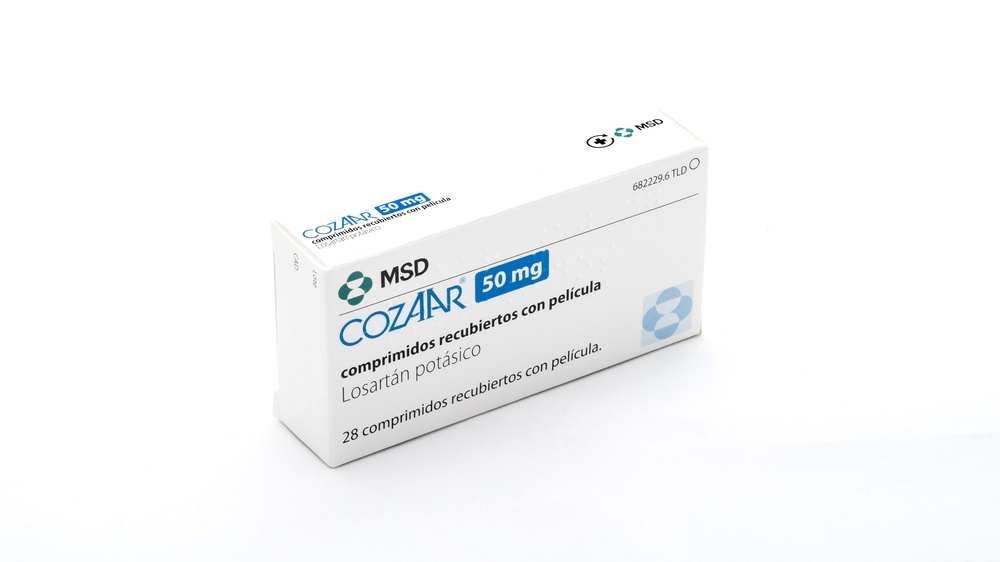
- País de registro
- Forma farmacéuticaCOMPRIMIDO, 50 mg losartan potasico
- Código ATCC09CA01
- Principio activo
- Requiere recetaSí
- Fabricante
- ComposiciónLACTOSA HIDRATADA (25,5 mg mg)
- Esta información es de carácter general y no sustituye la consulta con un profesional sanitario.
- Alternativas a COZAAR 50 mg COMPRIMIDOS RECUBIERTOS CON PELICULAForma farmacéutica: COMPRIMIDO, 100 mg losartan potasicoPrincipio activo: losartanFabricante: Organon Salud S.L.Requiere recetaForma farmacéutica: COMPRIMIDO, 12,5 mg losartan potasicoPrincipio activo: losartanFabricante: Organon Salud S.L.Requiere recetaForma farmacéutica: COMPRIMIDO, 100 mgPrincipio activo: losartanFabricante: Almus Farmaceutica S.A.U.Requiere receta
Médicos online para COZAAR 50 mg COMPRIMIDOS RECUBIERTOS CON PELICULA
Comenta la dosis, los posibles efectos secundarios, interacciones, contraindicaciones o la revisión de receta de COZAAR 50 mg COMPRIMIDOS RECUBIERTOS CON PELICULA, sujeto a valoración médica y a la normativa local.
Preguntas frecuentes
COZAAR 50 mg COMPRIMIDOS RECUBIERTOS CON PELICULA requiere receta en España. Puedes confirmarlo con un médico online según tu caso.
El principio activo de COZAAR 50 mg COMPRIMIDOS RECUBIERTOS CON PELICULA es losartan. Esta información ayuda a identificar medicamentos con la misma composición pero con diferentes nombres comerciales.
COZAAR 50 mg COMPRIMIDOS RECUBIERTOS CON PELICULA es fabricado por Organon Salud S.L.. La marca y el envase pueden variar según el distribuidor.
Los Médicos de familia, Psiquiatras, Dermatólogos, Cardiólogos, Endocrinólogos, Gastroenterólogos, Neumólogos, Nefrólogos, Reumatólogos, Hematólogos, Infectólogos, Alergólogos, Geriatras, Pediatras, Oncólogos pueden valorar la prescripción de COZAAR 50 mg COMPRIMIDOS RECUBIERTOS CON PELICULA cuando esté clínicamente indicado. Puedes reservar una videoconsulta para comentar tu caso y las opciones de tratamiento.
La receta la emite un médico tras valorar tu estado de salud. En España, COZAAR 50 mg COMPRIMIDOS RECUBIERTOS CON PELICULA se dispensa en las farmacias con esa receta médica. Una consulta online no garantiza su emisión: la decisión corresponde siempre al médico.
Para solicitar una valoración puedes usar Oladoctor:
Otros medicamentos con el mismo principio activo (losartan) incluyen COZAAR 100 mg COMPRIMIDOS RECUBIERTOS CON PELICULA, COZAAR 12.5 mg INICIO COMPRIMIDOS RECUBIERTOS CON PELICULA, LOSARTAN ALMUS 100 mg COMPRIMIDOS RECUBIERTOS CON PELICULA EFG. Pueden tener diferentes nombres comerciales o formulaciones, pero contienen el mismo componente terapéutico. Consulta siempre con un médico antes de cambiar o iniciar un nuevo medicamento.
