


Colistimetato 1 Millon de ui inyectable

Revisión de receta online
Un médico revisará tu caso y determinará si la prescripción es médicamente apropiada.

Habla con un médico sobre este medicamento
Comenta tus síntomas y las opciones de tratamiento en una consulta online.



Cómo usar COLISTIMETATO DE SODIO ACCORD 1 MILLON DE UI POLVO PARA SOLUCION INYECTABLE Y PARA PERFUSION EFG
Contenido del prospecto
- Introducción
- Qué es Colistimetato de sodio Accord y para qué se utiliza
- Qué necesita saber antes de empezar a usar Colistimetato de sodio Accord
- Cómo usar Colistimetato de sodio Accord
- Posibles efectos adversos
- Conservación de Colistimetato de sodio Accord
- Contenido del envase e información adicional
Introducción
Prospecto: información para el usuario
Colistimetato de sodio Accord 1 millón de UI polvo para solución inyectable / perfusión EFG
Lea todo el prospecto detenidamente antes de empezar a usar este medicamento, porque contiene información importante para usted.
- Conserve este prospecto, ya que puede tener que volver a leerlo.
- Si tiene alguna duda, consulte a su médico, farmacéutico o enfermero.
- Si experimenta efectos adversos, consulte a su médico o farmacéutico, incluso si se trata de efectos adversos que no aparecen en este prospecto. Ver sección 4.
Contenido del prospecto
- Qué es Colistimetato de sodio Accord y para qué se utiliza
- Qué necesita saber antes de empezar a tomar Colistimetato de sodio Accord
- Cómo usar Colistimetato de sodio Accord
- Posibles efectos adversos
- Conservación de Colistimetato de sodio Accord
- Contenido del envase e información adicional
1. Qué es Colistimetato de sodio Accord y para qué se utiliza
 Colistimetato de sodio Accord contiene el principio activo colistimetato de sodio. El colistimetato de sodio es un antibiótico del grupo de las polimixinas.
Colistimetato de sodio Accord indicado para adultos y pacientes pediátricos que se puede utilizar.
- Por vía intravenosa. Colistimetato de sodio Accord se administra mediante inyección para tratar algunos tipos de infecciones graves producidas por ciertas bacterias. Colistimetato de sodio Accord se utiliza cuando otros antibióticos no son adecuados.
- Por vía inhalatoria. Colistimetato de sodio Accord se administra en forma de inhalación para tratar infecciones respiratorias crónicas en pacientes con fibrosis quística. Colistimetato de sodio Accord se utiliza cuando dichas infecciones están causadas por una bacteria específica denominada Pseudomonas aeruginosa.

¿No estás seguro de si este medicamento es adecuado para ti?
Comenta tus síntomas y tratamiento con un médico online.
2. Qué necesita saber antes de empezar a usar Colistimetato de sodio Accord
No use Colistimetato de sodio Accord
- Si es alérgico (hipersensible) al colistimetato de sodio, a la colistina, o a otras polimixinas.
Advertencias y precauciones
Consulte a su médico, farmacéutico o enfermero antes de empezar a usar colistimetato de sodio
- Si tiene o ha tenido problemas en el riñón
- Si padece de miastenia gravis
- Si padece de porfiria
- Si padece de asma (en el uso por vía inhalatoria).
- Si sufre espasmos musculares, fatiga o aumento de la producción de orina en cualquier momento, informe a su médico inmediatamente, ya que estos episodios pueden estar relacionados con una enfermedad conocida como pseudo-síndrome de Bartter.
En los niños prematuros y los recién nacidos, se debe tener precaución al utilizar colistimetato de sodio porque los riñones no se encuentran aun completamente desarrollados.
Uso de Colistimetato de sodio Accord con otros medicamentos
- medicamentos que pueden afectar a la forma en que funcionan sus riñones. Tomar dichos medicamentos al mismo tiempo que colistimetato de sodio puede aumentar el riesgo de dañar los riñones
- medicamentos que pueden afectar al sistema nervioso. Tomar dichos medicamentos al mismo tiempo que colistimetato de sodio puede aumentar el riesgo de efectos adversos en su sistema nervioso
- medicamentos denominados relajantes musculares, usados a menudo durante la anestesia general. Colistimetato de sodio puede aumentar los efectos de estos medicamentos. Si le van a administrar un anestésico general, informe a su anestesista de que está usando colistimetato de sodio.
Si padece miastenia gravis y también está tomando otros antibióticos llamados macrólidos (como la azitromicina, la claritromicina o la eritromicina), o antibióticos denominados fluoroquinolonas (como el ofloxacino, el norfloxacino y el ciprofloxacino), tomar este medicamento aumenta aún más el riesgo de debilidad muscular y dificultades respiratorias.
Recibir colistimetato de sodio en forma de perfusión al mismo tiempo que recibe colistimetato de sodio en forma de inhalación, puede aumentar su riesgo de padecer efectos adversos.
Embarazo, lactanciay fertilidad
Si está embarazada o en periodo de lactancia, cree que podría estar embarazada o tiene intención de quedarse embarazada, consulte a su médico o farmacéutico antes de utilizar este medicamento.
Colistimetato de sodio Accord sólo debería administrarse a pacientes embarazadas si el beneficio esperado compensa cualquier riesgo potencial.
Se debe interrumpir la lactancia durante el tratamiento con este medicamento, ya que este medicamento puede pasar a la leche materna.
Conducción y uso de máquinas
Colistimetato de sodio Accord puede producir mareos, confusión o problemas visuales motivo por el que no debe conducir ni utilizar ninguna herramienta o maquinaria peligrosa en estos casos.
Colistimetato de sodio Accord contiene sodio
Este medicamento contiene menos de 23 mg (1 mmol) de sodio por dosis, esto es, esencialmente “exento de sodio “
3. Cómo usar Colistimetato de sodio Accord
Siga exactamente las instrucciones de administración de este medicamento indicadas por su médico o farmacéutico. En caso de duda, consulte con su médico o farmacéutico.
- Vía intravenosa:
Su médico le ha recetado colistimetato de sodio como perfusión en una vena durante 30 a 60 minutos.
La dosis habitual en adultos es de 9 millones de unidades, divididas en dos o tres dosis. Si se encuentra bastante mal se le administrará una vez, al comienzo del tratamiento, una dosis mayor, de 9 millones de unidades.
En algunos casos, su médico puede decidir darle una dosis diaria mayor, de hasta 12 millones de unidades.
La dosis diaria habitual en niños que pesan hasta 40 kg es de 75.000 a 150.000 unidades por kilogramo de peso corporal, divididas en tres dosis.
En casos de fibrosis quística, se han administrado ocasionalmente dosis superiores.
A los niños y adultos con problemas de riñón, incluidos los que están en diálisis, se les suele dar dosis más bajas.
Su médico vigilará su función renal regularmente mientras que esté recibiendo colistimetato de sodio.
- Vía inhalatoria:
La dosis habitual en adultos, adolescentes y niños de 2 años o mayores es de 1-2 millones de unidades dos o tres veces al día (como máximo 6 millones de unidades al día).
La dosis habitual en niños menores de 2 años es de 0,5-1 millón de unidades, dos veces al día (como máximo 2 millones de unidades al día).
Su médico puede decidir ajustar la dosis dependiendo de sus circunstancias. Si está tomando también otros medicamentos inhalados, su médico le indicará en qué orden debe tomarlos.
Si usa más Colistimetato de sodio Accord del que debe:
Si ha usado más Colistimetato de sodio Accord del que debiera podría tener problemas para respirar, debilidad en los músculos y problemas en la función del riñón.
En caso de sobredosis o ingestión accidental consulte inmediatamente a su médico o farmacéutico o llame al Servicio de Información Toxicológica, teléfono: 91 562 04 20, indicando el medicamento y la cantidad ingerida.
Si olvidó usar Colistimetato de sodio Accord:
No tome una dosis doble para compensar las dosis olvidadas.
En caso de que usted esté recibiendo este medicamento por vía intravenosa y siempre que no hayan transcurrido más de 3 horas desde el momento en que debiera haber recibido su dosis, puede solicitar que le administren la dosis que le corresponda. Si hubieran transcurrido más de 3 horas después de la dosis olvidada aguarde hasta la próxima administración.
En el caso de que la administración sea por via inhalatoria tome la dosis correspondiente tan pronto como lo recuerde y continúe con la dosis siguiente de manera normal.
Si interrumpe el tratamiento con Colistimetato de sodio Accord
Su médico le indicará la duración del tratamiento con Colistimetato de sodio Accord. No suspenda el tratamiento antes ya que existe el riesgo de que la infección reaparezca.
Si tiene cualquier otra duda sobre el uso de este medicamento, pregunte a su médico, farmacéutico o enfermero.

¿Has empezado a tomar el medicamento y tienes preguntas?
Comenta tus síntomas y tratamiento con un médico online.
4. Posibles efectos adversos
Al igual que todos los medicamentos, este medicamento puede producir efectos adversos, aunque no todas las personas los sufran.
Los efectos adversos observados han sido clasificados por órganos y sistemas y por frecuencias utilizando el siguiente convenio: muy frecuentes (pueden afectar a más de 1 de cada 10 personas); frecuentes (pueden afectar hasta 1 de cada 10 personas); poco frecuentes (pueden afectar hasta de 1 de cada 100 personas); raros (pueden afectar hasta 1 de cada 1.000 personas); muy raros (pueden afectar hasta 1 de cada 10.000 personas); frecuencia no conocida (no puede estimarse a partir de los datos disponibles).
En el caso del colistimetato de sodio éstos afectan sobre todo al sistema nervioso y a la función del riñón. Los efectos adversos más frecuentes después de la nebulización son tos y dificultad para respirar.
Efectos adversos posibles tras la administración por vía intravenosa:
Trastornos del sistema nervioso
- Muy frecuentes: Hormigueo o entumecimiento alrededor de los labios y la cara, dolor de cabeza.
- No conocida: Dificultad al hablar, alteraciones visuales, confusión, alteraciones mentales o rubor (enrojecimiento de la cara), psicosis, mareos, vértigo, dificultad en controlar los movimientos.
Trastornos renales y urinarios
- Muy frecuentes: Este medicamento puede afectar al riñón, especialmente si la dosis es alta o usted está tomando otra medicación que pueda afectar al riñón (incluyendo aumento de determinados resultados de pruebas analíticas especiales de los riñones, como urea y creatinina).
- Raros: Fallo renal.
Trastornos generales y alteraciones en el lugar de administración
- Muy frecuentes: Debilidad muscular, picor.
- No conocida: Reacciones alérgicas como erupciones cutáneas o hinchazón (de labios, boca, garganta). Si esto ocurriera comuníqueselo al médico inmediatamente porque puede ser necesario suspender el tratamiento. Dolor en el lugar de la inyección.
Tras la administración intravenosa, puede experimentar los siguientes síntomas que pueden estar relacionados con una enfermedad conocida como pseudo-síndrome de Bartter (ver sección 2):
- espasmos musculares
- aumento de la producción de orina
- fatiga
Efectos adversos posibles tras la administración de forma inhalatoria:
Trastornos respiratorios, torácicos y mediastínicos
- Muy frecuentes: La nebulización de este medicamento a través de un nebulizador puede producir tos y provocar en algunas personas opresión en el pecho, pitos o sensación de ahogo, dificultad al respirar por estrechamiento de las vías respiratorias.
Trastornos generales y alteraciones en el lugar de administración
- No conocida: Reacciones alérgicas como erupciones cutáneas. Si esto ocurriera comuníqueselo al médico inmediatamente porque puede ser necesario suspender el tratamiento. Dolor garganta e irritación en la boca que pueden deberse a alergia al medicamento o una infección añadida por hongos cuando se administra este medicamento a través de un nebulizador.
Comunicación de efectos adversos:
Si experimenta cualquier tipo de efecto adverso, consulte a su médico o farmacéutico o enfermero, incluso si se trata de posibles efectos adversos que no aparecen en este prospecto. También puede comunicarlos directamente a través del Sistema Español de Farmacovigilancia de medicamentos de Uso Humano: https://www.notificaram.es. Mediante la comunicación de efectos adversos usted puede contribuir a proporcionar más información sobre la seguridad de este medicamento.
5. Conservación de Colistimetato de sodio Accord
Mantener este medicamento fuera de la vista y del alcance de los niños.
No utilice este medicamento después de la fecha de caducidad que aparece en lel envase como “CAD”. La fecha de caducidad es el último día del mes que se indica.
Este medicamento no requiere condiciones especiales de conservación.
Colistimetato de sodio Accord no contiene conservantes. Después de prepararlo, se debe usar inmediatamente. Las soluciones inyectables diluidas con más volumen del volumen del vial original y / o con una concentración <80.000 UI / ml deben utilizarse inmediatamente, dado que el colistimetato de sodio se hidroliza significativamente por debajo de esta concentración.
En caso de administración intratecal e intraventricular, el volumen de solución administrado no debe exceder 1 ml (concentración reconstituida de 125.000 UI / ml). La solución reconstituida debe administrarse inmediatamente.
Cualquier solución restante debe desecharse.
No use este medicamento si nota algún signo de deterioro.
Los medicamentos no se deben tirar por los desagües ni a la basura. Deposite los envases y los medicamentos que no necesita en el Punto SIGREde la farmacia. En caso de duda pregunte a su farmacéutico cómo deshacerse de los envases y de los medicamentos que no necesita. De esta forma, ayudará a proteger el medio ambiente.
6. Contenido del envase e información adicional
Composición de Colistimetato de sodio Accord
- El principio activo es colistimetato de sodio.
Cada vial contiene 1 millón de unidades internacionales (UI) de colistimetato sódico, que pesan aproximadamente 80 miligramos (mg) de colistimetato de sodio.
- No hay ningún otro componente.
Aspecto del producto y contenido del envase
Colistimetato de sodio Accord es un polvo de color blanco a blanquecino que se suministra en un vial de vidrio.
El polvo debe disolverse en una solución para inyección o para perfusión.
Colistimetato de sodio Accord se suministra en envases de 10 viales.
Titular de la autorización de comercialización
Accord Healthcare, S.L.U.
Moll de Barcelona s/n,
World Trade Center Edifici Est 6ªplanta
08039 Barcelona
Responsable de la fabricación
Xellia Pharmaceuticals ApS
Dalslandsgade 11
2300 Copenhague S
Dinamarca
Fecha de la última revisión de este prospecto: Junio 2023
La información detallada y actualizada de este medicamento está disponible en la página Web de la Agencia Española de Medicamentos y Productos Sanitarios (AEMPS) http://www.aemps.es/.
La siguienteinformación está destinada exclusivamente a profesionales de la salud:
- Vía intravenosa:
Para inyección en bolo:
Reconstituir el contenido del vial con no más de 10 ml de agua para inyección o cloruro sódico al 0,9%.
Para infusión:
El contenido del vial reconstituido puede diluirse, normalmente con 50 ml de cloruro sódico al 0,9%.
Reconstituir el contenido del vial con agua para inyectables o con cloruro sódico 9 mg/ml (solución al 0,9%). El Colistimetato Sódico reconstituido es una solución clara y libre de partículas. Descartar la solución si se observan partículas.
Cuando se utilizan las vías de administración intratecal e intracerebroventricular, el volumen administrado no debe exceder de 1 ml (concentración reconstituida de 125.000 UI/ml).
- Vía inhalatoria con nebulizador:
Reconstituir el contenido del vial con agua para inyecciones, con una mezcla 50:50 de agua para inyecciones y cloruro sódico al 0,9% o con cloruro sódico 9 mg/ml (solución al 0,9%).
El volumen de reconstitución se ajustará a las instrucciones de uso proporcionadas con el dispositivo nebulizador, y normalmente no supera los 4 ml.
Una vez reconstituido, Colistimetato de sodio Accord puede administrarse con cualquier nebulizador convencional adecuado para la administración de soluciones de antibióticos.
El Colistimetato de Sodio reconstituido es una solución clara y libre de partículas. Descartar la solución si se observan partículas.
Las soluciones son de un solo uso y cualquier solución restante debe ser desechada.
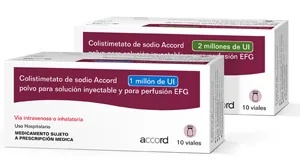
- País de registro
- Forma farmacéuticaINYECTABLE, 1MUI
- Código ATCJ01XB01
- Principio activo
- Requiere recetaSí
- Fabricante
- Esta información es de carácter general y no sustituye la consulta con un profesional sanitario.
- Alternativas a COLISTIMETATO DE SODIO ACCORD 1 MILLON DE UI POLVO PARA SOLUCION INYECTABLE Y PARA PERFUSION EFGForma farmacéutica: INHALACIÓN PULMONAR, 1 MIUPrincipio activo: colistinaFabricante: Pari Pharma GmbhRequiere recetaForma farmacéutica: INHALACIÓN PULMONAR, 2 MIUPrincipio activo: colistinaFabricante: Pari Pharma GmbhRequiere recetaForma farmacéutica: INYECTABLE, 2MUIPrincipio activo: colistinaFabricante: Accord Healthcare S.L.U.Requiere receta
Médicos online para COLISTIMETATO DE SODIO ACCORD 1 MILLON DE UI POLVO PARA SOLUCION INYECTABLE Y PARA PERFUSION EFG
Comenta la dosis, los posibles efectos secundarios, interacciones, contraindicaciones o la revisión de receta de COLISTIMETATO DE SODIO ACCORD 1 MILLON DE UI POLVO PARA SOLUCION INYECTABLE Y PARA PERFUSION EFG, sujeto a valoración médica y a la normativa local.









Preguntas frecuentes
COLISTIMETATO DE SODIO ACCORD 1 MILLON DE UI POLVO PARA SOLUCION INYECTABLE Y PARA PERFUSION EFG requiere receta en España. Puedes confirmarlo con un médico online según tu caso.
El principio activo de COLISTIMETATO DE SODIO ACCORD 1 MILLON DE UI POLVO PARA SOLUCION INYECTABLE Y PARA PERFUSION EFG es colistina. Esta información ayuda a identificar medicamentos con la misma composición pero con diferentes nombres comerciales.
COLISTIMETATO DE SODIO ACCORD 1 MILLON DE UI POLVO PARA SOLUCION INYECTABLE Y PARA PERFUSION EFG es fabricado por Accord Healthcare S.L.U.. La marca y el envase pueden variar según el distribuidor.
Los Médicos de familia, Psiquiatras, Dermatólogos, Cardiólogos, Endocrinólogos, Gastroenterólogos, Neumólogos, Nefrólogos, Reumatólogos, Hematólogos, Infectólogos, Alergólogos, Geriatras, Pediatras, Oncólogos pueden valorar la prescripción de COLISTIMETATO DE SODIO ACCORD 1 MILLON DE UI POLVO PARA SOLUCION INYECTABLE Y PARA PERFUSION EFG cuando esté clínicamente indicado. Puedes reservar una videoconsulta para comentar tu caso y las opciones de tratamiento.
La receta la emite un médico tras valorar tu estado de salud. En España, COLISTIMETATO DE SODIO ACCORD 1 MILLON DE UI POLVO PARA SOLUCION INYECTABLE Y PARA PERFUSION EFG se dispensa en las farmacias con esa receta médica. Una consulta online no garantiza su emisión: la decisión corresponde siempre al médico.
Para solicitar una valoración puedes usar Oladoctor:
Otros medicamentos con el mismo principio activo (colistina) incluyen COLFINAIR 1 MILLON DE UI POLVO PARA SOLUCION PARA INHALACION POR NEBULIZADOR, COLFINAIR 2 MILLONES DE UI POLVO PARA SOLUCION PARA INHALACION POR NEBULIZADOR, COLISTIMETATO DE SODIO ACCORD 2 MILLONES DE UI POLVO PARA SOLUCION INYECTABLE Y PARA PERFUSION EFG. Pueden tener diferentes nombres comerciales o formulaciones, pero contienen el mismo componente terapéutico. Consulta siempre con un médico antes de cambiar o iniciar un nuevo medicamento.
