






Cómo usar CLORURO DE POTASIO BRAUN 1 mEq/ml CONCENTRADO PARA SOLUCION PARA PERFUSION
Traducción generada por IA
Este contenido ha sido traducido automáticamente y se ofrece solo con fines informativos. No sustituye la consulta con un profesional sanitario.
Ver originalContenido del prospecto
- Introducción
- Qué es Cloruro de Potasio Braun 1 mEq/ml y para qué se utiliza
- Qué necesita saber antes de empezar a usar Cloruro de Potasio Braun 1 mEq/ml
- Cómo usar Cloruro de Posatsio Braun 1mEq/ml
- Posibles efectos adversos
- Conservación de Cloruro de Potasio Braun 1 mEq/ml
- Contenido del envase e información adicional
Introducción
Prospecto: información para el usuario
Cloruro de Potasio Braun 1 mEq/ml concentrado para solución para perfusión
Lea todo el prospecto detenidamente antes de empezar a recibir este medicamento, porque contiene información importante para usted.
- Conserve este prospecto, ya que puede tener que volver a leerlo.
- Si tiene alguna duda, consulte a su médico o farmacéutico.
- Si experimenta efectos adversos, consulte a su médico o farmacéutico, incluso si se trata de efectos adversos que no aparecen en este prospecto. Ver sección 4
Contenido del prospecto
- Qué es Cloruro de Potasio Braun 1 mEq/ml y para qué se utiliza
- Qué necesita saber antes de empezar a usar Cloruro de Potasio Braun 1 mEq/ml
- Cómo usar Cloruro de Potasio Braun 1 mEq/ml
- Posibles efectos adversos
- Conservación de Cloruro de Potasio Braun 1 mEq/ml
- Contenido del envase e información adicional

1. Qué es Cloruro de Potasio Braun 1 mEq/ml y para qué se utiliza
Cloruro de potasio 1 mEq/ml es una solución concentrada de cloruro de potasio.
Se utiliza para suministrarle potasio:
- cuando tiene una deficiencia de potasio, especialmente si ésta se acompaña de un exceso de álcali y de niveles anormalmente bajos de cloruro en la sangre (alcalosis hipoclorémica)
- como parte de la nutrición parenteral, cuando usted no puede tomar alimentos normalmente
2. Qué necesita saber antes de empezar a usar Cloruro de Potasio Braun 1 mEq/ml
No use Cloruro de Potasio Braun 1 mEq/ml :
Si tiene un nivel anormalmente alto de potasio o de cloruro en la sangre (hiperpotasemia, hipercloremia)
Advertencias y precauciones
Consulte a su médico antes de empezar a usar Cloruro de potasio1 mEq/ml.
Se requiere un cuidado especial con Cloruro de potasio 1 mEq/ml:
? si padece problemas de corazón
? si padece una enfermedad en la que la excreción de potasio en la orina a menudo está reducida, tal como disfunción renal, enfermedad de Addison (una enfermedad específica de las glándulas suprarrenales) o anemia drepanocítica (una enfermedad hereditaria de los glóbulos rojos) si la función de sus riñones está gravemente afectada o si usted está en diálisis, su médico consultará a un especialista del riñón antes de administrarle este medicamento
? si está tomando o recibiendo medicamentos que reducen la excreción de potasio en la orina; por ejemplo, si está tomando:
- ciertos medicamentos que aumentan el flujo de orina (diuréticos)
- ciertos medicamentos para la tensión arterial (antagonistas de los receptores de Angiotensina II, inhibidores de la ECA)
? si está tomando o recibiendo medicamentos que pueden afectar a la función de los riñones (p. ej., ciertos medicamentos que suprimen los procesos inflamatorios)
? si sufre un shock (un cuadro clínico agudo acompañado de una caída de presión arterial, piel fría, latido cardíaco rápido, y respiración irregular que pueden ocurrir, por ejemplo después de haber perdido gran cantidad de sangre, de sufrir quemaduras graves, de tener una reacción alérgica)
? si sufre una lesión intensa de los tejidos, por ejemplo, lesiones por quemaduras
? si padece un trastorno que causa debilidad muscular y a veces niveles de potasio en sangre más elevados de lo normal (parálisis periódica familiar por hiperpotasemia)
Su médico tendrá en cuenta estos puntos antes y durante su tratamiento con este medicamento.
Si recibe este medicamento porque le falta potasio, inicialmente usted no recibirá ninguna perfusión de glucosa al mismo tiempo porque la glucosa puede reducir aún más los niveles de potasio.
Mientras esté recibiendo este medicamento se hará un seguimiento de sus niveles de electrólitos en la sangre y de su equilibrio ácido-básico. Esto se hará para comprobar que son normales. Además, podría hacerse un seguimiento de su ECG.
Se asegurarán con absoluta certeza de que la solución se le administre en la vena, para evitar daños en los tejidos.
Si recibe este medicamento porque le falta potasio, su médico se lo administrará por medio de una bomba de perfusión.
Los pacientes de edad avanzada, que tienen mayor probabilidad de sufrir problemas de corazón y de riñón, serán vigilados estrechamente durante el tratamiento, y la posología se ajustará con cuidado.
Si está muy desnutrido, es decir no ha recibido suficiente comida, existe una posibilidad de que pueda padecer una condición denominada “Síndrome de realimentación”. Su médico le supervisará cuidadosamente y le incrementará lentamente la administración de nutrientes.
Uso de Cloruro de potasio 1mEq/ml con otros medicamentos
Informe a su médico si está tomando, ha tomado recientemente o pudiera tener que tomar cualquier otro medicamento.
En particular, su médico prestará atención a:
? Medicamentos para el tratamiento de la insuficiencia cardiaca (glucósidos cardiacos, p. ej., digoxina):
Los efectos de estos medicamentos disminuyen cuando el nivel de potasio en la sangre aumenta. Aumentan (posiblemente con un latido cardiaco irregular) cuando el nivel de potasio en la sangre disminuye.
? Medicamentos que reducen la excreción de potasio en la orina:
Este grupo de medicamentos incluye:
- algunos medicamentos que aumentan el flujo de orina (diuréticos ahorradores de potasio como el triamtereno, la amilorida y la espironolactona)
- ciertos medicamentos para el tratamiento de la tensión arterial alta (antagonistas de los receptores de Angiotensina II e inhibidores de la ECA)
- medicamentos que deprimen el sistema inmunitario (tacrolimús, ciclosporina)
- ciertos medicamentos utilizados para tratar el dolor o para tratar la inflamación (antiinflamatorios no esteroideos)
- medicamentos anticoagulantes (heparina)
La administración de potasio junto con estos medicamentos puede dar lugar a niveles muy altos de potasio en la sangre. Esto podría afectar al ritmo del corazón.
? Medicamentos que aumentan la excreción de potasio en la orina:
Los siguientes medicamentos pueden aumentar la excreción de potasio en la orina:
- una hormona concreta (corticotropina [ACTH])
- ciertos medicamentos para tratar la inflamación (corticosteroides)
- algunos medicamentos que aumentan el flujo de orina (diuréticos del asa)
Su administración conjunta con potasio le puede llevar a que reciba una dosis incorrecta de potasio ya que el potasio que se le administra se eliminará de su organismo más rápido de lo normal
? Suxametonio (un relajante muscular que se usa en anestesia general):
La administración de potasio junto con estos medicamentos también puede dar lugar a niveles muy altos de potasio en la sangre. Esto podría afectar al ritmo del corazón.
Embarazo y lactancia
Si está embarazada o en periodo de lactancia, cree que podría estar embarazada o tiene intención de quedarse embarazada, consulte a su médico antes de utilizar este medicamento.
Embarazo
Hasta ahora no se han recibido informes sobre efectos perjudiciales ni riesgos asociados al uso de este medicamento en mujeres embarazadas.
Su médico le administrará cloruro de potasio siempre con precaución y solo cuando sea claramente necesario.
Lactancia
Los concentrados de potasio para la perfusión pueden utilizarse durante la lactancia
Conducción y uso de máquinas
Este medicamento no influye en la capacidad para conducir y utilizar máquinas.

3. Cómo usar Cloruro de Posatsio Braun 1mEq/ml
Cloruro de potasio 1 mEq/ml se administra después de diluirlo en una solución adecuada. Se administra a través de una cánula o tubo pequeño en una vena (perfusión intravenosa).
Posología
La cantidad que recibirá será calculada por su médico basándose en sus valores de electrólitos en sangre, su equilibrio ácido-básico, su edad y sus necesidades individuales.
Si usa más Cloruro de Potasio Braun 1 mEq/ml Braun del que debe
Es improbable que usted reciba alguna vez una cantidad excesiva del medicamento. Su médico o profesional del sector sanitario vigilarán la administración.
Síntomas
La sobredosis puede dar lugar a niveles anormalmente altos de potasio, con los efectos adversos indicados a continuación. Es más probable que sufra efectos adversos si presenta una desviación de la sangre hacia el lado ácido (acidosis) o trastornos de los riñones.
Corazón y circulación:
? latido cardiaco lento o incluso paro cardiaco
? cambios en el electrocardiograma
? disminución de la tensión arterial
? redistribución de la sangre circulante de las extremidades a la cabeza y el tronco
Músculos y sistema nervioso:
? debilidad
? cansancio
? estados confusionales
? pesadez de las extremidades
? espasmos musculares
? pérdida de sensibilidad
? parálisis
Tratamiento
Si se produce una sobredosis, se detendrá inmediatamente la perfusión y su médico le dará el tratamiento necesario.
Si tiene cualquier otra duda sobre el uso de este medicamento, pregunte a su médico.
4. Posibles efectos adversos
Al igual que todos los medicamentos, este medicamento puede producir efectos adversos, aunque no todas las personas los sufran.
Los siguientes efectos adversos pueden ser graves. Si sufre alguno de los siguientes efectos adversos, consulte a su médico inmediatamente.
? acumulación de sustancias ácidas en la sangre (acidosis) (frecuencia no conocida)
? niveles anormalmente altos de cloruro en la sangre (hipercloremia) (frecuencia no conocida)
? latido cardiaco irregular (arritmia cardiaca, consecuencia de velocidades de administración anormalmente altas) (frecuencia no conocida)
Otros efectos adversos
? náuseas (frecuencia no conocida)
? reacciones en el lugar de inyección, tales como dolor local, irritación o inflamación de las venas (tromboflebitis) y escape de líquido al tejido (extravasación) (frecuencia no conocida)
Comunicación de efectos adversos
Si experimenta cualquier tipo de efecto adverso, consulte a su médico o farmacéutico, incluso si se trata de posibles efectos adversos que no aparecen en este prospecto. También puede comunicarlos directamente a través del Sistema Español de Farmacovigilancia de Medicamentos de Uso Humano: www.notificaRAM.es. Mediante la comunicación de efectos adversos usted puede contribuir a proporcionar más información sobre la seguridad de este medicamento.
5. Conservación de Cloruro de Potasio Braun 1 mEq/ml
Mantener este medicamento fuera de la vista y del alcance de los niños.
No utilice este medicamento después de la fecha de caducidad que aparece en la etiqueta y la caja. La fecha de caducidad es el último día del mes que se indica.
No requiere condiciones especiales de conservación.
Solamente debe usarse si la solución es transparente, incolora y libre de partículas y si el envase y su cierre están intactos.
Los envases son válidos para un solo uso. Deben desecharse el envase y el contenido no utilizado después de su uso.
6. Contenido del envase e información adicional
Composición de Cloruro de Potasio Braun 1 mEq/ml:
El principio activo es cloruro de potasio.
1 ml de solución contiene 74,5 mg de cloruro de potasio,
que corresponde a 1 mmol de potasio y 1 mmol de cloruro
Una ampolla de 10 ml contiene 745 mg de cloruro de potasio
Una ampolla de 20 ml contiene 1,49 g de cloruro de potasio
Los demás componentes son: agua para preparaciones inyectables.
Aspecto del producto y contenido del envase
Cloruro de Potasio Braun 1 mEq/ml es un concentrado para la preparación de una solución para perfusión. Debe diluirse antes de usarse y se administra por goteo intravenoso.
Es una solución acuosa transparente e incolora.
Cloruro de Potasio Barun 1 mEq/ml está disponible en:
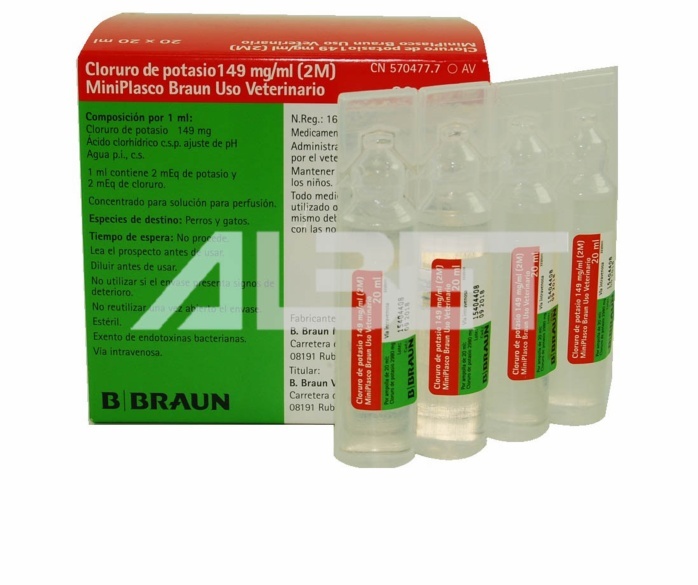
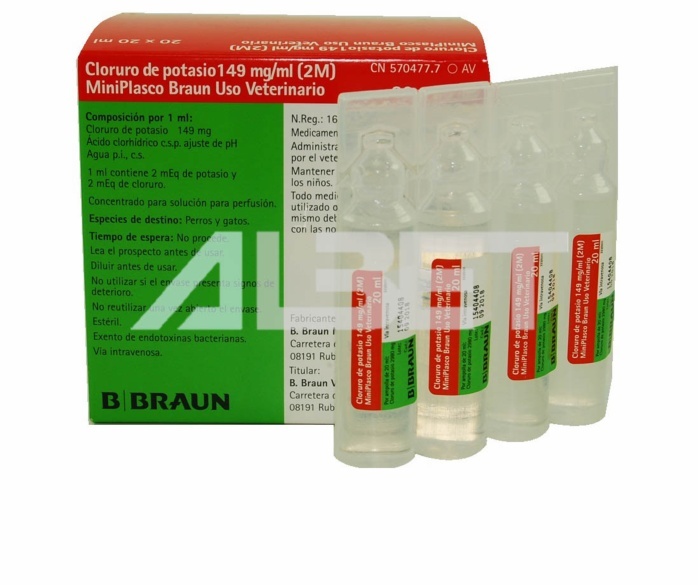
Ampollas de plástico de polietileno; contenido: 10 ml, 20 ml
Tamaños de los envases:
1x 10 ml, 20 x 10 ml, 100 x 10 ml
1 x 20 ml, 20 x 20 ml, 100 x 20 ml
Titular de la autorización de comercialización
B|BRAUN
- Braun Medical, S.A.
Ctra. de Terrassa, 121
08191-Rubí (Barcelona)
España
Responsable de la fabricación
B|BRAUN
- Braun Medical, S.A.
Ctra. de Terrassa, 121
08191-Rubí (Barcelona)
España
o
- Braun Melsungen AG
Carl Braun Str. 1
D- 34212 Melsungen
Alemania
Este prospecto ha sido aprobado en Noviembre 2017
La información detallada de este medicamento está disponible en la página Web de la Agencia Española de Medicamentos y Productos Sanitarios (AEMPS) (http://www.aemps.gob.es/)
Esta información está destinada únicamente a médicos o profesionales del sector sanitario:
Para ver la información completa sobre este medicamento, consulte la Ficha Técnica o Resumen de las Características del Producto.
-

- País de registro
- Forma farmacéuticaINYECTABLE PERFUSION, -
- Código ATCB05XA01
- Principio activo
- Requiere recetaSí
- Fabricante
- Esta información es de carácter general y no sustituye la consulta con un profesional sanitario.
- Alternativas a CLORURO DE POTASIO BRAUN 1 mEq/ml CONCENTRADO PARA SOLUCION PARA PERFUSIONForma farmacéutica: INYECTABLE PERFUSION, -Principio activo: Cloruro de potasioFabricante: B Braun Medical S.A.Requiere recetaForma farmacéutica: INYECTABLE PERFUSION, 2mEq/mlPrincipio activo: Cloruro de potasioFabricante: Fresenius Kabi España, S.A.U.Requiere recetaForma farmacéutica: INYECTABLE PERFUSION, 15 % p/vPrincipio activo: Cloruro de potasioFabricante: Laboratorios Serra Pamies S.A.Requiere receta

Médicos online para CLORURO DE POTASIO BRAUN 1 mEq/ml CONCENTRADO PARA SOLUCION PARA PERFUSION
Comenta la dosis, los posibles efectos secundarios, interacciones, contraindicaciones o la revisión de receta de CLORURO DE POTASIO BRAUN 1 mEq/ml CONCENTRADO PARA SOLUCION PARA PERFUSION, sujeto a valoración médica y a la normativa local.









Obtén una receta de CLORURO DE POTASIO BRAUN 1 mEq/ml CONCENTRADO PARA SOLUCION PARA PERFUSION online
Rellena un formulario de 2 minutos
Cuéntanos tus síntomas, historial y el medicamento que necesitas.
Elige un médico o nosotros te asignamos uno
Escoge un especialista o te conectamos con el próximo médico disponible.
El médico revisa tu caso
Normalmente en 30 minutos. Puede hacerte preguntas adicionales por chat.
Recógela en cualquier farmacia
Receta electrónica enviada a tu correo, válida en toda España.
Preguntas frecuentes
CLORURO DE POTASIO BRAUN 1 mEq/ml CONCENTRADO PARA SOLUCION PARA PERFUSION requires receta en España. Puedes confirmarlo con un médico online según tu caso.
El principio activo de CLORURO DE POTASIO BRAUN 1 mEq/ml CONCENTRADO PARA SOLUCION PARA PERFUSION es Cloruro de potasio. Esta información ayuda a identificar medicamentos con la misma composición pero con diferentes nombres comerciales.
CLORURO DE POTASIO BRAUN 1 mEq/ml CONCENTRADO PARA SOLUCION PARA PERFUSION es fabricado por B Braun Medical S.A.. La marca y el envase pueden variar según el distribuidor.
Los Médicos de familia, Psiquiatras, Dermatólogos, Cardiólogos, Endocrinólogos, Gastroenterólogos, Neumólogos, Nefrólogos, Reumatólogos, Hematólogos, Infectólogos, Alergólogos, Geriatras, Pediatras, Oncólogos pueden valorar la prescripción de CLORURO DE POTASIO BRAUN 1 mEq/ml CONCENTRADO PARA SOLUCION PARA PERFUSION cuando esté clínicamente indicado. Puedes reservar una videoconsulta para comentar tu caso y las opciones de tratamiento.
España cuenta con una infraestructura sanitaria bien desarrollada en ciudades principales como Madrid, Barcelona, Valencia y Sevilla. Las farmacias están ampliamente disponibles y operan bajo estrictas regulaciones, garantizando el acceso a medicamentos con receta.
Puedes comprar CLORURO DE POTASIO BRAUN 1 mEq/ml CONCENTRADO PARA SOLUCION PARA PERFUSION en Madrid, Barcelona, Sevilla o Valencia en cualquier farmacia local con una receta válida.
Para obtener una receta, puedes utilizar Oladoctor:
Otros medicamentos con el mismo principio activo (Cloruro de potasio) incluyen CLORURO DE POTASIO BRAUN 2 mEq/ml CONCENTRADO PARA SOLUCION PARA PERFUSION, CLORURO DE POTASIO MEINSOL 2 mEq/ml CONCENTRADO PARA SOLUCION PARA PERFUSION, CLORURO DE POTASIO SERRACLINICS 2 MEQ/ML CONCENTRADO PARA SOLUCION PARA PERFUSION. Pueden tener diferentes nombres comerciales o formulaciones, pero contienen el mismo componente terapéutico. Consulta siempre con un médico antes de cambiar o iniciar un nuevo medicamento.
