



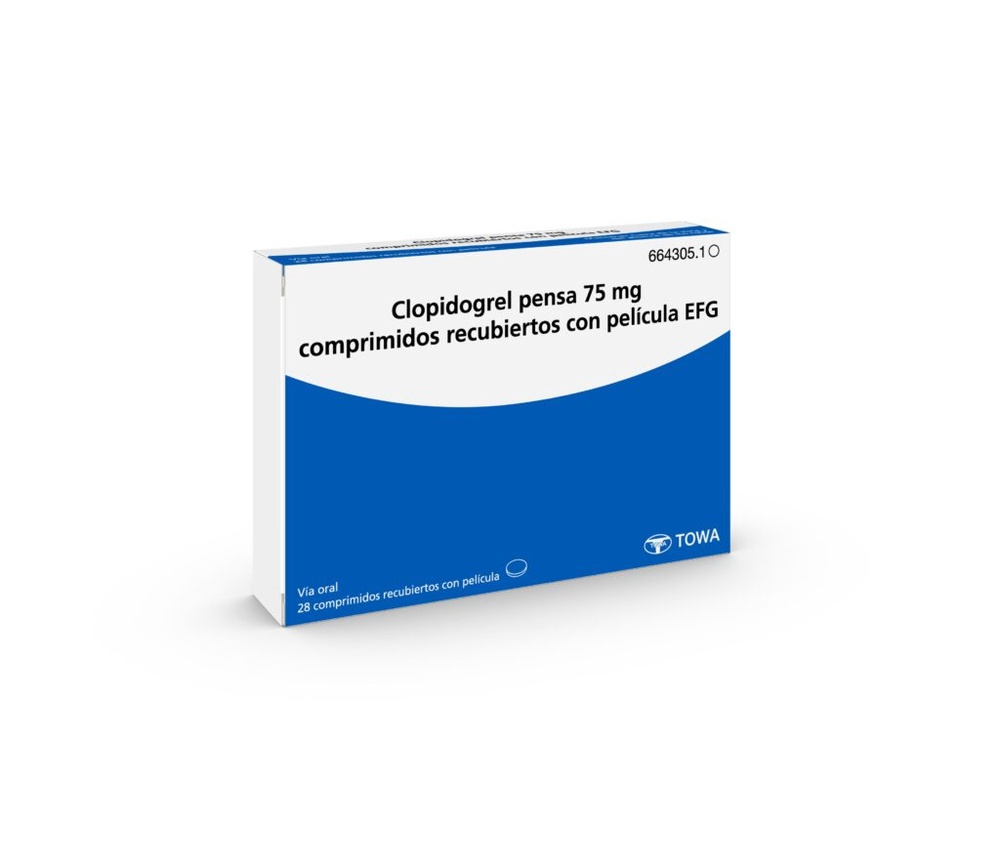
CLOPIDOGREL 75 mg Film-Coated Tablets

Prescription review online
A doctor will review your case and decide whether a prescription is medically appropriate.

Talk to a doctor about this medicine
Discuss your symptoms and possible next steps in a quick online consultation.



How to use CLOPIDOGREL PENSA 75 mg FILM-COATED TABLETS
Contents of the leaflet
- Introduction
- What is Clopidogrel Pensa and what is it used for
- What you need to know before taking Clopidogrel Pensa
- How to take Clopidogrel Pensa
- Possible side effects
- Storage of Clopidogrel Pensa
- Package Contents and Additional Information
Introduction
Package Leaflet: Information for the User
Clopidogrel Pensa 75 mg Film-Coated Tablets EFG
clopidogrel
Read the entire package leaflet carefully before starting to take this medication, as it contains important information for you.
- Keep this package leaflet, as you may need to read it again.- If you have any questions, ask your doctor or pharmacist.- This medication has been prescribed to you only, and you should not give it to others, even if they have the same symptoms as you, as it may harm them.
- If you experience side effects, contact your doctor or pharmacist, even if they are side effects not listed in this package leaflet. See section 4.
Contents of the Package Leaflet
- What is Clopidogrel Pensa and what is it used for
- What you need to know before taking Clopidogrel Pensa
- How to take Clopidogrel Pensa
- Possible side effects
- Storage of Clopidogrel Pensa
- Package Contents and Additional Information
1. What is Clopidogrel Pensa and what is it used for
Clopidogrel Pensa belongs to a group of medications called antiplatelet agents. Platelets are very small cells found in the blood, and they aggregate when the blood clots. Antiplatelet agents, by preventing this aggregation, reduce the possibility of blood clots forming (a process called thrombosis).
Clopidogrel Pensa is administered to prevent the formation of blood clots (thrombi) in blood vessels (arteries) that have become hardened, a process known as atherothrombosis, which can cause atherothrombotic events (such as stroke, myocardial infarction, or death).
This medication has been prescribed to help prevent the formation of blood clots and reduce the risk of these serious events, as you:
- suffer from a process that causes the hardening of the arteries (also called arteriosclerosis), and
- have previously suffered a myocardial infarction, a stroke, or suffer from a disease called peripheral arterial disease, or
- have suffered a type of severe chest pain, known as "unstable angina" or "myocardial infarction". For the treatment of this disease, your doctor may need to place a stent (a small tube) in the obstructed or narrowed artery to restore adequate blood flow. It is also possible that your doctor has prescribed acetylsalicylic acid (a substance present in many medications used to relieve pain and lower fever, as well as to prevent blood clot formation).
- have an irregular heartbeat, a disease called "atrial fibrillation", and you cannot take medications known as "oral anticoagulants" (vitamin K antagonists) that prevent the formation of new clots and prevent the growth of existing clots. You will have been told that "oral anticoagulants" are more effective than acetylsalicylic acid or the combined use of clopidogrel and acetylsalicylic acid for this disease. Your doctor will have prescribed clopidogrel plus acetylsalicylic acid if you cannot take "oral anticoagulants" and do not have a risk of severe bleeding

Not sure if this medicine is right for you?
Discuss your symptoms and treatment with a doctor online.
2. What you need to know before taking Clopidogrel Pensa
Do not take Clopidogrel Pensa
- If you are allergic (hypersensitive) to clopidogrel or any of the other components of this medication (listed in section 6);
- If you have active bleeding, such as a stomach ulcer or bleeding in the brain;
- If you have severe liver disease.
If you think any of these may apply to you, or if you have any doubts, consult your doctor before taking Clopidogrel Pensa.
Warnings and Precautions
Before starting treatment with Clopidogrel Pensa, inform your doctor if you are in any of the following situations:
- If you are at risk of bleeding (bleeding) because:
- You have a disease that involves a risk of internal bleeding (such as a stomach ulcer).
- You have a blood disorder that predisposes you to internal bleeding (bleeding in tissues, organs, or joints of the body).
- You have recently had a severe injury.
- You have recently undergone surgery (including dental surgery).
- You are scheduled to undergo surgery (including dental surgery) in the next seven days.
- If you have had a blood clot in an artery of the brain (ischemic stroke) in the last 7 days.
- If you have liver or kidney disease.
- If you have had an allergy or reaction to any medication used to treat your disease.
During treatment with Clopidogrel Pensa:
- Inform your doctor if you are scheduled to undergo surgery (including dental surgery).
- Inform your doctor immediately if you develop a disorder (also known as Thrombotic Thrombocytopenic Purpura or TTP) that includes fever and bruising (bruises) under the skin that can appear as red spots, accompanied or not by extreme fatigue, confusion, yellowing of the skin or eyes (jaundice) (see section 4 "Possible side effects")
- If you cut or injure yourself, bleeding may take longer than usual to stop. This is related to the way the medication works, as it prevents the blood's ability to form clots. For minor cuts or injuries, such as cuts while shaving, this is usually not a problem. However, if you are concerned about your bleeding, consult your doctor immediately (see section 2 "Warnings and Precautions").
- Your doctor may ask you to have blood tests.
Children and Adolescents
This medication should not be given to children as it is not effective.
Taking Clopidogrel Pensa with other medications
Inform your doctor or pharmacist if you are taking, have recently taken, or may need to take any other medication, including those purchased without a prescription.
Some medications may affect the use of Clopidogrel Pensa or vice versa.
You should specifically inform your doctor if you are taking:
- medications that may increase the risk of bleeding, such as:
- oral anticoagulants, medications used to decrease blood clotting,
- non-steroidal anti-inflammatory drugs, medications used to treat pain and/or muscle or joint inflammation,
- heparin, or any other injectable medication used to decrease blood clotting,
- -
- ticlopidine, another antiplatelet agent,
- a serotonin reuptake inhibitor (such as fluoxetine or fluvoxamine and other medications of the same type), medications used to treat depression,
- rifampicin (used for severe infections)
- omeprazole or esomeprazole, medications to treat stomach discomfort,
- fluconazole or voriconazole, medications to treat fungal infections,
- efavirenz, or other antiretroviral medications (used to treat HIV infections),
- carbamazepine, a medication to treat some forms of epilepsy,
- moclobemide, a medication for depression,
- repaglinide, a medication for diabetes treatment,
- paclitaxel, a medication for cancer treatment,
- opioids: if you are being treated with clopidogrel, you should inform your doctor before being prescribed any opioid (used to treat severe pain).
If you have suffered severe chest pain (unstable angina or myocardial infarction), you may have been prescribed Clopidogrel Pensa in combination with acetylsalicylic acid, a substance present in many medications used to relieve pain and lower fever. An occasional dose of acetylsalicylic acid (not exceeding 1,000 mg in 24 hours) should not cause any problems, but prolonged use in other circumstances should be discussed with your doctor.
Taking Clopidogrel Pensa with food and drinks
Clopidogrel Pensa can be taken with or without food.
Pregnancy and Breastfeeding
It is preferable not to use this medication during pregnancy.
If you are pregnant or think you may be pregnant, you should inform your doctor or pharmacist before taking Clopidogrel Pensa. If you become pregnant while taking Clopidogrel Pensa, consult your doctor immediately, as it is not recommended to take clopidogrel during pregnancy.
You should not breastfeed while taking this medication.
If you are breastfeeding or plan to do so, inform your doctor before taking this medication.
Consult your doctor or pharmacist before using any medication.
Driving and Using Machines
It is unlikely that Clopidogrel Pensa will affect your ability to drive or operate machinery.
Clopidogrel Pensa contains lactose
Clopidogrel Pensa contains lactose. Patients with hereditary galactose intolerance, total lactase deficiency, or glucose-galactose malabsorption should not take this medication.
3. How to take Clopidogrel Pensa
Follow the administration instructions of this medication exactly as indicated by your doctor or pharmacist. In case of doubt, consult your doctor or pharmacist again.
The recommended dose, even for patients with a disease called "atrial fibrillation" (an irregular heartbeat), is one 75 mg tablet of Clopidogrel Pensa per day, administered orally with or without food and at the same time every day.
If you have suffered severe chest pain (unstable angina or myocardial infarction), your doctor may prescribe 300 mg of Clopidogrel Pensa (4 tablets of 75 mg) to be taken once at the start of treatment. Afterward, the recommended dose is one 75 mg tablet of Clopidogrel Pensa per day, as described above.
You should take Clopidogrel Pensa for as long as your doctor continues to prescribe it.
If you take more Clopidogrel Pensa than you should
Contact your doctor or go to the emergency department of the nearest hospital, as there is a greater risk of bleeding.
In case of overdose or accidental ingestion, consult your doctor or pharmacist immediately or call the Toxicology Information Service, phone: 91 562 04 20 (indicating the medication and the amount ingested).
If you forget to take Clopidogrel Pensa
If you forget to take a dose of Clopidogrel Pensa, but remember before 12 hours have passed since the time you should have taken the medication, take the tablet immediately and the next one at the usual time.
If you forget for more than 12 hours, simply take the next dose at the usual time. Do not take a double dose to make up for the missed dose.
If you interrupt treatment with Clopidogrel Pensa
Do not interrupt your treatmentunless your doctor tells you to do so. Contact your doctor or pharmacist before stopping this medication.
If you have any other questions about the use of this medication, ask your doctor or pharmacist.

Started taking the medicine and have questions?
Discuss your symptoms and treatment with a doctor online.
4. Possible side effects
Like all medications, this medication can have side effects, although not everyone will experience them.
Contact your doctor immediately if you experience:
-fever, signs of infection, or extreme fatigue. These symptoms may be due to a rare decrease in some blood cells.
- signs of liver problems, such as yellowing of the skin and/or eyes (jaundice), associated or not with bleeding that appears under the skin as red spots and/or confusion (see section 2 "Warnings and Precautions").
-Swelling of the mouth or skin disorders such as rashes and itching, blisters on the skin. These can be signs of an allergic reaction.
The most common side effect reported with clopidogrelis bleeding.Bleeding can occur in the stomach or intestine, bruising, hematoma (abnormal bleeding or bruising under the skin), nosebleeds, blood in the urine. There have also been reports of a small number of cases of: bleeding from the blood vessels of the eyes, intracranial bleeding, pulmonary or joint bleeding.
If you experience prolonged bleeding while taking Clopidogrel Pensa
If you cut or injure yourself, it is possible that the bleeding may take a little longer than usual to stop. This is related to the mechanism of action of the medication, as it prevents the blood's ability to form clots. For minor cuts or injuries, such as cuts while shaving, this is usually not a problem. However, if you are concerned about your bleeding, consult your doctor immediately (see section 2 "Warnings and Precautions").
Other side effects include:
Common side effects (may affect up to 1 in 10 people): Diarrhea, abdominal pain, indigestion, or heartburn.
Uncommon side effects (may affect up to 1 in 100 people): headache, stomach ulcer, vomiting, nausea, constipation, excess gas in the stomach or intestine, rash, itching, dizziness, tingling sensation, and numbness.
Rare side effects (may affect up to 1 in 1,000 people): vertigo, breast enlargement in men.
Very rare side effects (may affect up to 1 in 10,000 people): jaundice, severe abdominal pain with or without back pain; fever, difficulty breathing, sometimes associated with cough; generalized allergic reactions (e.g., general feeling of heat with sudden general discomfort leading to fainting); swelling of the mouth; blisters on the skin, skin allergy; inflammation of the mucous membrane of the mouth (stomatitis); decrease in blood pressure; confusion; hallucinations; joint pain; muscle pain; changes in taste or loss of taste of food.
Side effects with unknown frequency (cannot be estimated from available data): hypersensitivity reactions with chest or abdominal pain, persistent symptoms of low blood sugar.
In addition, your doctor may observe changes in the results of your blood or urine tests.
Reporting side effects
If you experience any side effects, consult your doctor, pharmacist, or nurse, even if they are possible side effects not listed in this package leaflet. You can also report them directly through the Spanish Medication Surveillance System for Human Use: www.notificaram.es. By reporting side effects, you can contribute to providing more information on the safety of this medication.
5. Storage of Clopidogrel Pensa
Keep this medication out of the sight and reach of children.
Do not store above 30°C
Keep in the original packaging to protect it from moisture
Do not use Clopidogrel Pensa after the expiration date shown on the packaging after CAD. The expiration date is the last day of the month indicated.
Do not use Clopidogrel Pensa if you notice any visible signs of deterioration.
Medications should not be disposed of through wastewater or household waste. Deposit the packaging and medications you no longer need at the SIGRE point in the pharmacy. If in doubt, ask your pharmacist how to dispose of the packaging and medications you no longer need. This will help protect the environment.
6. Package Contents and Additional Information
Composition of Clopidogrel Pensa
The active ingredient is clopidogrel. Each tablet contains 75 mg of clopidogrel (in the form of besylate).
The other components are:
Core of the tablet: pregelatinized corn starch, microcrystalline cellulose, type A crospovidone, anhydrous colloidal silica, type 50 stearic acid.
Film coating: carnauba wax, lactose monohydrate, hypromellose (E464), titanium dioxide (E171), triacetin (E1518), red iron oxide (E172).
Appearance of the product and package contents
Clopidogrel Pensa film-coated tablets EFG are pink, round, and biconvex tablets with an approximate diameter of 8.3 mm.
Clopidogrel Pensa is marketed in blister packs of: 14, 28, 30, 50, 84, 90, and 100 film-coated tablets.
Not all pack sizes may be marketed.
Marketing Authorization Holder
Towa Pharmaceutical, S.A.
C/ de Sant Martí, 75-97
08107 Martorelles (Barcelona)
Spain
Manufacturer
FINE FOODS & PHARMACEUTICALS N.T.M.S.P.A.
Via Grignano, 43
24041 Brembate, Italy
Date of the last revision of this package leaflet: March 2021
Detailed and updated information on this medication is available on the website of the Spanish Agency for Medicines and Health Products (AEMPS) http://www.aemps.gob.es/
- Country of registration
- Dosage formTABLET, 75 mg
- ATC codeB01AC04
- Average pharmacy price16.81 EUR
- Active substance
- Prescription requiredYes
- Manufacturer
- CompositionLACTOSA MONOHIDRATO (2,80 mg mg)
- This information is for reference only and does not constitute medical advice. Always consult a doctor before taking any medication. Oladoctor is not responsible for medical decisions based on this content.
- Alternatives to CLOPIDOGREL PENSA 75 mg FILM-COATED TABLETSDosage form: TABLET, 75 mg Clopidogrel (112.10 mg Clopidogrel Besilate)Active substance: clopidogrelManufacturer: Especialidades Farmaceuticas Centrum S.A.Prescription requiredDosage form: TABLET, 75 mg clopidogrelActive substance: clopidogrelManufacturer: Almus Farmaceutica S.A.U.Prescription requiredDosage form: TABLET, 75 mgActive substance: clopidogrelManufacturer: Laboratorios Alter S.A.Prescription required
Online doctors for CLOPIDOGREL PENSA 75 mg FILM-COATED TABLETS
Discuss questions about CLOPIDOGREL PENSA 75 mg FILM-COATED TABLETS, including use, safety considerations and prescription review, subject to medical assessment and local regulations.









Get CLOPIDOGREL PENSA 75 mg FILM-COATED TABLETS Prescription Online
Fill in a 2-min form
Tell us your symptoms, history, and what medicine you're requesting.
Pick a doctor or let us assign
Choose a specialist or we'll match you with the next available doctor.
Doctor reviews your case
Usually within 30 minutes. They may ask follow-up questions via chat.
Collect from any pharmacy
Electronic prescription sent to your email — valid across Spain.
Frequently Asked Questions
CLOPIDOGREL PENSA 75 mg FILM-COATED TABLETS requires a prescription in Spain. You can check with a doctor online whether this medicine may be appropriate for your situation.
The active ingredient in CLOPIDOGREL PENSA 75 mg FILM-COATED TABLETS is clopidogrel. This information helps identify medicines with the same composition but different brand names.
The average pharmacy price for CLOPIDOGREL PENSA 75 mg FILM-COATED TABLETS is around 16.81 EUR. Prices may vary depending on the manufacturer and dosage form.
CLOPIDOGREL PENSA 75 mg FILM-COATED TABLETS is manufactured by Towa Pharmaceutical S.A.. Pharmacy brands and packaging may differ depending on the distributor.
Doctors such as Family doctors, Psychiatrists, Dermatologists, Cardiologists, Endocrinologists, Gastroenterologists, Pulmonologists, Nephrologists, Rheumatologists, Hematologists, Infectious disease physicians, Allergists, Geriatricians, Paediatricians, Oncologists may assess whether CLOPIDOGREL PENSA 75 mg FILM-COATED TABLETS is appropriate, depending on your situation and local regulations. You can book an online consultation to discuss your symptoms and possible next steps.
Spain has a well-developed healthcare infrastructure across major cities such as Madrid, Barcelona, Valencia, and Seville. Pharmacies are widely available and operate under strict regulations, ensuring access to prescribed medications.
You can buy CLOPIDOGREL PENSA 75 mg FILM-COATED TABLETS in Madrid, Barcelona, Seville, or Valencia at any local pharmacy with a valid prescription.
To obtain a prescription, you can use Oladoctor:
Other medicines with the same active substance (clopidogrel) include AGRELAN 75 mg FILM-COATED TABLETS, CLOPIDOGREL ALMUS 75 mg FILM-COATED TABLETS, CLOPIDOGREL ALTER 75 mg FILM-COATED TABLETS. These may have different brand names or formulations but contain the same therapeutic ingredient. Always consult a doctor before switching or starting a new medicine.
