







Cómo usar CLINDAMICINA KALCEKS 150 MG/ML SOLUCION INYECTABLE Y PARA PERFUSION EFG
Traducción generada por IA
Este contenido ha sido traducido automáticamente y se ofrece solo con fines informativos. No sustituye la consulta con un profesional sanitario.
Ver originalContenido del prospecto
Introducción
Prospecto: información para el usuario
Clindamicina Kalceks 150mg/ml solución inyectable y para perfusión EFG
Lea todo el prospecto detenidamente antes de empezar a usar este medicamento, porque contiene información importante para usted.
- Conserve este prospecto, ya que puede tener que volver a leerlo.
- Si tiene alguna duda, consulte a su médico o enfermero.
- Si experimenta efectos adversos, consulte a su médico o enfermero, incluso si se trata de efectos adversos que no aparecen en este prospecto. Ver sección 4.
Contenido del prospecto
- Qué es Clindamicina Kalceks y para qué se utiliza
- Qué necesita saber antes de empezar a usar Clindamicina Kalceks
- Cómo usar Clindamicina Kalceks
- Posibles efectos adversos
- Conservación de Clindamicina Kalceks
- Contenido del envase e información adicional
1. Qué es Clindamicina Kalceks y para qué se utiliza
Este medicamento contiene el principio activo clindamicina (como clindamicina fosfato), que es un antibiótico. Se utiliza para tratar infecciones.
Los antibióticos se utilizan para tratar infecciones bacterianas y no sirven para tratar infecciones víricas como la gripe o el catarro.
Es importante que siga las instrucciones relativas a la dosis, el intervalo de administración y la duración del tratamiento indicadas por su médico.
No guarde ni reutilice este medicamento. Si una vez finalizado el tratamiento le sobra antibiótico, devuélvalo a la farmacia para su correcta eliminación. No debe tirar los medicamentos por el desagüe ni a la basura.
Clindamicina Kalceks se utiliza para el tratamiento de las siguientes infecciones graves en adultos y niños a partir de 1 mes de edad:
- infecciones óseas y articulares
- sinusitis crónica causada por microorganismos anaerobios
- infecciones del aparato respiratorio inferior
- infecciones abdominales complicadas
- infecciones pélvicas y del tracto genital femenino
- infecciones complicadas de la piel y tejidos blandos.
Clindamicina Kalceks se puede utilizar para la profilaxis en cirugía en caso de alergia a los betalactámicos.

2. Qué necesita saber antes de empezar a usar Clindamicina Kalceks
No le deben administrar Clindamicina Kalceks
- si es alérgico a la clindamicina, a la lincomicina (otro antibiótico) o a alguno de los demás componentes de este medicamento (incluidos en la sección 6).
Advertencias y precauciones
Consulte a su médico o enfermero antes de empezar a usar clindamicina si:
- sufre alteraciones de la función hepática o renal;
- tiene problemas con las funciones musculares (por ejemplo, padece una debilidad muscular denominada miastenia gravis o la enfermedad de Parkinson);
- ha sufrido previamente enfermedades gastrointestinales (ej. inflamación del colon);
- sufre cualquier tipo de alergia, ej. hipersensibilidad a pencilina porque en casos individuales se han comunicado reacciones alérgicas a clindamicina en personas con hipersensibilidad conocida a penicilina;
- si sufre asma, eccema o fiebre del heno.
Consulte a su médico si no está seguro de si le afecta o le ha afectado alguna de las advertenciadas mencionadas anteriormente.
Informe inmediatamente a su médico o enfermero si durante el tratamiento experimenta:
- signos de reacción alérgica grave como sibilancia, dificultad respiratoria, hinchazón de párpados, cara o labios, erupción cutánea o picor (ver sección 4). Estos pueden aparecer incluso después de la primera administración. En este caso, su médico interrumpirá inmediatamente el tratamiento con clindamicina e iniciará las medidas de urgencia estándares;
- erupción cutánea grave con manchas rojas irregulares o con ampollas que contienen pus y descamación extensa de la piel, fiebre, tos, sensación de malestar e hinchazón de las encías, lengua o labios (ver sección 4);
- diarrea durante el tratamiento o hasta 3 semanas después, especialmente si se acompañan de mucosidad o sangre en las heces. Puede ser un signo de infección grave del colon (colitis). Es más probable que se produzca en pacientes inmunodeprimidos y/o de edad avanzada (mayores de 60 años).
Pueden producirse trastornos renales agudos. Informe a su médico de cualquier medicamento que esté tomando actualmente y si tiene algún problema de riñón. Si experimenta disminución de la producción de orina, retención de líquidos que provoca hinchazón de piernas, tobillos o pies, falta de aliento o náuseas, debe contactar inmediatamente con su médico.
El tratamiento prolongado y el uso repetido de clindamicina puede provocar una infección de la piel y de las mucosas con patógenos no sensibles a la clindamicina. También puede provocar el desarrollo de una infección fúngica.
Este medicamento no es adecuado para el tratamiento de la fiebre cerebral (meningitis).
Durante el tratamiento a largo plazo, el médico controlará periódicamente la función hepática y renal.
Para evitar efectos indeseables, la clindamicina se administrará en perfusión lenta en vena.
Niños
No se han establecido la seguridad y la posología en lactantes menores de un mes de edad.
Otros medicamentosyClindamicina Kalceks
Informe a su médico o enfermero si está utilizando, ha utilizado recientemente o pudiera tener que utilizar cualquier otro medicamento.
Especialmente si está utilizando alguno de los siguientes medicamentos:
- relajantes musculares (utilizados durante las operaciones para ayudar a relajar los músculos). El uso concomitante con clindamicina puede dar lugar a incidencias inesperadas y potencialmente mortales durante la cirugía. Por lo tanto, si está en el hospital para someterse a una operación o a un procedimiento hospitalario, informe a su médico de que está recibiendo clindamicina.
- warfarina o medicamentos similares: utilizados para diluir la sangre. Puede tener más probabilidades de sangrar. Es posible que su médico quiera hacerle análisis de sangre periódicos para comprobar la capacidad de coagulación de su sangre;
- eritromicina (un antibiótico);
- rifampicina (para tratar la tuberculosis);
- ciclosporina/tacrolimus (utilizados tras trasplantes de órganos).
Embarazo, lactancia y fertilidad
Si está embarazada o en periodo de lactancia, cree que podría estar embarazada o tiene intención de quedarse embarazada, consulte a su médico antes de que le administren este medicamento.
Su médico le recetará clindamicina durante el embarazo sólo si es absolutamente necesario. Este medicamento puede tener un efecto negativo sobre la flora intestinal del lactante. El médico sopesará detenidamente los beneficios de la lactancia para el lactante y los beneficios y riesgos esperados del tratamiento con clindamicina para la madre.
Conducción y uso de máquinas
La influencia de este medicamento sobre la capacidad para conducir y utilizar máquinas es nula o insignificante.
Clindamicina Kalceks contiene sodio
Este medicamento contiene 6,5 mg de sodio (componente principal de la sal de mesa/para cocinar) por ml de solución. Esto equivale al 0,33 % de la ingesta diaria máxima de sodio recomendada para un adulto.
3. Cómo usar Clindamicina Kalceks
Su médico decidirá la dosis correcta de tratamiento con clindamicina para usted.
Este medicamento se lo administrará un médico o enfermero, mediante inyección en el músculo o mediante perfusión intravenosa lenta (goteo). El medicamento se diluirá antes de la perfusión en vena. La perfusión durará de 10 a 60 minutos.
Adultos
- para el tratamiento de infecciones menos complicadas:
la dosis habitual es de 1.200–1.800 mg diarios administrados en 3 o 4 dosis iguales
- para el tratamiento de infecciones graves:
la dosis habitual es de 2.400–2.700 mg diarios administrados en 2, 3 o 4 dosis iguales.
En infecciones potencialmente mortales, la dosis administrada por vía intravenosa puede aumentarse hasta 4.800 mg diarios.
La dosis para la profilaxis de las infecciones postoperatorias será determinada por su médico. Dependerá del tipo y la duración de la intervención quirúrgica.
Vía intramuscular, la dosis única máxima recomendada es de 600 mg.
Vía intravenosa, la dosis máxima recomendada para una perfusión de una hora es de 1.200 mg.
Uso en pacientes de edad avanzada
No es necesario ajustar la dosis en pacientes de edad avanzada con función hepática y renal normal.
Pacientes con insuficiencia hepática y/o renal
En general, no es necesario ajustar la dosis en caso de insuficiencia hepática o renal leve o moderada.
El médico controlará la función renal en pacientes con insuficiencia renal grave.
En pacientes con insuficiencia hepática grave, el médico controlará la función hepática y, cuando sea posible, los niveles plasmáticos del medicamento. En caso necesario, el médico ajustará la dosis o los intervalos de dosificación.
Uso en niñosy adolescentes
Niños de más de 1 mes a 12 años
20-40 mg/kg de peso corporal al día administrados en 3 o 4 dosis iguales.
La dosis de clindamicina en niños debe basarse en el peso corporal total, independientemente de la obesidad. En infecciones graves se recomienda administrar no menos de 300 mg/día en niños, independientemente del peso corporal. La dosis diaria total no debe superar la dosis diaria máxima recomendada para adultos.
Adolescentes mayores de 12 años
Las dosis en adolescentes mayores de 12 años deben ser las mismas que en adultos, teniendo en cuenta posibles ajustes de dosis basados en la función hepática. En pacientes adolescentes con bajo peso, entre 12 y 18 años, no se recomienda superar la dosis máxima de 40 mg/kg/día. La dosis diaria total no debe superar la dosis diaria máxima recomendada para adultos.
Si recibe más Clindamicina Kalceks del que debe
Este medicamento se administrará siempre en condiciones cuidadosamente controladas. No obstante, si cree que se le ha administrado demasiado medicamento, informe inmediatamente a su médico o enfermero.
Si olvidó tomar Clindamicina Kalceks
Este medicamento se lo administrará un médico o enfermero. No obstante, si cree que se ha saltado una dosis, informe a su médico o enfermero.
Si tiene cualquier otra duda sobre el uso de este medicamento, pregunte a su médico o enfermero.

4. Posibles efectos adversos
Al igual que todos los medicamentos, este medicamento puede producir efectos adversos, aunque no todas las personas los sufran.
Efectos adversos graves
Informe inmediatamentea su médico o enfermero si presenta alguno de los siguientes efectos adversos, ya que puede requerir atención médica inmediata:
Frecuentes(pueden afectar hasta 1 de cada 10 personas)
- Trastornos gastrointestinales
Diarrea grave, persistente o sanguinolenta (que puede ir asociada a dolor de estómago o fiebre). Puede ocurrir durante o después del tratamiento con antibióticos y puede ser un signo de inflamación intestinal grave (colitis pseudomembranosa).
Poco frecuentes(pueden afectar hasta 1 de cada 100 personas)
- Trastornos cardiovasculares
Presión arterial baja (sensación de mareo, vértigo o desmayo) o dolor o presión repentinos en el pecho, dificultad para respirar, mareos, desmayos, náuseas o vómitos (signos de parada cardiaca). Esto puede ocurrir si el medicamento se administra demasiado rápido.
Frecuencia no conocida(no puede estimarse a partir de los datos disponibles)
- Reacciones alérgicas
Signos de una reacción alérgica grave, como sibilancias repentinas, dificultad para respirar, hinchazón de párpados, cara o labios, erupción cutánea o picor (que afecta especialmente a todo el cuerpo)
- Trastornos de la piel
Signos de reacciones cutáneas graves y potencialmente mortales como erupción cutánea grave con manchas rojas irregulares o con ampollas llenas de pus y descamación extensa de la piel, fiebre, tos, sensación de malestar e hinchazón de las encías, la lengua o los labios
- Trastornos hepáticos
Coloración amarillenta de la piel y el blanco de los ojos (ictericia)
- Trastornos renales
Retención de líquidos que provoca hinchazón de piernas, tobillos o pies, dificultad para respirar o náuseas.
- Cambios en los recuentos sanguíneos
Aumento de las infecciones, que pueden manifestarse como fiebres, escalofríos intensos, dolor de garganta o úlceras bucales (pueden indicar que tiene un número bajo de glóbulos blancos en el organismo)
Otros efectos adversos
Frecuentes(pueden afectar hasta 1 de cada 10 personas)
- Infección o inflamación de las venas de la pierna (tromboflebitis)
- Aumento de algunos glóbulos blancos (eosinofilia)
- Inflamación del revestimiento interior de la boca
- Diarrea
- Erupción cutánea elevada de color rojo
- Induración en la zona de inyección (tras la inyección en el músculo)
- Alteraciones de la función hepática (observadas en un análisis de sangre)
Poco frecuentes(pueden afectar hasta 1 de cada 100 personas)
- Bajo número de glóbulos blancos en el organismo (granulocitopenia)
- Deterioro del sentido del gusto
- Efecto relajante muscular
- Dolor abdominal
- Inflamación del revestimiento del esófago
- Náuseas
- Vómitos
- Urticaria
- Inflamación y enrojecimiento de la piel (eritema multiforme)
- Picor
- Dolor en el lugar de inyección
- Absceso en el lugar de inyección (tras inyección en el músculo)
Raros(pueden afectar hasta 1 de cada 1.000 personas)
- Hinchazón, especialmente de cara y garganta, sibilancias y/o dificultad para respirar (angioedema)
Muy raros(pueden afectar hasta 1 de cada 10.000 personas)
- Indigestión
Frecuencia no conocida(no puede estimarse a partir de los datos disponible)
- Infección del intestino grueso (colon) causada por una bacteria.
- Infección vaginal
- Hematomas o hemorragias inexplicables durante más tiempo de lo normal o pequeñas manchas de color rojo violáceo en la piel (pueden indicar que tiene un número bajo de plaquetas en la sangre)
- Reacciones alérgicas
- Cambios en el olfato
- Erupción cutánea plana o ligeramente elevada de color rojo rosado
- Irritación en la zona de inyección
Comunicación de efectos adversos
Si experimenta cualquier tipo de efecto adverso, consulte a su médico o enfermero, incluso si se trata de posibles efectos adversos que no aparecen en este prospecto. También puede comunicarlos directamente a través del Sistema Español de Farmacovigilancia de Medicamentos de Uso Humano: www.notificaRAM.es. Mediante la comunicación de efectos adversos usted puede contribuir a proporcionar más información sobre la seguridad de este medicamento.
5. Conservación de Clindamicina Kalceks
Mantener este medicamento fuera de la vista y del alcance de los niños.
No utilice este medicamento después de la fecha de caducidad que aparece en la etiqueta de la ampolla y en la caja de cartón después de EXP. La fecha de caducidad es el último día del mes que se indica
No conservar a temperatura superior a 25 °C. No refrigerar o congelar.
Conservar las ampollas en el embalaje exterior para protegerlo de la luz.
Periodo de validez después de abrir la ampolla: el producto debe utilizarse inmediatamente.
Periodo de validez tras dilución
La estabilidad química y física en uso se ha demostrado durante 48 horas a 25 °C y 2-8 °C.
Desde el punto de vista microbiológico, el producto debe utilizarse de inmediato. Si no se utiliza inmediatamente, los tiempos y condiciones de almacenamiento previos a la utilización son responsabilidad del usuario y normalmente no deberán ser superiores a 24 horas a una temperatura de 2 a 8 °C, a menos que la dilución se haya realizado en condiciones asépticas controladas y validadas.
Los medicamentos no se deben tirar por los desagües ni a la basura. Deposite los envases y los medicamentos que no necesita en el punto SIGRE de la farmacia. Pregunte a su farmacéutico cómo deshacerse de los envases y de los medicamentos que ya no necesita. De esta forma, ayudará a proteger el medio ambiente.
6. Contenido del envase e información adicional
Composición de Clindamicina Kalceks
- El principio activo es clindamicina.
Cada ml de solución contiene 150 mg de clindamicina (como clindamicina fosfato).
Cada ampolla de 2 ml contiene 300 mg de clindamicina (como clindamicina fosfato).
Cada ampolla de 4 ml contiene 600 mg de clindamicina (como clindamicina fosfato).
- Los demás componentes son edetato disódico, hidróxido sódico (para ajuste del pH), agua para preparaciones inyectables.
Aspecto del producto y contenido del envase
Solución transparente, de incolora a casi incolora, prácticamente exenta de partículas visibles.
2 ml o 4 ml de solución envasados en ampollas de vidrio incoloro con un punto de corte.
Cada envase contiene 1, 5 o 10 (envase clínico) ampollas.
Puede que solamente estén comercializados algunos tamaños de envases.
Titular de la autorización de comercialización y responsable de la fabricación
AS KALCEKS
Krustpils iela 71E,
Riga, LV‑1057,
Letonia
Tel.: +371 67083320
E-mail: [email protected]
Pueden solicitar más información respecto a este medicamento dirigiéndose al representante local del titular de la autorización de comercialización:
Grindeks Kalceks España, S.L.
c/ José Abascal, 58 2º dcha
28003 Madrid
España
Este medicamento está autorizado en los estados miembros del Espacio Económico Europeo con los siguientes nombres:
Dinamarca Clindamycin Kalceks
Austria, Alemania Clindamycin Kalceks 150 mg/ml Injektions-/Infusionslösung
Croacia Klindamicin Kalceks 150 mg/ml otopina za injekciju/infuziju
Finlandia, Noruega Clindamycin Kalceks
Francia CLINDAMYCINE KALCEKS 600 mg/4 mL, solution injectable/pour perfusion
Hungría Clindamycin Kalceks 150 mg/ml oldatos injekció vagy infúzió
Irlanda Clindamycin 150 mg/ml solution for injection/infusion
Italia Clindamicina Kalceks
Letonia Clindamycin Kalceks 150 mg/ml škidums injekcijam/infuzijam
Los países bajos Clindamycine Kalceks 150 mg/ml oplossing voor injectie/infusie
Eslovenia Klindamicin Kalceks 150 mg/ml raztopina za injiciranje/infundiranje
España Clindamicina Kalceks 150 mg/ml solución inyectable y para perfusión EFG
Fecha de la última revisión de este prospecto: junio 2024
La información detallada de este medicamento está disponible en la página web de la Agencia Española de Medicamentos y Productos Sanitarios (AEMPS) (http://www.aemps.gob.es/).
?--------------------------------------------------------------------------------------------------------------------
Esta información está destinada únicamente a profesionales del sector sanitario:
Consulte la Ficha Técnica para obtener información completa sobre la prescripción.
Forma de administración
Inyección intramuscular (IM) o perfusión intravenosa (IV).
Para la administración intramuscular, clindamicina debe utilizarse sin diluir. No se recomienda la administración intramuscular de más de 600 mg en un solo uso.
La administración intramuscular está indicada cuando la perfusión intravenosa no es posible por algún motivo.
Para la administración intravenosa, Clindamicina Kalceks debe diluirse antes de la administración IVy debe perfundirse durante al menos 10-60 minutos. La concentración no debe superar los 18 mg de clindamicina por ml de solución y la velocidad de perfusión no debe superar los 30 mg/min. Nunca debe administrarse como inyección intravenosa en bolo(puede causar efectos adversos graves). No se recomiendan perfusiones intravenosas de más de 1.200 mg en una hora.
Perfusiones habituales
Dosis | Diluyente | Concentración de clindamicina | Tiempo mínimo de perfusión |
300 mg | 50 ml | 6 mg/ml | 10 minutos |
600 mg | 50 ml | 12 mg/ml | 20 minutos |
900 mg | 50‑100 ml | 9 mg/ml a 18 mg/ml | 30 minutos |
1.200 mg | 100 ml | 12 mg/ml | 40 minutos |
Para diluyentes compatibles, ver “Instrucciones de uso, manipulación y eliminación”.
Incompatibilidades
Este medicamento no debe mezclarse con otros, excepto con los mencionados a continuación en el apartado “Instrucciones de uso, manipulación y eliminación”.
Los siguientes medicamentos son físicamente incompatibles con clindamicina fosfato: ampicilina, fenitoína sódica, barbitúricos, aminofilina, gluconato de calcio, sulfato de magnesio, ceftriaxona sódica, ciprofloxacino, idarubicina hidrocloruro y ranitidina hidrocloruro.
Instrucciones de uso, manipulación y eliminación
Para un solo uso. Desechar cualquier resto del medicamentono utilizado.
El medicamento debe inspeccionarse visualmente antes de su uso. No utilizar si hay signos visibles de deterioro (por ejemplo, partículas). Sólo deben utilizarse soluciones transparentes sin partículas visibles.
Puede diluirse con:
- 9 mg/ml (0,9 %) de solución de cloruro sódico para perfusión
- 50 mg/ml (5 %) de solución de glucosa para perfusión
Instrucciones de apertura de la ampolla
- Gire la ampolla con la punta coloreada hacia arriba. Si queda solución en la parte superior de la ampolla, golpee suavemente con el dedo para que toda la solución pase a la parte inferior de la ampolla.
- Abrir la ampolla con las dos manos; mientras sujeta la parte inferior de la ampolla con una mano, utilizar la otra para romper la parte superior de la ampolla en dirección contraria al punto coloreado (véanse las imágenes siguientes).
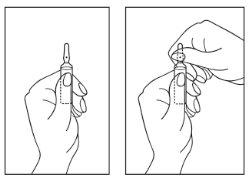
La eliminación del medicamento no utilizado y de todos los materiales que hayan estado en contacto con él, se realizará de acuerdo con la normativa local.
- País de registro
- Forma farmacéuticaINYECTABLE, 150 mg/ml
- Código ATCJ01FF01
- Principio activo
- Requiere recetaSí
- Fabricante
- Esta información es de carácter general y no sustituye la consulta con un profesional sanitario.
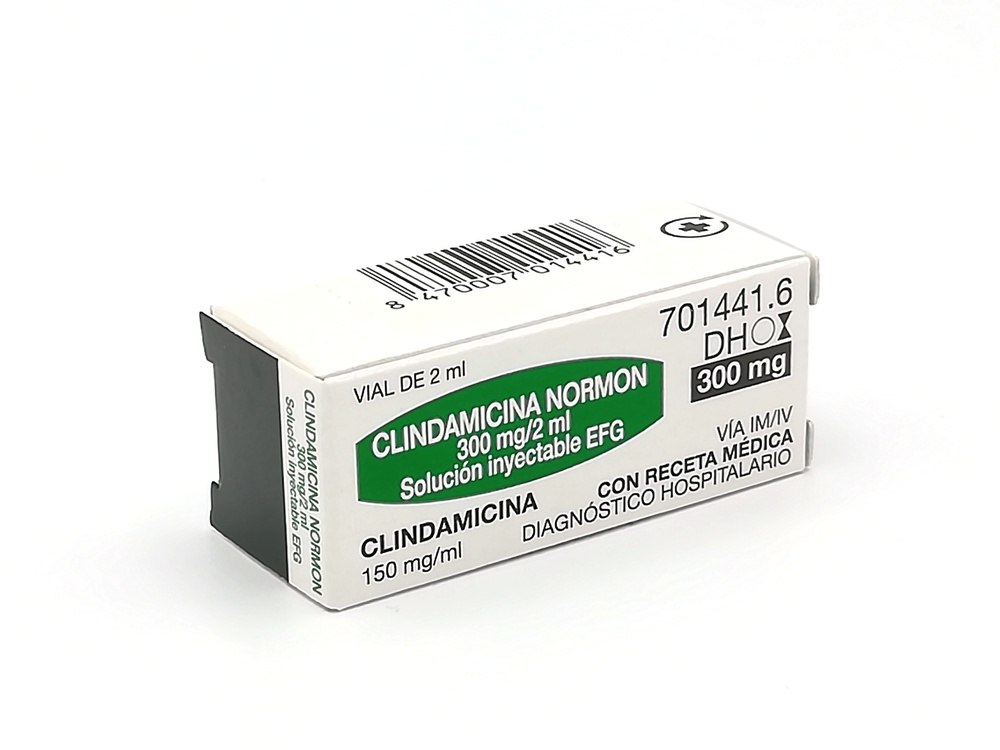
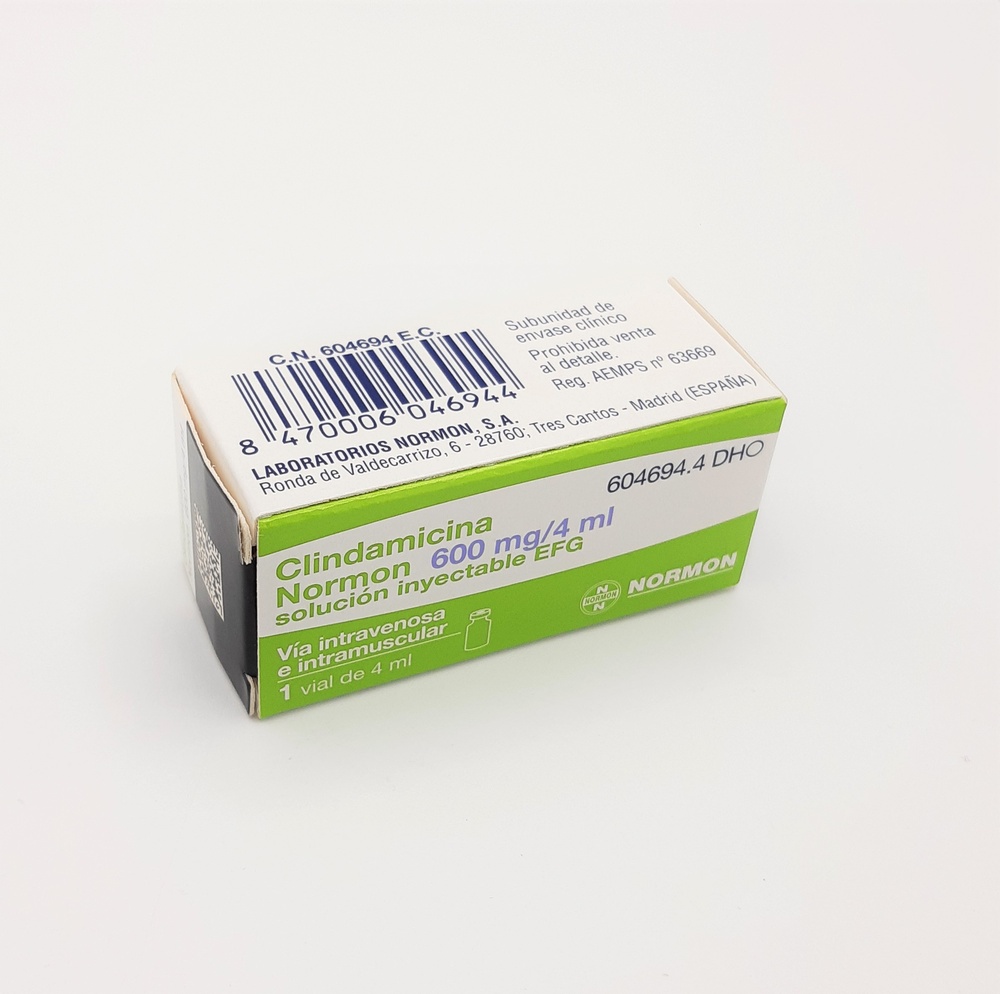
- Alternativas a CLINDAMICINA KALCEKS 150 MG/ML SOLUCION INYECTABLE Y PARA PERFUSION EFGForma farmacéutica: INYECTABLE, -Principio activo: clindamicinaFabricante: Laboratorios Normon S.A.Requiere recetaForma farmacéutica: INYECTABLE, 600 mgPrincipio activo: clindamicinaFabricante: Laboratorios Normon S.A.Requiere recetaForma farmacéutica: CAPSULA, 150 mgPrincipio activo: clindamicinaFabricante: Neuraxpharm Spain S.L.Requiere receta

Médicos online para CLINDAMICINA KALCEKS 150 MG/ML SOLUCION INYECTABLE Y PARA PERFUSION EFG
Comenta la dosis, los posibles efectos secundarios, interacciones, contraindicaciones o la revisión de receta de CLINDAMICINA KALCEKS 150 MG/ML SOLUCION INYECTABLE Y PARA PERFUSION EFG, sujeto a valoración médica y a la normativa local.









Obtén una receta de CLINDAMICINA KALCEKS 150 MG/ML SOLUCION INYECTABLE Y PARA PERFUSION EFG online
Rellena un formulario de 2 minutos
Cuéntanos tus síntomas, historial y el medicamento que necesitas.
Elige un médico o nosotros te asignamos uno
Escoge un especialista o te conectamos con el próximo médico disponible.
El médico revisa tu caso
Normalmente en 30 minutos. Puede hacerte preguntas adicionales por chat.
Recógela en cualquier farmacia
Receta electrónica enviada a tu correo, válida en toda España.
Preguntas frecuentes
CLINDAMICINA KALCEKS 150 MG/ML SOLUCION INYECTABLE Y PARA PERFUSION EFG requires receta en España. Puedes confirmarlo con un médico online según tu caso.
El principio activo de CLINDAMICINA KALCEKS 150 MG/ML SOLUCION INYECTABLE Y PARA PERFUSION EFG es clindamicina. Esta información ayuda a identificar medicamentos con la misma composición pero con diferentes nombres comerciales.
CLINDAMICINA KALCEKS 150 MG/ML SOLUCION INYECTABLE Y PARA PERFUSION EFG es fabricado por Kalceks As. La marca y el envase pueden variar según el distribuidor.
Los Médicos de familia, Psiquiatras, Dermatólogos, Cardiólogos, Endocrinólogos, Gastroenterólogos, Neumólogos, Nefrólogos, Reumatólogos, Hematólogos, Infectólogos, Alergólogos, Geriatras, Pediatras, Oncólogos pueden valorar la prescripción de CLINDAMICINA KALCEKS 150 MG/ML SOLUCION INYECTABLE Y PARA PERFUSION EFG cuando esté clínicamente indicado. Puedes reservar una videoconsulta para comentar tu caso y las opciones de tratamiento.
España cuenta con una infraestructura sanitaria bien desarrollada en ciudades principales como Madrid, Barcelona, Valencia y Sevilla. Las farmacias están ampliamente disponibles y operan bajo estrictas regulaciones, garantizando el acceso a medicamentos con receta.
Puedes comprar CLINDAMICINA KALCEKS 150 MG/ML SOLUCION INYECTABLE Y PARA PERFUSION EFG en Madrid, Barcelona, Sevilla o Valencia en cualquier farmacia local con una receta válida.
Para obtener una receta, puedes utilizar Oladoctor:
Otros medicamentos con el mismo principio activo (clindamicina) incluyen CLINDAMICINA NORMON 300 mg/2 ml SOLUCION INYECTABLE EFG, CLINDAMICINA NORMON 600 mg/4 ml SOLUCION INYECTABLE EFG, CLINDAMICINA QUALIGEN 150 MG CAPSULAS DURAS EFG. Pueden tener diferentes nombres comerciales o formulaciones, pero contienen el mismo componente terapéutico. Consulta siempre con un médico antes de cambiar o iniciar un nuevo medicamento.
