


Claritromicina Alter 500 mg comprimidos recubiertos con película

Revisión de receta online
Un médico revisará tu caso y determinará si la prescripción es médicamente apropiada.

Habla con un médico sobre este medicamento
Comenta tus síntomas y las opciones de tratamiento en una consulta online.



Cómo usar CLARITROMICINA ALTER 500 MG COMPRIMIDOS RECUBIERTOS CON PELICULA EFG
Contenido del prospecto
- Introducción
- Qué es Claritromicina Alter y para qué se utiliza
- Qué necesita saber antes de empezar a tomar Claritromicina Alter
- Conducción y uso de máquinas
- Cómo tomar Claritromicina Alter
- Si olvidó tomar Claritromicina Alter
- Posibles efectos adversos
- Conservación de Claritromicina Alter
- Contenido del envase e información adicional
Introducción
Prospecto: información para el usuario
Claritromicina Alter 500 mg comprimidos recubiertos con película EFG
Lea todo el prospecto detenidamente antes de empezar a tomar este medicamento, porque contiene información importante para usted.
- Conserve este prospecto, ya que puede tener que volver a leerlo.
- Si tiene alguna duda, consulte a su médico o farmacéutico.
- Este medicamento se le ha recetado solamente a usted, y no debe dárselo a otras personas aunque tengan los mismos síntomas que usted, ya que puede perjudicarles.
- Si experimenta efectos adversos, consulte a su médico o farmacéutico, incluso si se trata de efectos adversos que no aparecen en este prospecto. Ver sección 4.
Contenido del prospecto:
- Qué es Claritromicina Alter y para qué se utiliza
- Qué necesita saber antes de empezar a tomar Claritromicina Alter
- Cómo tomar Claritromicina Alter
- Posibles efectos adversos
- Conservación de Claritromicina Alter
- Contenido del envase e información adicional
1. Qué es Claritromicina Alter y para qué se utiliza
Claritromicina es un medicamento que pertenece al grupo de los antibióticos macrólidos.
Claritromicina Alter se utiliza para el tratamiento de las infecciones causadas por microorganismos sensibles en adultos y adolescentes (de 12 años de edad a menos de 18 años):
Adultos:
- Infecciones del tracto respiratorio superior, tales como faringitis, amigdalitis y sinusitis.
- Infecciones del tracto respiratorio inferior, tales como bronquitis aguda, reagudización de bronquitis crónica y neumonías bacterianas.
- Infecciones de la piel y tejidos blandos, tales como foliculitis, celulitis y erisipela.
- Infecciones producidas por micobacterias (tipo de bacterias).
- Erradicación de la bacteria Helicobacter pylorien pacientes con úlcera gástrica o duodenal.
Adolescentes (de 12 años de edad a menos de 18 años):
- Infecciones del tracto respiratorio superior, tales como faringitis.
- Infecciones del tracto respiratorio inferior, tales como bronquitis y neumonías bacterianas.
- Otitis media aguda.
- Infecciones de la piel y tejidos blandos, tales como impétigo, foliculitis, celulitis y abscesos.

¿No estás seguro de si este medicamento es adecuado para ti?
Comenta tus síntomas y tratamiento con un médico online.
2. Qué necesita saber antes de empezar a tomar Claritromicina Alter
No tome Claritromicina Alter:
- Si es alérgico a claritromicina, otros antibióticos macrólidos como eritromicina o azitromicina o a alguno de los demás componentes de este medicamento (incluidos en la sección 6).
- Si usted está tomando alguno de los siguientes medicamentos: cisaprida, pimozida y terfenadina, ya que administrados junto con claritromicina pueden producir alteraciones del ritmo cardiaco.
- toma medicamentos llamados ticagrelor, ivabradina o ranolazina (para la angina de pecho o para reducir el riesgo de infarto de miocardio o ictus)
- Si está tomando un medicamento con lomitapida
- Tiene unos niveles anormalmente bajos de potasio o magnesio en la sangre (hipopotasemia o hipomagnesemia)
Tenga especial cuidado con Claritromicina Alter:
- Dado que claritromicina se elimina por el hígado y el riñón, se deberá tener precaución en pacientes con trastornos de la función hepática, insuficiencia renal moderada o grave y en ancianos.
- Si presenta una diarrea intensa o persistente debe consultar inmediatamente a su médico.
Toma de otros medicamentos
Informe a su médico o farmacéutico si está tomando o ha tomado recientemente cualquier otro medicamento, incluso los adquiridos sin receta médica.
Claritromicina puede interaccionar con los siguientes medicamentos, por lo que su médico tomará precauciones al administrarlos conjuntamente con claritromicina, e incluso ajustará la dosis de los mismos:
- teofilina
- carbamazepina
- warfarina u otro anticoagulante, por ejemplo, dabigatrán, rivaroxabán, apixabán y edoxabán (para diluir la sangre)
- alcaloides ergotamínicos
- triazolam, midazolam
- lovastatina, simvastatina
- disopiramida
- fenitoína
- ciclosporina
- cisaprida, pimozida y terfenadina (ver apartado “No tome Claritromicina Alter”)
Esto también es importante si toma medicamentos llamados:
- hidroxicloroquina o cloroquina (utilizados para tratar enfermedades como la artritis reumatoide, o para tratar o prevenir la malaria). Tomar estos medicamentos al mismo tiempo que claritromicina puede aumentar la posibilidad de sufrir ritmos cardíacos anormales y otras reacciones adversas graves que afectan al corazón.
- corticoesteroides, administrados por vía oral, mediante inyección o inhalados (utilizados para suprimir el sistema inmunitario; esto es útil en el tratamiento de una gran variedad de enfermedades)
Embarazo y lactancia
Consulte a su médico o farmacéutico antes de tomar un medicamento. La seguridad de claritromicina durante el embarazo no ha sido establecida, por lo que su médico deberá sopesar cuidadosamente los beneficios obtenidos frente al riesgo potencial, especialmente durante los 3 primeros meses de embarazo. Por ello, si usted está embarazada o cree que pudiera estarlo, debe ponerlo en conocimiento de su médico antes de tomar este medicamento.
Claritromicina pasa a la leche materna, por lo que se recomienda interrumpir la lactancia durante el tratamiento con claritromicina.
Conducción y uso de máquinas
Dado que claritromicina puede producir mareos, durante el tratamiento con claritromicina Alter debe extremar las precauciones cuando conduzca o utilice maquinaria peligrosa.
Información importante sobre alguno de los componentes de Claritromicina Alter
El almidón presente en este medicamento contiene niveles muy bajos de gluten y es muy poco probable que le cause problemas si padece la enfermedad celíaca.
Un comprimido no contiene más de 189 microgramos de gluten.
Si usted padece alergia al trigo (distinta de la enfermedad celíaca) no debe tomar este medicamento.

¿Has empezado a tomar el medicamento y tienes preguntas?
Comenta tus síntomas y tratamiento con un médico online.
3. Cómo tomar Claritromicina Alter
Siga exactamente las instrucciones de administración de este medicamento contenidas en este prospecto o las indicadas por su médico o farmacéutico. En caso de duda, consulte de nuevo a su médico o farmacéutico. Claritromicina Alter se presenta en comprimidos para administración oral. Tome los comprimidos a la misma hora todos los días.
Su médico le indicará la duración de su tratamiento con Claritromicina Alter. No suspenda el tratamiento antes ya que, aunque usted se encuentre mejor, su enfermedad podría empeorar o volver a aparecer.
La dosis recomendada de claritromicina es:
Adultos y adolescentes (de 12 años de edad a menos de 18 años): la dosis recomendada es de 250 mg dos veces al día. En infecciones más severas, la dosis puede incrementarse a 500 mg dos veces al día. La duración habitual del tratamiento es de 6 a 14 días.
Niños menores de 12 años: la dosis recomendada es de 7,5 mg/kg dos veces al día, hasta un máximo de 500 mg dos veces al día. La duración habitual del tratamiento es de 5 a 10 días dependiendo del tipo y gravedad de la infección.
Esta forma farmacéutica no es adecuada para la administración de dosis inferiores a 250 mg ni para aquellos pacientes que tengan problemas en la deglución.
Pacientes con úlcera gástrica o duodenal asociada aHelicobacter pylori:
La dosis recomendada de claritromicina para la erradicación de la bacteria Helicobacter pylories de 500 mg dos o tres veces al día, en asociación con omeprazol y otro antibiótico, durante 7 a 14 días.
Pacientes con insuficiencia renal:
En pacientes con insuficiencia renal la dosis de claritromicina debe reducirse a la mitad.
Si estima que la acción de Claritromicina Alter es demasiado fuerte o débil, comuníqueselo a su médico o farmacéutico.
Si usted toma más Claritromicina Alter del que debe
Consulte inmediatamente a su médico o farmacéutico.
En caso de sobredosis o ingestión accidental, consultar al Servicio de Información Toxicológica, teléfono 91 562 04 20, indicando el medicamento y la cantidad ingerida. Se recomienda llevar el envase y el prospecto del medicamento al profesional sanitario.
Los síntomas más frecuentes que acompañan a una sobredosificación son trastornos gastrointestinales.
Si olvidó tomar Claritromicina Alter
No tome una dosis doble para compensar las dosis olvidadas.
Tome el comprimido tan pronto como se acuerde y continúe respetando el plazo de 12 horas entre toma y toma.
4. Posibles efectos adversos
Al igual que todos los medicamentos, este medicamento puede producir efectos adversos, aunque no todas las personas los sufran.
Los efectos adversos que pueden aparecer con mayor frecuencia están relacionados con el aparato digestivo, como náuseas, molestias gástricas o indigestión, diarrea, vómitos y dolor abdominal. Otras reacciones adversas incluyen dolores de cabeza, alteración del gusto y aumentos transitorios de los enzimas del hígado.
Se han observado, con menor frecuencia, alteraciones del hígado (que generalmente son reversibles), reacciones alérgicas que pueden ser desde picores y erupciones leves de la piel hasta alergias graves, efectos adversos transitorios del sistema nervioso central (visión borrosa, ansiedad, insomnio, pesadillas, confusión, alucinaciones y trastornos de la conducta), pérdida de audición (normalmente reversible con la interrupción del tratamiento), alteración del olfato normalmente acompañado de alteración del gusto, inflamación de las encías, inflamación superficial de la lengua, infecciones en la boca por hongos, y coloración de la lengua, así como coloración de los dientes (esta coloración desaparece normalmente con una limpieza dental realizada por un profesional).
En raras ocasiones se ha descrito la aparición de bajos niveles de azúcar en la sangre, en algunos casos asociado a la utilización de medicamentos para la diabetes.
Excepcionalmente, se han observado casos de disminución de los glóbulos blancos o plaquetas así como elevación de la creatinina en sangre.
Raras veces se ha descrito la aparición de alteraciones del electrocardiograma o del ritmo cardiaco.
Póngase en contacto con un médico cuanto antes si experimenta una reacción cutánea grave: una erupción roja y escamosa con bultos bajo la piel y ampollas (pustulosis exantémica). La frecuencia de este efecto adverso se considera como no conocida ( no puede estimarse a partir de los datos disponibles).
Comunicación de efectos adversos
Si experimenta cualquier tipo de efecto adverso, consulte a su médico o farmacéutico, incluso si se trata de posibles efectos adversos que no aparecen en este prospecto. También puede comunicarlos directamente a través del Sistema Español de Farmacovigilancia de medicamentos de Uso Humano: https://www.notificaRAM.es. Mediante la comunicación de efectos adversos usted puede contribuir a proporcionar más información sobre la seguridad de este medicamento.
5. Conservación de Claritromicina Alter
Mantener este medicamento fuera de la vista y del alcance de los niños.
Este medicamento no requiere condiciones especiales de conservación.
No utilice este medicamento después de la fecha de caducidad que aparece en el estuche después de CAD. La fecha de caducidad es el último día del mes que se indica.
Los medicamentos no se deben tirar por los desagües ni a la basura. Deposite los envases y los medicamentos que no necesita en el Punto SIGRE de la farmacia. En caso de duda pregunte a su farmacéutico cómo deshacerse de los envases y de los medicamentos que no necesita. De esta forma, ayudará a proteger el medio ambiente.
6. Contenido del envase e información adicional
Composición deClaritromicina Alter
El principio activo es claritromicina. Cada comprimido contiene 500 mg de claritromicina.
Los excipientes son: Polisorbato 80, povidona, almidón de trigo, celulosa microcristalina, croscarmelosa sódica, sílice coloidal anhidra, ácido esteárico, estearato de magnesio, hipromelosa (E 464), dióxido de titanio (E 171) y triacetato de glicerol.
Aspecto del producto y contenido del envase
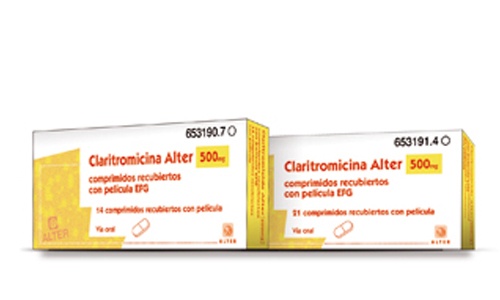
Claritromicina Alter 500 mg se presenta en forma de comprimidos recubiertos con película en envases con 14 ó 21 comprimidos.
Otras presentaciones: Claritromicina Alter 250 mg está disponible en envases con blísteres conteniendo 14 comprimidos
Titular de la autorización de comercialización y responsable de la fabricación
Laboratorios Alter, S.A.
C/ Mateo Inurria, 30
28036 Madrid
España
La última revisión de este prospecto: Abril 2021
La información detallada y actualizada de este medicamento está disponible en la página Web de la Agencia Española de Medicamentos y Productos Sanitarios (AEMPS) http://www.aemps.gob.es/
- País de registro
- Forma farmacéuticaCOMPRIMIDO, 500 mg claritromicina
- Código ATCJ01FA09
- Precio medio en farmacia12.24 EUR
- Principio activo
- Requiere recetaSí
- Fabricante
- ComposiciónCROSCARMELOSA SODICA (85,0 mg mg), POLISORBATO 80 (1,0 mg mg), ALMIDON DE TRIGO (90,0 mg mg)
- Esta información es de carácter general y no sustituye la consulta con un profesional sanitario.
- Alternativas a CLARITROMICINA ALTER 500 MG COMPRIMIDOS RECUBIERTOS CON PELICULA EFGForma farmacéutica: COMPRIMIDO, 500 mgPrincipio activo: ClaritromicinaFabricante: Accord Healthcare S.L.U.Requiere recetaForma farmacéutica: COMPRIMIDO, 500 mg claritromicinaPrincipio activo: ClaritromicinaFabricante: Almus Farmaceutica S.A.U.Requiere recetaForma farmacéutica: INYECTABLE PERFUSION, 500 MGPrincipio activo: ClaritromicinaFabricante: Altan Pharmaceuticals SaRequiere receta
Médicos online para CLARITROMICINA ALTER 500 MG COMPRIMIDOS RECUBIERTOS CON PELICULA EFG
Comenta la dosis, los posibles efectos secundarios, interacciones, contraindicaciones o la revisión de receta de CLARITROMICINA ALTER 500 MG COMPRIMIDOS RECUBIERTOS CON PELICULA EFG, sujeto a valoración médica y a la normativa local.









Preguntas frecuentes
CLARITROMICINA ALTER 500 MG COMPRIMIDOS RECUBIERTOS CON PELICULA EFG requiere receta en España. Puedes confirmarlo con un médico online según tu caso.
El principio activo de CLARITROMICINA ALTER 500 MG COMPRIMIDOS RECUBIERTOS CON PELICULA EFG es Claritromicina. Esta información ayuda a identificar medicamentos con la misma composición pero con diferentes nombres comerciales.
El precio medio en farmacia de CLARITROMICINA ALTER 500 MG COMPRIMIDOS RECUBIERTOS CON PELICULA EFG es de aproximadamente 12.24 EUR. Puede variar según el fabricante y la forma farmacéutica.
CLARITROMICINA ALTER 500 MG COMPRIMIDOS RECUBIERTOS CON PELICULA EFG es fabricado por Laboratorios Alter S.A.. La marca y el envase pueden variar según el distribuidor.
Los Médicos de familia, Psiquiatras, Dermatólogos, Cardiólogos, Endocrinólogos, Gastroenterólogos, Neumólogos, Nefrólogos, Reumatólogos, Hematólogos, Infectólogos, Alergólogos, Geriatras, Pediatras, Oncólogos pueden valorar la prescripción de CLARITROMICINA ALTER 500 MG COMPRIMIDOS RECUBIERTOS CON PELICULA EFG cuando esté clínicamente indicado. Puedes reservar una videoconsulta para comentar tu caso y las opciones de tratamiento.
La receta la emite un médico tras valorar tu estado de salud. En España, CLARITROMICINA ALTER 500 MG COMPRIMIDOS RECUBIERTOS CON PELICULA EFG se dispensa en las farmacias con esa receta médica. Una consulta online no garantiza su emisión: la decisión corresponde siempre al médico.
Para solicitar una valoración puedes usar Oladoctor:
Otros medicamentos con el mismo principio activo (Claritromicina) incluyen CLARITROMICINA ACCORD 500 MG COMPRIMIDOS RECUBIERTOS CON PELICULA EFG, CLARITROMICINA ALMUS 500 mg COMPRIMIDOS RECUBIERTOS CON PELICULA EFG, CLARITROMICINA ALTAN 500 mg LIOFILIZADO PARA SOLUCION PARA PERFUSION EFG. Pueden tener diferentes nombres comerciales o formulaciones, pero contienen el mismo componente terapéutico. Consulta siempre con un médico antes de cambiar o iniciar un nuevo medicamento.
