



CITALOPRAM 30 mg Comprimidos Recubiertos Con Película

Revisión de receta online
Un médico revisará tu caso y determinará si la prescripción es médicamente apropiada.

Habla con un médico sobre este medicamento
Comenta tus síntomas y las opciones de tratamiento en una consulta online.



Cómo usar CITALOPRAM NORMON 30 mg COMPRIMIDOS RECUBIERTOS CON PELICULA EFG
Contenido del prospecto
- Introducción
- Qué es Citalopram Normon y para qué se utiliza
- Qué necesita saber antes de empezar a tomar Citalopram Normon
- Cómo tomar Citalopram Normon
- Posibles efectos adversos
- Conservación de Citalopram Normon
- Contenido del envase e información adicional
Introducción
Prospecto: información para el paciente
Citalopram Normon 30 mg comprimidos recubiertos con película EFG
Citalopram (hidrobromuro)
Lea todo el prospecto detenidamente antes de empezar a tomar este medicamento, porque contiene información importante para usted.
- Conserve este prospecto, ya que puede tener que volver a leerlo.Si tiene alguna duda, consulte a su médico o farmacéutico.
- Este medicamento se le ha recetado solamente a usted, y no debe dárselo a otras personas aunque tengan los mismos síntomas que usted, ya que puede perjudicarles.
- Si experimenta efectos adversos, consulte a su médico o farmacéutico, incluso si se trata de efectos adversos que no aparecen en este prospecto. Ver sección 4.
Contenido del prospecto
- Qué es Citalopram Normon y para qué se utiliza
- Qué necesita saber antes de empezar a tomar Citalopram Normon
- Cómo tomar Citalopram Normon
- Posibles efectos adversos
- Conservación de Citalopram Normon
- Contenido del envase e información adicional
1. Qué es Citalopram Normon y para qué se utiliza
Citalopram es un medicamento antidepresivo que pertenece al grupo de medicamentos denominados “inhibidores selectivos de la recaptación de serotonina”.
Citalopram Normon está indicado en:
- Tratamiento de la depresión y prevención de recaídas.
- Tratamiento del trastorno de angustia con o sin agorafobia.
- Tratamiento del trastorno obsesivo compulsivo.

¿No estás seguro de si este medicamento es adecuado para ti?
Comenta tus síntomas y tratamiento con un médico online.
2. Qué necesita saber antes de empezar a tomar Citalopram Normon
No tome Citalopram Normon
- Si es alérgico a citalopram o a cualquiera de los demás componentes de este medicamento (incluidos en la sección 6).
- Si está siendo tratado con otros medicamentos antidepresivos del grupo de los inhibidores de la monoamino oxidasa (IMAOs) o si ha estado bajo dicho tratamiento en las dos últimas semanas.
- Si padece desde el nacimiento algún tipo de alteración del ritmo del corazón o ha sufrido alguna vez algún episodio de este tipo (esto se observa con el electrocardiograma, una prueba que sirve para evaluar como funciona el corazón).
- Si está tomando medicamentos porque padece alguna enfermedad que altera el ritmo del corazón.
- Si está tomando medicamentos que pueden llegar a afectar el ritmo del corazón.
Consulte también la sección “Uso de otros medicamentos” que se encuentra más abajo.
Advertencias y precauciones
- Si padece insuficiencia hepática o insuficiencia renal grave.
- Si ha tenido episodios maníacos.
- Si padece o tiene antecedentes de epilepsia. En caso de desarrollarse convulsiones o aumentar la frecuencia de los ataques se deberá interrumpir el tratamiento con citalopram.
- Si padece diabetes, ya que puede necesitar un ajuste de la dosis de insulina o de antidiabéticos orales.
- Si padece algún trastorno hemorrágico o está siendo tratado con medicamentos que afecten a la coagulación de la sangre, o si está embarazada (ver sección “Embarazo, lactancia y fertilidad”).
- Si padece o ha padecido algún problema de corazón o ha sufrido recientemente un infarto cardiaco.
- Si cuando está en reposo su corazón late despacio (esto se conoce como bradicardia) y/o cree que su organismo puede estar teniendo perdidas de sal por ejemplo porque ha tenido diarrea y vómitos intensos durante varios días o porque ha usado diuréticos (medicamentos para orinar).
- Si ha notado que los latidos de su corazón son rápidos o irregulares o ha sufrido desmayos o mareos al incorporarse desde la posición de sentado o tumbado. Esto podría indicar que tiene alguna alteración del ritmo del corazón.
- Pensamientos suicidas y empeoramiento de su depresión o trastorno de ansiedad. Si usted se encuentra deprimido y/o sufre un trastorno de ansiedad, puede en algunas ocasiones tener pensamientos de autolesión o de suicidio. Éstos pueden ir aumentado al tomar antidepresivos por primera vez, puesto que todos estos medicamentos requieren un tiempo para empezar a hacer efecto, generalmente alrededor de unas dos semanas, aunque en algunos casos podría ser mayor el tiempo.
Usted sería más propenso a tener este tipo de pensamientos:
- Si usted previamente ha tenido pensamientos de autolesión o de suicidio.
- Si usted es un adulto joven. Información de ensayos clínicos ha demostrado un aumento del riesgo de conductas suicidas en adultos jóvenes (menores de 25 años) con enfermedades psiquiátricas que fueron tratados con un antidepresivo.
Si en cualquier momento usted tiene pensamientos de autolesión o de suicidio, contacte a su médico o diríjase directamente a un hospital.
Puede ser de ayuda para usted decirle a un pariente o un amigo cercano que usted está deprimido o que tiene un trastorno de ansiedad y pedirle que lea este prospecto. Puede preguntarles si piensan que su depresión o trastorno de ansiedad ha empeorado, o si están preocupados por cambios en su comportamiento.
Se ha observado un aumento del riesgo de fracturas óseas en pacientes tratados con este tipo de medicamentos.
Algunos medicamentos del grupo al que pertenece Citalopram Normon (llamados ISRS/IRSN) pueden causar síntomas de disfunción sexual (ver sección 4). En algunos casos, estos síntomas persisten después de suspender el tratamiento.
Cuando se suspende el tratamiento es frecuente que aparezcan síntomas de retirada, particularmente si la suspensión del tratamiento se realiza de forma brusca (ver sección “posibles efectos adversos”).
Niños y adolescentes
Citalopram Normon no deberá utilizarse normalmente en el tratamiento de niños y adolescentes menores de 18 años. A la vez, debe saber que en pacientes menores de 18 años existe un mayor riesgo de efectos adversos como intentos de suicidio, ideas de suicidio y hostilidad (predominantemente agresión, comportamiento de confrontación e irritación) cuando ingieren esta clase de medicamentos. Pese a ello, el doctor que le corresponda puede prescribir Citalopram Normon a pacientes menores de 18 años cuando decida que es lo más conveniente para el paciente. Si el médico que le corresponda ha prescrito Citalopram Normon a un paciente menor de 18 años y desea discutir esta decisión, por favor, vuelva a su médico. Debe informar a su médico si alguno de los síntomas indicados anteriormente progresa o experimenta complicaciones cuando pacientes menores de 18 años están tomando Citalopram Normon. A la vez, los efectos a largo plazo por lo que a la seguridad se refiere y relativos al crecimiento, la madurez y el desarrollo cognitivo y conductual de Citalopram Normon en este grupo de edad todavía no han quedado demostrados.
Otros medicamentos y Citalopram Normon
Comunique a su médico o farmacéutico que está utilizando, ha utilizado recientemente o podría tener que utilizar cualquier otro medicamento.
Está contraindicada la administración simultánea de citalopram con medicamentos inhibidores de la monoamino oxidasa (IMAOs) no selectivos o selectivos B (como selegilina, medicamento antiparkinsoniano) y durante las dos semanas posteriores a la finalización del tratamiento. No se recomienda la administración simultánea de citalopram con medicamentos inhibidores de la monoamino oxidasa (IMAOs) selectivos A (como moclobemida, medicamento antidepresivo). La administración simultánea de citalopram con medicamentos IMAOs conlleva un riesgo de aparición de síndrome serotoninérgico (Ver apartado “Posibles efectos adversos”).
Se deberán tomar precauciones si se administra citalopram junto con alguno de los siguientes medicamentos:
- Carbamazepina (medicamento antiepiléptico): puede producirse un aumento de los niveles de carbamazepina en sangre, pudiendo ser necesario reducir la dosis de carbamazepina.
- Litio (medicamento para el tratamiento del trastorno maníaco depresivo): aumenta el riesgo de aparición de síndrome serotoninérgico.
- Anticoagulantes orales, ácido acetilsalicílico y antiinflamatorios no esteroideos y otros medicamentos que afecten a la coagulación de la sangre: puede aumentar el riesgo de hemorragias.
- Imipramina (medicamento antidepresivo): se produce un aumento de los niveles del metabolito de imipramina en sangre.
- Cimetidina, lansoprazol y omeprazol (utilizados para tratar úlceras de estómago), fluconazol (utilizado para tratar infecciones por hongos), fluvoxamina (antidepresivo) y ticlopidina (utilizada para reducir el riesgo de accidentes cerebrovasculares). Pueden aumentar los niveles de citalopram en sangre.
- Metoprolol (medicamento antihipertensivo, antianginoso y antiarrítmico).
- Preparaciones que contengan la hierba de San Juan: pueden ser más frecuentes los efectos adversos.
No tome Citalopram Normon si está tomando medicamentos porque usted ya padece alguna enfermedad que altera el ritmo del corazón o si está tomando medicamentos que por ellos mismos pudieran llegar a afectar el ritmo del corazón. Por ejemplo antiarrítmicos clase IA y III, antipsicóticos (ej. derivados de la fenitiazina, pimozide, haloperidol), antidepresivos tricíclicos, determinados agentes antimicrobianos (esparfloxaciono, moxifloxacino, eritromicina IV, pentamidina, medicamentos contra la malaria particularmente halofantrina), ciertos antihistamínicos (astemizol, mizolastina). Si tiene dudas sobre este tema consulte a su médico.
Toma de Citalopram Normon con alimentos, bebidas y alcohol
Es aconsejable evitar el consumo de alcohol mientras esté tomando este medicamento.
Embarazo, lactancia y fertilidad
Si está embarazada o en periodo de lactancia, cree que podría estar embarazada o tiene intención de quedarse embarazada, consulte a su médico o farmacéutico antes de utilizar este medicamento.
Asegúrese de que su matrona y/o médico sepa que usted está tomando Citalopram Normon. Cuando se toman durante el embarazo, particularmente en los últimos 3 meses del embarazo, los medicamentos como Citalopram Normon podrían aumentar el riesgo de una enfermedad grave en los bebés, llamada hipertensión pulmonar persistente del recién nacido (HPPN), lo que hace que el bebé respire más rápido y se ponga de un color azulado. Estos síntomas normalmente comienzan durante las primeras 24 horas después de que nazca el bebé. Si esto le sucediera a su bebé contacte inmediatamente con su matrona y/o su médico.
Si toma Citalopram NORMON en la etapa final del embarazo puede producirse un mayor riesgo de sangrado vaginal abundante poco después del parto, especialmente si tiene antecedentes de alteraciones hemorrágicas. Su médico o matrona deben saber que usted está tomando Citalopram NORMON para poderle aconsejar.
Estudios en animales han demostrado que Citalopram reduce la calidad del esperma. Teóricamente, esto podría afectar la fertilidad, pero el impacto sobre la fertilidad humana no se ha observado hasta ahora.
Conducción y uso de máquinas
Durante el tratamiento con citalopram puede que se sienta somnoliento o mareado. No conduzca ni maneja herramientas o máquinas hasta que sepa cómo le afecta el tratamiento con citalopram.
Citalopram Normon contiene lactosa y sodio
Este medicamento contiene lactosa. Si su médico le ha indicado que padece una intolerancia a ciertos azúcares, consulte con él antes de tomar este medicamento.
Este medicamento contiene menos de 1 mmol de sodio (23 mg) por comprimido; esto es, esencialmente “exento de sodio”.
3. Cómo tomar Citalopram Normon
Siga exactamente las instrucciones de administración de este medicamento indicadas por su médico o farmacéutico. En caso de duda, consulte de nuevo a su médico o farmacéutico. Recuerde tomar su medicamento.
Su médico le indicará la duración de su tratamiento con Citalopram Normon. No suspenda el tratamiento antes ni de forma brusca, ya que podría empeorar su enfermedad. Debe continuar tomando su medicamento incluso aunque no note mejoría, ya que pueden ser necesarias varias semanas para que el medicamento comience a actuar.
Citalopram Normon son comprimidos para administración por vía oral. Los comprimidos se pueden tomar en cualquier momento del día independientemente de las comidas y en una sola toma. Deben ingerirse con una cantidad suficiente de líquido (un vaso de agua) y sin masticar.
Qué cantidad debe tomar
Adultos:
Depresión:la dosis habitual es de 20 mg al día. Si así lo estima necesario, su médico podrá aumentarle esta dosis hasta alcanzar un máximo de 40 mg diarios.
Trastorno de la angustia (pánico):la dosis inicial es de 10 mg al día durante la primera semana antes de aumentarla a los 20-30 mg diarios. Si así lo estima necesario, su médico podrá subirle esta dosis hasta alcanzar un máximo de 40 mg diarios.
Trastorno obsesivo compulsivo (TOC):la dosis inicial es de 20 mg al día. Si así lo estima necesario, su médico podrá subirle esta dosis hasta alcanzar un máximo de 40 mg diarios.
Pacientes de edad avanzada (mayores de 65 años):en los pacientes de edad avanzada se debe iniciar el tratamiento con la mitad de la dosis recomendada por ejemplo 10-20 mg al día. En términos generales los pacientes de edad avanzada no deben tomar más de 20 mg al día.
Uso en niños y adolescentes
No se han establecido la seguridad y eficacia de Citalopram Normon en niños y adolescentes menores de 18 años, por lo que no se recomienda su uso en este grupo de población.
Pacientes con riesgos especiales
Los pacientes que tengan enfermedades del hígado no deben tomar más de 20 mg al día. No se recomienda el uso de citalopram en pacientes con insuficiencia renal grave.
Si estima que la acción de Citalopram Normon es demasiado fuerte o débil, comuníqueselo a su médico o farmacéutico.
Si toma más Citalopram Normon del que debe
En caso de sobredosis o ingestión accidental, consulte inmediatamente a su médico o farmacéutico o llame al Servicio de Información Toxicología, teléfono: 91 562 04 20, indicando el medicamento y la cantidad ingerida.
Los síntomas más frecuentes en caso de sobredosis son: náuseas, vómitos, sudoración, somnolencia, coloración azul de la piel, temblores, convulsiones, pérdida de conocimiento y palpitaciones.
Si olvidó tomar Citalopram Normon
No tome una dosis doble para compensar las dosis olvidadas. Tome sus dosis tan pronto como lo recuerde y, al día siguiente, tómela a la hora que corresponda.
Si interrumpe el tratamiento con Citalopram Normon
Si se interrumpe bruscamente el tratamiento con Citalopram Normon se pueden producir algunos trastornos debidos a la retirada tales como mareos, naúseas, sudoración, trastornos de los sentidos, alteraciones del sueño, dolor de cabeza, agitación o ansiedad y sensación de hormigueo en las manos o los pies. El riesgo de reacciones de retirada depende de varios factores entre los que se encuentran la duración del tratamiento, la dosis utilizada y el ritmo de la reducción de dosis. Generalmente estos síntomas son leves o moderados, sin embargo en algunos pacientes pueden ser graves. Normalmente estos síntomas son autolimitados y se resuelven en dos semanas, aunque en algunos pacientes su duración se puede prolongar.
Su médico le aconsejará la forma de dejar gradualmente el tratamiento con Citalopram Normon.
Si tiene cualquier otra duda sobre el uso de este medicamento, pregunte a su médico o farmacéutico.

¿Has empezado a tomar el medicamento y tienes preguntas?
Comenta tus síntomas y tratamiento con un médico online.
4. Posibles efectos adversos
Al igual que todos los medicamentos Citalopram Normon puede producir efectos adversos, aunque no todas las personas los sufran.
Los efectos adversos son generalmente de intensidad leve o moderada. Serán evidentes durante la primera e incluso las dos primeras semanas de tratamiento, y posteriormente desaparecen al mejorar la enfermedad.
Si usted nota alguno de los siguientes síntomas, deje de tomar Citalopram Normon y acuda a su médico inmediatamente:
- Latidos del corazón rápidos e irregulares o sensación de desmayo puesto que podrían ser síntomas de un problema grave del corazón conocido como torsade de pointes.
Se han descrito los siguientes efectos adversos:
Trastornos neuropsíquicos:nerviosismo, somnolencia, debilidad, dolores de cabeza, vértigos, trastornos del sueño, pérdidas de la memoria, tendencia suicida y síndrome serotoninérgico caracterizado por síntomas como agitación, confusión, sudoración aumentada, alucinaciones, aumento en la respuesta de los reflejos, movimientos involuntarios, escalofríos, taquicardia y temblor, agitación psicomotora/acatisia (caracterizada por intranquilidad y necesidad de estar en movimiento, frecuentemente acompañadas de dificultad para sentarse o permanecer en reposo. Su aparición es más probable durante las primeras semanas de tratamiento).
Trastornos gastrointestinales: náuseas, vómitos, diarrea, estreñimiento, sequedad de boca.
Trastornos cutáneos:erupción, picores, sudoración aumentada.
Trastornos visuales:trastornos visuales.
Trastornos metabólicos: pérdida o aumento de peso.
Trastornos cardiovasculares: taquicardia, mareo al levantarse debido a una bajada de la presión arterial, enlentecimiento del ritmo del corazón en algunos pacientes.
Trastornos del sistema reproductor y mama:alteraciones del deseo sexual.
Trastornos renales y urinarios: alteraciones de la micción.
Raramente se han observado casos de hemorragias en la piel y mucosas como derrames cutáneos, hemorragias vaginales y sangrado gastrointestinal.
Sangrado vaginal abundante poco después del parto (hemorragia posparto), ver «Embarazo, lactancia y fertilidad» en la sección 2 para más información. (Frecuencia no conocida).
Si experimenta efectos adversos, consulte a su médico o farmacéutico, incluso si se trata de efectos adversos que no aparecen en este prospecto.
5. Conservación de Citalopram Normon
Mantener este medicamento fuera de la vista y del alcance de los niños.
No requiere condiciones especiales de conservación. Conservar en el embalaje original.
No utilice este medicamento después de la fecha de caducidad que aparece en el envase después de CAD. La fecha de caducidad es el último día del mes que se indica.
Los medicamentos no se deben tirar por los desagües ni a la basura. Deposite los envases y los medicamentos que no necesita en el Punto Sigre de la farmacia. En caso de duda pregunte a su farmacéutico cómo deshacerse de los envases y de los medicamentos que no necesita. De esta forma, ayudará a proteger el medio ambiente.
6. Contenido del envase e información adicional
Composición de Citalopram Normon
El principio activo es citalopram (hidrobromuro). Cada comprimido recubierto con película contiene 30 mg de citalopram.
Los demás componentes son: lactosa monohidrato, celulosa microcristalina, croscarmelosa sódica, estearato de magnesio, dióxido de titanio (E-171), hipromelosa, talco y macrogol 6000.
Aspecto del producto y contenido del envase
Citalopram Normon 30 mg son comprimidos recubiertos con película, Los comprimidos recubiertos son de color blanco o casi blanco, alargados, biconvexos y ranurados por una cara. Se presenta en envases de 28 o 56 comprimidos recubiertos con película en embalaje alveolar (blíster) de PVC/Aluminio.
Puede que solamente estén comercializados algunos tamaños de envases.
Titular de la autorización de comercialización y responsable de la fabricación
LABORATORIOS NORMON, S.A.
Ronda de Valdecarrizo, 6 - 28760 Tres Cantos – Madrid (ESPAÑA)
Fecha de la última revisión de este prospecto:Agosto 2021
“La información detallada de este medicamento está disponible en la página Web de la Agencia Española de Medicamentos y Productos Sanitarios (AEMPS) http://www.aemps.gob.es”
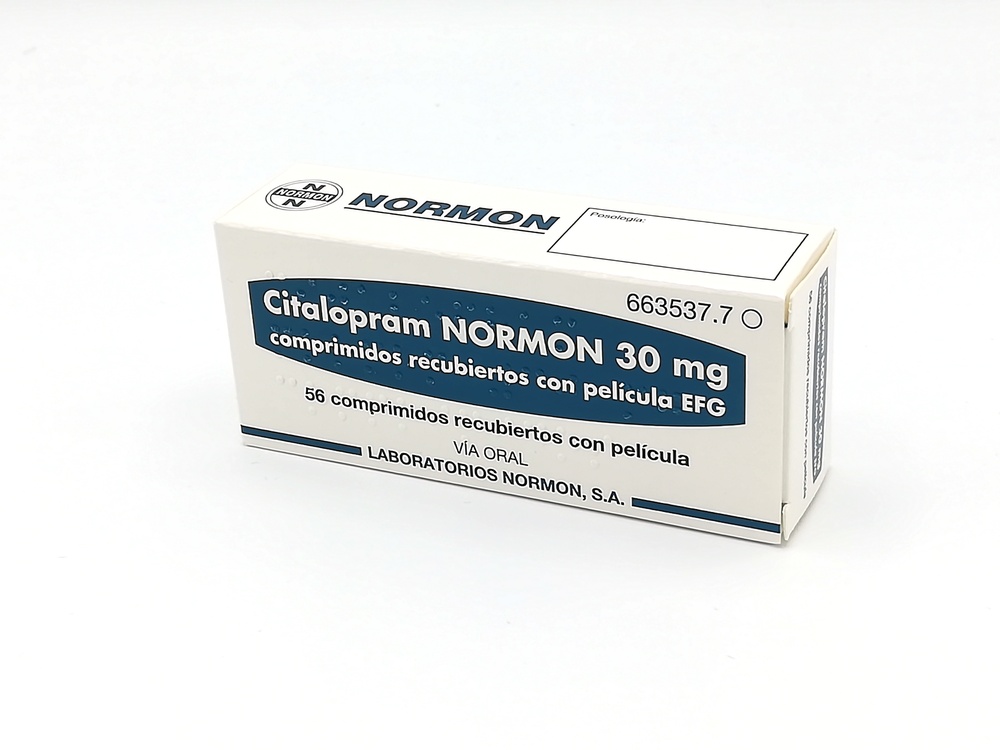
- País de registro
- Forma farmacéuticaCOMPRIMIDO, 30 MG
- Código ATCN06AB04
- Precio medio en farmacia7.68 EUR
- Principio activo
- Requiere recetaSí
- Fabricante
- ComposiciónCROSCARMELOSA SODICA (6 mg mg), LACTOSA HIDRATADA (96 mg mg)
- Esta información es de carácter general y no sustituye la consulta con un profesional sanitario.
- Alternativas a CITALOPRAM NORMON 30 mg COMPRIMIDOS RECUBIERTOS CON PELICULA EFGForma farmacéutica: COMPRIMIDO, 20 MGPrincipio activo: citalopramFabricante: Laboratorios Alter S.A.Requiere recetaForma farmacéutica: COMPRIMIDO, 30 MGPrincipio activo: citalopramFabricante: Laboratorios Alter S.A.Requiere recetaForma farmacéutica: COMPRIMIDO, 10 MGPrincipio activo: citalopramFabricante: Aristo Pharma GmbhRequiere receta
Médicos online para CITALOPRAM NORMON 30 mg COMPRIMIDOS RECUBIERTOS CON PELICULA EFG
Comenta la dosis, los posibles efectos secundarios, interacciones, contraindicaciones o la revisión de receta de CITALOPRAM NORMON 30 mg COMPRIMIDOS RECUBIERTOS CON PELICULA EFG, sujeto a valoración médica y a la normativa local.







Obtén una receta de CITALOPRAM NORMON 30 mg COMPRIMIDOS RECUBIERTOS CON PELICULA EFG online
Rellena un formulario de 2 minutos
Cuéntanos tus síntomas, historial y el medicamento que necesitas.
Elige un médico o nosotros te asignamos uno
Escoge un especialista o te conectamos con el próximo médico disponible.
El médico revisa tu caso
Normalmente en 30 minutos. Puede hacerte preguntas adicionales por chat.
Recógela en cualquier farmacia
Receta electrónica enviada a tu correo, válida en toda España.
Preguntas frecuentes
CITALOPRAM NORMON 30 mg COMPRIMIDOS RECUBIERTOS CON PELICULA EFG requiere receta en España. Puedes confirmarlo con un médico online según tu caso.
El principio activo de CITALOPRAM NORMON 30 mg COMPRIMIDOS RECUBIERTOS CON PELICULA EFG es citalopram. Esta información ayuda a identificar medicamentos con la misma composición pero con diferentes nombres comerciales.
El precio medio en farmacia de CITALOPRAM NORMON 30 mg COMPRIMIDOS RECUBIERTOS CON PELICULA EFG es de aproximadamente 7.68 EUR. Puede variar según el fabricante y la forma farmacéutica.
CITALOPRAM NORMON 30 mg COMPRIMIDOS RECUBIERTOS CON PELICULA EFG es fabricado por Laboratorios Normon S.A.. La marca y el envase pueden variar según el distribuidor.
Los Médicos de familia, Psiquiatras, Dermatólogos, Cardiólogos, Endocrinólogos, Gastroenterólogos, Neumólogos, Nefrólogos, Reumatólogos, Hematólogos, Infectólogos, Alergólogos, Geriatras, Pediatras, Oncólogos pueden valorar la prescripción de CITALOPRAM NORMON 30 mg COMPRIMIDOS RECUBIERTOS CON PELICULA EFG cuando esté clínicamente indicado. Puedes reservar una videoconsulta para comentar tu caso y las opciones de tratamiento.
España cuenta con una infraestructura sanitaria bien desarrollada en ciudades principales como Madrid, Barcelona, Valencia y Sevilla. Las farmacias están ampliamente disponibles y operan bajo estrictas regulaciones, garantizando el acceso a medicamentos con receta.
Puedes comprar CITALOPRAM NORMON 30 mg COMPRIMIDOS RECUBIERTOS CON PELICULA EFG en Madrid, Barcelona, Sevilla o Valencia en cualquier farmacia local con una receta válida.
Para obtener una receta, puedes utilizar Oladoctor:
Otros medicamentos con el mismo principio activo (citalopram) incluyen CITALOPRAM ALTER 20 mg COMPRIMIDOS RECUBIERTOS CON PELICULA EFG, CITALOPRAM ALTER 30 mg COMPRIMIDOS RECUBIERTOS CON PELICULA EFG, CITALOPRAM ARISTOGEN 10 MG COMPRIMIDOS RECUBIERTOS CON PELICULA EFG. Pueden tener diferentes nombres comerciales o formulaciones, pero contienen el mismo componente terapéutico. Consulta siempre con un médico antes de cambiar o iniciar un nuevo medicamento.
