



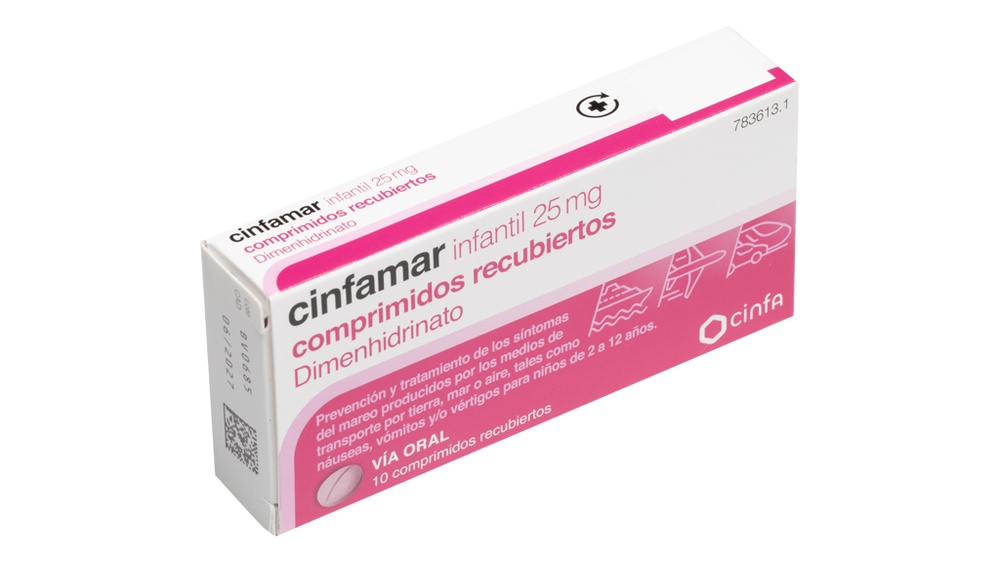
CINFAMAR INFANTIL 25 mg Comprimidos recubiertos

Revisión de receta online
Un médico revisará tu caso y determinará si la prescripción es médicamente apropiada.

Habla con un médico sobre este medicamento
Comenta tus síntomas y las opciones de tratamiento en una consulta online.



Cómo usar CINFAMAR INFANTIL 25 mg COMPRIMIDOS RECUBIERTOS
Contenido del prospecto
- Introducción
- Qué es cinfamar infantil y para qué se utiliza
- Qué necesita saber antes de empezar a tomar cinfamar infantil
- Cómo tomar cinfamar infantil
- Posibles efectos adversos
- Conservación de cinfamar infantil
- Contenido del envase e información adicional
Introducción
Prospecto: información para el usuario
cinfamar infantil 25 mg comprimidos recubiertos
dimenhidrinato
Lea todo el prospecto detenidamente antes de empezar a tomar este medicamento, porque contiene información importante para usted.
Siga exactamente las instrucciones de administración del medicamento contenidas en este prospecto o las indicadas por su médico o farmacéutico.
- Conserve este prospecto, ya que puede tener que volver a leerlo.
- Si necesita consejo o más información, consulte a su farmacéutico.
- Si experimenta efectos adversos, consulte a su médico o farmacéutico, incluso si se trata de efectos adversos que no aparecen en este prospecto. Ver sección 4.
- Debe consultar a un médico si empeora o si no mejora después de 7 días.
Contenido del prospecto
- Qué es cinfamar infantil y para qué se utiliza.
- Qué necesita saber antes de empezar a tomar cinfamar infantil.
- Cómo tomar cinfamar infantil.
- Posibles efectos adversos.
- Conservación de cinfamar infantil.
- Contenido del envase e información adicional.
1. Qué es cinfamar infantil y para qué se utiliza
El dimenhidrinato, es el principio activo de este medicamento y actúa contra el mareo producido por los medios de locomoción.
Está indicado en la prevención y tratamiento de los síntomas del mareo producido por los medios de transporte por tierra, mar o aire, tales como náuseas, vómitos y/o vértigos para niños de 2 a 12 años.

¿No estás seguro de si este medicamento es adecuado para ti?
Comenta tus síntomas y tratamiento con un médico online.
2. Qué necesita saber antes de empezar a tomar cinfamar infantil
No tome cinfamar infantil
- Si es alérgico al dimenhidrinato, a la difenhidramina o a alguno de los demás componentes de este medicamento (incluidos en la sección 6).
- Si padece porfiria (trastorno raro, normalmente hereditario, en el que se elimina gran cantidad de porfirina en heces y orina).
- Si tiene crisis asmáticas.
Advertencias y precauciones
Consulte a su médico o farmacéutico antes de empezar a tomar cinfamar infantil.
En particular, pregúntele si padece o ha padecido anteriormente cualquiera de las siguientes circunstancias:
- Si padece asma, enfermedades respiratorias graves (enfermedad pulmonar obstructiva crónica, enfisema, bronquitis crónica), ya que se puede producir espesamiento de las secreciones y alterar la expectoración.
- Si padece una enfermedad en la que se produce un aumento anormal de la actividad de la glándula tiroides (hipertiroidismo), aumento de la presión intraocular (glaucoma), presenta agrandamiento de la próstata (hipertrofia prostática), hipertensión o alguna enfermedad que provoque obstrucción del aparato urinario o del tracto gastrointestinal.
- Si padece de crisis en las que aparecen movimientos convulsivos, con o sin pérdida de conciencia (epilepsia).
- Si es mayor de 65 años puede producirse sequedad de boca, retención de orina, náuseas, sedación, confusión y bajada de la tensión (hipotensión).
- Si está utilizando algún medicamento que produce toxicidad en el oído, ya que pueden quedar enmascarados síntomas de esos efectos tóxicos, como pitidos en los oídos, mareos o vértigos.
- Si padece alguna enfermedad o trastorno del hígado o del riñón, úlcera de estómago o de duodeno, o inflamación del estómago (gastritis) deberá consultar a su médico antes de tomar este medicamento.
- Deberá consultar a su médico antes de tomar este medicamento si padece o ha padecido enfermedades o trastornos del corazón (arritmia cardiaca, isquemia miocárdica, etc.).
- Si sospecha que pueda tener síntomas de apendicitis como náuseas, vómitos o calambres abdominales, se recomienda acudir a un médico para que le pueda descartar la presencia o no de apendicitis, ya que el dimenhidrinato puede dificultar el diagnóstico de esta enfermedad.
- Se recomienda evitar la exposición a temperaturas muy altas y seguir unas medidas higiénico-dietéticas adecuadas, como una adecuada aireación e hidratación.
- Evite exponerse al sol (aun estando nublado) y a lámparas de rayos ultravioleta (rayos U.V.A.) mientras tome este medicamento.
Niños y adolescentes
No debe administrarse este medicamento a niños menores de 2 años.
Toma de cinfamar infantil con otros medicamentos
Informe a su médico o farmacéutico si está tomando, ha tomado recientemente o pudiera tener que tomar cualquier otro medicamento.
En particular, debe informarle si está utilizando algunos de los siguientes medicamentos; puede ser necesario modificar la dosis de cinfamar infantil o no tomarlo:
- Anestésicos y otras sustancias con acción depresora del Sistema Nervioso Central.
- Antibióticos del grupo de los aminoglucósidos.
- Antidepresivos, como inhibidores de la monoamino-oxidasa (IMAO).
- Antiparkinsonianos.
- Neurolépticos (utilizados para calmar la agitación y la hiperactividad neuromuscular).
- Medicamentos ototóxicos (que pueden afectar al oído) (ver apartado Advertencias y precauciones).
- Medicamentos que puedan producir fotosensibilidad (reacciones en la piel debidas a la sensibilidad a la luz solar).
Interferencias con pruebas de diagnóstico
Si le van a realizar alguna prueba de alergia, incluidas las pruebas cutáneas (de la piel), se recomienda suspender el tratamiento 72 horas antes de comenzar la prueba para no alterar los resultados de la misma.
Toma de cinfamar infantil con alimentos, bebidas y alcohol
No se recomienda el consumo de alcohol durante el tiempo que esté tomando este medicamento.
Se recomienda tomar este medicamento con alimentos o con leche.
Embarazo, lactancia y fertilidad
Si está embarazada o en periodo de lactancia, cree que podría estar embarazada o tiene intención de quedarse embarazada, consulte a su médico o farmacéutico antes de utilizar este medicamento.
Este medicamento está destinado exclusivamente para administrarse en niños.
El consumo de medicamentos durante el embarazo puede ser peligroso para el embrión o el feto y debe ser vigilado por su médico.
Las mujeres en período de lactancia no deben tomar este medicamento sin antes consultar al médico o farmacéutico, debido a que este medicamento pasa a la leche materna.
Conducción y uso de máquinas
No conduzca ni maneje maquinaria peligrosa ya que este medicamento produce somnolencia o disminución de la capacidad de reacción a las dosis recomendadas.
3. Cómo tomar cinfamar infantil
Siga exactamente las instrucciones de administración del medicamento contenidas en este prospecto o las indicadas por su médico o farmacéutico. En caso de duda, pregunte a su médico o farmacéutico.
Las dosis recomendadas son:
Niños de 7 a 12 años: tomar 1 o 2 comprimidos (que corresponden a 25 o 50 mg de dimenhidrinato). Si fuera necesario, repetir la dosis cada 6 u 8 horas. No tomar más de 6 comprimidos (150 mg de dimenhidrinato) al día y siempre repartidos en varias tomas.
Niños de 2 a 6 años: tomar medio comprimido o 1 comprimido (que corresponden a 12,5 o 25 mg de dimenhidrinato). Repetir la dosis cada 6 u 8 horas, si fuera necesario. No administrar en ningún caso más de 3 comprimidos (75 mg de dimenhidrinato) al día y siempre repartidos en varias tomas.
Niños menores de 2 años: no debe utilizarse en este grupo de edad.
Pacientes con enfermedades del hígado: deberán consultar al médico antes de tomar este medicamento, ya que puede ser necesario reducir la dosis.
cinfamar infantil se toma por vía oral.
El comprimido se puede partir en dosis iguales.
Se recomienda realizar la primera toma al menos media hora antes de iniciar el viaje (preferiblemente 1-2 horas antes), y en caso de no haberlo tomado con anterioridad la primera toma se realizará cuando aparezcan los síntomas. Si el mareo persiste, se dejará pasar al menos 6 horas entre una toma y la siguiente.
Los comprimidos de cinfamar infantil se deben tomar sin masticar, acompañados de una cantidad suficiente de líquido. Se recomienda ingerir los comprimidos con alimentos, agua o leche para minimizar la irritación gástrica.
Si los síntomas empeoran, o si persisten más de 7 días, debe consultar al médico.
Si toma más cinfamar infantil del que debe
En caso de sobredosis o ingestión accidental consulte inmediatamente a su médico o farmacéutico o llame al Servicio de Información Toxicológica, teléfono 91 562 04 20, indicando el medicamento y la cantidad ingerida.
.
Los síntomas por sobredosis incluyen principalmente: pupilas dilatadas, cara enrojecida, excitación, alucinaciones, confusión, irritación del estómago e intestino con náuseas, vómitos y diarreas, alteraciones en el movimiento, convulsiones, estado profundo de pérdida de conciencia (coma), disminución brusca de las funciones respiratorias y del corazón (colapso cardiorrespiratorio) y muerte.
Los síntomas pueden tardar en aparecer más de 2 horas desde la sobredosis.
Si tiene cualquier otra duda sobre el uso de este medicamento, pregunte a su médico o farmacéutico.

¿Has empezado a tomar el medicamento y tienes preguntas?
Comenta tus síntomas y tratamiento con un médico online.
4. Posibles efectos adversos
Al igual que todos los medicamentos, este medicamento puede producir efectos adversos, aunque no todas las personas los sufran.
Los efectos adversos suelen ser leves y transitorios, sobre todo al principio del tratamiento.
Durante el periodo de utilización del dimenhidrinato se han observado las siguientes reacciones adversas cuya frecuencia no se ha podido establecer con exactitud:
- Náuseas, vómitos, estreñimiento, diarrea, dolor de estómago.
- Falta de apetito y sequedad de boca.
- Sueño y sedación (adormecimiento).
- Dolor de cabeza, vértigo y mareo.
- Aumento de viscosidad del moco en los bronquios, dificultando la respiración.
- Retención de orina e impotencia sexual.
- Glaucoma (aumento de la presión intraocular del ojo).
- Dilatación de las pupilas, visión borrosa o visión doble.
- Reacciones alérgicas en la piel y sensibilidad a la luz solar, tras la exposición intensa, pudiendo aparecer urticaria, picor y enrojecimiento de la piel.
- Disminución en la sangre del número glóbulos rojos, glóbulos blancos, leucocitos y plaquetas.
- Porfiria (trastorno raro, normalmente hereditario, en el que se elimina gran cantidad de porfirina en heces y orina).
- Hipertensión o hipotensión (aumento o disminución de la presión arterial).
- Taquicardia, palpitaciones y/o arritmias cardiacas.
- Puede producirse una hiperexcitabilidad, sobre todo en niños, con síntomas como insomnio, nerviosismo, confusión, temblor, irritabilidad, euforia, delirio, palpitaciones e incluso convulsiones.
Comunicación de efectos adversos
Si experimenta cualquier tipo de efecto adverso, consulte a su médico o farmacéutico, incluso si se trata de posibles efectos adversos que no aparecen en este prospecto. También puede comunicarlos directamente a través del Sistema Español de Farmacovigilancia de Medicamentos de Uso Humano https://www.notificaram.es. Mediante la comunicación de efectos adversos usted puede contribuir a proporcionar más información sobre la seguridad de este medicamento.
5. Conservación de cinfamar infantil
Mantener este medicamento fuera de la vista y del alcance de los niños.
Este medicamento no requiere condiciones especiales de conservación.
No utilice este medicamento después de la fecha de caducidad que aparece en el envase después de CAD. La fecha de caducidad es el último día del mes que se indica.
Los medicamentos no se deben tirar por los desagües ni a la basura. Deposite los envases y los medicamentos que no necesita en el Punto SIGRE de la farmacia. En caso de duda, pregunte a su farmacéutico cómo deshacerse de los envases y de los medicamentos que no necesita. De esta forma, ayudará a proteger el medio ambiente.
6. Contenido del envase e información adicional
Composición de cinfamar infantil
- El principio activo es dimenhidrinato. Cada comprimido contiene 25 miligramos de dimenhidrinato.
- Los demás componentes son: hidrógeno fosfato de calcio dihidrato, almidón de maíz, sílice coloidal anhidra, celulosa microcristalina, povidona, talco, estearato de magnesio, Opadry OY-1141 (hipromelosa, dióxido de titanio, eritrosina, indigotina, óxido-hidróxido de hierro, macrogol 400), macrogol 6000.
Aspecto del producto y contenido del envase
cinfamar infantil son comprimidos recubiertos de color rosa, cilíndricos, biconvexos y ranurados en una de las caras.
Se presenta en envases que contienen 4 o 10 comprimidos recubiertos.
Titular de la autorización de comercialización y responsable de la fabricación:
Laboratorios Cinfa, S.A.
Carretera Olaz-Chipi, 10. Polígono Industrial Areta
31620 Huarte (Navarra) - España.
Fecha de la última revisión de este prospecto:enero 2021
La información detallada y actualizada de este medicamento está disponible en la página web de la Agencia Española de Medicamentos y Productos Sanitarios (AEMPS) www.aemps.gob.es/
- País de registro
- Forma farmacéuticaCOMPRIMIDO, 25 mg
- Código ATCR06AA02
- Principio activo
- Requiere recetaNo
- Fabricante
- Esta información es de carácter general y no sustituye la consulta con un profesional sanitario.
- Alternativas a CINFAMAR INFANTIL 25 mg COMPRIMIDOS RECUBIERTOSForma farmacéutica: CHICLE, 20 mg dimenhidrinatoPrincipio activo: diphenhydramineFabricante: Uriach Consumer Healthcare S.L.No requiere recetaForma farmacéutica: COMPRIMIDO, 50 mgPrincipio activo: diphenhydramineFabricante: Uriach Consumer Healthcare S.L.No requiere recetaForma farmacéutica: SOLUCIÓN/SUSPENSIÓN ORAL, 4 mg dimenhidrinato/mlPrincipio activo: diphenhydramineFabricante: Uriach Consumer Healthcare S.L.No requiere receta
Médicos online para CINFAMAR INFANTIL 25 mg COMPRIMIDOS RECUBIERTOS
Comenta la dosis, los posibles efectos secundarios, interacciones, contraindicaciones o la revisión de receta de CINFAMAR INFANTIL 25 mg COMPRIMIDOS RECUBIERTOS, sujeto a valoración médica y a la normativa local.









Obtén una receta de CINFAMAR INFANTIL 25 mg COMPRIMIDOS RECUBIERTOS online
Rellena un formulario de 2 minutos
Cuéntanos tus síntomas, historial y el medicamento que necesitas.
Elige un médico o nosotros te asignamos uno
Escoge un especialista o te conectamos con el próximo médico disponible.
El médico revisa tu caso
Normalmente en 30 minutos. Puede hacerte preguntas adicionales por chat.
Recógela en cualquier farmacia
Receta electrónica enviada a tu correo, válida en toda España.
Preguntas frecuentes
CINFAMAR INFANTIL 25 mg COMPRIMIDOS RECUBIERTOS no requiere receta en España. Puedes confirmarlo con un médico online según tu caso.
El principio activo de CINFAMAR INFANTIL 25 mg COMPRIMIDOS RECUBIERTOS es diphenhydramine. Esta información ayuda a identificar medicamentos con la misma composición pero con diferentes nombres comerciales.
CINFAMAR INFANTIL 25 mg COMPRIMIDOS RECUBIERTOS es fabricado por Laboratorios Cinfa S.A.. La marca y el envase pueden variar según el distribuidor.
Los Médicos de familia, Psiquiatras, Dermatólogos, Cardiólogos, Endocrinólogos, Gastroenterólogos, Neumólogos, Nefrólogos, Reumatólogos, Hematólogos, Infectólogos, Alergólogos, Geriatras, Pediatras, Oncólogos pueden valorar la prescripción de CINFAMAR INFANTIL 25 mg COMPRIMIDOS RECUBIERTOS cuando esté clínicamente indicado. Puedes reservar una videoconsulta para comentar tu caso y las opciones de tratamiento.
España cuenta con una infraestructura sanitaria bien desarrollada en ciudades principales como Madrid, Barcelona, Valencia y Sevilla. Las farmacias están ampliamente disponibles y operan bajo estrictas regulaciones, garantizando el acceso a medicamentos con receta.
Puedes comprar CINFAMAR INFANTIL 25 mg COMPRIMIDOS RECUBIERTOS en Madrid, Barcelona, Sevilla o Valencia en cualquier farmacia local con una receta válida.
Para obtener una receta, puedes utilizar Oladoctor:
Otros medicamentos con el mismo principio activo (diphenhydramine) incluyen BIODRAMINA 20 mg CHICLES MEDICAMENTOSOS, BIODRAMINA 50 mg COMPRIMIDOS, BIODRAMINA INFANTIL 4 mg/ml SOLUCION ORAL. Pueden tener diferentes nombres comerciales o formulaciones, pero contienen el mismo componente terapéutico. Consulta siempre con un médico antes de cambiar o iniciar un nuevo medicamento.
