



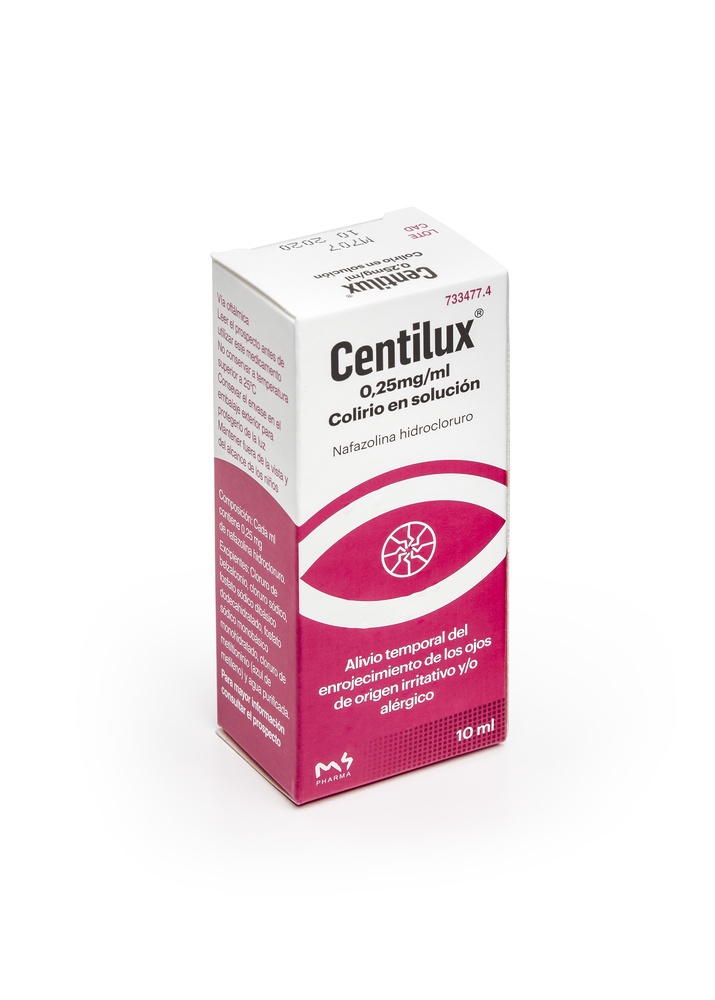
CENTILUX 0,25 mg/ml Colirio en solución

Revisión de receta online
Un médico revisará tu caso y determinará si la prescripción es médicamente apropiada.

Habla con un médico sobre este medicamento
Comenta tus síntomas y las opciones de tratamiento en una consulta online.



Cómo usar CENTILUX 0,25 mg/ml COLIRIO EN SOLUCION
Contenido del prospecto
- Introducción
- Qué es Centilux colirio y para qué se utiliza
- Qué necesita saber antes de empezar a usar Centilux colirio
- Cómo usar Centilux colirio
- Posibles efectos adversos
- Conservación de Centilux colirio
- Contenido del envase e información adicional
Introducción
Prospecto: informaciónpara el usuario
Centilux 0,25 mg/ml colirio en solución
Nafazolina
Lea todo el prospecto detenidamente antes de empezar a usar este medicamento, porque contiene información importante para usted.
Siga exactamente las instrucciones de administración del medicamento contenidas en este prospecto o las indicadas por su médico o farmacéutico.
- Conserve este prospecto, ya que puede teer que volver a leerlo.
- Si necesita consejo o más información, consulte a su farmacéutico.
- Si experimenta efectos adversos, consulte a su médico o farmacéutico, incluso si se trata de efectos adversos que no aparecen en este prospecto. Ver sección 4.
- Debe consultar a un médico si empeora o si no mejora después de 3 días.
Contenido del prospecto
- Qué es Centilux colirio y para qué se utiliza
- Qué necesita saber antes de empezar a usar Centilux colirio
- Cómo usar Centilux colirio
- Posibles efectos adversos
5 Conservación de Centilux colirio
- Contenido del envase e información adicional
1. Qué es Centilux colirio y para qué se utiliza
Contiene como principio activo nafazolina, con acción descongestiva (produce vasoconstricción o estrechamiento de los vasos sanguíneos visibles del ojo).
Centilux está indicado para: Alivio temporal de la congestión, enrojecimiento e irritación leves en los ojos de origen irritativo y/o alérgico, causados por agentes externos como: humo del tabaco, polvo, contaminación, ambientes secos o cargados, luz solar, agua clorada o del mar, lectura o trabajos que requieran fijación prolongada de la vista.

¿No estás seguro de si este medicamento es adecuado para ti?
Comenta tus síntomas y tratamiento con un médico online.
2. Qué necesita saber antes de empezar a usar Centilux colirio
No useCentilux:
- si es alérgico a la nafazolina u otros medicamentos adrenérgicos (que entre otras acciones pueden elevar la tensión arterial) o a alguno de los demás componentes de este medicamento (incluidos en la sección 6).
- si padece en los ojos glaucoma de ángulo estrecho.
Advertencias y precauciones
Consulte a su médico o farmacéutico antes de empezar a usar Centilux.
Tiene que tener precaución si se encuentra en alguno de los siguientes casos:
- En caso que le estén administrando determinados anestésicos (ej., halotano, que hace más sensible el corazón a los medicamentos del tipo de la nafazolina)
- Si padece asma bronquial
- Si padece alguna enfermedad del corazón o la circulación
- Si tiene arterioesclerosis en el cerebro
- Si tiene la presión sanguínea elevada
- Si padece enfermedad del tiroides
- Si padece diabetes
- Si está en tratamiento con medicamentos IMAO (Inhibidores de la monoamino oxidasa) (generalmente antidepresivos) o durante las dos semanas despues de cesar dicho tratamiento
- No usar durante más de 3 a 5 días
- No use lentes de contacto durante el uso de este medicamento.
Niños
No utilice Centilux en niños; no se ha establecido la seguridad y eficacia en los niños.
Pacientes mayores
Se debe tener precaución en mayores de 65 años, en particular los que padezcan enfermedades del corazón o la circulación graves.
Otros medicamentosy Centilux
Informe a su médico o farmacéutico si está utilizando, ha utilizado recientemente o pudiera tener que utilizar cualquier otro medicamento.
No se conocen interacciones con otros medicamentos.
Embarazo y lactancia
Si está embarazada o en periodo de lactancia, cree que podría estar embarazada o tiene intención de quedarse embarazada, consulte a su médico o farmacéutico antes de utilizar este medicamento.
Centilux solo debe administrarse durante el embarazo si se considera absolutamente necesario y el beneficio potencial supera el riesgo potencial para el feto.
No deben usar Centilux si se encuentra amamantando a un bebé.
Conducción y uso de máquinas
Este medicamento podría provocar momentáneamente molestias en la visión. No debe conducir ni utilizar máquinas durante unos minutos, hasta que desaparezca la visión borrosa transitoria.
Centilux contiene cloruro de benzalconio y fosfatos
Este medicamento contiene 0,1 mg de cloruro de benzalconio en cada ml.
El cloruro de benzalconio se puede absorber por las lentes de contacto blandas y puede alterar el color de las lentes de contacto.
Retirar las lentes de contacto antes de usar este medicamento y esperar al menos 15 minutos antes de volver a colocarlas.
El cloruro de benzalconio puede causar irritación ocular, especialmente si padece de ojo seco u otras enfermedades de la córnea (capa transparente de la zona frontal del ojo). Consulte a su médico si siente una sensación extraña, escozor o dolor en el ojo después de usar este medicamento.
Este medicamento contiene 2,2 mg de fosfatos en cada ml.
Si sufre de daño grave en la capa trasparente de la parte frontal del ojo (córnea) el tratamiento con fosfatos, en casos muy raros, puede provocar parches nublados en la córnea debido al calcio.
3. Cómo usar Centilux colirio
Siga exactamente las instrucciones de administración del medicamento contenidas en este prospecto o las indicadas por su médico o farmacéutico. En caso de duda pregunte a su médico o farmacéutico.
Las dosis recomendada es:
Vía oftálmica (en los ojos)
- Adultos:
La dosis es de una o dos gotas de Centilux administrada de 2 a 4 veces al día en el(los) ojo(s) afectado(s).
Cómo usar:
- Lávese las manos y sitúese, si le es posible, delante de un espejo.
- Después de abrir el envase cuentagotas (frasco) por primera vez, debe retirar el anillo de plástico del precinto.
- Tenga siempre cuidado de no tocar nada con la punta del gotero, porque podría contaminar el
contenido del frasco.
- Sostenga el frasco boca abajo con una mano.
- Con la otra mano, separe hacia abajo el párpado inferior del ojo afectado y dirija la
mirada hacia arriba, inclinando la cabeza hacia atrás.
- Coloque la punta del gotero cerca del ojo, pero sin tocarlo y presione suavemente la base del
envase para que las gotas caigan en el espacio entre el ojo y el párpado.
- Cierre suavemente los ojos y manténgalos cerrados durante algunos segundos.
- Repita los pasos 4, 5 y 6 para el otro ojo, si es necesario.
- Cierre bien el frasco después de su utilización.
Si emplea más de un medicamento por vía oftálmica, las aplicaciones deben espaciarse al menos 5 minutos.
La duración del tratamiento no debe ser mayor de 3-5 días (podría producirse congestión de rebote).
Si los síntomas no se resuelven en este periodo de tiempo (72 horas), debe consultar al médico quien deberá examinar el estado de sus ojos.
Si usa más Centilux del que debe
Debido a las características de este medicamento no son de esperar fenómenos de intoxicación con el uso tópico a las dosis recomendadas.
La toma de una cantidad considerablemente mayor de Alergoftal de la dosis recomendada, por ejemplo, si se traga Centilux accidentalmente, puede provocar efectos adversos graves que afectan al corazón y a la circulación sanguínea. Los síntomas pueden incluir: reducción de la frecuencia cardíaca (bradicardia), cefalea aguda, náuseas, vómitos, problemas respiratorios, aumento de la frecuencia cardíaca (taquicardia) y dolor de pecho.
Un exceso de dosis puede eliminarlo lavando los ojos con agua templada. No se aplique más gotas hasta que sea la hora de la siguiente dosis.
En caso de ingestión accidental del contenido de un envase, especialmente en niños, pueden aparecer signos de afectación del sistema nervioso central (S.N.C.) tales como sedación importante, depresión del SNC, disminución de la temperatura corporal y coma.
Con dosis muy altas de nafazolina pueden producirse efectos adversos en el corazón o la circulación.
Otros síntomas que pueden aparecer si se ingiere accidentalmente el medicamento, especialmente por niños, son: nauseas, vómitos, letargo, dificultad respiratoria, etc.
En caso de sobredosis o ingestión accidental, consulte inmediatamente a su médico o farmacéutico, acuda a un centro médico, o llame al Servicio de Información Toxicológica, Teléfono 91 562 04 20, indicando el medicamento y la cantidad ingerida.
Si olvidó usar Centilux
No use una dosis doble para compensar la dosis olvidada.
Aplíquese una única dosis en cuanto se dé cuenta. Si ya es casi la hora de la siguiente dosis, espere a la siguiente dosis y continúe con su régimen habitual.
Si tiene cualquier otra duda sobre el uso de este medicamento, pregunte a su médico o farmacéutico.

¿Has empezado a tomar el medicamento y tienes preguntas?
Comenta tus síntomas y tratamiento con un médico online.
4. Posibles efectos adversos
Al igual que todos los medicamentos, este medicamento puede producir efectos adversos, aunque no todas las personas los sufran.
Se ha observado que podría producirse: dilatación de la pupila, aumento de la presión dentro del ojo (intraocular), efectos debidos a la absorción al interior del cuerpo (aumentos en la presión sanguínea, trastornos cardíacos y aumento del azúcar en la sangre), dolor de cabeza y náuseas.
En raras ocasiones, se han observado picor tras la aplicación.
Posible aparición, con poca frecuencia, de enrojecimiento continuo e irritación del ojo.
Con frecuencia no conocida: conjuntivitis, dolor en los ojos.
En muy raras ocasiones: zonas opacas en la córnea.
En pacientes predispuestos y con el uso con mayor cantidad o frecuencia de lo recomendado, se podrían producir palpitaciones, temblor, debilidad y sudoración.
También podría presentarse reacción alérgica a alguno de los componentes.
Comunicación de efectos adversos
Si experimenta cualquier tipo de efecto adverso, consulte a su médico o farmacéutico, incluso si se trata de posibles efectos adversos que no aparecen en este prospecto. También puede comunicarlos directamente a través del Sistema Español de Farmacovigilancia de Medicamentos de Uso Humano: https://www.notificaram.es. Mediante la comunicación de efectos adversos usted puede contribuir a proporcionar más información sobre la seguridad de este medicamento.
5. Conservación de Centilux colirio
Mantener este medicamento fuera de la vista y del alcance de los niños.
No conservar a temperatura superior a 25ºC.
Conservar el envase en el embalaje exterior para protegerlo de la luz.
No utilice este medicamento después de la fecha de caducidad que aparece en el envase y la caja después de CAD. La fecha de caducidad es el último día del mes que se indica.
No utilice este medicamento si observa que la solución cambia de color o se enturbia.
Debe desechar el frasco cuatro semanas después de la primera apertura.
Los medicamentos no se deben tirar por los desagües ni a la basura. Deposite los envases y los medicamentos que no necesita en el Punto SIGRE de la farmacia. Pregunte a su farmacéutico cómo deshacerse de los envases y de los medicamentos que no necesita. De esta forma, ayudará a proteger el medio ambiente.
6. Contenido del envase e información adicional
Composición de Centilux
- El principio activo es nafazolina hidrocloruro. Un ml de colirio contiene 0,25 mg de nafazolina hidrocloruro (0,025%).
- Los demás componentes son: cloruro de benzalconio, cloruro sódico, fosfato sódico dibásico dodecahidratado, fosfato sódico monobásico monohidratado, cloruro de metiltioninio (azul de metileno) y agua purificada.
Aspecto del producto y contenido del envase
El medicamento es un colirio en solución; es un líquido de color azul.
Se presenta en un envase cuentagotas (frasco de plástico) con 10 ml de colirio en solución.
Titular de la autorización de comercialización y responsable de la fabricación
Titular de la autorización de comercialización
Reva Health Europe, S.L.
Pl. Ausiàs March,1, 4-6
08195 Sant Cugat del Vallès-España
Responsable de la fabricación
Tubilux Pharma S.P.A
VIA COSTA RICA, 20/22
00071-POMEZIA (ROMA)
Fecha de la última revisión de este prospecto:Junio 2025
La información detallada de este medicamento está disponible en la página Web de la Agencia Española de Medicamentos y Productos Sanitarios (AEMPS) http://www.aemps.gob.es/
- País de registro
- Forma farmacéuticaCOLIRIO, 0,25 mg/ml
- Código ATCS01GA01
- Principio activo
- Requiere recetaNo
- Fabricante
- ComposiciónBENZALCONIO, CLORURO DE (0,1 mg mg), CLORURO DE SODIO (8,7 mg mg), FOSFATO DE SODIO MONOBASICO MONOHIDRATADO (1,616 mg mg), HIDROGENOFOSFATO DE SODIO DODECAHIDRATO (0,587 mg mg)
- Esta información es de carácter general y no sustituye la consulta con un profesional sanitario.
- Alternativas a CENTILUX 0,25 mg/ml COLIRIO EN SOLUCIONForma farmacéutica: COLIRIO, 0,25 mg/ml-5 mg/mlPrincipio activo: naphazoline, combinationsFabricante: Reva Health Europe S.L.No requiere recetaForma farmacéutica: COLIRIO, 0,25 MG/MLPrincipio activo: BrimonidinaFabricante: Bausch + Lomb Ireland LimitedNo requiere recetaForma farmacéutica: COLIRIO, 1,25 mg fenilefrina hidrocloruroPrincipio activo: fenilefrinaNo requiere receta
Médicos online para CENTILUX 0,25 mg/ml COLIRIO EN SOLUCION
Comenta la dosis, los posibles efectos secundarios, interacciones, contraindicaciones o la revisión de receta de CENTILUX 0,25 mg/ml COLIRIO EN SOLUCION, sujeto a valoración médica y a la normativa local.









Obtén una receta de CENTILUX 0,25 mg/ml COLIRIO EN SOLUCION online
Rellena un formulario de 2 minutos
Cuéntanos tus síntomas, historial y el medicamento que necesitas.
Elige un médico o nosotros te asignamos uno
Escoge un especialista o te conectamos con el próximo médico disponible.
El médico revisa tu caso
Normalmente en 30 minutos. Puede hacerte preguntas adicionales por chat.
Recógela en cualquier farmacia
Receta electrónica enviada a tu correo, válida en toda España.
Preguntas frecuentes
CENTILUX 0,25 mg/ml COLIRIO EN SOLUCION no requiere receta en España. Puedes confirmarlo con un médico online según tu caso.
El principio activo de CENTILUX 0,25 mg/ml COLIRIO EN SOLUCION es naphazoline. Esta información ayuda a identificar medicamentos con la misma composición pero con diferentes nombres comerciales.
CENTILUX 0,25 mg/ml COLIRIO EN SOLUCION es fabricado por Reva Health Europe S.L.. La marca y el envase pueden variar según el distribuidor.
Los Médicos de familia, Psiquiatras, Dermatólogos, Cardiólogos, Endocrinólogos, Gastroenterólogos, Neumólogos, Nefrólogos, Reumatólogos, Hematólogos, Infectólogos, Alergólogos, Geriatras, Pediatras, Oncólogos pueden valorar la prescripción de CENTILUX 0,25 mg/ml COLIRIO EN SOLUCION cuando esté clínicamente indicado. Puedes reservar una videoconsulta para comentar tu caso y las opciones de tratamiento.
España cuenta con una infraestructura sanitaria bien desarrollada en ciudades principales como Madrid, Barcelona, Valencia y Sevilla. Las farmacias están ampliamente disponibles y operan bajo estrictas regulaciones, garantizando el acceso a medicamentos con receta.
Puedes comprar CENTILUX 0,25 mg/ml COLIRIO EN SOLUCION en Madrid, Barcelona, Sevilla o Valencia en cualquier farmacia local con una receta válida.
Para obtener una receta, puedes utilizar Oladoctor:
Otros medicamentos con el mismo principio activo (naphazoline) incluyen ALERGOFTAL 0,25 mg/ml+ 5 mg/ml COLIRIO EN SOLUCION, LUMOBRY 0,25 MG/ML COLIRIO EN SOLUCION, MIRAZUL 1,25 MG/ML COLIRIO EN SOLUCIÓN.. Pueden tener diferentes nombres comerciales o formulaciones, pero contienen el mismo componente terapéutico. Consulta siempre con un médico antes de cambiar o iniciar un nuevo medicamento.
