



CEMIDON 60 mg /Ml Solución Inyectable

Revisión de receta online
Un médico revisará tu caso y determinará si la prescripción es médicamente apropiada.

Habla con un médico sobre este medicamento
Comenta tus síntomas y las opciones de tratamiento en una consulta online.



Cómo usar CEMIDON 60 MG/ML SOLUCIÓN INYECTABLE
Contenido del prospecto
- Introducción
- Qué es Cemidon y para qué se utiliza
- Qué necesita saber antes de empezar a tomar Cemidon
- Cómo tomar Cemidon
- Posibles efectos adversos
- Conservación de Cemidon
- Contenido del envase e información adicional
Introducción
Prospecto: información para el paciente
Cemidon 60 mg/ml solución inyectable
isoniazida
Lea todo el prospecto detenidamente antes de empezar a tomar este medicamento, porque contiene información importante para usted.
- Conserve este prospecto, ya que puede tener que volver a leerlo.
- Si tiene alguna duda, consulte a su médico o farmacéutico.
- Este medicamento se le ha recetado solamente a usted, y no debe dárselo a otras personas aunque tengan los mismos síntomas que usted, ya que puede perjudicarles.
- Si experimenta efectos adversos, consulte a su médico o farmacéutico, incluso si se trata de efectos adversos que no aparecen en este prospecto. Ver sección 4.
Contenido del prospecto
- Qué es Cemidon y para qué se utiliza
- Qué necesita saber antes de empezar a tomar Cemidon
- Cómo tomar Cemidon
- Posibles efectos adversos
- Conservación de Cemidon
- Contenido del envase e información adicional
1. Qué es Cemidon y para qué se utiliza
Cemidon contiene isoniazida, un antibiótico perteneciente al grupo de medicamentos antituberculosos.
Los antibióticos se utilizan para tratar infecciones bacterianas y no sirven para tratar infecciones víricas como la gripe o el catarro. Es importante que siga las instrucciones relativas a la dosis, las tomas y la duración del tratamiento indicadas por su médico. No guarde ni reutilice este medicamento. Si una vez finalizado el tratamiento le sobra antibiótico, devuélvalo a la farmacia para su correcta eliminación. No debe tirar los medicamentos por el desagüe ni a la basura. |
Cemidon está indicado para el tratamiento de la tuberculosis y, excepcionalmente, para el tratamiento de infecciones por micobacterias atípicas.
Además, se usa en la prevención de:
- Infección aguda asintomática identificada por prueba de la tuberculina.
- Personas con riesgo de reactivación de una tuberculosis.
- Contacto con una persona con tuberculosis.

¿No estás seguro de si este medicamento es adecuado para ti?
Comenta tus síntomas y tratamiento con un médico online.
2. Qué necesita saber antes de empezar a tomar Cemidon
No tome Cemidon
- Si es alérgico a los principios activos o a alguno de los demás componentes de este medicamento (incluidos en la sección 6).
- Si tiene problemas de hígado graves.
- Si ha sufrido alguna vez una erupción cutánea grave o descamación de la piel, ampollas y/o llagas en la boca después de tomar Cemidon.
Advertencias y precauciones
Consulte a su médico o farmacéutico antes de empezar a tomar Cemidon.
Tenga especial cuidado:
- Si tiene antecedentes de convulsiones o problemas neurológicos. Se deberán administrar medicamentos para evitar las convulsiones en caso de riesgo.
- Si padece alguna alteración de la función del hígado. En ese caso su médico controlará el funcionamiento de su hígado semanalmente, durante el primer mes y después mensualmente mientras dure el tratamiento. Si apareciera alguna lesión, su médico le suspenderá el tratamiento.
- Si tiene un problema de adicción al alcohol.
- Si tiene alguna enfermedad de riñón. Su médico prescribirá la dosis más adecuada para usted.
- Se han notificado casos de reacciones cutáneas graves, como: síndrome de Stevens-Johnson (SSJ), necrólisis epidérmica tóxica (NET), reacción a fármaco con eosinofilia y síntomas sistémicos (DRESS), acné, inflamación de los ganglios y pustulosis exantemática generalizada aguda (PEGA) asociadas al tratamiento con Cemidon. Deje de tomar Cemidon y solicite atención médica inmediatamente si nota alguno de los síntomas descritos en la sección 4.
Otros medicamentos y Cemidon
Informe a su médico o farmacéutico si está tomando, ha tomado recientemente o pudiera tener que tomar cualquier otro medicamento, incluidos los de venta sin receta médica.
En particular, informe a su médico o farmacéutico si está usando cualquiera de los siguientes medicamentos:
- Medicamentos utilizados para el tratamiento de la epilepsia (fenitoína, carbamazepina). Posiblemente su médico le ajustará la dosis de este medicamento.
- Sales de aluminio (medicamentos para el tratamiento de la acidez gástrica). Deberán tomarse con más de 2 horas de separación entre la toma de ambos productos.
- Anestésicos halogenados (medicamentos utilizados en intervenciones quirúrgicas). Se recomienda interrumpir el tratamiento con Cemidon una semana antes de la intervención y no reiniciarlo hasta transcurridos 15 días.
- Anticoagulantes orales (medicamentos que se utilizan para evitar la aparición de coágulos) como acenocumarol.
- Glucocorticoides (como prednisolona).
- Ketoconazol (medicamento para el tratamiento de infecciones por hongos). Las tomas de Cemidon deberán espaciarse al menos 12 horas. Posiblemente su médico le ajustará la dosis del medicamento a base de ketoconazol.
- Medicamentos antibióticos utilizados para el tratamiento de la tuberculosis (pirazinamida, rifampicina) se deberá incrementar la vigilancia clínica y biológica.
Toma de Cemidon con alimentos, bebidas y alcohol
La isoniazida interacciona con los alimentos que contienen una sustancia llamada tiramina y que se encuentra presente en alimentos como el queso y el vino tinto. Asimismo, si se toma con alimentos que contienen una sustancia llamada histamina (por ejemplo, atún u otros pescados tropicales), se puede producir una respuesta exagerada con dolor de cabeza, sudoración, palpitaciones, enrojecimiento y disminución de la tensión arterial. Debido a esto su médico le indicará que no tome alimentos que contengan tiramina o histamina durante su tratamiento con Cemidon.
Embarazo y lactancia
Si está embarazada o en periodo de lactancia, cree que podría estar embarazada o tiene intención de quedarse embarazada, consulte a su médico o farmacéutico antes de utilizar este medicamento.
En caso de embarazo, no se debe administrar Cemidon excepto cuando los beneficios potenciales superan los posibles riesgos asociados con el tratamiento. Será su médico quien realice esta evaluación.
Las mujeres en periodo de lactancia deben consultar a su médico antes de tomar este medicamento, ya que la isoniazida pasa a leche materna.
Conducción y uso de máquinas
La influencia de Cemidon sobre la capacidad para conducir y utilizar máquinas es importante ya que puede producir visión borrosa y/o mareos.
Cemidon Inyectable contiene metabisulfito sódico.
Este medicamento puede producir reacciones alérgicas graves y broncoespasmo (sensación repentina de ahogo) porque contiene metabisulfito sódico.
3. Cómo tomar Cemidon
Siga exactamente las instrucciones de administración de este medicamento indicadas por su médico o farmacéutico. En caso de duda, consulte de nuevo a su médico o farmacéutico.
La dosis recomendada es:
Adultos y adolescentes con un peso superior a 45 kg:
- Tratamiento:
- 5mg/kg diarios hasta un máximo de 300 mg.
- o 10 mg/kg tres veces por semana.
- o 15 mg/kg dos veces por semana.
- Prevención: 300 mg al día, durante seis meses como mínimo.
Uso en niños y adolescentes
- Tratamiento en niños y adolescentes con peso igual o inferior a 45 kg: la dosis recomendada es de 10 mg/kg al día. La dosis máxima diaria no debe superar los 300 mg.
- Prevención en niños menores de 5 años o inmunodeprimidos: 7-15 mg/kg al día (máximo 300 mg), durante seis meses como mínimo.
No se dispone de datos del uso de isoniazida en menores de 3 meses de edad.
Forma de administración
Puede administrarse por vía intramuscular o por vía intravenosa lenta (3-5 minutos).
Si estima que la acción de Cemidon es demasiado fuerte o débil, comuníqueselo a su médico o farmacéutico.
Si toma más Cemidon del que debe
Si a usted se le ha administrado más Cemidon del que debe, consulte inmediatamente a su médico o farmacéutico o llame al Servicio de Información Toxicológica, teléfono: (91) 562 04 20, indicando el medicamento y la cantidad ingerida.
Tras una toma excesiva de este medicamento, puede esperarse la aparición de náuseas, vómitos, vértigos, alteraciones visuales o alucinaciones, incremento de los niveles de ácido en el organismo, aparición de acetona en orina y niveles altos de azúcar en sangre. Con dosis más altas puede presentarse depresión respiratoria y depresión central pudiendo llegar a convulsiones y coma profundo.
Si olvidó tomar Cemidon
No tome una dosis doble para compensar las dosis olvidadas.
Si interrumpe el tratamiento con Cemidon
Su médico le indicará la duración de su tratamiento con Cemidon. No suspenda el tratamiento antes, aunque se sienta mejor. Si deja de tomar el tratamiento demasiado pronto, la infección podría reaparecer.
Si tiene cualquier otra duda sobre el uso de este medicamento, pregunte a su médico o farmacéutico.

¿Has empezado a tomar el medicamento y tienes preguntas?
Comenta tus síntomas y tratamiento con un médico online.
4. Posibles efectos adversos
Al igual que todos los medicamentos, este medicamento puede producir efectos adversos, aunque no todas las personas los sufran.
Efectos adversos poco frecuentes(pueden afectar hasta 1 de cada 100 personas):
- Hepatitis (inflamación del hígado).
Efectos adversos raros(pueden afectar hasta 1 de cada 1.000 personas):
- necrólisis epidérmica tóxica (reacción de la piel que provoca grandes áreas de piel con ampollas y descamación pudiendo llegar a poner en riesgo la vida), síndrome de erupción medicamentosa con eosinofilia y síntomas sistémicos (reacción cutánea grave caracterizada por erupción generalizada en la piel, inflamación de los ganglios linfáticos y aumento del número de algunas células de la sangre como los eosinófilos).
Frecuencia no conocida(no puede estimarse a partir de los datos disponibles):
- agranulocitosis (disminución de un tipo de glóbulos blancos, los granulocitos), anemia aplásica (insuficiencia de la médula ósea para producir suficientes células sanguíneas), anemia hemolítica (destrucción de los glóbulos rojos en sangre), eosinofilia (aumento de un tipo de glóbulos blancos, los eosinófilos),
- acidosis (incremento de los niveles de ácido en el organismo), niveles bajos de glucosa en sangre, deficiencia de ácido nicotínico (vitamina B3), anorexia,
- hiperactividad, euforia, insomnio, crisis maníacas, delirios agudos, depresión,
- neuropatía periférica (daño en los nervios que se encuentran fuera del cerebro y la médula espinal), inflamación del nervio óptico, convulsiones,
- alteraciones visuales, visión borrosa,
- aumento de las glándulas mamarias en hombres,
- sordera, zumbido en los oidos, vértigo,
- vasculitis (inflamación de los vasos sanguíneos),
- insuficiencia hepática (deterioro severo del hígado), trastornos agudos en el hígado, daño en el hígado, ictericia (coloración amarilla de la piel y ojos),
- estreñimiento, boca seca, náuseas, vómitos, pancreatitis (inflamación aguda del páncreas), dolor de estómago (dolor abdominal),
- lesiones que causan inflamación o cicatrización de los pulmones (enfermedad pulmonar intersticial),
- reacciones agudas en la piel, síndrome de Stevens-Johnson (reacción cutánea severa que cursa con ampollas y descamación de la piel, particularmente alrededor de la boca, nariz, ojos y genitales), acné, inflamación de los ganglios,
- erupción cutánea generalizada, roja y escamosa, con bultos debajo de la piel y ampollas,
acompañada de fiebre. Los síntomas suelen aparecer al inicio del tratamiento (pustulosis
- exantemática generalizada aguda),
- lupus eritematoso sistémico (enfermedad autoinmunitaria crónica que puede afectar las articulaciones, la piel, el cerebro, los pulmones, los riñones y los vasos sanguíneos), síndrome tipo lupus (que causa síntomas como inflamación de las articulaciones, cansancio y erupciones cutáneas), síndrome hombro-mano, dolor en las articulaciones, dolor muscular,
- dolor o molestar al orinar,
- fiebre,
- aumento de las enzimas hepáticas.
Cuando se retira o interrumpe el tratamiento pueden aparecer los siguientes síntomas: dolor de cabeza, dificultad para dormir, exceso de sueño, irritabilidad, nerviosismo.
Comunicación de efectos adversos
Si experimenta cualquier tipo de efecto adverso, consulte a su médico o farmacéutico, incluso si se trata de posibles efectos adversos que no aparecen en este prospecto. También puede comunicarlos directamente a través del Sistema Español de Farmacovigilancia de Medicamentos de Uso Humano: https://www.notificaram.es. Mediante la comunicación de efectos adversos usted puede contribuir a proporcionar más información sobre la seguridad de este medicamento.
5. Conservación de Cemidon
Mantener este medicamento fuera de la vista y del alcance de los niños.
No utilice este medicamento después de la fecha de caducidad que aparece en la caja después de CAD. La fecha de caducidad es el último día del mes que se indica.
Este medicamento debe conservarse en un lugar fresco y seco. Almacenar protegido de la luz a temperatura no superior a 25ºC.
Los medicamentos no se deben tirar por los desagües ni a la basura. Deposite los envases y los medicamentos que no necesita en el Punto SIGRE de la farmacia. Pregunte a su farmacéutico cómo deshacerse de los envases y de los medicamentos que ya no necesita. De esta forma, ayudará a proteger el medio ambiente.
6. Contenido del envase e información adicional
Composición de Cemidon
- El principio activo es isoniazida.
- Los demás componentes (excipientes) son: metabisulfito sódico (E-223) y agua para preparaciones inyectables.
Aspecto del producto y contenido del envase
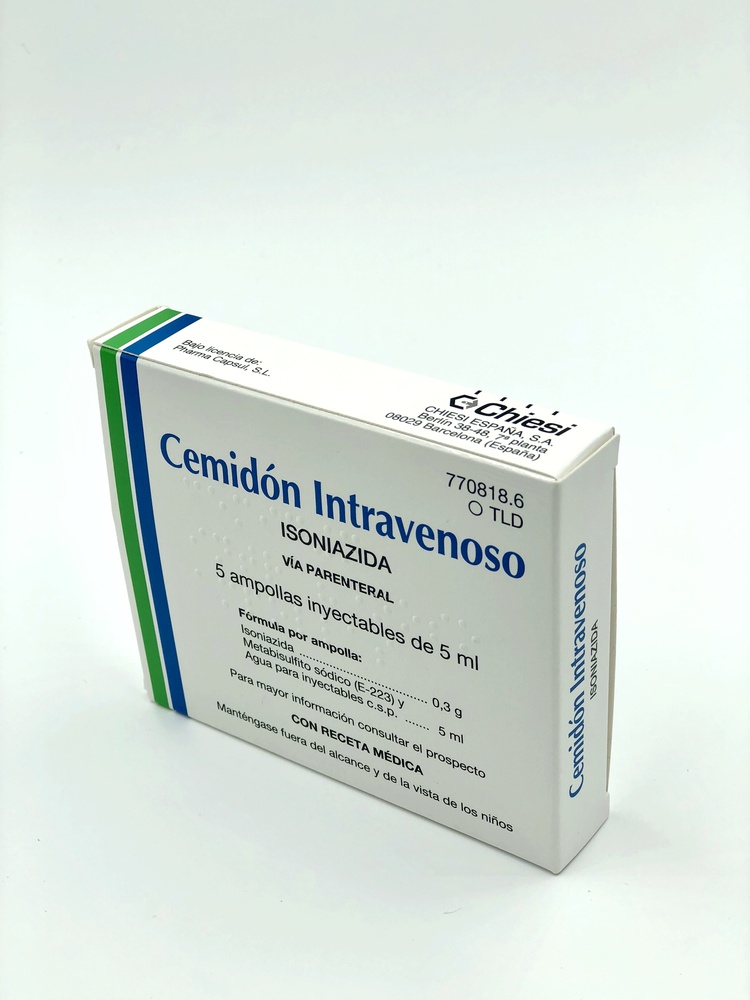
Cemidon Intravenoso se presenta en ampollas de de 5 ml de vidrio transparente neutro tipo I autorrompible.
Cada envase contiene 5 ampollas.
Titular de la autorización de comercialización y responsable de la fabricación
Titular de la autorización de comercialización
CHIESI ESPAÑA, S.A.U.
Plaça d’Europa, 41-43, planta 10
08908 L’Hospitalet de Llobregat
Barcelona (España)
Responsable de la fabricación
LABORATORIOS ALCALA FARMA S.L.
Avenida de Madrid, 82
28802 Alcalá de Henares
Madrid (España)
Fecha de la última revisión de este prospecto:Agosto 2025
La información detallada de este medicamento está disponible en la página web de la Agencia Española de Medicamentos y Productos Sanitarios (AEMPS): http://www.aemps.gob.es
- País de registro
- Forma farmacéuticaINYECTABLE, 300 mg
- Código ATCJ04AC01
- Precio medio en farmacia12.11 EUR
- Disponibilidad en farmaciasProblema de suministro reportado
- Principio activo
- Requiere recetaSí
- Fabricante
- ComposiciónSODIO, METABISULFITO DE (E 223) (5 ml mg)
- Esta información es de carácter general y no sustituye la consulta con un profesional sanitario.
- Alternativas a CEMIDON 60 MG/ML SOLUCIÓN INYECTABLEForma farmacéutica: COMPRIMIDO, 150/25 mg/mgPrincipio activo: isoniazid, combinationsFabricante: Chiesi España S.A.U.Requiere recetaForma farmacéutica: COMPRIMIDO, 300/50 mg/mgPrincipio activo: isoniazid, combinationsFabricante: Chiesi España S.A.U.Requiere recetaForma farmacéutica: COMPRIMIDO, 50/15 mg/mgPrincipio activo: isoniazid, combinationsFabricante: Chiesi España S.A.U.Requiere receta
Médicos online para CEMIDON 60 MG/ML SOLUCIÓN INYECTABLE
Comenta la dosis, los posibles efectos secundarios, interacciones, contraindicaciones o la revisión de receta de CEMIDON 60 MG/ML SOLUCIÓN INYECTABLE, sujeto a valoración médica y a la normativa local.









Obtén una receta de CEMIDON 60 MG/ML SOLUCIÓN INYECTABLE online
Rellena un formulario de 2 minutos
Cuéntanos tus síntomas, historial y el medicamento que necesitas.
Elige un médico o nosotros te asignamos uno
Escoge un especialista o te conectamos con el próximo médico disponible.
El médico revisa tu caso
Normalmente en 30 minutos. Puede hacerte preguntas adicionales por chat.
Recógela en cualquier farmacia
Receta electrónica enviada a tu correo, válida en toda España.
Preguntas frecuentes
CEMIDON 60 MG/ML SOLUCIÓN INYECTABLE requiere receta en España. Puedes confirmarlo con un médico online según tu caso.
El principio activo de CEMIDON 60 MG/ML SOLUCIÓN INYECTABLE es isoniazida. Esta información ayuda a identificar medicamentos con la misma composición pero con diferentes nombres comerciales.
El precio medio en farmacia de CEMIDON 60 MG/ML SOLUCIÓN INYECTABLE es de aproximadamente 12.11 EUR. Puede variar según el fabricante y la forma farmacéutica.
CEMIDON 60 MG/ML SOLUCIÓN INYECTABLE es fabricado por Chiesi España S.A.U.. La marca y el envase pueden variar según el distribuidor.
Los Médicos de familia, Psiquiatras, Dermatólogos, Cardiólogos, Endocrinólogos, Gastroenterólogos, Neumólogos, Nefrólogos, Reumatólogos, Hematólogos, Infectólogos, Alergólogos, Geriatras, Pediatras, Oncólogos pueden valorar la prescripción de CEMIDON 60 MG/ML SOLUCIÓN INYECTABLE cuando esté clínicamente indicado. Puedes reservar una videoconsulta para comentar tu caso y las opciones de tratamiento.
España cuenta con una infraestructura sanitaria bien desarrollada en ciudades principales como Madrid, Barcelona, Valencia y Sevilla. Las farmacias están ampliamente disponibles y operan bajo estrictas regulaciones, garantizando el acceso a medicamentos con receta.
Puedes comprar CEMIDON 60 MG/ML SOLUCIÓN INYECTABLE en Madrid, Barcelona, Sevilla o Valencia en cualquier farmacia local con una receta válida.
Para obtener una receta, puedes utilizar Oladoctor:
Otros medicamentos con el mismo principio activo (isoniazida) incluyen CEMIDON B6 150 MG/25 MG COMPRIMIDOS, CEMIDON B6 300 MG/50 MG COMPRIMIDOS, CEMIDON B6 50 MG/15 MG COMPRIMIDOS. Pueden tener diferentes nombres comerciales o formulaciones, pero contienen el mismo componente terapéutico. Consulta siempre con un médico antes de cambiar o iniciar un nuevo medicamento.
