



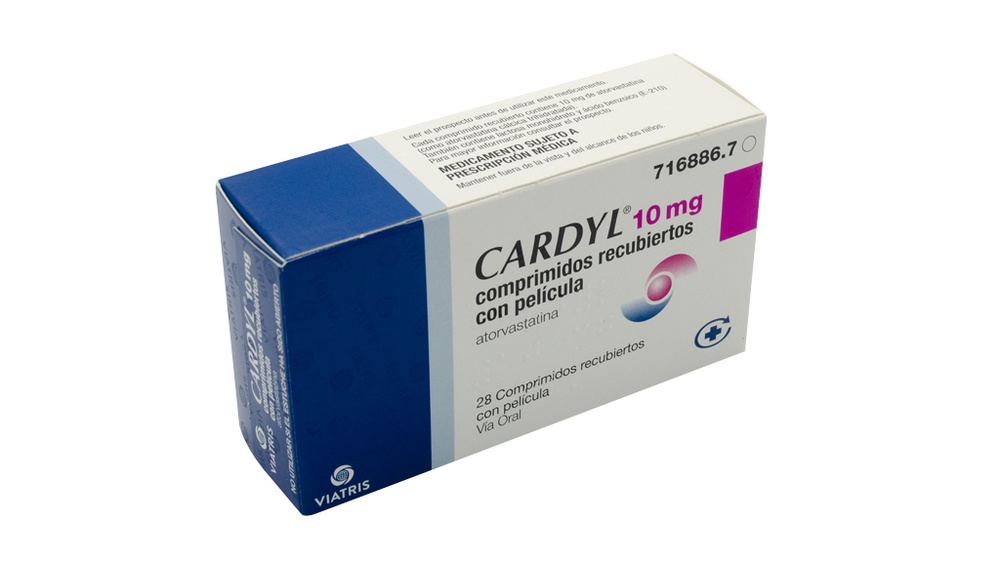
CARDYL 10 mg Comprimidos Recubiertos Con Película

Revisión de receta online
Un médico revisará tu caso y determinará si la prescripción es médicamente apropiada.

Habla con un médico sobre este medicamento
Comenta tus síntomas y las opciones de tratamiento en una consulta online.



Cómo usar CARDYL 10 mg COMPRIMIDOS RECUBIERTOS CON PELICULA
Contenido del prospecto
- Introducción
- Qué es Cardyl y para qué se utiliza
- Qué necesita saber antes de empezar a tomar Cardyl
- Cómo tomar Cardyl
- Posibles efectos adversos
- Conservación de Cardyl
- Contenido del envase e información adicional
Introducción
Prospecto: información para el usuario
CARDYL 10mg comprimidos recubiertos con película
atorvastatina
Lea todo el prospecto detenidamente antes de empezar a tomar este medicamento,porque contiene información importante para usted.
- Conserve este prospecto, ya que puede tener que volver a leerlo.
- Si tiene alguna duda, consulte a su médico, farmacéutico o enfermero.
- Este medicamento se le ha recetado solamente a usted, y no debe dárselo a otras personas aunque tengan los mismos síntomas que usted, ya que puede perjudicarles.
- Si experimenta efectos adversos, consulte a su médico o farmacéutico, incluso si se trata de efectos adversos que no aparecen en este prospecto. Ver sección 4.
Contenido del prospecto
- Qué es Cardyl y para qué se utiliza
- Qué necesita saber antes de empezar a tomar Cardyl
- Cómo tomar Cardyl
- Posibles efectos adversos
- Conservación de Cardyl
- Contenido del envase e información adicional
1. Qué es Cardyl y para qué se utiliza
Cardyl pertenece a un grupo de medicamentos conocidos como estatinas, que son medicamentos que regulan los lípidos (grasas).
Cardyl se utiliza para reducir los lípidos como el colesterol y los triglicéridos en la sangre cuando una dieta baja en grasas y los cambios en el estilo de vida por si solos han fracasado. Si usted presenta un riesgo elevado de enfermedad cardiaca, Cardyl también puede utilizarse para reducir este riesgo incluso aunque sus niveles de colesterol sean normales. Durante el tratamiento debe seguirse una dieta estándar baja en colesterol.

¿No estás seguro de si este medicamento es adecuado para ti?
Comenta tus síntomas y tratamiento con un médico online.
2. Qué necesita saber antes de empezar a tomar Cardyl
No tome Cardyl
- si es alérgico a atorvastatina o a alguno de los demás componentes de este medicamento (incluidos en la sección 6).
- si tiene o ha tenido alguna enfermedad que afecte al hígado.
- si tiene o ha tenido resultados anómalos injustificados en los tests sanguíneos de función hepática.
- si es una mujer en edad fértil y no utiliza medidas anticonceptivas adecuadas.
- si está embarazada o intentando quedarse embarazada.
- si está amamantando.
- si usa la combinación de glecaprevir/pibrentasvir para el tratamiento de la hepatitis C.
Advertencias y precauciones
Consulte a su médico, farmacéutico o enfermero antes de empezar a tomar Cardyl
- si tiene insuficiencia respiratoria grave.
- si está tomando o ha tomado en los últimos 7 días un medicamento llamado ácido fusídico (un medicamento utilizado para tratar las infecciones bacterianas) por vía oral o por inyección. La combinación de ácido fusídico y Cardyl puede provocar problemas musculares graves (rabdomiolisis).
- si ha tenido un ictus anterior con sangrado en el cerebro, o tiene pequeños embolsamientos de líquido en el cerebro debidos a ictus anteriores.
- si tiene problemas de riñón.
- si tiene una glándula tiroidea con baja actividad (hipotiroidismo).
- si tiene dolores musculares repetidos o injustificados, antecedentes personales o familiares de problemas musculares.
- si ha tenido anteriormente problemas musculares durante el tratamiento con otros medicamentos para reducir los lípidos (por ejemplo, con otra estatina o fibratos).
- si bebe regularmente grandes cantidades de alcohol.
- si tiene antecedentes de problemas de hígado.
- si tiene más de 70 años.
- si tiene o ha tenido miastenia (una enfermedad que cursa con debilidad muscular generalizada que, en algunos casos, afecta a los músculos utilizados al respirar) o miastenia ocular (una enfermedad que provoca debilidad de los músculos oculares), ya que las estatinas a veces pueden agravar la enfermedad o provocar la aparición de miastenia (ver sección 4).
En cualquiera de estos casos, su médico podrá indicarle si debe realizarse análisis de sangre antes y, posiblemente, durante el tratamiento con Cardyl para predecir el riesgo de sufrir efectos adversos relacionados con el músculo. Se sabe que el riesgo de sufrir efectos adversos relacionados con el músculo (por ejemplo rabdomiolisis) aumenta cuando se toman ciertos medicamentos al mismo tiempo (ver sección 2 “Uso de Cardyl con otros medicamentos”).
Informe también a su médico o farmacéutico si presenta debilidad muscular constante. Podrían ser necesarias pruebas y medicamentos adicionales para diagnosticar y tratar este problema.
Mientras esté tomando este medicamento su médico controlará si tiene diabetes o riesgo de desarrollar diabetes. Este riesgo de diabetes aumenta si usted tiene altos niveles de azúcares y grasas en la sangre, sobrepeso y presión arterial alta.
Otros medicamentos y Cardyl
Informe a su médico o farmacéutico si está tomando, ha tomado recientemente o pudiera tener que tomar cualquier otro medicamento. Existen algunos medicamentos que pueden afectar el correcto funcionamiento de Cardyl o los efectos de estos medicamentos pueden verse modificados por Cardyl. Este tipo de interacción puede disminuir el efecto de uno o de los dos medicamentos. Alternativamente este uso conjunto puede aumentar el riesgo o la gravedad de los efectos adversos, incluyendo el importante deterioro muscular, conocido como rabdomiolisis descrito en la sección 4:
- Medicamentos utilizados para modificar el funcionamiento de su sistema inmunológico, por ejemplo ciclosporina.
- Ciertos antibióticos o medicamentos antifúngicos, por ejemplo, eritromicina, claritromicina, telitromicina, ketoconazol, itraconazol, voriconazol, fluconazol, posaconazol, rifampicina, ácido fusídico.
- Otros medicamentos para regular los niveles de los lípidos, por ejemplo, gemfibrozilo, otros fibratos, colestipol.
- Algunos bloqueantes de los canales del calcio utilizados en el tratamiento de la angina de pecho o para la tensión arterial alta, por ejemplo, amlodipino, diltiazem; medicamentos para regular su ritmo cardiaco, por ejemplo, digoxina, verapamilo, amiodarona.
- Letermovir, un medicamento que ayuda a evitar enfermedades causadas por citomegalovirus.
- Medicamentos utilizados en el tratamiento del SIDA, por ejemplo, ritonavir, lopinavir, atazanavir, indinavir, darunavir, tipranavir combinado con ritonavir, etc.
- Algunos medicamentos empleados para el tratamiento de la hepatitis C, como telaprevir, boceprevir y la combinación de elbasvir/grazoprevir, ledipasvir/sofosbuvir.
- Otros medicamentos que se sabe que interaccionan con Cardyl incluyen ezetimiba (que reduce el colesterol), warfarina (que reduce la coagulación sanguínea), anticonceptivos orales, estiripentol (anticonvulsivo para tratar la epilepsia), cimetidina (utilizada para el ardor de estómago y úlcera péptica), fenazona (un analgésico), colchicina (utilizada para el tratamiento de la gota) y antiácidos (productos para la indigestión que contienen aluminio o magnesio)
- Medicamentos obtenidos sin receta médica: hierba de San Juan.
- Si necesita tomar ácido fusídico oral para tratar una infección bacteriana tendrá que dejar de usar este medicamento temporalmente. Su médico le indicará cuándo es seguro reiniciar el tratamiento con Cardyl. Tomar Cardyl en combinación con ácido fusídico puede provocar raramente debilidad muscular, dolor a la palpación o dolor (rabdomiolisis). Para más información sobre la rabdomiolisis consulte la sección 4.
- Daptomicina (un medicamento utilizado para tratar infecciones de la piel y de la estructura de la piel con complicaciones y bacterias presentes en la sangre).
Toma deCardylcon alimentos, bebidas y alcohol
Ver sección 3 para las instrucciones de cómo tomar Cardyl. Por favor tenga en cuenta lo siguiente:
Zumo de pomelo
No tome más de uno o dos pequeños vasos de zumo de pomelo al día debido a que en grandes cantidades el zumo de pomelo puede alterar los efectos de Cardyl.
Alcohol
Evite beber mucho alcohol mientras toma este medicamento. Ver los detalles en la sección 2 “Advertencias y precauciones”.
Embarazo, lactancia y fertilidad
No tome Cardyl si está embarazada, cree que podría estar embarazada o tiene intención de quedarse embarazada.
No tome Cardyl si está en edad fértil a no ser que tome las medidas anticonceptivas adecuadas.
No tome Cardyl si está amamantando a su hijo.
No se ha demostrado la seguridad de Cardyl durante el embarazo y la lactancia.
Consulte a su médico o farmacéutico antes de utilizar cualquier medicamento.
Conducción y uso de máquinas
Normalmente este medicamento no afecta a la capacidad para conducir o manejar maquinaria. No obstante, no conduzca si este medicamento afecta a su capacidad de conducción. No maneje herramientas o máquinas si este medicamento afecta a su habilidad para manejarlas.
Cardyl contiene lactosa
Si su médico le ha indicado que padece una intolerancia a ciertos azúcares, consulte con él antes de tomar este medicamento.
Cardyl contiene sodio
Este medicamento contiene menos de 23 mg de sodio (1mmol) por comprimido, esto es, esencialmente “exento de sodio”.
Cardyl contiene ácido benzoico
Este medicamento contiene 0,00004 mg de ácido benzoico en cada comprimido.
3. Cómo tomar Cardyl
Antes de iniciar el tratamiento, su médico le pondrá una dieta baja en colesterol, que debe usted seguir también durante el tratamiento con Cardyl.
La dosis inicial normal de Cardyl es de 10 mg una vez al día en adultos y niños a partir de los 10 años. Su médico puede aumentarla si fuera necesario hasta alcanzar la dosis que usted necesita. Su médico adaptará la dosis a intervalos de 4 semanas o más. La dosis máxima de Cardyl es 80 mg una vez al día.
Los comprimidos de Cardyl deben tragarse enteros con un vaso de agua y pueden tomarse a cualquier hora del día con o sin comida. No obstante, intente tomar todos los días su comprimido siempre a la misma hora.
Siga exactamente las instrucciones de administración de este medicamento indicadas por su médico o farmacéutico. En caso de duda, consulte de nuevo a su médico o farmacéutico.
Su médico decidirá la duración del tratamiento conCardyl
Pregunte a su médico si usted cree que el efecto de Cardyl es demasiado fuerte o demasiado débil.
Si toma más Cardyl del que debe
Si accidentalmente toma demasiados comprimidos de Cardyl (más de su dosis diaria habitual), consulte con su médico o con el hospital más cercano o llame al Servicio de Información Toxicológica, teléfono 91 562 04 20, indicando el medicamento y la cantidad tomada. Lleve los comprimidos que le queden, el estuche y la caja completa de manera que el personal del hospital pueda identificar fácilmente el medicamento que ha tomado.
Si olvidó tomar Cardyl
Si olvidó tomar una dosis, tome la siguiente dosis prevista a la hora correcta. No tome una dosis doble para compensar las dosis olvidadas.
Si interrumpe el tratamiento con Cardyl
Si tiene cualquier otra duda sobre el uso de este medicamento o desea interrumpir el tratamiento, pregunte a su médico o farmacéutico.

¿Has empezado a tomar el medicamento y tienes preguntas?
Comenta tus síntomas y tratamiento con un médico online.
4. Posibles efectos adversos
Al igual que todos los medicamentos, este medicamento puede producir efectos adversos, aunque no todas las personas los sufran.
Si nota cualquiera de los siguientes efectos adversos o síntomas graves, deje de tomar estos comprimidos e informe a su médico inmediatamente o acuda al servicio de urgencias del hospital más cercano.
Raros: pueden afectar hasta 1 de cada 1.000 personas
- Reacción alérgica grave que provoca hinchazón de la cara, lengua y garganta que puede producir gran dificultad para respirar.
- Enfermedad grave con descamación severa e inflamación de la piel; ampollas en la piel, boca, genitales y ojos, y fiebre. Erupción cutánea con manchas de color rosa-rojo, especialmente en las palmas de las manos o plantas de los pies que pueden formar ampollas.
- Debilidad en los músculos, dolor a la palpación, dolor, rotura o coloración marrón rojiza de la orina y especialmente, si al mismo tiempo tiene malestar o tiene fiebre alta, puede ser debida a una rotura anormal de los músculos (rabdomiolisis). La rotura anormal de los músculos no siempre desaparece, incluso después de haber dejado de tomar atorvastatina, y puede ser mortal y causar problemas en los riñones.
Muy raros: pueden afectar hasta 1 de cada 10.000 personas
- Si experimenta problemas con hemorragias o hematomas inesperados o inusuales, esto puede sugerir un problema de hígado. Debe consultar a su médico tan pronto como sea posible.
- Síndrome similar al lupus (incluyendo erupción, trantornos articulares y efectos sobre las células de la sangre).
Otros posibles efectos adversos con Cardyl
Frecuentes: pueden afectar hasta 1 de cada 10 personas
- inflamación de las fosas nasales, dolor de garganta, sangrado por la nariz
- reacciones alérgicas
- aumentos en los niveles de azúcar en la sangre (si es usted diabético vigile sus niveles de azúcar en sangre), aumento de la creatincinasa en sangre
- dolor de cabeza
- náuseas, estreñimiento, gases, indigestión, diarrea
- dolor en las articulaciones, dolor en los músculos y dolor de espalda
- resultados de los análisis de sangre que pueden mostrar un funcionamiento anormal del hígado
Poco frecuentes: pueden afectar hasta 1 de cada 100 personas
- anorexia (pérdida de apetito), ganancia de peso, disminución de los niveles de azúcar en la sangre (si es usted diabético debe continuar vigilando cuidadosamente sus niveles de azúcar en la sangre)
- pesadillas, insomnio
- mareo, entumecimiento u hormigueo en los dedos de las manos y de los pies, la reducción de la sensibilidad al dolor o al tacto, cambios en el sentido del gusto, pérdida de memoria
- visión borrosa
- zumbidos en los oídos y/o la cabeza
- vómitos, eructos, dolor abdominal superior e inferior, pancreatitis (inflamación del páncreas que produce dolor de estómago)
- hepatitis (inflamación del hígado)
- erupción, erupción en la piel y picazón, habones, caída del pelo
- dolor de cuello, fatiga de los músculos
- fatiga, sensación de malestar, debilidad, dolor en el pecho, inflamación, especialmente en los tobillos (edema), aumento de la temperatura
- pruebas de orina positivas para los glóbulos blancos de la sangre
Raros: pueden afectar hasta 1 de cada 1.000 personas
- alteraciones en la vista
- hemorragias o moratones no esperados
- colestasis (coloración amarillenta de la piel y del blanco de los ojos)
- lesión en el tendón
- erupción de la piel o úlceras en la boca (reacción liquenoide al fármaco)
- lesiones cutáneas de color púrpura (signos de inflamación de los vasos sanguíneos, vasculitis)
Muy raros: pueden afectar hasta 1 de cada 10.000 personas
- reacción alérgica - los síntomas pueden incluir silbidos repentinos al respirar y dolor u opresión en el pecho, hinchazón de los párpados, cara, labios, boca, lengua o garganta, dificultad para respirar, colapso
- pérdida de audición
- ginecomastia (aumento de las mamas en los hombres)
Frecuencia no conocida: no puede estimarse a partir de los datos disponibles:
- debilidad muscular constante
- miastenia grave (una enfermedad que provoca debilidad muscular generalizada que, en algunos casos, afecta a los músculos utilizados al respirar)
- miastenia ocular (una enfermedad que provoca debilidad de los músculos oculares)
Consulte a su médico si presenta debilidad en los brazos o las piernas que empeora después de periodos de actividad, visión doble o caída de los párpados, dificultad para tragar o dificultad para respirar.
Los posibles efectos secundarios de algunas estatinas (medicamentos del mismo tipo):
- dificultades sexuales
- depresión
- problemas respiratorios como tos persistente y/o dificultad para respirar o fiebre
- diabetes. Es más probable si usted tiene altos niveles de azúcares y grasas en la sangre, sobrepeso y presión arterial alta. Su médico le controlará mientras esté tomando este medicamento
Comunicación de efectos adversos
Si experimenta cualquier tipo de efecto adverso, consulte a su médico o farmacéutico, incluso si se trata de posibles efectos adversos que no aparecen en este prospecto. También puede comunicarlos directamente a través del Sistema Español de Farmacovigilancia de Medicamentos de Uso Humano: https://www.notificaram.es. Mediante la comunicación de efectos adversos usted puede contribuir a proporcionar más información sobre la seguridad de este medicamento.
5. Conservación de Cardyl
Mantener este medicamento fuera de la vista y del alcance de los niños.
No utilice este medicamento después de la fecha de caducidad que aparece en el blíster y en el envase después de “CAD”. La fecha de caducidad es el último día del mes que se indica.
Este medicamento no requiere condiciones especiales de conservación.
Los medicamentos no se deben tirar por los desagües ni a la basura. Deposite los envases y los medicamentos que no necesita en el Punto SIGRE de la farmacia. Pregunte a su farmacéutico cómo deshacerse de los envases y de los medicamentos que ya no necesita. De esta forma, ayudará a proteger el medio ambiente.
6. Contenido del envase e información adicional
Composición de Cardyl
- El principio activo es atorvastatina.
Cada comprimido recubierto con película contiene 10 mg de atorvastatina (como atorvastatina cálcica trihidrato).
- Los demás componentes (excipientes) son:
carbonato cálcico, celulosa microcristalina, lactosa monohidrato, croscarmelosa sódica, polisorbato 80, hidroxipropilcelulosa y estearato de magnesio.
El recubrimiento de Cardyl contiene hipromelosa, macrogol 8000, dióxido de titanio (E 171), talco, emulsión de simeticona que contiene simeticona, estearatos emulgentes (polisorbato 65, estearato de macrogol 400, monoestearato de glicerol 40-55), espesantes (metilcelulosa, goma xantana), ácido benzoico (E 210), ácido sórbico y ácido sulfúrico.
Aspecto del producto y contenido del envase
Los comprimidos recubiertos con película de Cardyl 10 mg son blancos de forma redonda y tienen 5.6 mm de diámetro. Están marcados con 10 por un lado y con “ATV” por el otro lado.
Blísteres formados por una parte delantera de poliamida/lámina de aluminio/cloruro de polivinilo y una parte posterior de lámina de aluminio/recubrimiento de vinilo termosellante.
El bote está fabricado de HDPE, contiene un desecante, y lleva un cierre “apretar y girar” a prueba de niños.
Cardyl 10 mg se presenta en estuches con blísteres conteniendo 4, 7, 10, 14, 20, 28, 30, 50, 56, 60, 84, 90, 98 y 100 comprimidos recubiertos con película y en envases clínicos conteniendo 50, 84, 100 o 200 (10 x 20) comprimidos recubiertos con película y botes conteniendo 90 comprimidos recubiertos.
Puede que solamente estén comercializados algunos tamaños de envases.
Titular de la autorización de comercialización y responsable de la fabricación
Titular de la autorización de comercialización
Viatris Healthcare Limited
Damastown Industrial Park
Mulhuddart, Dublín 15
Dublín
Irlanda
Responsable de la fabricación
Pfizer Manufacturing Deutschland GmbH
Mooswaldallee 1
79108 Freiburg Im Breisgau
Alemania
o
- Menarini Manufacturing Logistics and Services, s.r.l.
Via Campo di Pile
67100 L'Aquila
Italia
o
Menarini-Von Heyden GmbH
Leipziger Strasse 7-13
01097 Dresden
Alemania
o
Mylan Hungary Kft.
Mylan utca 1
Komárom, 2900
Hungría
Pueden solicitar más información respecto a este medicamento dirigiéndose al representante local del titular de la autorización de comercialización:
Viatris Pharmaceuticals, S.L.U.
Calle General Aranaz, 86
28027 Madrid
España
Fecha de la última revisión de este prospecto: octubre 2024
La información detallada de este medicamento está disponible en la página web de la Agencia Española de Medicamentos y Productos Sanitarios (AEMPS) http://www.aemps.gob.es/
- País de registro
- Forma farmacéuticaCOMPRIMIDO, 10 mg
- Código ATCC10AA05
- Precio medio en farmacia4.09 EUR
- Principio activo
- Requiere recetaSí
- Fabricante
- ComposiciónLACTOSA HIDRATADA (27,25 mg mg), CROSCARMELOSA SODICA (6 mg mg), POLISORBATO 80 (0,40 mg mg)
- Esta información es de carácter general y no sustituye la consulta con un profesional sanitario.
- Alternativas a CARDYL 10 mg COMPRIMIDOS RECUBIERTOS CON PELICULAForma farmacéutica: COMPRIMIDO, 20 mgPrincipio activo: atorvastatinaFabricante: Krka D.D. Novo MestoRequiere recetaForma farmacéutica: COMPRIMIDO, 30 mgPrincipio activo: atorvastatinaFabricante: Krka D.D. Novo MestoRequiere recetaForma farmacéutica: COMPRIMIDO, 80 mgPrincipio activo: atorvastatinaFabricante: Krka D.D. Novo MestoRequiere receta
Médicos online para CARDYL 10 mg COMPRIMIDOS RECUBIERTOS CON PELICULA
Comenta la dosis, los posibles efectos secundarios, interacciones, contraindicaciones o la revisión de receta de CARDYL 10 mg COMPRIMIDOS RECUBIERTOS CON PELICULA, sujeto a valoración médica y a la normativa local.
Obtén una receta de CARDYL 10 mg COMPRIMIDOS RECUBIERTOS CON PELICULA online
Rellena un formulario de 2 minutos
Cuéntanos tus síntomas, historial y el medicamento que necesitas.
Elige un médico o nosotros te asignamos uno
Escoge un especialista o te conectamos con el próximo médico disponible.
El médico revisa tu caso
Normalmente en 30 minutos. Puede hacerte preguntas adicionales por chat.
Recógela en cualquier farmacia
Receta electrónica enviada a tu correo, válida en toda España.
Preguntas frecuentes
CARDYL 10 mg COMPRIMIDOS RECUBIERTOS CON PELICULA requiere receta en España. Puedes confirmarlo con un médico online según tu caso.
El principio activo de CARDYL 10 mg COMPRIMIDOS RECUBIERTOS CON PELICULA es atorvastatina. Esta información ayuda a identificar medicamentos con la misma composición pero con diferentes nombres comerciales.
El precio medio en farmacia de CARDYL 10 mg COMPRIMIDOS RECUBIERTOS CON PELICULA es de aproximadamente 4.09 EUR. Puede variar según el fabricante y la forma farmacéutica.
CARDYL 10 mg COMPRIMIDOS RECUBIERTOS CON PELICULA es fabricado por Viatris Healthcare Limited. La marca y el envase pueden variar según el distribuidor.
Los Médicos de familia, Psiquiatras, Dermatólogos, Cardiólogos, Endocrinólogos, Gastroenterólogos, Neumólogos, Nefrólogos, Reumatólogos, Hematólogos, Infectólogos, Alergólogos, Geriatras, Pediatras, Oncólogos pueden valorar la prescripción de CARDYL 10 mg COMPRIMIDOS RECUBIERTOS CON PELICULA cuando esté clínicamente indicado. Puedes reservar una videoconsulta para comentar tu caso y las opciones de tratamiento.
España cuenta con una infraestructura sanitaria bien desarrollada en ciudades principales como Madrid, Barcelona, Valencia y Sevilla. Las farmacias están ampliamente disponibles y operan bajo estrictas regulaciones, garantizando el acceso a medicamentos con receta.
Puedes comprar CARDYL 10 mg COMPRIMIDOS RECUBIERTOS CON PELICULA en Madrid, Barcelona, Sevilla o Valencia en cualquier farmacia local con una receta válida.
Para obtener una receta, puedes utilizar Oladoctor:
Otros medicamentos con el mismo principio activo (atorvastatina) incluyen ATORIS 20 mg COMPRIMIDOS RECUBIERTOS CON PELICULA EFG, ATORIS 30 mg COMPRIMIDOS RECUBIERTOS CON PELICULA, ATORIS 80 mg COMPRIMIDOS RECUBIERTOS CON PELICULA EFG. Pueden tener diferentes nombres comerciales o formulaciones, pero contienen el mismo componente terapéutico. Consulta siempre con un médico antes de cambiar o iniciar un nuevo medicamento.
