







Cómo usar CAPD/DPCA 2 SOLUCION PARA DIALISIS PERITONEAL
Traducción generada por IA
Este contenido ha sido traducido automáticamente y se ofrece solo con fines informativos. No sustituye la consulta con un profesional sanitario.
Ver originalContenido del prospecto
Introducción
Prospecto:información para el usuario
CAPD/DPCA 2 solución para diálisis peritoneal
Lea todo el prospecto detenidamente antes de empezar a usar este medicamento,porque contiene información importante para usted.
- Conserve este prospecto, ya que puede tener que volver a leerlo.
- Si tiene alguna duda, consulte a su médico o farmacéutico
- Este medicamento se le ha recetado solamente a usted, y no debe dárselo a otras personas aunque tengan los mismos síntomas que usted, ya que puede perjudicarles.
- Si experimenta efectos adversos, consulte a su médico o farmacéutico, incluso si se trata de efectos adversos que no aparecen en este prospecto. Ver sección 4.
Contenido del prospecto:
- Qué es CAPD/DPCA 2 y para qué se utiliza
- Qué necesita saber antes de empezar a usar CAPD/DPCA 2
- Cómo usar CAPD/DPCA 2
- Posibles efectos adversos
- Conservación de CAPD/DPCA 2
- Contenido del envase e información adicional
1. Qué es CAPD/DPCA 2 y para qué se utiliza
CAPD/DPCA 2se utiliza para limpiar la sangrea través del peritoneo en pacientes con insuficiencia renal crónica en fase terminal. Este tipo de limpieza de la sangre es conocida como diálisis peritoneal.

2. Qué necesita saber antes de empezar a usar CAPD/DPCA 2
No use CAPD/DPCA 2
- si su nivel de potasio en sangre es muy bajo
- si su nivel de calcio en sangre es muy alto
- si padece un trastorno en el metabolismo de lactato
- si tiene un trastorno en el metabolismo de la fructosa(intolerancia hereditaria a la fructosa)
En general, el tratamiento de diálisis peritoneal no debe iniciarse si padece:
- alteraciones en la región abdominal como
- heridas, o después de una operación quirúrgica
- quemaduras graves
- reacciones inflamatorias importantes de la piel
- inflamación del peritoneo
- heridas supurantes no cicatrizadas
- hernia umbilical, inguinal o diafragmática
- tumores en el abdomen o intestino
- inflamación del intestino
- obstrucción intestinal
- enfermedad pulmonar, especialmente neumonía
- infección generalizada de la sangre causada por bacterias
- niveles muy elevados de grasa en sangre
- contaminación por la acumulación de toxinas urémicas en la sangre cuya eliminación no puede realizarse limpiando la sangre.
- malnutrición grave y pérdida de peso, particularmente si no es posible un consumo adecuado de alimentos que contengan proteínas
Advertencias y precauciones
Consulte a su médico inmediatamente
- en caso de pérdida grave de electrolitos (sales)causada por vómitos y/o diarreas.
- en caso de inflamación del peritoneo, reconocible por una solución de diálisis peritoneal que sale de su peritoneo turbia, dolor abdominal, fiebre, mal estar o, en muy raras ocasiones, contaminación de la sangre.
Muestre a su doctor la bolsa que contiene la solución de drenaje.
- en caso de dolor abdominal grave, distensión abdominal o vómitos. Esto puede ser un signo de esclerosis peritoneal encapsulante, una complicación derivada del tratamiento de diálisis peritoneal que puede llegar a provocar la muerte.
La diálisis peritoneal puede ocasionar una pérdida de proteínasy vitaminas solublesen agua. Se recomienda seguir una dieta adecuada o tomar suplementos nutricionales con el fin de evitar estados nutricionales deficientes.
Su médico deberá controlar de forma regular el equilibrio de electrolitos (sales), recuento de células sanguíneas, función renal, su peso corporal y estado nutricional.
CAPD/DPCA 2 contiene 15 g de glucosa en 1000 ml de solución. Dependiendo de las instrucciones de dosificación y el tamaño del envase utilizado, se administra con cada bolsa hasta 38 g de glucosa (CAPD: una bolsa stay•safede 2500 ml) o hasta 75 g de glucosa (APD: una bolsa sleep•safede 5000 ml). Esto deberá tenerse en cuenta en el tratamiento de pacientes con diabetes mellitus
Uso de CAPD/DPCA 2 conotros medicamentos
Informe a su médico o farmacéutico si está utilizando, ha utilizado recientemente o pudiera tener que utilizar cualquier otro medicamento.
La diálisis peritoneal puede alterar el efecto de algunos medicamentos, por lo que puede ser necesario que su médico cambie la dosis para alguno de ellos, especialmente los siguientes:
- Medicamentos para el fallo cardíaco, como la digitoxina.
Su médico comprobará el nivel de potasio en sangre y, si es necesario, tomará las medidas oportunas.
- Medicamentos que influyan en los niveles de calcio, como los que contienen calcio o vitamina D.
- Medicamentos que aumenten la excreción de orina, como los diuréticos.
- Medicamentosadministrados por vía oral que disminuyen los niveles de azúcar en sangreo insulina. Se debe controlar el nivel de azúcar en sangre regularmente.
Embarazo y lactancia
Si está embarazada o en periodo de lactancia, cree que podría estar embarazada o tiene intención de quedarse embarazada, consulte a su médico antes de utilizar este medicamento. No hay datos adecuados relativos al uso de CAPD/DPCA 2 en mujeres embarazadas o durante el periodo de lactancia. Si usted está embarazada no debe utilizar CAPD/DPCA 2 a menos que su médico lo considere absolutamente necesario.
Se desconoce si los principios activos de CAPD/DPCA 2 o sus metabolitos se excretan en la leche materna. No se recomienda la lactancia para madres sometidas a diálisis peritoneal.
Conducción y uso de máquinas
La influencia de CAPD/DPCA 2 sobre la capacidad para conducir y utilizar máquinas es nula o insignificante.
3. Cómo usar CAPD/DPCA 2
Siga exactamente las instrucciones de administración de este medicamento indicadas por su médico o farmacéutico. En caso de duda, consulte de nuevo a su médico o farmacéutico.
Su médico determinará el método, la duración y la frecuencia de uso, así como el volumen requerido de solución y el tiempo de permanencia en la cavidad peritoneal.
Si tiene tensión en la región del abdomen, su médico puede reducir el volumen.
Diálisis Peritoneal Continua Ambulatoria (DPCA)
- Adultos: la dosis recomendada es entre 2000 – 3000 ml de solución cuatro veces al día dependiendo del peso corporal y la función renal.
Después de un tiempo de permanencia entre 2 y 10 horas la solución es drenada.
- Niños: El médico determinará el volumen de solución de diálisis requerido dependiendo de la tolerancia, de la edad, y del área de superficie corporal del niño.
La dosis inicial recomendada es de 600 – 800 ml/m2 de área de superficie corporal cuatro veces al día (hasta 1000 ml/m2 por la noche).
Diálisis Peritoneal Automatizada (DPA)
El intercambio de las bolsas se controla automáticamente por una máquina a lo largo de la noche. Para ello se utiliza el sistema sleep•safede CAPD/DPCA.
- Adultos:La prescripción normal es de 2000 ml (máximo 3000 ml) por intercambio con 3-10 intercambios durante la noche y el tiempo del ciclador de 8 a 10 horas, y uno o dos intercambios durante el día.
- Niños:El volumen por intercambio debe ser 800-1000 ml/m2 (hasta 1400 ml/m2) de área de superficie corporal con 5-10 intercambios durante la noche.
Usar CAPD/DPCA 2 sólo en la cavidad peritoneal.
Usar sólo CAPD/DPCA 2 si la solución es transparente y el envase no está dañado.
Instrucciones de uso
Sistemastay•safepara Diálisis Peritoneal Continua Ambulatoria (DPCA)
En primer lugar se calienta la bolsa con la solución a temperatura corporal. Esto debe realizarse utilizando una placa calefactora especial. Una bolsa de 2000 ml a una temperatura inicial de 22ºC necesitará unos 120 min de tiempo de calentamiento. Puede obtener una información más detallada en el manual de su calentador. Para calentar la solución no deben utilizarse hornos microondas debido al riesgo de sobrecalentamiento local. Después de calentar la solución, puede llevarse a cabo el intercambio de las bolsas.
- Comprobar la bolsa de solución (etiqueta, fecha de caducidad, transparencia de la solución, integridad de la bolsa y sobrebolsa) ? abrir la bolsa exterior y el envoltorio del tapón desinfectante.
- Lavarse las manos con una solución de lavado antimicrobiana.
- Colocar el DISC en el organizador (colgar la bolsa con la solución por el colgador superior del soporte de infusión ? desenrollar la línea "DISC-bolsa de solución" ? colocar el DISC en el organizador ? colocar la bolsa de drenaje en el colgador inferior del soporte de infusión).
- Colocar la extensión del catéter en uno de los dos insertos del organizador. ? Poner el tapón desinfectante nuevo en el otro inserto libre.
- Desinfectarse las manos y quitar el tapón protector del DISC.
- Conectar la extensión del catéter al DISC.
- Abrir la llave de la extensión ? posición “?” ? inicia el flujo de salida
- Tras la finalización del vaciado: Purga ? posición “??” ? purgar la bolsa de drenaje con solución limpia (aprox. 5 segundos).
- Flujo de entrada ? posición “???” ? conectar la bolsa con la solución al catéter.
- Fase de seguridad ? posición "????" ? cerrar la extensión del catéter introduciendo el PIN.
- Desconexión ? quitar el tapón de protección del nuevo tampón desinfectante y enroscarlo en el antiguo ?desenroscar la extensión del catéter del DISC y enroscar el nuevo tapón desinfectante.
- Cerrar el DISC con el extremo abierto del tapón desinfectante (situado en el agujero de la derecha del organizador).
- Controlar la claridad y el peso del dializado drenado y si el líquido es claro, desecharlo.
Sistemasleep•safepara Diálisis Peritoneal Automatizada (DPA)
Durante la diálisis peritoneal automatizada (DPA) el aparato calienta la solución automáticamente.
- Preparación de la solución
- Comprobar la bolsa con la solución (etiqueta, fecha de caducidad, transparencia de la solución, integridad de la bolsa y la sobrebolsa).
- Colocar la bolsa en una superficie sólida.
- Abrir la sobrebolsa.
- Lavarse las manos utilizando una loción de lavado antimicrobiana.
- Comprobar que la solución es transparente y que la bolsa no tiene fugas.
- Desenrollar el tubo de la bolsa.
- Quitar el tapón de protección
- Colocar el conector en la conexión libre de la bandejasleep•safe
- La bolsa ya está preparada para su uso con el equiposleep•safe
Las bolsas son de un solo uso y cualquier resto de solución sin utilizar debe desecharse.
Después de la formación adecuada, CAPD/DPCA 2 puede utilizarse independientemente en casa. Asegúrese que sigue todos los pasos que ha aprendido durante la formación y mantiene las condiciones higiénicas adecuadas cuando intercambia las bolsas.
Compruebe siempre la turbidez del drenaje dializado. Ver sección 2.
Si usa más CAPD/DPCA 2 del que debe
Cualquier exceso de solución de diálisis que haya entrado en la cavidad peritoneal, puede fácilmente ser drenada a la bolsa de drenaje. En caso de utilizar demasiadas bolsas, por favor contacte con su médico, ya que puede causar desequilibrio de electrolitos y/o de fluidos..
Si olvidó usar CAPD/DPCA 2
Trate de llegar al volumen de dializado prescrito para cada periodo de 24 horas para evitar consecuencias que puedan poner en peligro su vida. Debe consultar a su médico si tiene dudas.
Si tiene cualquier otra duda sobre el uso de este medicamento, pregunte a su médico, farmacéutico o enfermero.

4. Posibles efectos adversos
Al igual que todos los medicamentos, este medicamento puede producir efectos adversos, aunque no todas las personas los sufran.
Puede presentar los siguientes efectos adversos como resultado del tratamiento:
muy frecuentes(pueden afectar a más de 1 de cada 10 personas)
- inflamación del peritoneo, que se observa por una turbidez del dializado drenado, dolor abdominal, fiebre, mal estar o, en muy raras ocasiones, infección de la sangre.
Muestre a su médico la bolsa que contiene la solución de drenaje.
- inflamación de la piel en el sitio de salida del catéter o a lo largo de la longitud del catéter, reconocible por enrojecimiento, hinchazón, dolor, exudación o costras.
- hernia en la pared abdominal.
Contacte inmediatamente con su médico si sufre alguno de estos efectos adversos.
Otros efectos adversos del tratamiento son los siguientes:
frecuentes(pueden afectar hasta 1 de cada 10 personas)
- problemas con la entrada o salida del drenaje de la solución de diálisis.
- sensación de estiramiento o plenitud del abdomen
- dolor de hombro
poco frecuentes(pueden afectar hasta 1 de cada 100 personas)
- diarrea
- estreñimiento
frecuencia no conocida(la frecuencia no puede estimarse a partir de los datos disponibles)
- dificultades respiratorias debido a la elevación del diafragma
- esclerosis peritoneal encapsulante, cuyos síntomas podrían ser dolor abdominal, distensión abdominal o vómitos
Puede presentar los siguientes efectos adversos cuando utiliza CAPD/DPCA 2:
muy frecuentes(pueden afectar a más de 1 de cada 10 personas)
- deficiencia de potasio
frecuentes(pueden afectar hasta 1 de cada 10 personas)
- niveles elevados de azúcar en sangre
- niveles elevados de grasa en sangre
- aumento de peso
- exceso de calcio si la ingesta de calcio es demasiado alta
poco frecuentes(pueden afectar hasta 1 de cada 100 personas)
- nivel de fluido corporal demasiado bajo, que puede reconocerse por una rápida pérdida de peso
- mareo
- disminución de la presión sanguínea
- pulso rápido
- nivel de fluido corporal demasiado alto, que puede reconocerse por un incremento rápido de peso
- agua en los tejidos y pulmones
- elevada presión arterial
- dificultades respiratorias
Comunicación de efectos adversos
Si experimenta cualquier tipo de efecto adverso, consulte a su médico o farmacéutico, incluso si se trata de posibles efectos adversos que no aparecen en este prospecto. También puede comunicarlos directamente a través del Sistema Español de Farmacovigilancia de Medicamentos de Uso Humano: https://www.notificaram.es. Mediante la comunicación de efectos adversos usted puede contribuir a proporcionar más información sobre la seguridad de este medicamento.
5. Conservación de CAPD/DPCA 2
Mantener este medicamento fuera de la vista y del alcance de los niños.
No utilice este medicamento después de la fecha de caducidad que aparece en la bolsa y en la caja después de CAD. La fecha de caducidad es el último día del mes que se indica.
No conservar a temperatura superior a 25ºC. No refrigerar o congelar.
La solución deber utilizarse inmediatamente después de la primera apertura.
6. Contenido del envase e información adicional
Composición deCAPD/DPCA 2
- Los principios activos en un litro de solución son:
Cloruro de calcio dihidrato | 0,2573 g |
Cloruro de sodio | 5,786 g |
Solución (S)-lactato de sodio (3,925 g de (S)-lactato de sodio) | 7,85 g |
Cloruro de magnesio hexahidrato | 0,1017 g |
Glucosa monohidrato (15,0 g glucosa) Fructosa hasta 0,75 g | 16,5 g |
Estas cantidades de sustancia activa son equivalentes a:
1,75 mmol/l calcio, 134 mmol/l sodio, 0,5 mmol/l magnesio, 103,5 mmol/l cloro, 35 mmol/l (S)-lactato y 83,2 mmol/l glucosa.
- Los demás componentes de CAPD/DPCA 2 son agua para preparaciones inyectables, ácido clorhídrico e hidróxido de sodio.
Aspecto del producto y contenido del envase
La solución es transparente y de incolora a ligeramente amarillenta.
La osmolaridad teórica de la solución es 358 mosm/l, el pH está sobre 5,5.
CAPD/DPCA 2 está disponible en los siguientes sistemas de aplicación y tamaños de envase:
stay•safe: 6 bolsas de 1500 ml cada una 4 bolsas de 2000 ml cada una 4 bolsas de 2500 ml cada una | sleep•safe: 2 bolsas de 5000 ml cada una |
Puede que solamente estén comercializados algunos tamaños de envases.
Titular de la autorización de comercialización
Fresenius Medical Care Deutschland GmbH
Else-Kröner-Straße 1, 61352 Bad Homburg v.d.H.
Alemania
Responsable de la fabricación
Fresenius Medical Care Deutschland GmbH,
Frankfurter Straße 6-8, 66606 St. Wendel
Alemania
Representante local
Fresenius Medical Care España S.A.,
C/ Ronda de Poniente, 8, planta baja, Parque Empresarial Euronova,
28760 Tres Cantos (Madrid),
España
Fecha de la última revisión de este prospecto: 09/2019
La información detallada y actualizada de este medicamento está disponible en la página Web de la Agencia Española de Medicamentos y Productos Sanitarios (AEMPS) http://www.aemps.gob.es/.
- País de registro
- Forma farmacéuticaDIALISIS PERITONEAL, -
- Código ATCB05DB91
- Principio activo
- Requiere recetaSí
- Fabricante
- Esta información es de carácter general y no sustituye la consulta con un profesional sanitario.
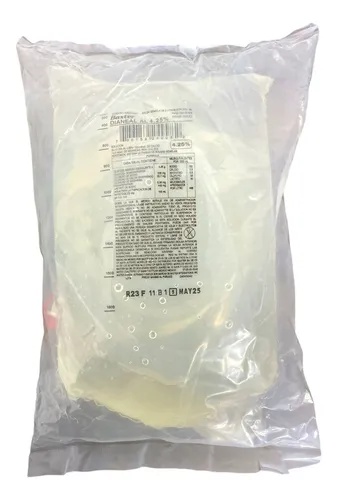
- Alternativas a CAPD/DPCA 2 SOLUCION PARA DIALISIS PERITONEALForma farmacéutica: DIALISIS PERITONEAL, 1000 mlPrincipio activo: Hypertonic solutionsFabricante: Fresenius Medical Care Deutschland GmbhRequiere recetaForma farmacéutica: DIALISIS PERITONEAL, 1000 mlPrincipio activo: Hypertonic solutionsFabricante: Fresenius Medical Care Deutschland GmbhRequiere recetaForma farmacéutica: DIALISIS PERITONEAL, 4,25 %Principio activo: Hypertonic solutionsFabricante: Fresenius Medical Care Deutschland GmbhRequiere receta
Médicos online para CAPD/DPCA 2 SOLUCION PARA DIALISIS PERITONEAL
Comenta la dosis, los posibles efectos secundarios, interacciones, contraindicaciones o la revisión de receta de CAPD/DPCA 2 SOLUCION PARA DIALISIS PERITONEAL, sujeto a valoración médica y a la normativa local.









Obtén una receta de CAPD/DPCA 2 SOLUCION PARA DIALISIS PERITONEAL online
Rellena un formulario de 2 minutos
Cuéntanos tus síntomas, historial y el medicamento que necesitas.
Elige un médico o nosotros te asignamos uno
Escoge un especialista o te conectamos con el próximo médico disponible.
El médico revisa tu caso
Normalmente en 30 minutos. Puede hacerte preguntas adicionales por chat.
Recógela en cualquier farmacia
Receta electrónica enviada a tu correo, válida en toda España.
Preguntas frecuentes
CAPD/DPCA 2 SOLUCION PARA DIALISIS PERITONEAL requires receta en España. Puedes confirmarlo con un médico online según tu caso.
El principio activo de CAPD/DPCA 2 SOLUCION PARA DIALISIS PERITONEAL es Hypertonic solutions. Esta información ayuda a identificar medicamentos con la misma composición pero con diferentes nombres comerciales.
CAPD/DPCA 2 SOLUCION PARA DIALISIS PERITONEAL es fabricado por Fresenius Medical Care Deutschland Gmbh. La marca y el envase pueden variar según el distribuidor.
Los Médicos de familia, Psiquiatras, Dermatólogos, Cardiólogos, Endocrinólogos, Gastroenterólogos, Neumólogos, Nefrólogos, Reumatólogos, Hematólogos, Infectólogos, Alergólogos, Geriatras, Pediatras, Oncólogos pueden valorar la prescripción de CAPD/DPCA 2 SOLUCION PARA DIALISIS PERITONEAL cuando esté clínicamente indicado. Puedes reservar una videoconsulta para comentar tu caso y las opciones de tratamiento.
España cuenta con una infraestructura sanitaria bien desarrollada en ciudades principales como Madrid, Barcelona, Valencia y Sevilla. Las farmacias están ampliamente disponibles y operan bajo estrictas regulaciones, garantizando el acceso a medicamentos con receta.
Puedes comprar CAPD/DPCA 2 SOLUCION PARA DIALISIS PERITONEAL en Madrid, Barcelona, Sevilla o Valencia en cualquier farmacia local con una receta válida.
Para obtener una receta, puedes utilizar Oladoctor:
Otros medicamentos con el mismo principio activo (Hypertonic solutions) incluyen BICAVERA GLUCOSA 1,5%, Calcio 1,75 mmol/l SOLUCION PARA DIALISIS PERITONEAL, BICAVERA GLUCOSA 2,3%, Calcio 1,75 mmol/l SOLUCION PARA DIALISIS PERITONEAL, BICAVERA GLUCOSA 4,25%, Calcio 1,75 mmol/l SOLUCION PARA DIALISIS PERITONEAL. Pueden tener diferentes nombres comerciales o formulaciones, pero contienen el mismo componente terapéutico. Consulta siempre con un médico antes de cambiar o iniciar un nuevo medicamento.
