


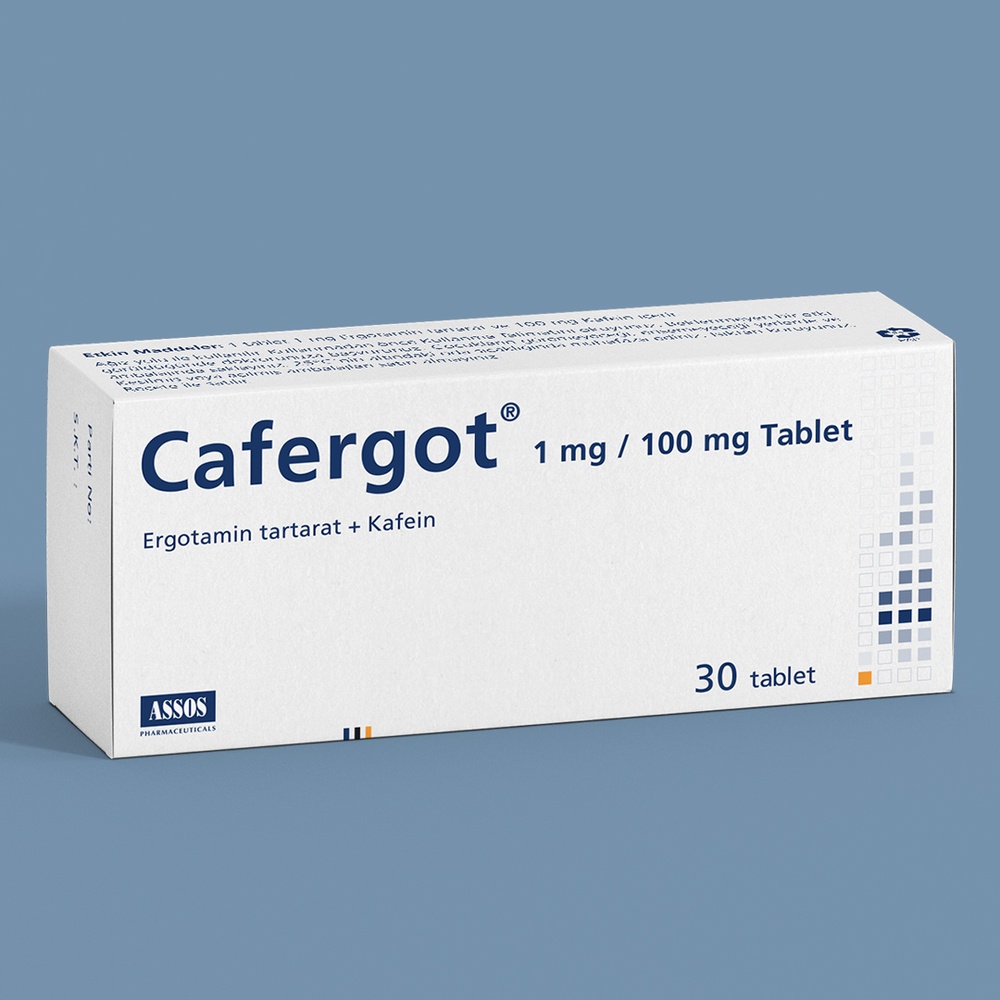
CAFERGOT 1 mg/100 mg COMPRIMIDOS



Cómo usar CAFERGOT 1 mg/100 mg COMPRIMIDOS
Traducción generada por IA
Este contenido ha sido traducido automáticamente y se ofrece solo con fines informativos. No sustituye la consulta con un profesional sanitario.
Ver originalContenido del prospecto
Introducción
Prospecto: información para el usuario
Cafergot 1 mg/100 mg comprimidos
Ergotamina, tartrato/cafeína
Lea todo el prospecto detenidamente antes de empezar a tomar este medicamento, porque contiene información importante para usted.
- Conserve este prospecto, ya que puede tener que volver a leerlo.
- Si tiene alguna duda, consulte a su médico, farmacéutico o enfermero.
- Este medicamento se le ha recetado solamente a usted, y no debe dárselo a otras personas aunque tengan los mismos síntomas que usted, ya que puede perjudicarles.
- Si experimenta efectos adversos, consulte a su médico, farmacéutico o enfermero, incluso si se trata de efectos adversos que no aparecen en este prospecto.Ver sección 4.
Contenido del prospecto:
- Qué es Cafergot y para qué se utiliza
- Qué necesita saber antes de empezar a tomar Cafergot
- Cómo tomar Cafergot
- Posibles efectos adversos
- Conservación de Cafergot
- Contenido del envase e información adicional
1. Qué es Cafergot y para qué se utiliza
Ergotamina, sustancia activa de Cafergot, pertenece a un grupo de medicamentos conocidos como alcaloides del cornezuelo del centeno. Esta sustancia constriñe los vasos sanguíneos dilatados en el cerebro que son responsables de la sensación dolorosa , por lo que corta los ataques de migraña. La cafeína acelera y aumenta la absorción de la ergotamina en el organismo.
Cafergot está indicado para el tratamiento de los ataques agudos de migraña con o sin “aura” (es decir, los problemas de visión, sensitivos o del lenguaje que algunas personas tienen poco antes del ataque y que pueden aparecer también durante y después del mismo).

2. Qué necesita saber antes de empezar a tomar Cafergot
No tome Cafergot
- - Si es alérgico al principio activo o a cualquiera de los demás componentes de este medicamento(incluidos en la sección 6).
- - Si sufre trastornos circulatorios, p.ej. síndrome de Raynaud (condición que afecta el suministro de sangre a ciertas partes del cuerpo, por lo general los dedos de manos y pies), hipertiroidismo, enfermedad vascular que disminuye el riego sanguíneo de brazos y piernas (Enfermedad vascular obliterante), enfermedad cardiaca por disminución del riego sanguíneo del corazón (Cardiopatía isquémica), hipertensión mal controlada, estado de infección generalizada (Sepsis o shock).
- - Si sufre insuficiencia hepática o renal severa.
- - Si sufre una enfermedad inflamatoria de la arteria temporal (arteria principal de la cabeza)
- - Si sufre migrañas acompañadas de síntomas neurológicos como alteración del equilibrio, del habla, de la visión, sensación de hormigueo en dedos de manos y pies y alrededor de la boca (migraña hemipléjica o basilar).
- - Si está embarazada o en periodo de lactancia.
Advertencias y precauciones
Consulte a su médico,farmacéutico o enfermero antes de empezar a tomar Cafergot
- - Cafergot está sólo indicado para el tratamiento de los ataques agudos de migraña y no como tratamiento para prevenir su aparición.
- - Debe evitarse el uso continuado de Cafergot o su uso a dosis superiores a las recomendadas ya que con dosis superiores a las recomendadas puede producirse vasoespasmo (contracción de las arterias que puede dar lugar a trastornos cerebrales, cardíacos) y tras tratamientos prolongados pueden aparecer alteraciones de la pleura (membrana que recubre los pulmones) del peritoneo (membrana que recubre las asas intestinales) o, más raramente, de las válvulas cardíacas, fibrosis cardiaca, pulmonar (enfermedad respiratoria en la que se forman cicatrices en los tejidos pulmonares) y fibrosis pleural (condición en la que el tejido que cubre los pulmones se vuelve grueso y rígido) y ergotismo (efecto de envenenamiento del cornezuelo de centeno a largo plazo), incluidos los casos graves de síntomas de la constricción de los vasos sanguíneos, con posible resultado de muerte.
- - Se recomienda precaución en pacientes con anemia.
- - Los pacientes con trastornos hereditarios raros como intolerancia a la galactosa o malabsorción de glucosa-galactosa no deben tomar este medicamento.
- - Si aparecen síntomas como hormigueo en los dedos de manos y pies, interrumpa el tratamiento inmediatamente y consulte a su médico.
- Las personas afectadas por alteración leve o moderada de la función hepática deberán ser controladas (por su médico) .
Niños y adolescentes
Cafergot no se recomienda en niños y adolescentes menores de 18 años.
Uso en ancianos
Como este medicamento contiene ergotamina, se recomienda precaución en este tipo de pacientes, ya que son más susceptibles de tener una enfermedad vascular que reduzca el flujo sanguíneo en los brazos y piernas y, por lo tanto, a experimentar los eventos adversos del diámetro reducido de los vasos sanguineos en los brazos y las piernas que adultos jóvenes. El riesgo de reducción del flujo sanguíneo en los vasos sanguíneos del corazón también es mayor en las personas de edad avanzada.
Toma de Cafergot con otros medicamentos
Informe a su médico o farmacéutico si está tomando, ha tomado recientemente o podría tener que tomar cualquier otro medicamento. La administración de antibióticos macrólidos (eritromicina, claritromicina), tetraciclina (antibiótico, utilizado para tratar infecciones bacterianas) medicamentos para el tratamiento de la infección por el HIV (p.ej. ritonavir, indinavir, nelfinavir, amprenavir, delavirdina, saguinavir, atazinavir y efavirenz) o medicamentos para el tratamiento de las infecciones por Hongos (p.ej. ketoconazol, itraconazol, voriconazol) con Cafergot puede producir una falta de riego ya que aumentan los niveles de ergotamina en sangre. Otros medicamentos que pueden provocar interacciones son: medicamentos para el tratamiento de enfermedades cardiacas y la tensión arterial como propranolol, otros preparados que contengan alcaloides del cornezuelo del centeno, nicotina (p.ej. fumar en exceso) y medicamentos para el tratamiento de la migraña como sumatriptán.
- Existe un mayor riesgo de vasoespasmo (contracción de las arterias que puede conllevar trastornos del cerebro y del corazón) observados con triptanos tales como almitriptán, fovatriptan, naratriptán, rizatriptán, sumtriptán, zolmitriptán y eletriptán). Un mayor riesgo de hipertensión.
- Las fluoroquinolonas (antibióticos de amplio espectro), la mexiletina (utilizada para tratar latidos cardíacos irregulares), la fluvoxamina (medicamento utilizado en la depresión) y los anticonceptivos orales pueden aumentar la exposición plasmática de la cafeína. Las interacciones de la cafeína con simpaticomiméticos (p.ej. epinefrina) puede conducir a un aumento de la presión arterial.
- Los inhibidores del CYP3A4 moderados a débiles, tales como cimetidina, fluvoxamina, zumo de pomelo, guinuspristina/dalfopristina y zileuton también pueden aumentar la exposición a la ergotamina y se requiere precaución para su uso concomitante.
- El uso concomitante de ergotamina con inhibidores de la recaptación de serotonina (p. ej., amitriptilina), incluidos agentes selectivos (p. ej., sertralina) puede conducir al sindrome de serotonina (interacción farmacológica potencialmente mortal) y estos deben utilizarse con precaución.
- Los fármacos (p.ej., nevirapina, rifampcina) inductores del CYP3A4 pueden conducir a una disminución de la acción farmacológica de la ergotamina.
- Quinuspristina-dalfopristina (combinado): ergotismo con posibilidad de necrosis (daño celular) de las extremidades.
- Estriripentol: ergotismo con posibilidad de necrosis (daño celular) de las extremidades.
- Alcaloides del cornezuelo de centeno dopaminérgicos (bromocriptina, cabergolina, pregolida, lisurida): riesgo de vasoconstricción (esstrechamiento de los vasos sanguíneos) y/o una crisis de hipertensión (aumento grave de la presión arterial que puede conducir a un derrame cerebral).
- Simpaticométicos alfa (vía oral y/o nasal) (etilefrina, midodrina, nafazolina, oximetazolina, fenilefrina, sinefrina, tetrisolina, tuaminoheptano, timazolina): riesgo de vasoconstricción y/o crisis de hipertensión.
- La toma con reboxetina puede causar un aumento de la presión arterial alta.
- Enoxacina (fluoroquinolonas): gran aumento en las concentraciones de cafeina en el organismo que podria conllevar excitación y alucinaciones.
- Fluoroquinolonas (ciprofloxacina, norfloxacina): gran aumento en las concentraciones de cafeina en el organismo que podría conllevar excitación y alucinaciones.
Toma de Cafergot con los alimentos, bebidas y alcohol
Cafergot puede tomarse con o sin alimentos.
Embarazo, lactancia y fertilidad
No debe tomar Cafergot si está embarazada o en período de lactancia.
Si cree que podría estar embarazada o tiene intención de quedarse embarazada, consulte a su médico o farmacéutico antes de utilizar este medicamento.
En ratas macho que recibieron la combinación de ergotamina y cafeína por vía oral, no se alteró la fertilidad.
Conducción y uso de máquinas
Los pacientes con un historial de vértigo u otros trastornos cerebrales no deberán conducir ni operar máquinas. Los pacientes no deberán conducir un vehiculo ni operar maquinaría si experimentan molestias visuales.
Este medicamento puede producir mareos. Debe tener en cuenta que algunos síntomas, como somnolencia, mareos y debilidad, causados por la propia crisis migrañosa, pueden afectar a la capacidad para conducir o utilizar máquinas.
Información importante sobre alguno de los componentes de Cafergot
Se informa a los deportistas que este medicamento contiene un componente que puede establecer un resultado analítico de control del dopaje como positivo.

3. Cómo tomar Cafergot
Siga exactamente las instrucciones de administración de este medicamento indicadas por su médico o farmacéutico. En caso de duda, consulte de nuevo a su médico o farmacéutico.
Su médico le indicará la duración de su tratamiento con Cafergot. No suspenda el tratamiento antes, sin consultar a su médico.
Vía oral.
Cafergot debe administrarse cuando aparecen los primeros síntomas de un ataque.
La dosis recomendada es:
Adultos
Si es la primera vez que toma Cafergot, se recomienda una dosis de 2 comprimidos. Si en la primera media hora no ha cedido el dolor puede tomar otro comprimido. Esto puede repetirse a intervalos de media hora sin sobrepasar la dosis máxima diaria.
Crisis posteriores: dependiendo de las dosis que fueron necesarias en crisis anteriores se puede aumentar la dosis inicial a 3 comprimidos. En caso necesario, se pueden administrar dosis adicionales de un comprimido a intervalos de media hora hasta alcanzar la dosis máxima.
Uso en niños y adolescentes
No se recomienda el uso en niños y adolescentes (menores de 18 años).
Dosis máxima diaria:
Adultos: 6 mg de ergotamina tartrato = 6 comprimidos.
Dosis máxima semanal
Adultos: 10 mg de ergotamina tartrato = 10 comprimidos.
Si toma más Cafergot del que debe
En caso de sobredosis o ingestión accidental, informe a su médico o farmacéutico inmediatamente o consulte al Servicio de Información Toxicológica, teléfono 91 562 04 20, indicando el medicamento y la cantidad ingerida. Se recomienda llevar el prospecto y el envase del medicamento al profesional sanitario.
Los síntomas ocasionados por la sobredosificación con Cafergot son: náuseas, vómitos, somnolencia, confusión, taquicardia, (aumento de la frecuencia cardiaca) mareo, entumecimiento, hormigueo y dolor de los dedos de manos y pies. Se puede llegar a producir disminución de la frecuencia respiratoria y coma.
Si olvidó tomar Cafergot
No tome una dosis doble para compensar las dosis olvidadas.
Si interrumpe el tratamiento con Cafergot
Si tiene cualquier otra duda sobre el uso de este medicamento, pregunte a su médico, o farmacéutico o enfermero.
4. Posibles efectos adversos
Al igual quetodos los medicamentos, este medicamento puede producir efectos adversos, aunque no todas las personas los sufran.
Si experimenta alguno de los siguientes efectos adversos, consulte a su médico inmediatamente:
- Reacciones alérgicas graves como erupción o picazón, hinchazón de la cara, párpados, labios, urticaria, dificultad para respirar.
Otros efectos adversos:
Frecuente:Pueden afectar hasta 1 de cada 10 personas
Mareos, náuseas y vómitos no relacionados con la migraña y dolor abdominal.
Poco frecuentes: Pueden afectar hasta 1 de cada 100 personas
Entumecimiento y hormigueo de los dedos de manos y pies, coloración azulada de piel, diarrea, dolor y debilidad en brazos y piernas. Decoloración azulada de la piel debido a mala circulación sanguínea.
Raras:Pueden afectar hasta 1 de cada 1.000 personas
Aceleración o enlentecimiento del ritmo de latido del corazón, aumento de la presión sanguínea, erupción en la piel, hinchazon en la cara, urticaria, dolor en los músculos, falta de pulso y dificultad para respirar, cefalea, vértigo, espasmos muculares, ergotismo (efecto del envenenamiento a largo plazo).
Muy raros:Pueden afectar hasta 1 de cada 10.000 personas
Infarto de miocardio (ataque cardíaco) oangina de pecho (dolor torácico), gangrena (muerte del tejido del cuerpo debido a la falta de flujo de sangre o a una infección bacteriana).
No conocidos:la frecuencia no puede estimarse a partir de los datos disponibles
Fibrosis endocárdica (una forma de trastorno del corazón en el que las paredes del corazón son rigidas y el corazón es incapaz de estirarse y llenarse de sangre adecuadamente), fibrosis pleural (afección en la que el tejido que cubre los pulmones se vuelve grueso y rígido), fibrosis retroperitoneal (rara condición en la cual los conductos que llevan la orina desde los riñones hasta la vejiga son bloqueados por las masas ubicadas en la parte posterior de la cavidad abdominal), úlcera rectal, úlcera anal, dolor de cabeza inducido por fármacos.
Comunicación de efectos adversos:
Si experimenta cualquier tipo de efecto adverso, consulte a su médico, farmacéutico o enfermero, incluso si se trata de posibles efectos adversos que no aparecen en este prospecto. También puede comunicarlos directamente a través del Sistema Español de Farmacovigilancia de medicamentos de Uso Humano: https://www.notificaram.es. Mediante la comunicación de efectos adversos usted puede contribuir a proporcionar más información sobre la seguridad de este medicamento.
5. Conservación de Cafergot
Mantener este medicamento fuera de la vista y del alcance de los niños.
Conservar en el embalaje original para proteger de la luz.
No conservar a temperatura superior a 25ºC No utilicer este medicamento después de la fecha de caducidad que aparece en el envase después de CAD. La fecha de caducidad es el último día del mes que se indica.
Los medicamentos no se deben tirar por los desagües ni a la basura. Deposite los envases y los medicamentos que no necesita en el Punto SIGREde la farmacia. En caso de duda pregunte a su farmacéutico cómo deshacerse de los envases y de los medicamentos que ya no necesita. De esta forma, ayudará a proteger el medio ambiente.
6. Contenido del envase e información adicional
Composición de Cafergot
Los principios activos son ergotamina (DOE) tartrato 1 mg y cafeína anhidra 100 mg.
Los demás componentes del comprimido son: ácido tartárico, estearato magnésico, talco, almidón de maíz, celulosa microcristalina, óxido de hierro amarillo (E172).
Aspecto del producto y contenido del envase
Cafergot se presenta en forma de comprimidos. Cafergot está disponible en envases tipo blister de aluminio/PVC/PVDC de 10 comprimidos.La ranura sirve únicamente para fraccionar y facilitar la deglución pero no para dividir en partes iguales.
Titular de la autorización de comercialización y responsable de la fabricación
Titular
Amdipharm Limited
Temple Chambers,
3 Burlington Road,
Dublín 4, Irlanda
Responsable de la fabricación
CENEXI 52 rue Marcel et Jacques Gaucher (Fontenay Souus Bois) - 94120 - Francia
Pueden solicitar más información respecto a este medicamento dirigiéndose al representante local del titular de la autorización de comercialización:
Representante local
Ferrer Internacional, S.A.
Gran Vía Carlos III, 94
08028 – Barcelona
Fecha de revisión de este prospecto: Julio 2022
La información detallada y actualizada de este medicamento está disponible en la página web de la Agencia Española de Medicamentos y Productos Sanitarios (AEMPS)http://www.aemps.gob.es/
- País de registro
- Forma farmacéuticaCOMPRIMIDO, 1 mg ergotamina+100 mg cafeina
- Código ATCN02CA52
- Principio activo
- Requiere recetaSí
- Fabricante
- Esta información es de carácter general y no sustituye la consulta con un profesional sanitario.
- Alternativas a CAFERGOT 1 mg/100 mg COMPRIMIDOSForma farmacéutica: SUPOSITORIO, 400mg paracetamol; 100mg cafeína; 2mg ergotaminaPrincipio activo: ergotamine, combinations excl. psycholepticsFabricante: Desma Laboratorio Farmaceutico S.L.Requiere recetaForma farmacéutica: COMPRIMIDO, 300mg paracetamol; 100mg cafeína; 1mg ergotaminaPrincipio activo: ergotamine, combinations excl. psycholepticsFabricante: Desma Laboratorio Farmaceutico S.L.Requiere recetaForma farmacéutica: INYECTABLE, 140 mgPrincipio activo: ErenumabFabricante: Novartis Europharm LimitedRequiere receta

Médicos online para CAFERGOT 1 mg/100 mg COMPRIMIDOS
Comenta la dosis, los posibles efectos secundarios, interacciones, contraindicaciones o la revisión de receta de CAFERGOT 1 mg/100 mg COMPRIMIDOS, sujeto a valoración médica y a la normativa local.











Preguntas frecuentes
