






Cómo usar BUPIVACAINA PHYSAN 2,5 MG/ML SOLUCION INYECTABLE
Traducción generada por IA
Este contenido ha sido traducido automáticamente y se ofrece solo con fines informativos. No sustituye la consulta con un profesional sanitario.
Ver originalContenido del prospecto
- Introducción
- Qué es Bupivacaína Physan 2,5 mg/ml y para qué se utiliza
- Qué necesita saber antes de empezar a usar Bupivacaína Physan 2,5 mg/ml
- Cómo usar Bupivacaína Physan 2,5 mg/ml
- Posibles efectos adversos
- Si experimenta cualquier tipo de efecto adverso, consulte a su médico o farmacéutico, incluso si se trata de posibles efectos adversos que no aparecen en este prospecto. También puede comunicarlos directamente a través del Sistema Español de Farmacovigilancia de Medicamentos de Uso Humano: www.notificaram.es. Mediante la comunicación de efectos adversos usted puede contribuir a proporcionar más información sobre la seguridad de este medicamento
- Conservación de Bupivacaína Physan 2,5 mg/ml
- Los medicamentos no se deben tirar por los desagües ni a la basura. Pregunte a su farmacéutico cómo deshacerse de los envases y de los medicamentos que no necesita. De esta forma ayudará a proteger el medio ambiente.
- Contenido del envase e información adicional
Introducción
Prospecto: información para el usuario
Bupivacaína Physan 2,5 mg/ml solución inyectable
Hidrocloruro de bupivacaína
Leer todo el prospecto detenidamente antes de empezar a usar el medicamento, porque contiene información importante para usted
- Conserve este prospecto, ya que puede tener que volver a leerlo.
- Si tiene alguna duda, consulte a su médico, farmacéutico o enfermero.
- Este medicamento se le ha recetado solamente a usted, y no debe dárselo a otras personas aunque tengan los mismos síntomas que usted, ya que puede perjudicarles.
- Si experimenta efectos adversos consulte a su médico, farmacéutico o enfermero, incluso si se trata de efectos adversos que no aparecen en este prospecto. Ver sección 4.
Contenido del prospecto:
- Qué es Bupivacaína Physan 2,5 mg/ml y para qué se utiliza
- Qué necesita saber antes de empezar a usar Bupivacaína Physan 2,5 mg/ml
- Cómo usar Bupivacaína Physan 2,5 mg/ml
- Posibles efectos adversos
- Conservación de Bupivacaína Physan 2,5 mg/ml
- Contenido del envase e información adicional
1. Qué es Bupivacaína Physan 2,5 mg/ml y para qué se utiliza
Este medicamento contiene hidrocloruro de bupivacaína, un anestésico local (agente que reduce o elimina las sensaciones, afectando una región particular) que pertenece al subgrupo de las amidas.
Le ha sido recetado para proporcionarle efecto anestésico.

2. Qué necesita saber antes de empezar a usar Bupivacaína Physan 2,5 mg/ml
No use Bupivacaína Physan 2,5 mg/ml:
- Si es alérgico al hidrocloruro de bupivacaína o a alguno de los demás componentes de este medicamento (incluidos en la sección 6).
- Si es alérgico a cualquier otro anestésico local del mismo grupo (por ejemplo, articaína, mepivacaína, lidocaína o prilocaína).
- Si se emplea como anestesia regional intravenosa (bloqueo de Bier), ya que el paso inadvertido de bupivacaína a la circulación sanguínea puede dar lugar a reacciones sistémicas de toxicidad aguda.
- Si padece alguna de las siguientes afecciones no se debe realizar una anestesia epidural:
- Enfermedad del sistema nervioso central preexistente atribuible a infección, tumores u otras causas.
- Deformación espinal y enfermedad activa (ej. espondilitis, tumor, tuberculosis) o lesión reciente (ej. fractura) de la columna vertebral.
- Infección de la piel en el lugar de la inyección o en posición próxima.
- Enfermedad cardiovascular, sobre todo bloqueo cardíaco o shock hipovolémico.
- Alteraciones de la coagulación o tratamiento anticoagulante en curso.
Advertencias y precauciones
Consulte a su médico antes de empezar a usar Bupivacaína Physan 2,5 mg/ml:
- Si tiene algún tipo de bloqueo en el corazón
- Si padece alteraciones del ritmo del corazón
- Si tiene la presión arterial baja
- Si tiene hemorragia
- Si padece algún tipo de infección
- Si padece alteraciones del hígado o riñón.
Niños
La bupivacaína deberá utilizarse con precaución en niños de 1 a 12 años, debido a que tienen una mayor probabilidad de toxicidad sistémica
Otros medicamentos y Bupivacaína Physan 2,5 mg/ml
Informe a su médico o farmacéutico si está utilizando o ha utilizado recientemente o podría tener que utilizar cualquier otro medicamento, incluso los adquiridos sin receta.
Bupivacaína debe usarse con precaución en pacientes que están recibiendo tratamiento con agentes estructuralmente parecidos a los anestésicos locales tipo amida, ya que puede producirse aumento de los efectos tóxicos sistémicos.
Informe a su médico si está tomando alguno de los siguientes medicamentos, ya que pueden alterar los efectos de Bupivacaína Physan 2,5 mg/ml:
- Anticoagulantes, como heparina.
- Antiinflamatorios no esteroideos (AINE) como ibuprofeno, para combatir la inflamación, el dolor o la fiebre.
- Sustitutos del plasma (dextrano).
Embarazo y lactancia
Si está embarazada o en periodo de lactancia, cree que podría estar embarazada o tiene intención de quedarse embarazada, consulte a su médico o farmacéutico antes de utilizar este medicamento.
Embarazo
En caso de estar embarazada su médico le recetará Bupivacaína Physan 2,5 mg/ml teniendo en cuenta el beneficio que pueda tener frente al riesgo para su bebé.
Lactancia
Bupivacaína se excreta en la leche materna, pero a las dosis terapéuticas de este medicamento no se esperan efectos en los niños en período de lactancia.
Conducción y uso de máquinas
Bupivacaína Physan 2,5 mg/ml puede alterar temporalmente su capacidad de movimiento, atención y coordinación. Su médico le indicará si puede conducir o utilizar máquinas.
Bupivacaína Physan 2,5 mg/ml contiene sodio
Este medicamento contiene 31,5 mg de sodio (componente principal de la sal de mesa/para cocinar) por ampolla de 10 ml. Esto equivale al 1,58% de la ingesta diaria máxima de sodio recomendada para un adulto.
3. Cómo usar Bupivacaína Physan 2,5 mg/ml

Este medicamento debe administrarse solo bajo la supervisión de un médico con experiencia en la utilización de este tipo de medicamentos.
Este medicamento se administra en forma de inyección mediante infiltración, por vía subcutánea, vía intramuscular, vía epidural, vía intraarticular, vía perineural y uso perióseo.
La dosis, velocidad de administración y duración del tratamiento será variable dependiendo del proceso anestésico que se lleve a cabo, del área que debe ser anestesiada y del peso, situación clínica y respuesta del paciente.
Si se administra más Bupivacaína Physan 2,5 mg/ml del que se debe
Al igual que con los otros anestésicos locales, debido a una excesiva dosificación, una rápida absorción o una inyección accidental en vasos sanguíneos, pueden presentarse síntomas de intoxicación que pueden manifestarse:
- Sobre el sistema nervioso central:
Caracterizados por hormigueos, entumecimiento de la lengua, ligero desvanecimiento, pitidos en los oídos, visión borrosa y temblores musculares. A continuación pueden aparecer convulsiones e inconsciencia, seguidas de problemas para respirar.
- Sobre el sistema cardiovascular:
Presión arterial baja (hipotensión), disminución del ritmo cardiaco, arritmia y paro cardíaco.
Si se producen efectos tóxicos, la primera medida es cesar la administración del anestésico local. El subsiguiente tratamiento consiste en parar las convulsiones y asegurar la respiración adecuada con oxígeno, si es necesario por respiración asistida. Si se producen convulsiones pueden tratarse con 100 - 150 mg de tiopental i.v o 5 - 10 mg de diazepam i.v. Si existe hipotensión debe administrarse un vasopresor por vía intravenosa, por ejemplo 5 - 10 mg de efedrina. Si se produce un paro circulatorio debe aplicarse inmediatamente la reanimación cardiopulmonar y administrar lo antes posible una dosis de 0,1 – 0,2 mg de adrenalina por vía intravenosa o intracardiaca. Si aparece paro cardiaco, debe aplicarse un esfuerzo de reanimación prolongado.
En caso de sobredosis o administración accidental, consulte inmediatamente a su médico o farmacéutico o llame al Servicio de Información Toxicológica, teléfono: 91 562 04 20, indicando el medicamento y la cantidad ingerida.
4. Posibles efectos adversos
Al igual que todos los medicamentos, Bupivacaína Physan 2,5 mg/ml puede producir efectos adversos, aunque no todas las personas los sufran.
Los efectos adversos que puede experimentar pueden clasificarse en función de su frecuencia en:
- Muy frecuentes (pueden afectar a más de 1 de cada 10 personas):descenso de la presión arterial y náuseas.
- Frecuentes (pueden afectar a hasta 1 de cada 10 personas):hormigueo, vértigo, disminución del ritmo cardiaco, aumento de la presión arterial, vómitos, retención de orina.
- Poco frecuentes (pueden afectar a hasta 1 de cada 100 personas):convulsiones, hormigueo alrededor de la boca, adormecimiento de la lengua, aumento de la sensibilidad auditiva, alternaciones visuales, pérdida de conciencia, temblores, ligero dolor de cabeza, zumbido en los oídos, dificultad para hablar correctamente.
- Raros (pueden afectar a hasta 1 de cada 1.000 personas):reacciones alérgicas, choque anafiláctico, alteraciones nerviosas, visión doble, paro cardiaco, arritmias, dificultad para respirar,.
Comunicación de efectos adversos
Si experimenta cualquier tipo de efecto adverso, consulte a su médico o farmacéutico, incluso si se trata de posibles efectos adversos que no aparecen en este prospecto. También puede comunicarlos directamente a través del Sistema Español de Farmacovigilancia de Medicamentos de Uso Humano: www.notificaram.es. Mediante la comunicación de efectos adversos usted puede contribuir a proporcionar más información sobre la seguridad de este medicamento
5. Conservación de Bupivacaína Physan 2,5 mg/ml
Mantener este medicamento fuera de la vista y del alcance de los niños.
No conservar a temperatura superior a 25ºC. No congelar.
No utilice este medicamento después de la fecha de caducidad que aparece en la ampolla y en el cartón del producto. La fecha de caducidad es el último día del mes que se indica.
Las soluciones no contienen conservantes y deben ser usadas inmediatamente tras su apertura. Todo resto de solución debe ser desechado.
Los medicamentos no se deben tirar por los desagües ni a la basura. Pregunte a su farmacéutico cómo deshacerse de los envases y de los medicamentos que no necesita. De esta forma ayudará a proteger el medio ambiente.
6. Contenido del envase e información adicional
Composición de Bupivacaína Physan 2,5 mg/ml
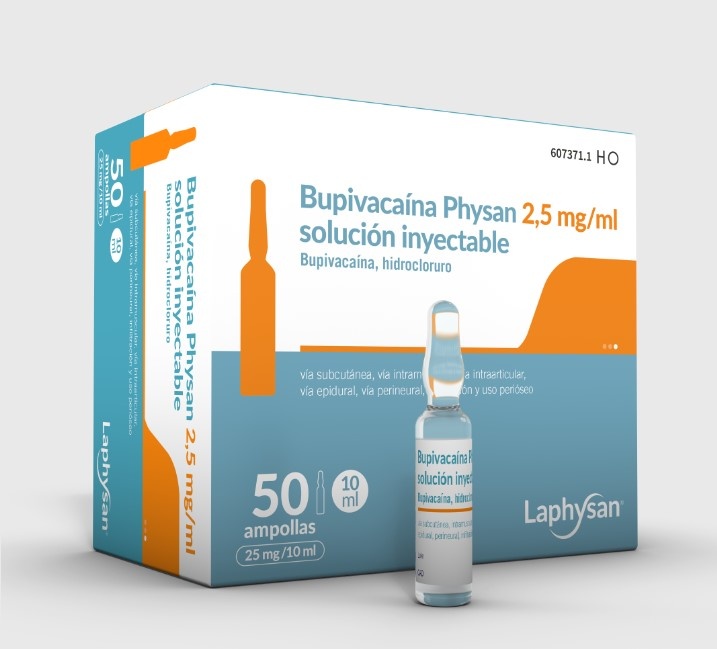
- El principio activo es hidrocloruro de bupivacaína. Un ml contiene 2,5 mg de hidrocloruro de bupivacaína. Cada ampolla de 10 ml contiene 25 mg de hidrocloruro de bupivacaína.
- Los demás componentes son: cloruro de sodio, hidróxido de sodio (E-524) y/o ácido clorhídrico (para el ajuste de pH) y agua para preparaciones inyectables.
Aspecto del producto y contenido del envase
Bupivacaína Physan 2,5 mg/ml está envasado en ampollas de vidrio.
Este medicamento se presenta en envases clínicos que contienen 50 ampollas o 100 ampollas de vidrio de 10 ml.
Puede que solamente estén comercializados algunos tamaños de envases.
Titular de la autorización de comercialización
LAPHYSAN S.A.U.
Anabel Segura, 11 Edificio A, Planta 4, Puerta D,
28108 Alcobendas
MADRID. ESPAÑA
Responsable de la fabricación
LABORATORIOS BASI – INDUSTRIA FARMACÉUTICA, S.A.
Parque Industrial Manuel Lourenço Ferreira,
Nº 8, Nº 15 y Nº 16
3450-232 Mortágua - Portugal
Esta información está destinada únicamente a médicos o profesionales del sector sanitario
Las soluciones deben ser usadas inmediatamente después de su apertura. Todo resto de solución debe ser desechado.
Es necesario tomar precauciones con el fin de prevenir reacciones de toxicidad aguda, evitando la inyección intravascular. Se aconseja realizar una aspiración antes y durante la administración. Una inyección intravascular accidental puede ser detectada por un aumento temporal del ritmo cardiaco. La dosis máxima debe ser administrada muy lentamente, a un ritmo de 25-50 mg/min, o en incrementos de dosis, manteniendo un contacto verbal constante con el paciente. Si aparecen síntomas de toxicidad, debe cesarse inmediatamente la administración.
Los procesos de anestesia regional o local, exceptuando aquellos de naturaleza trivial, deben ser siempre llevados a cabo por profesionales debidamente formados y en áreas con acceso inmediato al equipo y medicamentos de reanimación. Cuando se llevan a cabo bloqueos mayores, debe insertarse previamente un catéter intravascular en el lugar de inyección del anestésico local. Los médicos deben recibir la formación adecuada según el proceso que deben realizar y estar familiarizados con el diagnóstico y tratamiento de los efectos secundarios, la toxicidad sistémica y otras complicaciones.
En cualquier caso, y teniendo en cuenta que la posología debe calcularse en función de varios factores, aconsejamos consultar la información facilitada en la Ficha Técnica antes de usar este medicamento.
Incompatibilidades
Bupivacaína presenta una solubilidad limitada a pH superior a 6,5. Esto debe tenerse en cuenta en el caso de que deban añadirse soluciones alcalinas (por ej. carbonatos), ya que puede aparecer precipitación.
Última revisión del prospecto: octubre 2020
La información detallada y actualizada de este medicamento está disponible en la página Web de la Agencia Española de Medicamentos y Productos Sanitarios (AEMPS) http://www.aemps.es/
-

- País de registro
- Forma farmacéuticaINYECTABLE, 0,25% bupivacaina hidrocloruro
- Código ATCN01BB01
- Principio activo
- Requiere recetaSí
- Fabricante
- Esta información es de carácter general y no sustituye la consulta con un profesional sanitario.
- Alternativas a BUPIVACAINA PHYSAN 2,5 MG/ML SOLUCION INYECTABLEForma farmacéutica: INYECTABLE, 2,5 mg/mlPrincipio activo: bupivacaineFabricante: Eugia Pharma (Malta) LimitedRequiere recetaForma farmacéutica: INYECTABLE, 5 mg/mlPrincipio activo: bupivacaineFabricante: Eugia Pharma (Malta) LimitedRequiere recetaForma farmacéutica: INYECTABLE, 50 mg bupivacaina hidrocloruro/ 10 mlPrincipio activo: bupivacaineFabricante: B Braun Medical S.A.Requiere receta

Médicos online para BUPIVACAINA PHYSAN 2,5 MG/ML SOLUCION INYECTABLE
Comenta la dosis, los posibles efectos secundarios, interacciones, contraindicaciones o la revisión de receta de BUPIVACAINA PHYSAN 2,5 MG/ML SOLUCION INYECTABLE, sujeto a valoración médica y a la normativa local.









Obtén una receta de BUPIVACAINA PHYSAN 2,5 MG/ML SOLUCION INYECTABLE online
Rellena un formulario de 2 minutos
Cuéntanos tus síntomas, historial y el medicamento que necesitas.
Elige un médico o nosotros te asignamos uno
Escoge un especialista o te conectamos con el próximo médico disponible.
El médico revisa tu caso
Normalmente en 30 minutos. Puede hacerte preguntas adicionales por chat.
Recógela en cualquier farmacia
Receta electrónica enviada a tu correo, válida en toda España.
Preguntas frecuentes
BUPIVACAINA PHYSAN 2,5 MG/ML SOLUCION INYECTABLE requires receta en España. Puedes confirmarlo con un médico online según tu caso.
El principio activo de BUPIVACAINA PHYSAN 2,5 MG/ML SOLUCION INYECTABLE es bupivacaine. Esta información ayuda a identificar medicamentos con la misma composición pero con diferentes nombres comerciales.
BUPIVACAINA PHYSAN 2,5 MG/ML SOLUCION INYECTABLE es fabricado por Laphysan S.A.U.. La marca y el envase pueden variar según el distribuidor.
Los Médicos de familia, Psiquiatras, Dermatólogos, Cardiólogos, Endocrinólogos, Gastroenterólogos, Neumólogos, Nefrólogos, Reumatólogos, Hematólogos, Infectólogos, Alergólogos, Geriatras, Pediatras, Oncólogos pueden valorar la prescripción de BUPIVACAINA PHYSAN 2,5 MG/ML SOLUCION INYECTABLE cuando esté clínicamente indicado. Puedes reservar una videoconsulta para comentar tu caso y las opciones de tratamiento.
España cuenta con una infraestructura sanitaria bien desarrollada en ciudades principales como Madrid, Barcelona, Valencia y Sevilla. Las farmacias están ampliamente disponibles y operan bajo estrictas regulaciones, garantizando el acceso a medicamentos con receta.
Puedes comprar BUPIVACAINA PHYSAN 2,5 MG/ML SOLUCION INYECTABLE en Madrid, Barcelona, Sevilla o Valencia en cualquier farmacia local con una receta válida.
Para obtener una receta, puedes utilizar Oladoctor:
Otros medicamentos con el mismo principio activo (bupivacaine) incluyen BUPIVACAINA AUROVITAS 2,5 MG/ML SOLUCION INYECTABLE EFG, BUPIVACAINA AUROVITAS 5 MG/ML SOLUCION INYECTABLE EFG, BUPIVACAINA B. BRAUN 5 mg/ml SOLUCION INYECTABLE. Pueden tener diferentes nombres comerciales o formulaciones, pero contienen el mismo componente terapéutico. Consulta siempre con un médico antes de cambiar o iniciar un nuevo medicamento.
