



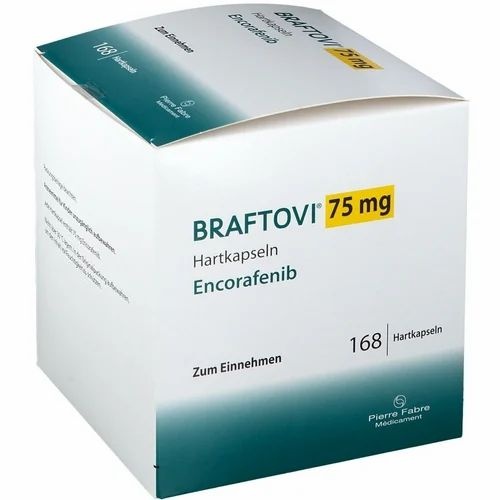
BRAFTOVI 75 mg Capsulas Duras

Revisión de receta online
Un médico revisará tu caso y determinará si la prescripción es médicamente apropiada.

Habla con un médico sobre este medicamento
Comenta tus síntomas y las opciones de tratamiento en una consulta online.



Cómo usar BRAFTOVI 75 MG CAPSULAS DURAS
Contenido del prospecto
- Introducción
- Qué es Braftovi y para qué se utiliza
- Qué necesita saber antes de empezar a tomar Braftovi
- Cómo tomar Braftovi
- Posibles efectos adversos
- Conservación de Braftovi
- Contenido del envase e información adicional
Introducción
Prospecto: información para el paciente
Braftovi 50 mg cápsulas duras
Braftovi 75 mg cápsulas duras
encorafenib
Lea todo el prospecto detenidamente antes de empezar a tomar este medicamento, porque
contiene información importante para usted.
- Conserve este prospecto, ya que puede tener que volver a leerlo.
- Si tiene alguna duda, consulte a su médico, farmacéutico o enfermero.
- Este medicamento se le ha recetado solamente a usted, y no debe dárselo a otras personas aunque tengan los mismos síntomas que usted, ya que puede perjudicarles.
- Si experimenta efectos adversos, consulte a su médico, farmacéutico o enfermero, incluso si se trata de efectos adversos que no aparecen en este prospecto. Ver sección 4.
Contenido del prospecto
- Qué es Braftovi y para qué se utiliza
- Qué necesita saber antes de empezar a tomar Braftovi
- Cómo tomar Braftovi
- Posibles efectos adversos
- Conservación de Braftovi
- Contenido del envase e información adicional
1. Qué es Braftovi y para qué se utiliza
Braftovi es un medicamento contra el cáncer que contiene encorafenib como principio activo.
Cambios (mutaciones) en el gen BRAF pueden producir proteínas que causan el crecimiento del melanoma. Braftovi se dirige a las proteínas sintetizadas a partir de este gen BRAF modificado.
Se utiliza en combinación con otro medicamento que contiene binimetinib, para tratar pacientes adultos con un tipo de cáncer de piel llamado melanoma o un tipo de cáncer de pulmón llamado cáncer de pulmón no microcítico (CPNM) cuando el cáncer:
- presenta una alteración (mutación) específica en un gen responsable de producir una proteína denominada BRAF, y
- se ha extendido a otras partes del cuerpo o no se puede eliminar mediante cirugía.
Cuando Braftovi se utiliza en combinación con binimetinib, que se dirige a otra proteína que estimula el crecimiento de la célula cancerosa, la combinación enlentece o incluso detiene el crecimiento del cáncer.
Braftovi también se utiliza en combinación con otro medicamento que contiene cetuximab, para tratar pacientes adultos con un tipo de cáncer colorrectal cuando:
- presenta una alteración (mutación) específica en un gen responsable de producir una proteína llamada BRAF, y
- se ha extendido a otras partes del cuerpo de los pacientes que han sido tratados previamente con otros medicamentos contra el cáncer.
Cuando Braftovi se utiliza en combinación con cetuximab (que se une al receptor del factor de crecimiento epidérmico (EGFR), una proteina en la superficie de ciertas células cancerosas), la combinación ralentiza o detiene el crecimiento de su cáncer.

¿No estás seguro de si este medicamento es adecuado para ti?
Comenta tus síntomas y tratamiento con un médico online.
2. Qué necesita saber antes de empezar a tomar Braftovi
Antes de comenzar el tratamiento, su médico verificará la mutación de BRAF.
Puesto que Braftovi se utiliza en combinación con binimetinib para tratar el melanoma y CPNM, lea detenidamente el prospecto de binimetinib, además de este prospecto.
Puesto que Braftovi se utiliza en combinación con cetuximab para tratar el cáncer colorrectal, lea detenidamente el prospecto de cetuximab, además de este prospecto.
No tome Braftovi
- si es alérgico a encorafenib o a alguno de los demás componentes de este medicamento (incluidos en la sección 6).
Advertencias y precauciones
Consulte a su médico, farmacéutico o enfermero antes de empezar a tomar Braftovi, e indíquele todos sus problemas de salud, en especial si tiene:
- problemas de corazón, como alteraciones de la actividad eléctrica cardíaca (prolongación del intervalo QT)
- problemas de sangrado o si está tomando algún medicamento que pueda provocar sangrados
- problemas en los ojos
- problemas de hígado o riñones
Informe a su médico si ha tenido algún otro cáncer distinto del melanoma, del cáncer colorrectal o CPNM, ya que Braftovi puede empeorar otros tipos de cáncer.
Póngase en contacto inmediatamente con su médico, farmacéutico o enfermero si sufre alguno de los siguientes trastornos mientras está tomando este medicamento:
- Problemas de corazón: Braftovi, cuando se toma con binimetinib, puede hacer que su corazón no funcione tan bien, alterar la actividad eléctrica cardíaca denominada "prolongación del intervalo QT", o hacer que empeoren otros problemas de corazón ya existentes. El médico comprobará que su corazón funciona correctamente antes, durante y después del tratamiento con estos medicamentos. Consulte inmediatamente a su médico si tiene algún síntoma de problema cardiaco como mareos, cansancio, aturdimiento, le falta el aire, si su corazón late con fuerza, se le acelera, late de forma irregular o si tiene hinchazón en las piernas.
- Problemas de sangrado: Braftovi puede causar problemas graves de sangrado. Consulte
inmediatamente a su médico si tiene cualquier signo de sangrado como tos con sangre, coágulos de sangre, vómitos que contienen sangre o que parecen "café molido", heces rojas o negras, que parecen alquitrán, sangre en la orina, dolor de estómago (abdominal), sangrado vaginal inusual. También informe a su médico si tiene dolor de cabeza, mareos o debilidad.
- Problemas en los ojos: Braftovi, cuando se toma con binimetinib, puede causar problemas oculares graves. Consulte inmediatamente a su médico si tiene visión borrosa, pérdida de visión u otros cambios en la visión (por ejemplo, ver puntos coloreados), halos (ver borrosos los contornos de los objetos). El médico le examinará los ojos para detectar cualquier problema de visión mientras esté tomando Braftovi.
- Cambios en la piel: Braftovi puede causar otros tipos de cáncer de piel, como el carcinoma de células escamosas de la piel. También se pueden producir nuevos melanomas mientras está tomando Braftovi. El médico le examinará la piel en busca de nuevos cánceres de piel antes del tratamiento, cada 2 semanas mientras dure el tratamiento y hasta 6 meses después de que haya dejado de tomar Braftovi. Consulte inmediatamente al médico si observa cambios en la piel durante el tratamiento y después del mismo, por ejemplo: nuevas verrugas, úlceras en la piel o bultos rojizos que sangran o no se curan, o cambios de tamaño o color de algún lunar. Además, el médico le examinará para detectar carcinoma de células escamosas de la piel en la cabeza, el cuello, la boca y los ganglios linfáticos, y se le realizará un TAC con regularidad. Esto es por precaución, en caso de que se desarrolle un nuevo carcinoma de células escamosas dentro de su cuerpo. También se recomiendan exploraciones genitales (en las mujeres) y anales, antes del tratamiento y al finalizar el mismo.
- Problemas de hígado: Braftovi puede causar anomalías en los análisis de sangre, relacionadas con el funcionamiento de su hígado (niveles elevados de enzimas hepáticas). El médico le pedirá que se haga análisis de sangre para controlar su hígado antes y durante el tratamiento.
- Problemas de riñón: Braftovi puede alterar la actividad de los riñones (a menudo manifestada por anomalías en los análisis de sangre y, más raramente, como deshidratación y vómitos). El médico le pedirá que se haga análisis de sangre para controlar la función renal antes y durante el tratamiento. Beba mucho líquido durante el tratamiento. Consulte inmediatamente al médico si sufre vómitos y se deshidrata.
Si experimenta los siguientes síntomas, comuníquese con su médico de inmediato, ya que puede ser un trastorno potencialmente mortal: náuseas, dificultad para respirar, latidos cardíacos irregulares, calambres musculares, convulsiones, orina turbia, disminución de la producción de orina y cansancio. Estos pueden ser causados por un grupo de complicaciones metabólicas que pueden ocurrir durante el tratamiento del cáncer y que son causadas por los productos de descomposición de las células cancerosas moribundas (síndrome de lisis tumoral (SLT)) y pueden provocar cambios en la función renal (ver también la sección 4: Posibles efectos secundarios).
Niños y adolescentes
Braftovi no se recomienda en niños y adolescentes menores de 18 años. Este medicamento no se ha estudiado en este grupo de edad.
Otros medicamentos y Braftovi
Informe a su médico, farmacéutico o enfermero si está tomando, ha tomado recientemente o pudiera tener que tomar cualquier otro medicamento.
Algunos medicamentos pueden influir en la forma que actúa Braftovi o aumentar el riesgo de efectos adversos.
En particular, consulte a su médico si está tomando algún medicamento de esta lista o cualquier otro:
- algunos medicamentos para tratar las infecciones por hongos (como itraconazol, posaconazol, fluconazol)
- algunos medicamentos para tratar las infecciones por bacterias (como rifampicina, claritromicina, telitromicina, eritromicina, penicilina)
- medicamentos usados de forma habitual para tratar la epilepsia (convulsiones) (como fenitoína, carbamazepina)
- medicamentos usados de forma habitual para tratar el cáncer (como metotrexato, imatinib)
- medicamentos utilizados de forma habitual para tratar el colesterol alto (como rosuvastatina, atorvastatina)
- un tratamiento herbal para la depresión: hierba de San Juan
- algunos medicamentos para el tratamiento del VIH (como ritonavir, amprenavir, raltegravir, dolutegravir).
- medicamentos anticonceptivos que contienen hormonas
- medicamentos utilizados de forma habitual para tratar la presión arterial alta (como diltiazem, bosentán, furosemida)
- un medicamento utilizado para tratar un latido cardíaco desigual: amiodarona.
Toma de Braftovi con alimentos y bebidas
No tome zumo de pomelo durante su tratamiento con Braftovi. Esto se debe a que podría aumentar los efectos secundarios de Braftovi.
Embarazo
No se recomienda utilizar Braftovi durante el embarazo. Puede causar daños al feto o defectos de nacimiento.
Si está embarazada, cree que podría estar embarazada o tienen intención de quedarse embarazada, consulte a su médico antes de utilizar este medicamento.
Si es usted mujer con posibilidad de quedarse embarazada, debe utilizar un método anticonceptivo fiable mientras esté tomando Braftovi, y debe continuar utilizándolo durante al menos 1 mes después de tomar la última dosis. Es posible que los medicamentos anticonceptivos que contienen hormonas (como las píldoras, inyecciones, parches, implantes y ciertos dispositivos intrauterinos (DIU) que liberan hormonas) no sean eficaces mientras esté tomando Braftovi. Se debe utilizar otro método anticonceptivo fiable, como un método de barrera (p. ej., preservativo) para no quedarse embarazada mientras esté tomando este medicamento. Consulte con su médico, farmacéutico o enfermero.
Contacte inmediatamente con su médico si se queda embarazada mientras está tomando Braftovi.
Lactancia
No se recomienda utilizar Braftovi durante la lactancia. Se desconoce si Braftovi pasa a la leche materna. Si está dando el pecho o tienen intención de dar el pecho, consulte a su médico antes de tomar este medicamento.
Fertilidad
Braftovi puede reducir el número de espermatozoides, lo que podría afectar a su capacidad para engendrar. Consulte a su médico si esto le supone un problema.
Conducción y uso de máquinas
Braftovi puede afectar a su capacidad para conducir o utilizar máquinas. Evite conducir o utilizar máquinas si tiene problemas de visión o cualquier otro efecto adverso que pueda afectar a su capacidad para conducir o utilizar máquinas (ver sección 4), mientras tome Braftovi. Consulte a su médico si no está seguro de poder conducir.
3. Cómo tomar Braftovi
Cuánto debe tomar
Siga exactamente las instrucciones de administración de este medicamento indicadas por su médico o farmacéutico. En caso de duda, consulte de nuevo a su médico o farmacéutico.
Para tratamiento del melanoma y CPNM
La dosis recomendada de Braftovi es de 6 cápsulas de 75 mg una vez al día (que corresponde a una dosis diaria de 450 mg). También recibirá tratamiento con otro medicamento, binimetinib.
Para el tratamiento del cáncer colorrectal
La dosis recomendada de Braftovi para tratar el cáncer colorrectal es de 4 cápsulas de 75 mg una vez al día (que corresponde a una dosis diaria de 300 mg). También recibirá tratamiento con otro medicamento, cetuximab.
Si tiene problemas de hígado o riñón, su médico podría indicarle iniciar el tratamiento a una dosis menor.
Si sufre efectos adversos graves (como problemas de corazón, oculares o de sangrado) su médico podría bajarle la dosis o suspender el tratamiento de manera temporal o definitiva.
Cómo tomar Braftovi
 Instrucciones para abrir el blíster:
- No presione la cápsula a través del blíster.
- Separe una de las unidades del blíster doblándola y rompiéndola suavemente por la línea perforada.
- Despegue con cuidado la lámina del blíster comenzando por la esquina marcada con una flecha.
- Retire con cuidado la cápsula.
Trague las cápsulas enteras con agua. Braftovi se puede tomar con alimentos o entre comidas.
Si tiene vómitos
En caso de que vomite en cualquier momento después de tomar Braftovi, no tome una dosis adicional.
Tome la siguiente dosis cuando lo tenía programado.
Si toma más Braftovi del que debe
Si toma más cápsulas de las que debe, póngase inmediatamente en contacto con su médico, farmacéutico o enfermero. Algunos efectos adversos de Braftovi, como náuseas, vómitos, deshidratación y visión borrosa, pueden empeorar. Si es posible, muéstreles este prospecto y el envase del medicamento.
Si olvidó tomar Braftovi
Si ha olvidado tomar una dosis de Braftovi, tómela tan pronto como se dé cuenta. Sin embargo, si han pasado más de 12 horas desde el momento en que tenía que haber tomado la dosis olvidada, sáltesela y tome la siguiente dosis cuando lo tenía programado. Después, siga tomando las cápsulas de la forma habitual.
No tome una dosis doble para compensar las dosis olvidadas.
Si interrumpe el tratamiento con Braftovi
Es importante que tome Braftovi durante el tiempo que su médico le ha prescrito. No deje de tomar este medicamento a menos que su médico se lo indique.
Si tiene cualquier otra duda sobre el uso de este medicamento, pregunte a su médico, farmacéutico o enfermero.

¿Has empezado a tomar el medicamento y tienes preguntas?
Comenta tus síntomas y tratamiento con un médico online.
4. Posibles efectos adversos
Al igual que todos los medicamentos, este medicamento puede producir efectos adversos, aunque no todas las personas los sufran.
Efectos adversos graves
Braftovi puede causar efectos adversos graves. Consulte a su médico inmediatamentesi tiene cualquiera de los siguientes efectos adversos por primera vez o si empeoran los ya existentes (ver también la sección 2):
Problemas de corazón: Braftovi, cuando se toma con binimetinib, puede afectar a la forma de funcionar de su corazón (disminución de la fracción de eyección del ventrículo izquierdo); los signos y síntomas pueden ser:
- sentirse mareado, cansado o aturdido
- falta de aliento
- sentir que el corazón late con fuerza, deprisa o de manera irregular
- piernas hinchadas
Problemas en los ojos: Braftovi, cuando se toma con binimetinib, puede causar problemas oculares graves, como pérdida de líquido del ojo debajo de la retina, que puede ocasionar el desprendimiento de algunas capas (desprendimiento del epitelio pigmentario retiniano). Póngase inmediatamente en contacto con su médico si presenta los siguientes síntomas oculares:
- visión borrosa, pérdida de visión u otros cambios (como ver puntos coloreados)
- halos (ver borrosos los contornos de los objetos)
- dolor ocular, hinchazón o enrojecimiento
Problemas de sangrado: Braftovi puede causar graves problemas de sangrado. Consulte inmediatamente al médico si observa algún signo inusual de sangrado, como:
- dolores de cabeza, mareos o debilidad
- tos con sangre o coágulos
- vómitos que contienen sangre o con aspecto de "granos de café"
- heces rojas o negras con aspecto de alquitrán
- sangre en la orina
- dolor de estómago (abdominal)
- sangrado vaginal inusual
Problemas musculares: Braftovi, cuando se toma con binimetinib, puede provocar la destrucción de las fibras musculares (rabdomiolisis) que, a su vez, puede causar daño renal y llegar a ser mortal; los signos y síntomas pueden ser:
- dolor, calambres, rigidez o espasmos musculares
- orina de color oscuro
Otros cánceres de piel: el tratamiento con Braftovi puede causar otros tipos de cáncer de piel, como el carcinoma de células escamosas de la piel. Por lo general, estos cambios en la piel (ver también la sección 2) afectan a una pequeña área y se pueden eliminar con cirugía, y el tratamiento con Braftovi puede seguir sin interrupción. Algunas personas que toman Braftovi pueden también presentar nuevos melanomas. Estos melanomas se suelen eliminar con cirugía, y el tratamiento con Braftovi puede seguir sin interrupción.
Síndrome de lisis tumoral: Braftovi puede provocar una rápida descomposición de las células cancerosas que en algunas personas puede ser mortal. Los síntomas pueden incluir náuseas, dificultad para respirar, latidos cardíacos irregulares, calambres musculares, convulsiones, orina turbia, disminución de la producción de orina y cansancio.
Otros efectos adversos
Además de los graves efectos adversos mencionados más arriba, las personas que toman Braftovi pueden sufrir también otros efectos adversos.
Efectos adversos cuando Braftovi se toma junto con binimetinibpara el tratamiento del melanoma o CPNM
Muy frecuentes(pueden afectar a más de 1 de cada 10 personas):
- disminución del número de glóbulos rojos (anemia)
- problemas en los nervios, que causan dolor, pérdida de sensibilidad u hormigueo en manos y pies
- dolor de cabeza
- mareos
- sangrado en distintas partes del cuerpo
- hipertensión arterial
- problemas de visión (déficit visual)
- dolor de estómago
- diarrea
- vómitos
- náuseas
- estreñimiento
- picores
- piel seca
- pérdida o debilitamiento del cabello (alopecia)
- erupción cutánea de varios tipos
- engrosamiento de las capas externas de la piel
- dolor de las articulaciones (artralgia)
- trastornos musculares
- dolor de espalda
- dolor en las extremidades
- fiebre
- hinchazón de las manos o los pies (edema periférico), hinchazón localizada
- cansancio
- resultados anómalos en los análisis de sangre de la función hepática
- resultados anómalos en los análisis de sangre relacionados con la creatina cinasa (una enzima que se encuentra en la sangre que puede indicar inflamación o daño muscular)
Frecuentes(pueden afectar hasta 1 de cada 10 personas)
- algunos tipos de tumores de piel, como el papiloma cutáneo
- reacción alérgica que puede incluir hinchazón de la cara y dificultad para respirar
- cambios en el sentido del gusto
- inflamación del ojo (uveítis)
- coágulos sanguíneos
- inflamación del colon (colitis)
- enrojecimiento, agrietamiento o rotura de la piel
- inflamación de la capa grasa de debajo de la piel, con síntomas como nódulos blandos bajo la piel
- erupción cutánea con una zona con manchas planas o con protuberancias como en el acné (dermatitis acneiforme)
- enrojecimiento, descamación de la piel o ampollas en las manos y los pies (eritrodisestesia palmoplantar o síndrome mano-pie)
- fallo renal
- resultados anómalos en las pruebas de función renal (aumento de la creatinina)
- resultados anómalos en los análisis de sangre de la función hepática (fosfatasa alcalina)
- resultados anómalos en los análisis de sangre de la función del páncreas (amilasa, lipasa)
- aumento de la sensibilidad de la piel al sol.
Poco frecuentes(pueden afectar hasta 1 de cada 100 personas)
- algunos tipos de tumores de piel como el carcinoma basocelular
- debilidad y parálisis de los músculos faciales
- inflamación del páncreas (pancreatitis) que causa un dolor abdominal intenso
Efectos adversoscuando se utilizó Braftovi solo en los ensayos clínicosrealizados en
pacientes con melanoma
Si continúa tomando Braftovi por sí solo mientras se interrumpe de forma temporal el otro
medicamento (binimetinib), en base en la decisión de su médico, puede sufrir alguno de los efectos adversos que se indican a continuación, aunque la frecuencia puede cambiar (aumentar o disminuir).
Muy frecuentes(pueden afectar a más de 1 de cada 10 personas)
- cansancio
- malestar general (náuseas)
- vómitos
- estreñimiento
- erupción cutánea de varios tipos
- enrojecimiento, descamación de la piel o ampollas en las manos y los pies (llamada eritrodisestesia palmoplantar o síndrome mano-pie)
- engrosamiento de las capas externas de la piel (hiperqueratosis)
- piel seca
- picores
- pérdida o debilitamiento anormal del cabello (alopecia)
- enrojecimiento, agrietamiento o rotura de la piel
- oscurecimiento de la piel
- pérdida de apetito
- dificultad para dormir (insomnio)
- dolor de cabeza
- problemas con los nervios, que pueden causar dolor, pérdida de sensibilidad u hormigueo en manos y pies
- cambios en el sentido del gusto
- dolor de las articulaciones (artralgia)
- dolor, espasmos o debilidad muscular
- dolor en las extremidades
- dolor de espalda
- fiebre
- algunos tipos de tumores benignos de la piel, como el nevus melanocítico y el papiloma cutáneo
- resultados anómalos en los análisis de sangre relacionados con el hígado
Frecuentes(pueden afectar hasta 1 de cada 10 personas)
- reacción alérgica que puede incluir hinchazón de la cara y dificultad para respirar
- debilidad y parálisis de los músculos faciales
- aumento de la frecuencia cardiaca
- erupción cutánea con una zona con manchas planas o con protuberancias como en el acné (dermatitis acneiforme)
- descamación de la piel
- inflamación de las articulaciones (artritis)
- fallo renal
- resultados anómalos en las pruebas de función renal (aumento de la creatinina)
- aumento de la sensibilidad de la piel al sol
- resultados anómalos en los análisis de sangre de la función del páncreas (lipasa)
Poco frecuentes(pueden afectar hasta 1 de cada 100 personas)
- tipos de cáncer de piel como carcinoma basocelular
- inflamación del ojo (uveítis)
- inflamación del páncreas (pancreatitis) que causa un dolor abdominal intenso
- resultados anómalos en los análisis de sangre de la función del páncreas (amilasa)
Efectos adversos cuando Braftovi se toma junto con cetuximab para el tratamiento del cáncer colorrectal
Además de los efectos adversos graves mencionados anteriormente, las personas que toman Braftovi junto con cetuximab también pueden sufrir los siguientes efectos adversos.
Muy frecuentes(pueden afectar a más de 1 de cada 10 personas)
- nuevos lunares llamados "nevus melanocítico"
- pérdida de apetito
- dificultad para dormir (insomnio)
- problemas en los nervios, que causan dolor, pérdida de sensibilidad u hormigueo en
manos y pies.
- dolor de cabeza
- sangrado en distintas partes del cuerpo
- diarrea
- dolor de estómago
- malestar general (náuseas)
- vómitos
- estreñimiento
- erupción cutánea con una zona con manchas planas o con protuberancias como en el acné
(dermatitis acneiforme)
- erupción cutánea de varios tipos
- piel seca
- picores
- dolor de las articulaciones (artralgia) y dolor muscular y/o óseo (dolor
musculoesquelético)
- dolor, debilidad o espasmos musculares
- dolor en las extremidades
- dolor de espalda
- cansancio
- fiebre
Frecuentes(pueden afectar hasta 1 de cada 10 personas)
- algunos tipos de tumores de la piel, como el papiloma cutáneo.
- reacción alérgica que puede incluir hinchazón de la cara y dificultad para respirar
- mareos
- cambios en el sentido del gusto
- aumento de la frecuencia cardíaca
- oscurecimiento de la piel
- enrojecimiento, descamación de la piel o ampollas en las manos y los pies (eritrodisestesia palmoplantar o síndrome mano-pie)
- engrosamiento de las capas externas de la piel (hiperqueratosis)
- enrojecimiento, agrietamiento o rotura de la piel
- pérdida o debilitamiento del cabello (alopecia)
- fallo renal
- resultados anómalos en las pruebas de función renal (aumento de la creatinina)
- resultados anómalos en los análisis de sangre relacionados con el hígado
Poco frecuentes(pueden afectar hasta 1 de cada 100 personas)
- algunos tipos de tumores de piel como el carcinoma basocelular
- inflamación del páncreas (pancreatitis) que causa dolor abdominal intenso
- descamación de la piel
- resultados anómalos de análisis de sangre de la función del páncreas (amilasa, lipasa)
Comunicación de efectos adversos
Si experimenta cualquier tipo de efecto adverso, consulte a su médico, farmacéutico
enfermero,incluso si se trata de posibles efectos adversos que no aparecen en este prospecto.
También puede comunicarlos directamente a través del sistema nacional de notificación
incluido en el Apéndice V. Mediante la comunicación de efectos adversos usted puede
contribuir a proporcionar más información sobre la seguridad de este medicamento.
5. Conservación de Braftovi
Mantener este medicamento fuera de la vista y del alcance de los niños.
No utilice este medicamento después de la fecha de caducidad que aparece en la caja y el blíster
después de CAD. La fecha de caducidad es el último día del mes que se indica.
Conservar por debajo de 30 ºC.
Conservar en el embalaje original para protegerlo de la humedad.
Los medicamentos no se deben tirar por los desagües ni a la basura. Pregunte a su farmacéutico
cómo deshacerse de los envases y de los medicamentos que ya no necesita. De esta forma,
ayudará a proteger el medio ambiente.
6. Contenido del envase e información adicional
Composición de Braftovi
- El principio activo es encorafenib.
Braftovi 50 mg cápsulas duras: cada cápsula dura contiene 50 mg de encorafenib
Braftovi 75 mg cápsulas duras: cada cápsula dura contiene 75 mg de encorafenib
- Los demás componentes son:
- Contenido de la cápsula: copovidona (E1208), poloxámero 188, celulosa microcristalina (E460i), ácido succínico (E363), crospovidona (E1202), sílice coloidal anhidra (E551), estearato de magnesio (E470b).
- Cubierta de la cápsula: gelatina (E441), dióxido de titanio (E171), óxido de hierro rojo (E172), óxido de hierro amarillo (E172), óxido de hierro negro (E172).
- Tinta de impresión: goma laca (E904), óxido de hierro negro (E172), propilenglicol (E1520).
Aspecto del producto y contenido del envase
Braftovi 50 mg cápsulas duras
La cápsula dura (cápsula) tiene una tapa de la cápsula naranja opaca y un cuerpo de color carne
opaco, con una “A” impresa en la tapa de la cápsula y “LGX 50 mg” impreso en el cuerpo.
Braftovi 50 mg se presenta en envases de 28x1 cápsulas o 112x1 cápsulas en blíster precortado
unidosis. Puede que solamente estén comercializados algunos tamaños de envases.
Braftovi 75 mg cápsulas duras
La cápsula dura (cápsula) tiene una tapa de la cápsula opaca de color carne y un cuerpo opaco de color blanco, con una “A” impresa en la tapa de la cápsula y “LGX 75 mg” impreso en el cuerpo.
Braftovi 75 mg se presenta en envases de 42x1 cápsulas o 168x1 cápsulas en blíster precortado unidosis. Puede que solamente estén comercializados algunos tamaños de envases.
Titular de la autorización de comercialización
PIERRE FABRE MEDICAMENT
Les Cauquillous
81500 Lavaur
Francia
Responsable de la fabricación
PIERRE FABRE MEDICAMENT PRODUCTION
Site Progipharm, Rue du Lycée
45500 GIEN
Francia
Fecha de la última revisión de este prospecto:
La información detallada de este medicamento está disponible en la página web de la Agencia Europea de Medicamentos: https://www.ema.europa.eu.
- País de registro
- Forma farmacéuticaCAPSULA, 75 mg
- Código ATCL01EC03
- Principio activo
- Requiere recetaSí
- Fabricante
- ComposiciónPROPILENGLICOL (2 Porcentaje peso/peso mg)
- Esta información es de carácter general y no sustituye la consulta con un profesional sanitario.
- Alternativas a BRAFTOVI 75 MG CAPSULAS DURASForma farmacéutica: CAPSULA, 50 mgPrincipio activo: EncorafenibFabricante: Pierre Fabre MedicamentRequiere recetaForma farmacéutica: COMPRIMIDO, 10 mgPrincipio activo: dabrafenibFabricante: Novartis Europharm LimitedRequiere recetaForma farmacéutica: CAPSULA, 50 MGPrincipio activo: dabrafenibFabricante: Novartis Europharm LimitedRequiere receta
Médicos online para BRAFTOVI 75 MG CAPSULAS DURAS
Comenta la dosis, los posibles efectos secundarios, interacciones, contraindicaciones o la revisión de receta de BRAFTOVI 75 MG CAPSULAS DURAS, sujeto a valoración médica y a la normativa local.
Obtén una receta de BRAFTOVI 75 MG CAPSULAS DURAS online
Rellena un formulario de 2 minutos
Cuéntanos tus síntomas, historial y el medicamento que necesitas.
Elige un médico o nosotros te asignamos uno
Escoge un especialista o te conectamos con el próximo médico disponible.
El médico revisa tu caso
Normalmente en 30 minutos. Puede hacerte preguntas adicionales por chat.
Recógela en cualquier farmacia
Receta electrónica enviada a tu correo, válida en toda España.
Preguntas frecuentes
BRAFTOVI 75 MG CAPSULAS DURAS requiere receta en España. Puedes confirmarlo con un médico online según tu caso.
El principio activo de BRAFTOVI 75 MG CAPSULAS DURAS es Encorafenib. Esta información ayuda a identificar medicamentos con la misma composición pero con diferentes nombres comerciales.
BRAFTOVI 75 MG CAPSULAS DURAS es fabricado por Pierre Fabre Medicament. La marca y el envase pueden variar según el distribuidor.
Los Médicos de familia, Psiquiatras, Dermatólogos, Cardiólogos, Endocrinólogos, Gastroenterólogos, Neumólogos, Nefrólogos, Reumatólogos, Hematólogos, Infectólogos, Alergólogos, Geriatras, Pediatras, Oncólogos pueden valorar la prescripción de BRAFTOVI 75 MG CAPSULAS DURAS cuando esté clínicamente indicado. Puedes reservar una videoconsulta para comentar tu caso y las opciones de tratamiento.
España cuenta con una infraestructura sanitaria bien desarrollada en ciudades principales como Madrid, Barcelona, Valencia y Sevilla. Las farmacias están ampliamente disponibles y operan bajo estrictas regulaciones, garantizando el acceso a medicamentos con receta.
Puedes comprar BRAFTOVI 75 MG CAPSULAS DURAS en Madrid, Barcelona, Sevilla o Valencia en cualquier farmacia local con una receta válida.
Para obtener una receta, puedes utilizar Oladoctor:
Otros medicamentos con el mismo principio activo (Encorafenib) incluyen BRAFTOVI 50 MG CAPSULAS DURAS, FINLEE 10 MG COMPRIMIDOS DISPERSABLES, TAFINLAR 50 mg capsulas duras. Pueden tener diferentes nombres comerciales o formulaciones, pero contienen el mismo componente terapéutico. Consulta siempre con un médico antes de cambiar o iniciar un nuevo medicamento.
