






Cómo usar BISOLVON ANTITUSIVO COMPOSITUM 3 mg/ml + 1,5 mg/ml SOLUCION ORAL
Traducción generada por IA
Este contenido ha sido traducido automáticamente y se ofrece solo con fines informativos. No sustituye la consulta con un profesional sanitario.
Ver originalContenido del prospecto
- Introducción
- Qué es Bisolvon Antitusivo Compositum y para qué se utiliza
- Qué necesita saber antes de empezar a tomar Bisolvon Antitusivo Compositum
- Cómo tomar Bisolvon Antitusivo Compositum
- Posibles efectos adversos
- Conservación de Bisolvon Antitusivo Compositum
- Contenido del envase e información adicional
Introducción
Prospecto: información para el usuario
Bisolvon Antitusivo Compositum 3 mg / ml + 1,5 mg / ml solución oral
dextrometorfano hidrobromuro/ difenhidramina hidrocloruro
Lea todo el prospecto detenidamente antes de empezar a tomar este medicamento, porque contiene información importante para usted.
Siga exactamente las instrucciones de administración del medicamento contenidas en este prospecto o las indicadas por su médico o farmacéutico.
- Conserve este prospecto, ya que puede tener que volver a leerlo.
- Si necesita consejo o más información, consulte a su farmacéutico.
- Si experimenta efectos adversos, consulte a su médico o farmacéutico, incluso si se trata de efectos adversos que no aparecen en este prospecto. Ver sección 4.
- Si los síntomas empeoran o persisten después de 5 días, o si van acompañados de fiebre alta, erupciones en la piel o de dolor de cabeza persistente, debe consultar al médico.
Contenido del prospecto
- Qué es Bisolvon Antitusivo Compositum y para qué se utiliza
- Qué necesita saber antes de empezar a tomar Bisolvon Antitusivo Compositum
- Cómo tomar Bisolvon Antitusivo Compositum
- Posibles efectos adversos
- Conservación de Bisolvon Antitusivo Compositum
- Contenido del envase e información adicional
1. Qué es Bisolvon Antitusivo Compositum y para qué se utiliza
Es un medicamento antitusivo.
Está indicado para el tratamiento sintomático de las formas de tos que no vayan acompañadas de expectoración (tos irritativa, tos nerviosa) en resfriados y procesos gripales en adultos y niños mayores de 6 años.
Debe consultar a un médico si empeora o si no mejora después de 5 días de tratamiento.

2. Qué necesita saber antes de empezar a tomar Bisolvon Antitusivo Compositum
Este medicamento puede provocar dependencia. Por lo tanto el tratamiento debe ser de corta duración.
No tomeBisolvon Antitusivo Compositum
- si es alérgico al dextrometorfano, a la difenhidramina o a cualquiera de los demás componentes de este medicamento (incluidos en la sección 6).
- si está en tratamiento o ha estado en las 2 semanas anteriores con algún medicamento inhibidor de la monoaminooxidasa (IMAO) utilizado para el tratamiento de la depresión, medicamentos inhibidores de la recaptación de la serotonina utilizados para el tratamiento de la depresión, bupropión que es un medicamento utilizado para dejar de fumar, linezolid que es un medicamento antibacteriano, procarbazina que es un medicamento utilizado para tratar el cáncer o selegilina que se utiliza para el tratamiento del Parkinson.
- si tiene asma bronquial.
- si tiene EPOC.
- si tiene neumonía.
- los niños menores de 6 años no pueden tomar este medicamento.
- si tiene una enfermedad grave en los pulmones.
- si tiene depresión respiratoria.
- si padece un problema cardíaco.
- mujeres en período de lactancia.
Advertencias y precauciones
Consulte a su médico o farmacéutico antes de empezar a tomar Bisolvon Antitusivo Compositum.
- Si usted está tomando otros medicamentos como antidepresivos o antipsicóticos, Bisolvon Antitusivo Compositum puede interactuar con estos medicamentos y es posible que experimente cambios en su estado mental (p. ej. agitación, alucinaciones, coma) y otros efectos como temperatura corporal superior a los 38 ºC, aumento de la frecuencia cardíaca, hipertensión arterial y exageración de los reflejos, rigidez muscular, falta de coordinación y/o síntomas gastrointestinales (p. ej., náuseas, vómitos y diarrea).
No deben tomar este medicamento personas en tratamiento con depresores del sistema nervioso central ni con antidepresivos inhibidores de la monoaminooxidasa (IMAO) (ver apartado Otros medicamentos y Bisolvon Antitusivo Compositum).
Deben consultar al médico antes de utilizar este medicamento los pacientes:
- con tos persistente o crónica.
- con tos productiva (tos acompañada de abundante expectoración).
- tras uso prolongado ya que se puede desarrollar tolerancia y dependencia al medicamento. Los pacientes no deben superar la dosis ni la duración del tratamiento recomendada.
- se han dado casos de abuso con medicamentos que contienen dextrometorfano en adolescentes y niños, por lo tanto deberá tenerse en cuenta esta posibilidad, debido a que pueden ocasionarse efectos adversos graves (ver apartado Si toma más Bisolvon Antitusivo Compositum del que debe).
- en pacientes con tendencia a abuso o dependencia y/o con enfermedades psiquiátricas.
- con enfermedad del hígado y riñón.
- con dermatitis atópica y mastocitis.
- en tratamiento con inhibidores selectivos de la recaptación de serotonina (ISRS) utilizados para tratar la depresión y la ansiedad, o antidepresivos tricíclicos.
- que están sedados, debilitados o encamados.
- con hipertrofia de próstata, obstrucción de la vejiga o retención de orina, niveles bajos de potasio en sangre.
- con presión ocular aumentada (glaucoma), hipertiroidismo, enfermedades cardiovasculares, tensión arterial alta (hipertensión), obstrucción del intestino o con retención de orina, úlcera de estómago.
- en tratamiento con medicamentos tóxicos para el oído.
- la difenhidramina puede aumentar la sensibilidad a la luz solar.
Niños y adolescentes
- los niños menores de 6 años no pueden tomar este medicamento excepto bajo consejo médico.
- se recomienda la supervisión de un profesional sanitario en niños de 6 a 12 años.
- pueden producirse efectos adversos graves en niños en caso de sobredosis, incluidas alteraciones neurológicas. Los cuidadores no deben exceder la dosis recomendada.
Otros medicamentos y Bisolvon Antitusivo Compositum
Informe a su médico o farmacéutico si está tomando o ha tomado recientemente o pudiera tener que tomar cualquier otro medicamento.
No tome este medicamento durante el tratamiento, ni en las 2 semanas posteriores al mismo, con los siguientes medicamentos, ya que se puede producir excitación, tensión arterial alta y fiebre más alta de 40 ºC (hiperpirexia) o aumentarse los efectos de la difenhidramina:
- Antidepresivos inhibidores de la monoaminooxidasa
- Antidepresivos inhibidores selectivos de la recaptación de la serotonina (paroxetina, fluoxetina)
- Bupropión (utilizado para dejar de fumar)
- Isoniazida (utilizado para las infecciones)
- Linezolid (utilizado como antibacteriano)
- Moclobemida o tranilcipromina (utilizados para tratar la depresión)
- Pargilina (utilizado para tratar la tensión arterial alta)
- Procarbazina (utilizado para tratar el cáncer)
- Medicamentos para el Parkinson, como la selegilina
- Neurolépticos
Antes de tomar este medicamento debe consultar a su médico si está utilizando alguno de los siguientes medicamentos porque podría ser necesario modificar la dosis de alguno de ellos o interrumpir el tratamiento:
- Medicamentos para tratar las arritmias del corazón como amiodarona o quinidina.
- Medicamentos antiinflamatorios como celecoxib, parecoxib o valdecoxib.
- Medicamentos utilizados para eliminar flemas y mocos como expectorantes o mucolíticos.
- Administración conjunta con metoprolol (para el tratamiento de enfermedades graves del corazón).
- Medicamentos que actúen en el sistema nervioso central.
Administración conjunta con medicamentos que inhiben el Citocromo P450 2D6 que incluyen medicamentos como amiodarona, quinidina (medicamentos para tratar las arritmias del corazón), fluoxetina, paroxetina (antidepresivos inhibidores selectivos de la recaptación de la serotonina), haloperidol (utilizado como antipsicótico), propafenón (utilizado para las arritmias), tioridazina (utilizado como antipsicótico), cimetidina (para tratar la úlcera péptica), ritonavir (medicamento para tratar el SIDA), berberina, bupropión (utilizado para dejar de fumar), cinacalcet (tratar hiperparatiroidismo secundario), flecainida (para tratar las arritmias) y terbinafina (tratamiento de infecciones fúngicas).
El uso de antihipertensivos conjuntamente con este medicamento podría aumentar el cansancio.
Puede potenciarse el efecto sedante de medicamentos para tratar el Parkinson, antidepresivos tricíclicos, IMAO, neurolépticos, hipnóticos, ansiolíticos, barbitúricos, antipsicóticos y analgésicos opioides.
Podrían verse enmascarados los signos de lesión causados por medicamentos tóxicos para el oído como antibióticos aminoglicósidos.
Interferencia con pruebas analíticas
Si le van a realizar alguna prueba analítica (incluidos análisis de sangre, orina, pruebas cutáneas que utilizan alérgenos, etc…) comunique al médico que está tomando este medicamento, ya que puede alterar los resultados.
Toma deBisolvon Antitusivo Compositumcon alimentos, bebidas y alcohol
No se deben consumir bebidas alcohólicas durante el tratamiento porque se pueden producir reacciones adversas.
No se recomienda tomar conjuntamente con zumo de pomelo o naranja amarga.
Embarazo, lactancia y fertilidad
Si está embarazada o en periodo de lactancia, cree que podría estar embarazada o tiene intención de quedarse embarazada consulte a su médico o farmacéutico antes de tomar este medicamento.
Dextrometorfano y difenhidramina solo deberían tomarse durante el embarazo tras una cuidadosa valoración por parte de su médico o farmacéutico.
Este medicamento no se debe tomar durante la lactancia (ver apartado No tome Bisolvon Antitusivo Compositum).
No se ha observado que este medicamento afecte a la fertilidad.
Conducción y uso de máquinas
Este medicamento puede producir una leve somnolencia o mareos y alterar la capacidad de reacción, incluso si se toma a las dosis recomendadas. Por lo que la capacidad para conducir o utilizar máquinas peligrosas durante el tratamiento se puede ver afectada.
Este riesgo se incrementa cuando se toma en combinación con alcohol o con otros medicamentos que puedan afectar por sí mismos la capacidad de reacción.
Bisolvon Antitusivo Compositum contiene sorbitol (E 420), amaranto (E 123), benzoato de sodio (E 211) y propilenglicol (E 1520)
Este medicamento contiene sorbitol (E 420). Este medicamento contiene 500,15 mg de sorbitol en cada ml. El sorbitol es una fuente de fructosa. Si su médico le ha indicado que usted (o su hijo) padecen una intolerancia a ciertos azúcares, o se les ha diagnosticado intolerancia hereditaria a la fructosa (IHF), una enfermedad genética rara, en la que el paciente no puede descomponer la fructosa, consulte usted (o su hijo) con su médico antes de tomar este medicamento.
El sorbitol puede provocar malestar gastrointestinal y un ligero efecto laxante.
Este medicamento puede provocar reacciones de tipo alérgico porque contiene amaranto (E 123).
Este medicamento contiene 2 mg de benzoato de sodio (E 211) en cada ml. El benzoato de sodio puede aumentar el riesgo de ictericia (coloración amarillenta de la piel y los ojos) en los recién nacidos (hasta de 4 semanas de edad).
Este medicamento contiene 50 mg de propilenglicol (E 1520) en cada ml. Si el bebé tiene menos de 4 semanas de edad, consulte a su médico o farmacéutico, en particular si al bebé se le han administrado otros medicamentos que contengan propilenglicol o alcohol.
Este medicamento contiene menos de 1 mmol de sodio (23 mg) por ml; esto es, esencialmente "exento de sodio".
3. Cómo tomar Bisolvon Antitusivo Compositum
Siga exactamente las instrucciones de administración del medicamento contenidas en este prospecto o las indicadas por su médico o farmacéutico. En caso de duda, pregunte a su médico o farmacéutico.
Si cree que ha tomado demasiado Bisolvon Antitusivo Compositum, busque ayuda médica inmediatamente. Se recomienda tomar este medicamento en las comidas y beber abundante cantidad de agua durante el tratamiento. Se han notificado casos de abuso de difenhidramina y dextrometorfano, incluidos casos en niños y adultos.
La dosis recomendada es:
Adultos y adolescentes a partir de 12 años:
Tome una medida de 5 ml cada 4 a 8 horas. Máximo al día: 120 mg de hidrobromuro de dextrometorfano y 60 mg de hidrocloruro de difenhidramina (40 ml). No sobrepasar las 6 tomas diarias.
Uso en niños
Niños entre 6 y 11 años:
Tome una medida de 2,5 ml cada 4 a 8 horas. Máximo al día: 60 mg de hidrobromuro de dextrometorfano y 30 mg de hidrocloruro de difenhidramina (20 ml). No sobrepasar las 6 tomas diarias.
Pueden producirse efectos adversos graves en niños en caso de sobredosis, incluidas alteraciones neurológicas. Los cuidadores no deben exceder la dosis recomendada.
Niños menores de 6 años:
Este medicamento está contraindicado en niños menores de 6 años.
Forma de administración
Bisolvon Antitusivo Compositum se administra por vía oral, abriendo el cierre a prueba de niños del frasco presionando hacia abajo y girando el tapón hacia la izquierda, utilizando el vasito dosificador que se incluye en el tapón.
En caso de tos nocturna, se aconseja administrar este medicamento antes de acostarse.
Si la tos empeora, si persiste más de 5 días, o si va acompañada de fiebre alta, erupciones en la piel o de dolor de cabeza persistente, debe consultar al médico.
La duración del tratamiento no debe superar los 5 días sin supervisión médica.
Si toma másBisolvon Antitusivo Compositumdel que debe
Debido al dextrometorfano:
Si se ha tomado una sobredosis, los signos más frecuentes, especialmente en niños y adolescentes o en casos de abusos, son: náuseas, vómitos y trastornos gastrointestinales, mareos, fatiga, somnolencia y alucinaciones. Inquietud y excitabilidad que con aumento de sobredosis pueden desencadenar en agitación.
Además también pueden aparecer síntomas como alteraciones de la concentración y pérdida de la conciencia, coma (en casos de intoxicación grave), cambios en el estado de ánimo, trastornos psicóticos como desorientación y delirios hasta estados de confusión o paranoides, aumento del tono muscular, ataxia (movimientos descoordinados), disartria, nistagmo (movimiento incontrolado e involuntario de los ojos) y alteración de la visión así como depresión respiratoria, hipertensión o hipotensión (tensión alta o baja) y taquicardia (aceleración de los latidos del corazón).
También puede aumentar el síndrome de serotonina.
Se han notificado casos de muerte por sobredosis al tomar dextrometorfano con otros fármacos (intoxicación combinada).
Si toma más Bisolvon Antitusivo Compositum de lo indicado, puede experimentar los siguientes síntomas: náuseas y vómitos, contracciones musculares involuntarias, agitación, confusión, somnolencia, trastornos de la consciencia, movimientos oculares involuntarios y rápidos, trastornos cardíacos (aceleración del ritmo cardíaco), trastornos de coordinación, psicosis con alucinaciones visuales e hiperexcitabilidad.
Otros síntomas en caso de sobredosis masiva pueden ser: coma, problemas respiratorios graves y convulsiones.
Póngase en contacto con su médico u hospital inmediatamente si experimenta cualquiera de los síntomas mencionados.
Debido a la difenhidramina:
Si se ha tomado una sobredosis, los signos son sequedad de membranas, retención urinaria, peristaltismo reducido, midriasis (dilatación de la pupila del ojo), enrojecimiento cutáneo, hipertermia, somnolencia, taquicardia, alucinaciones y convulsiones.
También se han descrito síntomas de depresión y estimulación del sistema nervioso central e hipotensión.
La toma accidental de dosis muy altas puede producir en los niños síntomas agravados respecto a los síntomas descritos anteriormente.
En caso de sobredosis o ingestión accidental, acuda a su médico o llame al Servicio de Información Toxicológica (teléfono: 91.5620420), indicando el medicamento y la cantidad ingerida.
Si olvidó tomarBisolvon Antitusivo Compositum
No tome una dosis doble para compensar las dosis olvidadas. Si los síntomas persisten, reinicie el tratamiento según se indica en la sección 3.

4. Posibles efectos adversos
Al igual que todos los medicamentos, este medicamento puede producir efectos adversos, aunque no todas las personas los sufran.
Durante el período de utilización del dextrometorfano y la difenhidramina se han observado los siguientes efectos adversos:
Muy frecuentes: mareo y somnolencia.
Frecuentes: confusión mental, molestias gastrointestinales (náuseas, vómitos y estreñimiento) y cansancio.
Poco frecuentes: visión borrosa, sequedad de boca y dificultad para orinar, más probable en pacientes de edad avanzada.
Muy raro: elevación de la presión intraocular, trastornos en la sangre, reacciones alérgicas, por ejemplo en la piel.
Frecuencia no conocida: alucinaciones, dependencia al medicamento, reacciones alérgicas como reacción anafiláctica, angioedema, broncoespasmo, urticaria, reacciones de la piel como eritema con prurito, dolor de cabeza, vértigo, habla confusa, nistagmo, distonía, erupción fija por medicamentos, dermatitis atópica y reacciones paradójicas y sensibilidad a la luz solar, tras una exposición intensa al sol.
Comunicación de efectos adversos
Si experimenta cualquier tipo de efecto adverso, consulte a su médico o farmacéutico, incluso si se trata de posibles efectos adversos que no aparecen en este prospecto. También puede comunicarlos directamente a través del Sistema Español de Farmacovigilancia de medicamentos de Uso Humano: www.notificaram.es.
Mediante la comunicación de efectos adversos usted puede contribuir a proporcionar más información sobre la seguridad de este medicamento.
5. Conservación de Bisolvon Antitusivo Compositum
Mantener este medicamento fuera de la vista y del alcance de los niños.
No utilice este medicamento después de la fecha de caducidad que aparece en el envase después de CAD. La fecha de caducidad es el último día del mes que se indica.
No utilizar después de 6 meses de abrir el envase por primera vez.
Conservar por debajo de 30 ºC. No congelar.
Los medicamentos no se deben tirar por los desagües ni a la basura. Deposite los envases y los medicamentos que no necesite en el Punto SIGRE de la farmacia. En caso de duda pregunte a su farmacéutico cómo deshacerse de los envases y de los medicamentos que no necesita. De esta forma, ayudará a proteger el medio ambiente.
6. Contenido del envase e información adicional
Composición deBisolvon Antitusivo Compositum
- Los principios activos son hidrobromuro de dextrometorfano y hidrocloruro de difenhidramina. Cada ml contiene 3 mg de hidrobromuro de dextrometorfano y 1,5 mg de hidrocloruro de difenhidramina.
- Los demás componentes (excipientes) son: benzoato de sodio (E211), ácido cítrico monohidratado, hidróxido de sodio, hidroxietilcelulosa, propilenglicol, aroma de frambuesa, amaranto (E123), glicerol (E422), sorbitol (E420), agua purificada.
Aspecto del producto y contenido del envase
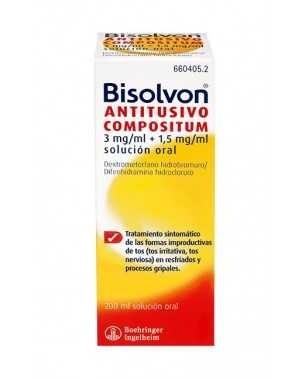
Bisolvon Antitusivo Compositum es una solución clara, translúcida de color rojo.
Se presenta en frascos de vidrio incoloros con tapón de rosca de plástico a prueba de niños que contienen 200 ml de solución y vasito dosificador marcado con las siguientes medidas 1,25 ml, 2,5 ml y 5 ml.
Titular de la autorización de comercialización:
Opella Healthcare Spain, S.L.
C/ Rosselló i Porcel, 21
08016 – Barcelona
España
Grupo Sanofi
Responsable de la fabricación:
Boehringer Ingelheim España, S.A.
Prat de la Riba, 50
08174 Sant Cugat del Vallès (Barcelona)
España
O
Opella Healthcare Italy, S.r.l.
Viale Europa 11, 21040
Origgio (Va)
Italia
Fecha de la última revisión de este prospecto:junio 2024
La información detallada de este medicamento está disponible en la página web de la Agencia Española de Medicamentos y Productos Sanitarios (AEMPS) http://www.aemps.gob.es/
Puede acceder a información detallada y actualizada sobre este medicamento escaneando con su teléfono móvil (smartphone) el código QR incluido en el prospecto y cartonaje. También puede acceder a esta información en la siguiente dirección de internet: https://cima.aemps.es/cima/dochtml/p/69543/P_69543.html
-

- País de registro
- Forma farmacéuticaSOLUCIÓN/SUSPENSIÓN ORAL, 15mg dextrometorfano/5ml; 7,5mg difenhidramina/5ml
- Código ATCR05DA20
- Principio activo
- Requiere recetaNo
- Fabricante
- Esta información es de carácter general y no sustituye la consulta con un profesional sanitario.
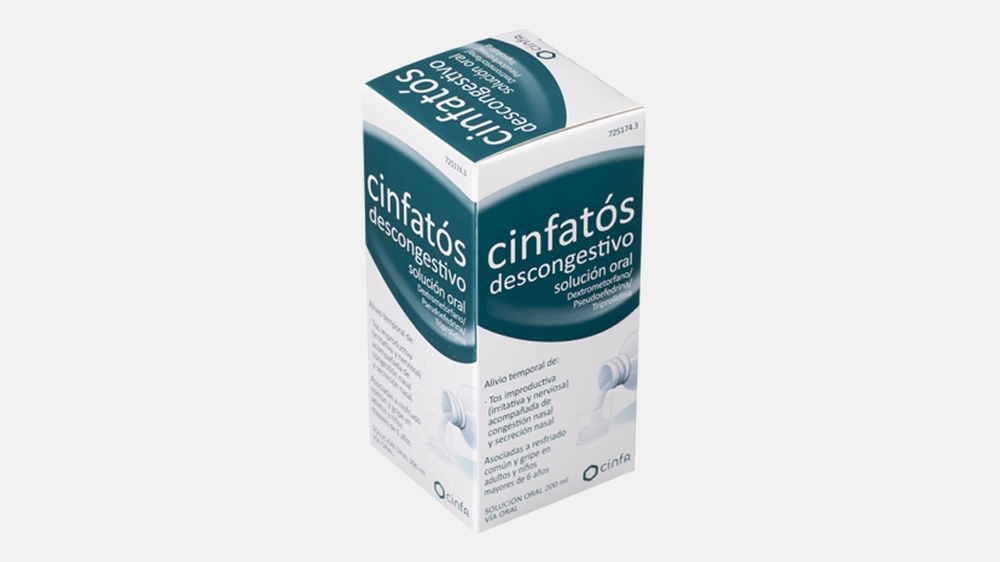
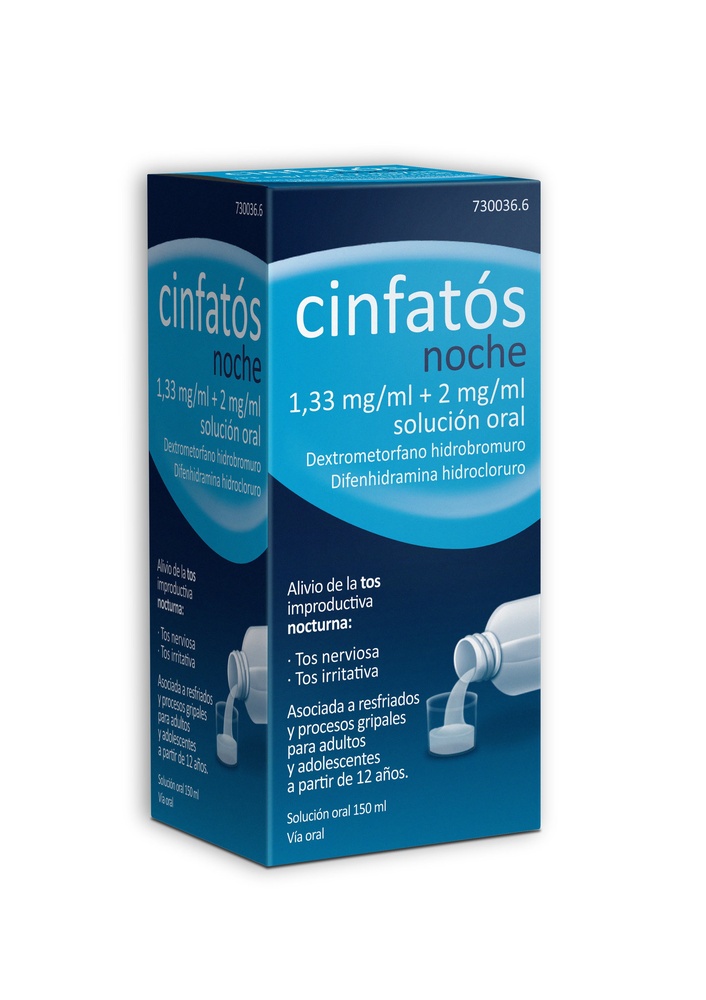
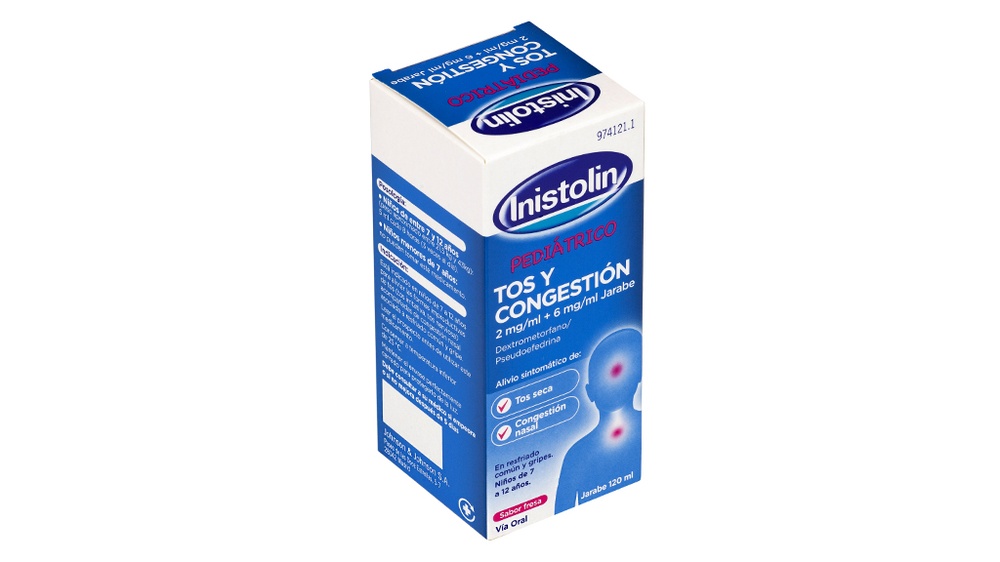
- Alternativas a BISOLVON ANTITUSIVO COMPOSITUM 3 mg/ml + 1,5 mg/ml SOLUCION ORALForma farmacéutica: SOLUCIÓN/SUSPENSIÓN ORAL, 20,0mg DextHBr+60,0mg PseuHCl+2,5mg TripHCl/10mlPrincipio activo: combinationsFabricante: Laboratorios Cinfa S.A.No requiere recetaForma farmacéutica: SOLUCIÓN/SUSPENSIÓN ORAL, 1,33 mg/ml + 2 mg/mlPrincipio activo: combinationsFabricante: Laboratorios Cinfa S.A.No requiere recetaForma farmacéutica: SOLUCIÓN/SUSPENSIÓN ORAL, 30 mg; 10 mg/5 mlPrincipio activo: combinationsFabricante: Jntl Consumer Health (Spain) S.L.No requiere receta
Médicos online para BISOLVON ANTITUSIVO COMPOSITUM 3 mg/ml + 1,5 mg/ml SOLUCION ORAL
Comenta la dosis, los posibles efectos secundarios, interacciones, contraindicaciones o la revisión de receta de BISOLVON ANTITUSIVO COMPOSITUM 3 mg/ml + 1,5 mg/ml SOLUCION ORAL, sujeto a valoración médica y a la normativa local.









Obtén una receta de BISOLVON ANTITUSIVO COMPOSITUM 3 mg/ml + 1,5 mg/ml SOLUCION ORAL online
Rellena un formulario de 2 minutos
Cuéntanos tus síntomas, historial y el medicamento que necesitas.
Elige un médico o nosotros te asignamos uno
Escoge un especialista o te conectamos con el próximo médico disponible.
El médico revisa tu caso
Normalmente en 30 minutos. Puede hacerte preguntas adicionales por chat.
Recógela en cualquier farmacia
Receta electrónica enviada a tu correo, válida en toda España.
Preguntas frecuentes
BISOLVON ANTITUSIVO COMPOSITUM 3 mg/ml + 1,5 mg/ml SOLUCION ORAL does not require receta en España. Puedes confirmarlo con un médico online según tu caso.
El principio activo de BISOLVON ANTITUSIVO COMPOSITUM 3 mg/ml + 1,5 mg/ml SOLUCION ORAL es combinations. Esta información ayuda a identificar medicamentos con la misma composición pero con diferentes nombres comerciales.
BISOLVON ANTITUSIVO COMPOSITUM 3 mg/ml + 1,5 mg/ml SOLUCION ORAL es fabricado por Opella Healthcare Spain S.L.. La marca y el envase pueden variar según el distribuidor.
Los Médicos de familia, Psiquiatras, Dermatólogos, Cardiólogos, Endocrinólogos, Gastroenterólogos, Neumólogos, Nefrólogos, Reumatólogos, Hematólogos, Infectólogos, Alergólogos, Geriatras, Pediatras, Oncólogos pueden valorar la prescripción de BISOLVON ANTITUSIVO COMPOSITUM 3 mg/ml + 1,5 mg/ml SOLUCION ORAL cuando esté clínicamente indicado. Puedes reservar una videoconsulta para comentar tu caso y las opciones de tratamiento.
España cuenta con una infraestructura sanitaria bien desarrollada en ciudades principales como Madrid, Barcelona, Valencia y Sevilla. Las farmacias están ampliamente disponibles y operan bajo estrictas regulaciones, garantizando el acceso a medicamentos con receta.
Puedes comprar BISOLVON ANTITUSIVO COMPOSITUM 3 mg/ml + 1,5 mg/ml SOLUCION ORAL en Madrid, Barcelona, Sevilla o Valencia en cualquier farmacia local con una receta válida.
Para obtener una receta, puedes utilizar Oladoctor:
Otros medicamentos con el mismo principio activo (combinations) incluyen CINFATOS DESCONGESTIVO SOLUCION ORAL, CINFATOS NOCHE 1,33 MG/ML + 2 MG/ML SOLUCION ORAL, INISTOLIN PEDIATRICO TOS Y CONGESTION 2 MG/ML + 6 MG/ML JARABE. Pueden tener diferentes nombres comerciales o formulaciones, pero contienen el mismo componente terapéutico. Consulta siempre con un médico antes de cambiar o iniciar un nuevo medicamento.
