



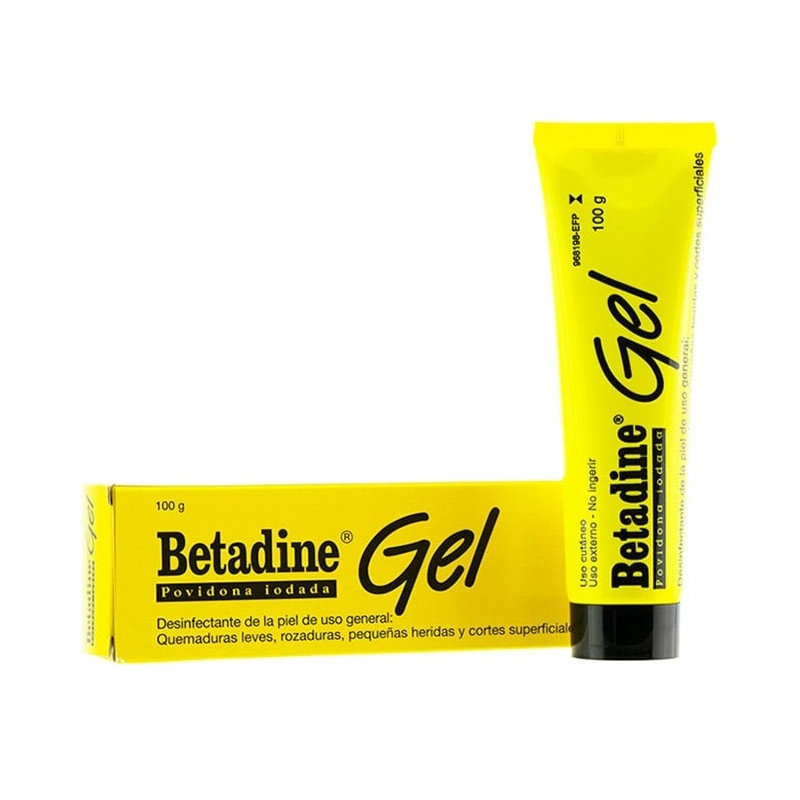
BETADINE 100 mg /G Gel

Revisión de receta online
Un médico revisará tu caso y determinará si la prescripción es médicamente apropiada.

Habla con un médico sobre este medicamento
Comenta tus síntomas y las opciones de tratamiento en una consulta online.



Cómo usar BETADINE GEL 100 MG/G GEL
Contenido del prospecto
- Introducción
- Qué es Betadine gel y para qué se utiliza
- Qué necesita saber antes de empezar a usar Betadine gel
- Cómo usar Betadine gel
- Posibles efectos adversos
- Conservación de Betadine gel
- Contenido del envase e información adicional
- MEDA Manufacturing, Burdeos
Introducción
Prospecto: información para el usuario
Betadinegel 100 mg/g gel
Povidona iodada
Lea todo el prospecto detenidamente antes de empezar a usar este medicamento, porque contiene información importante para usted.
Siga exactamente las instrucciones de administración del medicamento contenidas en este prospecto o las indicadas por su médico, farmacéutico o enfermero.
- Conserve este prospecto, ya que puede tener que volver a leerlo.
- Si necesita consejo o más información, consulte a su farmacéutico.
- Si experimenta efectos adversos, consulte a su médico, farmacéutico o enfermero, incluso si se trata de efectos adversos que no aparecen en este prospecto. Ver sección 4.
- Debe consultar a un médico si empeora o si no mejora.
Contenido del prospecto
- Qué es Betadine gel y para qué se utiliza.
- Qué necesita saber antes de empezar a usar Betadine gel.
- Cómo usar Betadine gel.
- Posibles efectos adversos.
- Conservación de Betadine gel.
- Contenido del envase e información adicional.
1. Qué es Betadine gel y para qué se utiliza
La povidona iodada, principio activo de este medicamento, es un antiséptico (que destruye los gérmenes que producen infecciones) que contiene iodo.
Betadine gel está indicado como antiséptico de la piel de uso general, en caso de pequeñas heridas y cortes superficiales, quemaduras leves o rozaduras.

¿No estás seguro de si este medicamento es adecuado para ti?
Comenta tus síntomas y tratamiento con un médico online.
2. Qué necesita saber antes de empezar a usar Betadine gel
No use Betadine gel
- Si es alérgico a la povidona iodada o a alguno de los demás componentes de este medicamento (incluidos en la sección 6).
- Si tiene hipertiroidismo u otras enfermedades agudas del tiroides.
- Antes, durante y después de la administración de yodo radiactivo
- Con los productos que contienen mercurio debido a la formación de una sustancia que puede dañar la piel.
- En niños menores de un año.
Advertencias y precauciones
Consulte a su médico, farmacéutico o enfermero antes de empezar a usar Betadine gel.
Uso externo. No ingerir. Evite el contacto con ojos, oídos y otras mucosas. Consulte a su médico si persisten o se agravan los síntomas.
Si se utiliza en preparación antes de una operación, evitar la acumulación debajo del paciente. Puede producir irritación y raramente reacciones graves en la piel. Pueden darse quemaduras químicas en la piel por la acumulación. En ese caso, suspenda su uso. No calentar antes de aplicarlo.
Los pacientes con bocio, nódulos en tiroides, u otras enfermedades del tiroides no agudas, tienen riesgo de padecer hipertiroidismo con la administración de cantidades elevadas de iodo. En estos pacientes, no se debe aplicar durante periodos prolongados de tiempo y en áreas extensas de piel a menos que esté estrictamente indicado. Incluso al final del tratamiento se debe estar atento a síntomas tempranos de un posible hipertiroidismo y, si es necesario, se debe controlar la función tiroidea.
No se debe utilizar antes o después de una cintigrafía de iodo radiactivo o del tratamiento de un carcinoma de tiroides con iodo radiactivo.
Deberán realizarse pruebas de la función tiroidea en caso de utilización prolongada.
Niños
Los niños recién nacidos y niños pequeños tienen mayor riesgo de padecer hipotiroidismo. Si se utiliza en niños es importante controlar el tiroides.
No se recomienda el uso en niños menores de un año.
Uso de Betadine gel con otros medicamentos
Informe a su médico o farmacéutico si está utilizando, ha utilizado recientemente o pudiera tener que utilizar cualquier otro medicamento.
No utilizar con derivados mercuriales, con plata, con peróxido de hidrógeno o con taurolidina (antisépticos).
Se debe evitar el uso continuado en pacientes que se encuentren en terapia simultánea con litio (utilizado en psiquiatría).
Cuando se utiliza a la vez o después de antisépticos con octenidina, puede aparecer decoloración oscura transitoria de las áreas involucradas.
Interacción con pruebas diagnósticas: el uso de povidona iodada puede dar lugar a errores en pruebas con tolvidina o guayacol, para determinar hemoglobina o glucosa en heces u orina. También puede interferir con pruebas de tiroides y los tratamientos con iodo radioactivo.
Avise al médico cuando tenga que hacerse algún tipo de prueba diagnóstica.
Informe a su médico si:
- Los síntomas no mejoran o empeoran
- Ha recibido tratamientos con iodo radioactivo en las últimas 4 semanas
- Tiene alergia o irratación dérmica como rojez, pequeñas ampollas, picor o rasch que podrían aparecer imediatamente.
Embarazo, lactancia y fertilidad
Si está embarazada o en periodo de lactancia, cree que podría estar embarazada o tiene intención de quedarse embarazada, consulte a su médico o farmacéutico antes de utilizar este medicamento.
Utilizar solo si está estrictamente indicado, su uso debe mantenerse en el mínimo absoluto. Evite su uso continuado.
Su uso podría producir hipotiroidismo transitorio en fetos y recién nacidos. Puede ser necesario el control del tiroides en niños.
Debe consultar con el médico el uso en niños entre 1 y 2 años
Conducción y uso de máquinas
Betadine no afecta a la capacidad de conducir o utilizar maquinaria.
3. Cómo usar Betadine gel
Siga exactamente las instrucciones de administración del medicamento contenidas en este prospecto o las indicadas por su médico, farmacéutico o enfermero. En caso de duda, pregunte a su médico, farmacéutico o enfermero.
Uso cutáneo. Después de lavar y secar, aplicar directamente sobre la superficie afectada 1 a 3 veces al día. Después de la aplicación, es aconsejable cubrir la zona tratada con una gasa.
Si usa más Betadine gel del que debe
En caso de que se aplique una cantidad excesiva de producto y se produzca irritación de la piel, hay que lavar la zona lesionada con abundante agua, suspenda el tratamiento y, si la irritación continúa, acuda al médico.
Los síntomas podrían ser dolores abdominales, anuria (supresión o disminución de orina), problemas circulatorios, respiratorios y metabólicos. El exceso de iodo puede producir bocio, hipotiroidismo e hipertiroidismo.
En caso de ingestión accidental acudir a un centro médico o llamar al Servicio de Información Toxicológica, tfno.: 91 562 04 20, indicando el producto y la cantidad ingerida.
Si tiene cualquier otra duda sobre el uso de este medicamento, pregunte a su médico, farmacéutico o enfermero.

¿Has empezado a tomar el medicamento y tienes preguntas?
Comenta tus síntomas y tratamiento con un médico online.
4. Posibles efectos adversos
Al igual que todos los medicamentos, este medicamento puede producir efectos adversos, aunque no todas las personas los sufran.
En los raros casos en los que se produzca irritación de la piel o alergia, suspender el tratamiento y lavar la zona afectada con agua.
Los efectos adversos raros (pueden afectar entre 1 y 10 de cada 10.000 personas) son hipersensibilidad y dermatitis de contacto que se manifiesta con piel roja, ampollas pequeñas y picor.
De forma muy rara (pueden afectar a menos de 1 de cada 10.000 personas) se han observado, reacciones anafilácticas (reacción alérgica grave), hipertiroidismo con taquicardia y agitación, y angioedema (hinchazón producida por alergia).
Otros efectos adversos de frecuencia no conocida, han sido hipotiroidismo, desequilibrio electrolítico, acidosis metabólica, insuficiencia renal aguda, osmolaridad anormal de la sangre, dermatitis exfoliativa, piel seca, decoloración de la piel y quemadura química en la piel.
Comunicación de efectos adversos
Si experimenta cualquier tipo de efecto adverso, consulte a su médico, farmacéutico o enfermero, incluso si se trata de posibles efectos adversos que no aparecen en este prospecto. También puede comunicarlos directamente a través del Sistema Español de Farmacovigilancia de medicamentos de Uso Humano: https://www.notificaram.es. Mediante la comunicación de efectos adversos usted puede contribuir a proporcionar más información sobre la seguridad de este medicamento.
5. Conservación de Betadine gel
Mantener este medicamento fuera de la vista y del alcance de los niños.
No requiere condiciones especiales de conservación.No conservar a una temperatura superior a 25C.
No utilice este medicamento después de la fecha de caducidad que aparece en el envase después de CAD. La fecha de caducidad es el último día del mes que se indica.
Los medicamentos no se deben tirar por los desagües ni a la basura. Deposite los envases y los medicamentos que no necesita en el Punto SIGRE de la farmacia. En caso de duda pregunte a su farmacéutico cómo deshacerse de los envases y de los medicamentos que no necesita. De esta forma, ayudará a proteger el medio ambiente.
6. Contenido del envase e información adicional
Composición de Betadine gel
El principio activo es povidona iodada. Cada gramo de gel contiene 100 mg de povidona iodada.
Los demás componentes (excipientes) son: macrogol 400, macrogol 4000, macrogol 6000 y agua purificada.
Aspecto del producto y contenido del envase
Gel de color marrón.
Se presenta en tubos de 30 g y 100 g.
Titular de la autorización de comercialización y responsable de la fabricación
Titular de la autorización de comercialización
Cooper Consumer Health B.V.
Verrijn Stuartweg 60,
1112 AX Diemen,
Países Bajos
Responsable de la fabricación
MEDA Manufacturing, Burdeos
Av. Pdt. J. F. Kennedy. BP 100
Merignac – Cedex
F-33700
Francia
Pueden solicitar más información respecto a este medicamento dirigiéndose al representante local del titular de la autorización de comercialización:
Vemedia Pharma Hispania, S.A.
C/ Aragón, 182, 5ª planta
08011 Barcelona
España
Fecha de la última revisión de este prospecto:mayo 2022
La información detallada y actualizada de este medicamento está disponible en la página Web de la Agencia Española de Medicamentos y Productos Sanitarios (AEMPS) https://www.aemps.gob.es/
- País de registro
- Forma farmacéuticaGEL, 10 % povidona iodada
- Código ATCD08AG02
- Principio activo
- Requiere recetaNo
- Fabricante
- Esta información es de carácter general y no sustituye la consulta con un profesional sanitario.
- Alternativas a BETADINE GEL 100 MG/G GELForma farmacéutica: LIQUIDO USO TOPICO, 100 mg/mlPrincipio activo: Povidona iodadaFabricante: Cooper Consumer Health B.V.No requiere recetaForma farmacéutica: LIQUIDO USO TOPICO, 4% povidona iodadaPrincipio activo: Povidona iodadaFabricante: Cooper Consumer Health B.V.No requiere recetaForma farmacéutica: LIQUIDO USO TOPICO, 7,5 % povidona iodadaPrincipio activo: Povidona iodadaFabricante: Cooper Consumer Health B.V.No requiere receta
Médicos online para BETADINE GEL 100 MG/G GEL
Comenta la dosis, los posibles efectos secundarios, interacciones, contraindicaciones o la revisión de receta de BETADINE GEL 100 MG/G GEL, sujeto a valoración médica y a la normativa local.









Obtén una receta de BETADINE GEL 100 MG/G GEL online
Rellena un formulario de 2 minutos
Cuéntanos tus síntomas, historial y el medicamento que necesitas.
Elige un médico o nosotros te asignamos uno
Escoge un especialista o te conectamos con el próximo médico disponible.
El médico revisa tu caso
Normalmente en 30 minutos. Puede hacerte preguntas adicionales por chat.
Recógela en cualquier farmacia
Receta electrónica enviada a tu correo, válida en toda España.
Preguntas frecuentes
BETADINE GEL 100 MG/G GEL no requiere receta en España. Puedes confirmarlo con un médico online según tu caso.
El principio activo de BETADINE GEL 100 MG/G GEL es Povidona iodada. Esta información ayuda a identificar medicamentos con la misma composición pero con diferentes nombres comerciales.
BETADINE GEL 100 MG/G GEL es fabricado por Cooper Consumer Health B.V.. La marca y el envase pueden variar según el distribuidor.
Los Médicos de familia, Psiquiatras, Dermatólogos, Cardiólogos, Endocrinólogos, Gastroenterólogos, Neumólogos, Nefrólogos, Reumatólogos, Hematólogos, Infectólogos, Alergólogos, Geriatras, Pediatras, Oncólogos pueden valorar la prescripción de BETADINE GEL 100 MG/G GEL cuando esté clínicamente indicado. Puedes reservar una videoconsulta para comentar tu caso y las opciones de tratamiento.
España cuenta con una infraestructura sanitaria bien desarrollada en ciudades principales como Madrid, Barcelona, Valencia y Sevilla. Las farmacias están ampliamente disponibles y operan bajo estrictas regulaciones, garantizando el acceso a medicamentos con receta.
Puedes comprar BETADINE GEL 100 MG/G GEL en Madrid, Barcelona, Sevilla o Valencia en cualquier farmacia local con una receta válida.
Para obtener una receta, puedes utilizar Oladoctor:
Otros medicamentos con el mismo principio activo (Povidona iodada) incluyen BETADINE 100 MG/ML SOLUCIÓN CUTÁNEA, BETADINE JABONOSO 40 MG/ML SOLUCION CUTANEA, BETADINE JABONOSO 75 MG/ML SOLUCIÓN CUTÁNEA. Pueden tener diferentes nombres comerciales o formulaciones, pero contienen el mismo componente terapéutico. Consulta siempre con un médico antes de cambiar o iniciar un nuevo medicamento.
