



BERIATE 1000 UI Polvo Y Disolvente Para Solucion Inyectable Y Para Perfusion

Revisión de receta online
Un médico revisará tu caso y determinará si la prescripción es médicamente apropiada.

Habla con un médico sobre este medicamento
Comenta tus síntomas y las opciones de tratamiento en una consulta online.



Cómo usar BERIATE 1000 UI POLVO Y DISOLVENTE PARA SOLUCION INYECTABLE Y PARA PERFUSION
Contenido del prospecto
- Introducción
- Qué es Beriate y para qué se utiliza
- Qué es Beriate
- Qué necesita saber antes de empezar a usar Beriate
- Cómo usar Beriate
- Posibles efectos adversos
- Conservación de Beriate
- Contenido del envase e información adicional
- Presentaciones:
- Cirugía
- Cirugía mayor
Introducción
PROSPECTO: INFORMACIÓN PARA EL USUARIO
Beriate 1000 UI polvo y disolvente para solución inyectable y para perfusión
Factor VIII de la coagulación humano
Lea todo el prospecto detenidamente antes de empezar a usar este medicamento porque contiene información importante para usted.
- Conserve este prospecto, ya que puede tener que volver a leerlo.
- Si tiene alguna duda, consulte a su médico o farmacéutico.
- Este medicamento se le ha recetado solamente a usted y no debe dárselo a otras personas, aunque tengan los mismos síntomas que usted, ya que puede perjudicarles.
- Si experimenta efectos adversos, consulte a su médico o farmacéutico, incluso si se trata de efectos adversos que no aparecen en este prospecto. Ver sección 4.
Contenido del prospecto:
- Qué es Beriate y para qué se utiliza
- Qué necesita saber antes de empezar a usar Beriate
- Cómo usar Beriate
- Posibles efectos adversos
- Conservación de Beriate
- Contenido del envase e información adicional
1. Qué es Beriate y para qué se utiliza

¿No estás seguro de si este medicamento es adecuado para ti?
Comenta tus síntomas y tratamiento con un médico online.
Qué es Beriate
Beriate se presenta como polvo, acompañado del disolvente. La solución obtenida debe administrarse en una vena, bien por inyección, bien por perfusión.
Beriate se obtiene del plasma humano (que es la parte líquida de la sangre) y contiene el factor VIII de la coagulación humano. Se utiliza para prevenir o detener las hemorragias que están causadas por la falta del factor VIII (hemofilia A) en la sangre. Puede usarse también en el tratamiento de la deficiencia adquirida de factor VIII.
Para qué se utiliza Beriate
El factor VIII está involucrado en la coagulación de la sangre. La falta de factor VIII significa que la sangre no coagula con la rapidez que debería hacerlo, con lo que se produce un incremento de la tendencia al sangrado. Beriate aporta factor VIII con lo que se normalizan, temporalmente, los mecanismos de la coagulación.
2. Qué necesita saber antes de empezar a usar Beriate
Los siguientes párrafos contienen información que usted y su médico deben tener en consideración antes de usar Beriate.
No use Beriate:
- Si es alérgico al factor VIII de la coagulación humano o a cualquiera de los demás componentes de este medicamento (incluidos en la sección 6).
Advertencias y precauciones
Trazabilidad
Se recomienda encarecidamente que cada vez que se administre Beriate, registre la fecha de administración, el número de lote y el volumen inyectado en su diario de tratamiento.
Consulte a su médico o farmacéutico antes de empezar a usar Beriate
- Es posible que se presenten reacciones de hipersensibilidad de tipo alérgico. Su médico deberá informarle sobre la aparición de síntomas precoces de reacciones de hipersensibilidad, incluyendo ronchas, urticaria generalizada, presión en el pecho, respiración dificultosa, caída de la tensión sanguínea y anafilaxia (reacción alérgica grave que causa problemas graves en la respiración, o mareos). Si se presentan estos síntomas, debe interrumpir de inmediato la administración del medicamento y contactar con su médico.
- La formación de inhibidores(anticuerpos) es una complicación conocida que puede producirse durante el tratamiento con todos los medicamentos compuestos por factor VIII. Estos inhibidores, especialmente en grandes cantidades, impiden que el tratamiento funcione correctamente, por lo que se les supervisará cuidadosamente a usted y a su hijo por si desarrollan dichos inhibidores. Si su hemorragia o la de su hijo no se está controlando con Beriate, consulte a su médico inmediatamente.
- Si padece una enfermedad cardíaca o tiene riesgo de padecerla, informe a su médico o farmacéutico.
- Si para la administración de Beriate se necesita un dispositivo de acceso venoso central (DAVC) su médico deberá considerar el riesgo de complicaciones relacionadas con el catéter incluyendo las infecciones locales, bacterianas (bacteriemia) y la formación de coágulos de sangre (trombosis) en el sitio de inserción del catéter.
Su médico valorará cuidadosamente el beneficio del tratamiento con Beriate frente al riesgo de estas complicaciones.
Seguridad vírica
Cuando se administran medicamentos derivados de la sangre o plasma humanos, se adoptan ciertas medidas para prevenir la transmisión de infecciones a los pacientes. Esto incluye la cuidadosa selección de los donantes de sangre y plasma para excluir aquellos que pueden representar un riesgo de transmisión de infecciones, y el análisis de cada donante y bancos de plasma para signos de virus/infecciones. Los fabricantes de estos productos también incluyen etapas en los procesos de producción que pueden inactivar o eliminar virus u otros patógenos. A pesar de esto, cuando se administran medicamentos derivados de la sangre o plasma humanos, la posibilidad de transmisión de agentes infecciosos no se puede excluir totalmente. Esto también se refiere a virus emergentes o de naturaleza desconocida y otros patógenos.
Estos procedimientos se consideran efectivos frente a virus envueltos tales como el virus de la inmunodeficiencia humana (VIH, virus del SIDA), el virus de la hepatitis B y el virus de la hepatitis C (inflamación del hígado), así como para virus no envueltos tales como el virus de la hepatitis A y parvovirus B19.
Su médico puede recomendarle que considere la vacunación contra la hepatitis A y B si regularmente/repetidamente se le administran productos derivados de plasma humano (por ej. factor VIII).
Uso de Beriate con otros medicamentos:
- Comunique a su médico o farmacéutico si está utilizando, ha utilizado recientemente o podría tener que utilizar cualquier otro medicamento.
- Beriate no debe mezclarse con otros medicamentos, diluyentes y disolventes, excepto aquellos que están recomendados por el fabricante (ver sección 6).
Embarazo, lactancia y fertilidad
- Si está embarazada o en periodo de lactancia, cree que podría estar embarazada o tiene intención de quedarse embarazada, consulte a su médico o farmacéutico antes de utilizar este medicamento.
- Durante el embarazo y la lactancia, Beriate solo debe usarse en el caso de que esté claramente indicado.
- No se dispone de información sobre fertilidad
Conducción y uso de máquinas
Beriate no afecta la capacidad de conducir vehículos o utilizar maquinaria.
Beriatecontiene sodio
Beriate 1000 UI contiene 27,55 mg de sodio (componente principal de la sal de mesa/para cocinar) en cada vial. Esto equivale al 1,4% de la ingesta máxima diaria de sodio recomendada para un adulto.

¿Has empezado a tomar el medicamento y tienes preguntas?
Comenta tus síntomas y tratamiento con un médico online.
3. Cómo usar Beriate
Siga exactamente las instrucciones de administración de este medicamento indicadas por su médico. En caso de duda, consulte de nuevo con su médico o farmacéutico.
El tratamiento de la hemofilia A debe iniciarse bajo la supervisión de un médico con experiencia en el tratamiento de este tipo de alteraciones.
Posología
La dosis de factor VIII que usted necesita y la duración del tratamiento dependen de varios factores, tales como su peso corporal, la gravedad de su enfermedad, la localización e importancia de la hemorragia o la necesidad de prevenir la hemorragia durante una operación o una revisión médica.
Si le han indicado que debe usar Beriate en casa, su médico se asegurará de que usted reciba las instrucciones debidas de como se inyecta el producto y cuanto producto debe usar.
Siga las instrucciones que le ha dado su médico o las indicaciones de las enfermeras de su centro de hemofilia.
Uso en niños y adolescentes
La dosis se calcula en base al peso corporal y se determina de la misma manera que para los adultos.
Si usa más Beriate del que debe
No se han informado sobre síntomas de sobredosificación con el factor VIII.
Si olvidó usar Beriate
Aplique inmediatamente la siguiente dosis y continúe a intervalos regulares siguiendo las indicaciones de su médico. No tome una dosis doble para compensar las dosis olvidadas.
Reconstitución y administración
Instrucciones generales:
- El polvo debe mezclarse (reconstituido) con el solvente (líquido) y retirado del vial bajo condiciones asépticas.
- La solución reconstituida debe ser clara o ligeramente opalescente, es decir, puede brillar cuando se sobrepone contra una luz. Ocasionalmente, pueden aparecer algunos flóculos o partículas en el vial. El filtro incluido en el Mix2Vial elimina estas partículas. Esta filtración no afecta a los cálculos de las dosis. Después de la filtración y de la transferencia del producto reconstituido a la jeringa (ver más adelante), y antes de la administración, la solución debe ser controlada mediante un control visual a fin de detectar pequeñas partículas y decoloraciones. No usar las soluciones que presenten una turbidez visible o que contengan flóculos o partículas en la jeringa.
- Una vez que el producto se transfiere a la jeringa, debe usarse inmediatamente. Noalmacene el produto en la jeringa.
- El producto no utilizado y los materiales desechados deberán eliminarse adecuadamente según los requerimientos locales y según las instrucciones de su médico.
Reconstitución:
Atemperar los viales de Beriate (vial con el polvo y el vial con el líquido), sin abrirlos, a temperatura ambiente. Esto puede hacerse dejando los viales a temperatura ambiente durante 1 hora, o bien manteniéndolos en las manos durante unos minutos. NO exponer los viales al calor directo. Los viales no deben calentarse por encima de la temperatura corporal (37 ºC).
Retirar cuidadosamente las cápsulas protectoras de los viales que contienen el polvo y el solvente, y limpiar la parte expuesta de los tapones con una toallita empapada en alcohol. Dejar secar los viales antes de abrir el contenedor del Mix2Vial, y siga las siguientes instrucciones.
|
|
|
|
|
|
|
|
|
|
|
|
|
|
 1
1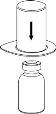 2
2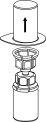 3
3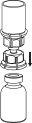 4
4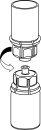 5
5 6
6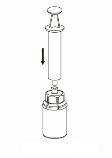 7
7Aplicación y retirada:
|
|
9 |
|
 8
8Usar el equipo de punción venosa que se suministra con el producto. Insertar la aguja en la vena. Dejar que entre la sangre hasta el final del tubo. Acoplar la jeringa al final roscado y con cierre del equipo de punción venosa. Inyectar lentamente la solución reconstituida en la vena,siguiendo las instrucciones de su médico. La velocidad de inyección o de perfusión no debe superar los 2 ml por minuto. Tenga cuidado de que no entre sangre en la jeringa que contiene el producto.
Cuando deba administrarse un volumen grande, la perfusión es una opción a tener en cuenta. El producto reconstituido debe transferirse a un sistema de perfusión autorizado. La perfusión debe realizarse de acuerdo con las instrucciones de su médico.
Contrólese usted mismo acerca de cualquier efecto adverso que pudieran presentarse inmediatamente. Si usted tiene algún efecto adverso que esté relacionado con la administración de Beriate, la inyección o la perfusión debe interrumpirse (ver también sección 2).
Si usted tiene alguna otra pregunta sobre el uso de este medicamento, pregunte a su médico o farmacéutico.
4. Posibles efectos adversos
Al igual que todos los medicamentos, este medicamento puede producir efectos adversos, aunque no todas las personas los sufran.
Si alguno de los siguientes efectos adversos se presentara, consulte con su médico inmediatamente o vaya al Servicio de Urgencia o centro de hemofilia en su hospital más próximo:
- Síntomas de angioedema
- inflamación de la cara, lengua o faringe,
- dificultad para tragar,
- ronchas y dificultad para respirar.
Estos efectos adversos han sido observados muy raramente (pueden afectar hasta 1 de cada 10.000 personas), y en algunos casos pueden dar lugar a reacciones alérgicas graves (anafilaxia), incluido el shock
- Pérdida de efecto (sangrado no se detiene). En los niños que no han recibido tratamiento previo con medicamentos compuestos por factor VIII pueden producirse anticuerpos inhibidores (ver sección 2) muy frecuentemente (más de 1 de cada 10 pacientes); sin embargo, en los pacientes que han recibido tratamiento previo con factor VIII (más de 150 días de tratamiento), el riesgo es poco frecuente (menos de 1 de cada 100 pacientes). Si esto sucede, los medicamentos que toman usted o su hijo pueden dejar de funcionar correctamente y usted o su hijo pueden sufrir una hemorragia persistente. En ese caso, contacte con su médico inmediatamente.
Otros efectos adversos son:
- Reacciones alérgicas (hipersensibilidad), que pueden incluir:
- sensación de quemazón y picor en el lugar donde se inyectó o perfundió el producto.
- escalofríos, enrojecimiento, sarpullido de la piel de todo el cuerpo, pápulas.
- dolor de cabeza.
- caída de la presión sanguínea, desasosiego, latido del corazón más rápido, opresión en el pecho, respiración dificultosa.
- somnolencia (letargia).
- nauseas, vómitos.
- hormigueo.
Estos efectos adversos han sido observados muy raramente, pero en algunos casos pueden evolucionar a reacciones alérgicas graves (anafilaxia), incluido el shock.
- En muy raras ocasiones se ha observado fiebre.
Efectos adversos en niños y adolescentes
La frecuencia, tipo y gravedad de las reacciones adversas en niños se espera que sean las mismas que para adultos.
Comunicación de efectos adversos
Si experimenta cualquier tipo de efecto adverso, consulte a su médico, incluso si se trata de posibles efectos adversos que no aparecen en este prospecto. También puede comunicarlos directamente a través del Sistema Español de Farmacovigilancia de Medicamentos de Uso Humano: www.notificaRAM.es. Mediante la comunicación de efectos adversos usted puede contribuir a proporcionar más información sobre la seguridad de este medicamento.
5. Conservación de Beriate
No utilice este medicamento después de la fecha de caducidad que aparece en la etiqueta y en el envase. La fecha de caducidad es el último día del mes que se indica.
- Conservar en nevera (entre 2 ºC y 8 °C).
- Durante su periodo de validez Beriate puede almacenarse hasta 25 ºC, durante un periodo de 1 mes como máximo. Este periodo de almacenamiento a temperatura ambiente debe apuntarse en su diario de tratamiento a fin de cumplir el periodo de 1 mes en su totalidad.
- Beriate no contiene conservantes, por lo que el producto reconstituido debe preferiblemente usarse inmediatamente.
- Si el producto reconstituido no es administrado inmediatamente, el almacenamiento en el vial a temperatura ambiente no debe exceder un período de 8 horas. Una vez transferido a la jeringa, el producto debe usarse inmediatamente.
- No congelar.
- Conservar el vial en el embalaje original para protegerlo de la luz.
Mantener fuera de la vista y del alcance de los niños.
6. Contenido del envase e información adicional
Composición de Beriate
El principio activo es:
Beriate se presenta como un polvo (conteniendo nominalmente 1000 UI de factor VIII de la coagulación humano por vial) y un líquido (disolvente). La solución reconstituida se administra, bien por inyección, bien por perfusión.
Beriate 1000 UI se reconstituye con 10 ml de agua para preparaciones inyectables y contiene aproximadamente 100 UI/ml de factor VIII de la coagulación humano.
Los demás componentes son:
Glicina, cloruro cálcico, hidróxido sódico (en pequeñas cantidades) para ajustar el pH, sacarosa y cloruro sódico
Disolvente: agua para preparaciones inyectables 10 ml.
Aspecto del producto y contenido del envase
Beriate se presenta como un polvo blanco, y se suministra con la correspondiente agua para preparaciones inyectables.
La solución reconstituida debe ser clara o ligeramente opalescente, es decir, puede brillar cuando se sobrepone contra una luz pero no debe contener partículas.
Presentaciones:
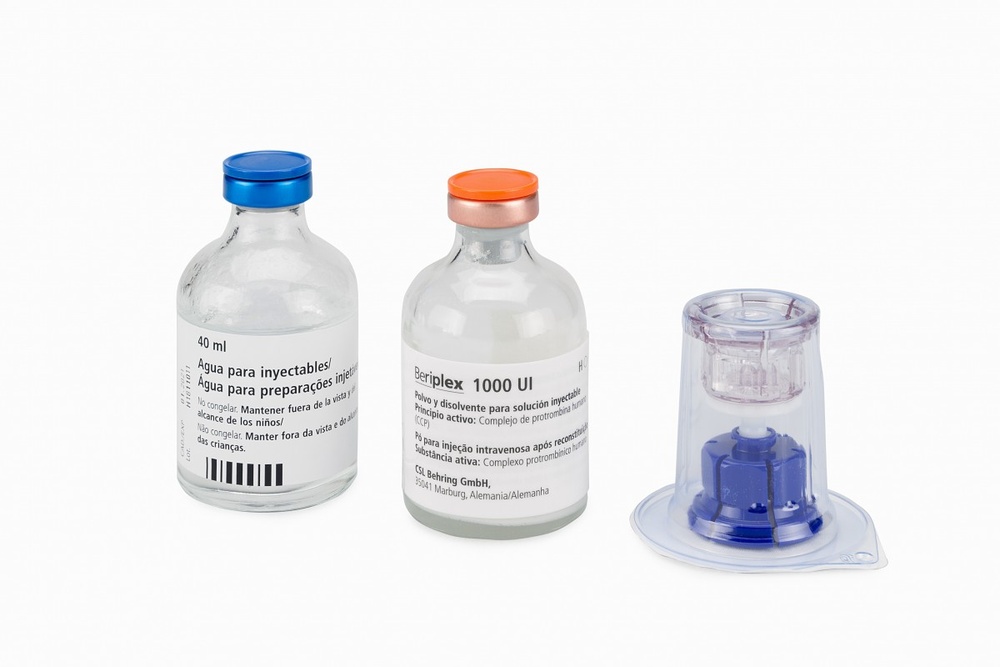
Caja con 1000 UI que contiene:
- 1 vial con polvo
- 1 vial con 10 ml de Agua para preparaciones inyectables
- 1 trasvasador con filtro 20/20
Equipo de administración (caja interior):
- 1 jeringa de 10 ml de un solo uso
- 1 equipo de venopunción
- 2 toallitas impregnadas de alcohol
- 1 apósito no estéril
Titular de la Autorización de comercialización y responsable de la fabricación
CSL Behring GmbH
Emil-von-Behring-Straße 76
35041 Marburg, Alemania
Puede solicitar más información respecto a este medicamento dirigiéndose al representante local del titular de autorización de comercialización:
CSL Behring, S.A.
c/ Tarragona 157, planta 18
08014 Barcelona
España
Este medicamento está autorizado en los estados miembros del Espacio Económico Europeo con los siguientes nombres:
Austria:
Beriate 100 I.E./ml Pulver und Lösungsmittel zur Herstellung einer Injektions- oder Infusionslösung (250 I.E., 500 I.E., 1000 I.E.)
Beriate 200 I.E./ml Pulver und Lösungsmittel zur Herstellung einer Injektions- oder Infusionslösung (2000 I.E.)
Bulgaria:
Beriate 250 IU Powder and solvent for solution for injection or infusion
Beriate 500 IU Powder and solvent for solution for injection or infusion
Beriate 1000 IU Powder and solvent for solution for injection or infusion
Beriate 2000 IU Powder and solvent for solution for injection or infusion
Croacia:
Beriate 250 IU prašak i otapalo za otopinu za injekciju ili infuziju
Beriate 500 IU prašak i otapalo za otopinu za injekciju ili infuziju
Beriate 1000 IU prašak i otapalo za otopinu za injekciju ili infuziju
Beriate 2000 IU prašak i otapalo za otopinu za injekciju ili infuziju
República Checa:
Beriate 250 IU, Beriate 500 IU, Beriate 1000 IU, Beriate 2000 IU
Estonia:
Beriate
Alemania:
Beriate 250, Beriate 500, Beriate 1000, Beriate 2000
Hungría:
Presentations of Beriate 250, 500 and 1000:
BERIATE 100 NE/ml por és oldószer oldatos injekcióhoz vagy infúzióhoz
Presentation 2000:
BERIATE 200 NE/ml por és oldószer oldatos injekcióhoz vagy infúzióhoz
Italia:
Beriate
Letonia:
Beriate 250 SV pulveris un škidinatajs injekciju vai infuziju škiduma pagatavošanai
Beriate 500 SV pulveris un škidinatajs injekciju vai infuziju škiduma pagatavošanai
Beriate 1000 SV pulveris un škidinatajs injekciju vai infuziju škiduma pagatavošanai
Beriate 2000 SV pulveris un škidinatajs injekciju vai infuziju škiduma pagatavošanai
Lituania:
Beriate® 250 TV milteliai ir tirpiklis injekciniam ar infuziniam tirpalui
Beriate® 500 TV milteliai ir tirpiklis injekciniam ar infuziniam tirpalui
Beriate® 1000 TV milteliai ir tirpiklis injekciniam ar infuziniam tirpalui
Beriate® 2000 TV milteliai ir tirpiklis injekciniam ar infuziniam tirpalui
Polonia:
Beriate 250
Beriate 500
Beriate 1000
Beriate 2000
Portugal:
Beriate
Rumanía:
Beriate 250 pulbere si solvent pentru solutie injectabila/perfuzabila
Beriate 500 pulbere si solvent pentru solutie injectabila/perfuzabila
Beriate 1000 pulbere si solvent pentru solutie injectabila/perfuzabila
Beriate 2000 pulbere si solvent pentru solutie injectabila/perfuzabila
España:
Beriate 500 UI polvo y disolvente para solución inyectable y para perfusión
Beriate 1000 UI polvo y disolvente para solución inyectable y para perfusión
Beriate 2000 UI polvo y disolvente para solución inyectable y para perfusión
Eslovaquia:
Beriate 250 IU
Beriate 500 IU
Beriate 1000 IU
Beriate 2000 IU
Eslovenia:
Beriate 250 i.e. prašek in vehikel za raztopino za injiciranje/infundiranje
Beriate 500 i.e. prašek in vehikel za raztopino za injiciranje/infundiranje
Beriate 1000 i.e. prašek in vehikel za raztopino za injiciranje/infundiranje
Beriate 2000 i.e. prašek in vehikel za raztopino za injiciranje/infundiranje
Fecha de la última revisión de este prospecto:Abril 2020
La información detallada y actualizada de este medicamento está disponible en la página web de la Agencia Española de Medicamentos y Productos Sanitarios (AEMPS)http://www.aemps.gob.es.
----------------------------------------------------------------------------------------------------------
Esta información está destinada únicamente a profesionales del sector sanitario
Posología
Monitorización del tratamiento
Durante el tratamiento se recomienda controlar, adecuadamente, los niveles de factor VIII para determinar la dosis a administrar y la frecuencia de las perfusiones repetidas. La respuesta de cada paciente frente al factor VIII puede variar, demostrando distintas semividas y recuperaciones. La dosis basada en el peso corporal puede requerir un ajuste en pacientes con bajo peso o sobrepeso. En el caso particular de intervenciones de cirugía mayor, es indispensable monitorizar con precisión la terapia de sustitución mediante pruebas de la coagulación (actividad plasmática del factor VIII).
Debe monitorizarse en los pacientes el desarrollo de inhibidores del factor VIII. Ver también sección 2.
El número de unidades de factor VIII administradas se expresa en Unidades Internacionales (UI), en relación con el vigente estándar de la Organización Mundial de la Salud (OMS) para concentrados de factor VIII. La actividad plasmática de factor VIII se expresa como un porcentaje (en relación con el plasma humano normal) o preferiblemente en UI (en relación con un estándar internacional para el factor VIII en plasma).
La actividad de una UI de factor VIII es equivalente a la cantidad de factor VIII contenido en un ml de plasma humano normal.
Tratamiento a demanda
El cálculo de la dosis necesaria de factor VIII se basa en la observación empírica de que 1 UI de factor VIII por kg. de peso corporal, incrementa la actividad plasmática de factor VIII aproximadamente en un 2% (2 UI/dL) sobre la actividad normal. La dosis requerida se determina mediante la fórmula siguiente:
Unidades requeridas = peso corporal (kg) x aumento deseado de factor VIII [% o UI/dl] x 0,5
La cantidad administrada y la frecuencia de administración se establecerán siempre en función de la eficacia observada en cada caso.
En los siguientes episodios hemorrágicos, la actividad de factor VIII no debe ser inferior al nivel plasmático de actividad que se indica (en % del nivel normal o UI/dL), durante el periodo correspondiente. La tabla siguiente puede usarse como una guía posológica en episodios hemorrágicos y cirugía.
Tipo de episodio hemorrágico/ Tipo de procedimiento quirúrgico | Nivel de factor VIII requerido (% o UI/dL) | Frecuencia de dosificación (horas) / Duración de la terapia (días) |
Hemorragia | ||
Hemartrosis precoz, sangrado muscular o de la cavidad bucal | 20-40 | Repetir cada 12-24 horas. Al menos 1 día, hasta que la hemorragia se haya resuelto, en función del dolor, o hasta la cicatrización adecuada de la herida |
Hemartrosis más extensa, sangrado muscular o hematoma | 30-60 | Repetir la perfusión cada 12-24 horas, durante 3-4 días o más, hasta que el dolor y la discapacidad aguda se hayan resuelto |
Hemorragias con riesgo vital | 60-100 | Repetir la perfusión cada 8-24 horas hasta que desaparezca el riesgo |
Cirugía | ||
Cirugía menor, incluyendo extracciones dentales | 30-60 | Cada 24 horas, al menos 1 día, hasta la cicatrización de la herida |
Cirugía mayor | 80-100 (pre y postoperatorio) | Repetir la perfusión cada 8-24 horas hasta la cicatrización adecuada de la herida; continuar la terapia durante un mínimo de 7 días más para mantener una actividad de factor VIII del 30 al 60 % (30-60 UI/dl correspondientes a 0,30-0,60 UI/ml) |
Profilaxis
Para la profilaxis a largo plazo de las hemorragias en pacientes con hemofilia A grave, la dosis habitual es de 20 a 40 UI de factor VIII/kg de peso corporal a intervalos de 2 a 3 días. En algunos casos, especialmente en pacientes jóvenes, puede ser necesario acortar los intervalos de administración o administrar dosis más elevadas.
Población pediátrica
La posología en pediatría se basa en el peso corporal y por lo tanto sigue, generalmente, las mismas directrices que se usan para los adultos. La frecuencia de administración debe estar siempre orientada a conseguir la eficacia clínica en cada caso particular. Existe alguna experiencia en el tratamiento de niños menores de 6 años.
Información sobre las propiedades farmacológicas del Factor de von Willebrand
Además de la función protectora del factor VIII, el factor de von Willebrand facilita la adhesión de las plaquetas en los sitios con una herida vascular y juega un papel en la agregación plaquetaria.
- País de registro
- Forma farmacéuticaINYECTABLE, 1000 UI de Factor VIII / ml
- Código ATCB02BD02
- Principio activo
- Requiere recetaSí
- Fabricante
- ComposiciónSACAROSA (60-90 mg mg), CLORURO DE SODIO (45-70 mg mg)
- Esta información es de carácter general y no sustituye la consulta con un profesional sanitario.
- Alternativas a BERIATE 1000 UI POLVO Y DISOLVENTE PARA SOLUCION INYECTABLE Y PARA PERFUSIONForma farmacéutica: INYECTABLE, 1.000 UIPrincipio activo: factor de coagulación VIIIFabricante: Takeda Manufacturing Austria AgRequiere recetaForma farmacéutica: INYECTABLE, 1.500 UIPrincipio activo: factor de coagulación VIIIFabricante: Takeda Manufacturing Austria AgRequiere recetaForma farmacéutica: INYECTABLE, 1000 UI - tras reconstitución en 2 ml de agua para inyectables la dosis es de 500 UI/mlPrincipio activo: factor de coagulación VIIIFabricante: Takeda Manufacturing Austria AgRequiere receta
Médicos online para BERIATE 1000 UI POLVO Y DISOLVENTE PARA SOLUCION INYECTABLE Y PARA PERFUSION
Comenta la dosis, los posibles efectos secundarios, interacciones, contraindicaciones o la revisión de receta de BERIATE 1000 UI POLVO Y DISOLVENTE PARA SOLUCION INYECTABLE Y PARA PERFUSION, sujeto a valoración médica y a la normativa local.









Obtén una receta de BERIATE 1000 UI POLVO Y DISOLVENTE PARA SOLUCION INYECTABLE Y PARA PERFUSION online
Rellena un formulario de 2 minutos
Cuéntanos tus síntomas, historial y el medicamento que necesitas.
Elige un médico o nosotros te asignamos uno
Escoge un especialista o te conectamos con el próximo médico disponible.
El médico revisa tu caso
Normalmente en 30 minutos. Puede hacerte preguntas adicionales por chat.
Recógela en cualquier farmacia
Receta electrónica enviada a tu correo, válida en toda España.
Preguntas frecuentes
BERIATE 1000 UI POLVO Y DISOLVENTE PARA SOLUCION INYECTABLE Y PARA PERFUSION requiere receta en España. Puedes confirmarlo con un médico online según tu caso.
El principio activo de BERIATE 1000 UI POLVO Y DISOLVENTE PARA SOLUCION INYECTABLE Y PARA PERFUSION es factor de coagulación VIII. Esta información ayuda a identificar medicamentos con la misma composición pero con diferentes nombres comerciales.
BERIATE 1000 UI POLVO Y DISOLVENTE PARA SOLUCION INYECTABLE Y PARA PERFUSION es fabricado por Csl Behring Gmbh. La marca y el envase pueden variar según el distribuidor.
Los Médicos de familia, Psiquiatras, Dermatólogos, Cardiólogos, Endocrinólogos, Gastroenterólogos, Neumólogos, Nefrólogos, Reumatólogos, Hematólogos, Infectólogos, Alergólogos, Geriatras, Pediatras, Oncólogos pueden valorar la prescripción de BERIATE 1000 UI POLVO Y DISOLVENTE PARA SOLUCION INYECTABLE Y PARA PERFUSION cuando esté clínicamente indicado. Puedes reservar una videoconsulta para comentar tu caso y las opciones de tratamiento.
España cuenta con una infraestructura sanitaria bien desarrollada en ciudades principales como Madrid, Barcelona, Valencia y Sevilla. Las farmacias están ampliamente disponibles y operan bajo estrictas regulaciones, garantizando el acceso a medicamentos con receta.
Puedes comprar BERIATE 1000 UI POLVO Y DISOLVENTE PARA SOLUCION INYECTABLE Y PARA PERFUSION en Madrid, Barcelona, Sevilla o Valencia en cualquier farmacia local con una receta válida.
Para obtener una receta, puedes utilizar Oladoctor:
Otros medicamentos con el mismo principio activo (factor de coagulación VIII) incluyen ADVATE 1.000 UI POLVO Y DISOLVENTE PARA SOLUCION INYECTABLE, ADVATE 1.500 UI POLVO Y DISOLVENTE PARA SOLUCION INYECTABLE, ADVATE 1000 UI POLVO Y DISOLVENTE PARA SOLUCION INYECTABLE. Pueden tener diferentes nombres comerciales o formulaciones, pero contienen el mismo componente terapéutico. Consulta siempre con un médico antes de cambiar o iniciar un nuevo medicamento.
