

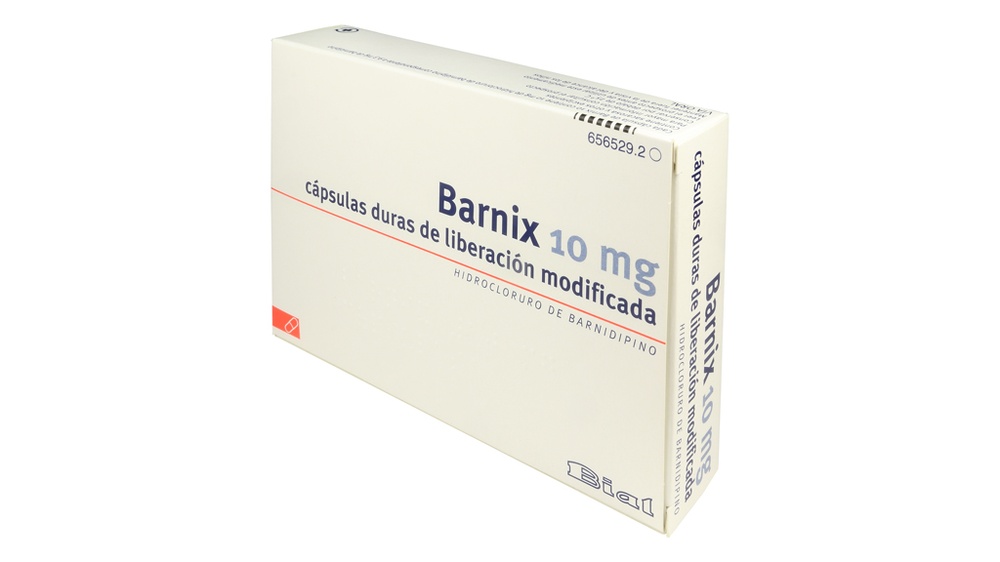
BARNIX 10 mg Cápsulas Duras De Liberación Modificada





Cómo usar BARNIX 10 mg CAPSULAS DURAS DE LIBERACION MODIFICADA
Traducción generada por IA
Este contenido ha sido traducido automáticamente y se ofrece solo con fines informativos. No sustituye la consulta con un profesional sanitario.
Ver originalContenido del prospecto
Introducción
Prospecto: información para el paciente
Barnix 10 mg cápsulas duras de liberación modificada
Hidrocloruro de barnidipino
Lea todo el prospecto detenidamente antes de empezar a tomareste medicamento, porque contiene información importante para usted.
- Conserve este prospecto, ya que puede tener que volver a leerlo.
- Si tiene alguna duda, consulte a su médico o farmacéutico.
- Este medicamento se le ha recetado solamente a usted, y no debe dárselo a otras personas aunque tengan los mismos síntomas que usted, ya que puede perjudicarles.
- Si experimenta efectos adversos, consulte a su médico o farmacéutico, incluso si se trata de efectos adversos que no aparecen en este prospecto.
Contenido del prospecto
- Qué es Barnix y para qué se utiliza
- Qué necesita saber antes de empezar a tomar Barnix
- Cómo tomar Barnix
- Posibles efectos adversos
- Conservación de Barnix
- Contenido del envase e información adicional
1. Qué es Barnix y para qué se utiliza
El principio activo de Barnix pertenece a un grupo de medicamentos denominados antagonistas del calcio. Barnix provoca una dilatación de los vasos sanguíneos lo que da lugar a una reducción de la presión arterial. Barnix cápsulas es una forma de liberación prolongada. Esto significa que el principio activo se absorbe dentro del organismo gradualmente y tiene un efecto más prolongado. Esto es por lo que la toma de una dosis diaria es suficiente.
Barnix se utiliza para el tratamiento de la tensión arterial elevada.

2. Qué necesita saber antes de empezar a tomar Barnix
No tome Barnix
- si es alérgico a barnidipino o a cualquiera de los demás componentes de este medicamento (incluidos en la sección 6).
- si es alérgico a otras dihidropiridinas (utilizadas para el tratamiento de la tensión arterial alta).
- si padece una enfermedad de hígado.
- si padece una enfermedad de riñón grave.
- si padece determinadas afecciones de corazón: insuficiencia cardíaca no tratada, ciertas formas de dolor en el pecho (angina de pecho inestable) o crisis cardíaca aguda.
- si está tomando alguno de los siguientes medicamentos: inhibidores de la proteasa (medicamentos utilizados para el tratamiento del SIDA), ketoconazol o itraconazol (medicamentos utilizados para el tratamiento de infecciones por hongos), eritromicina o claritromicina (antibióticos).
Advertencias y precauciones
Consulte a su médico o farmacéutico antes de empezar a tomar Barnix
- si padece una enfermedad de riñón.
- si padece una enfermedad de corazón.
Niños y adolescentes
Barnix no se puede utilizar en niños o adolescentes menores de 18 años.
Uso de Barnix con otros medicamentos
Comunique a su médico o farmacéutico si está tomando, ha tomado recientemente o podría tener que tomar cualquier otro medicamento.
Es especialmente importante si usted está utilizando alguno de los siguientes medicamentos, ya que NO DEBEN de utilizarse junto con Barnix:
- Inhibidores de la proteasa (medicamentos utilizados para el tratamiento del SIDA).
- Ketoconazol o itraconazol (medicamentos empleados para el tratamiento de infecciones por hongos).
- Eritromicina o claritromicina (antibióticos).
Además informe a su médico si usted está tomando:
- Otros medicamentos utilizados para el tratamiento de la tensión arterial elevada ya que pueden provocar una reducción de la tensión arterial adicional.
- Cimetidina (medicamento empleado para el tratamiento de problemas de estómago) porque pueden aumentar los efectos de Barnix.
- Fenitoína o carbamazepina (medicamentos empleados para el tratamiento de la epilepsia) o rifampicina (un antibiótico) porque se pueden necesitar dosis más altas de Barnix. Si usted termina el tratamiento con estos medicamentos, su médico puede disminuirle la dosis de Barnix.
Toma de Barnix con bebidas y alcohol
Tenga especial cuidado cuando beba alcohol o zumo de pomelo ya que podrían causar un aumento del efecto de Barnix.
Embarazo y lactancia
Si está embarazada o en periodo de lactancia, cree que podría estar embarazada o tiene intención de quedarse embarazada, consulte a su médico o farmacéutico antes de utilizar este medicamento.
No debería utilizar Barnix durante el embarazo a menos que sea claramente necesario.
No debe de utilizar Barnix durante la lactancia. Barnidipino puede pasar a leche materna.
Conducción y uso de máquinas
No hay información que sugiera que Barnix afecta a la capacidad para conducir o utilizar máquinas. Sin embargo, dado que Barnix puede producir mareos/vértigos, debe saber cómo le puede afectar este medicamento antes de conducir o utilizar máquinas.
Barnix contiene sacarosa. Si su médico le ha indicado que padece una intolerancia a ciertos azúcares, consulte con él antes de tomar este medicamento.
3. Cómo tomar Barnix
Dosificación
Siga exactamente las instrucciones de administración de este medicamento indicadas por su médico. En caso de duda, consulte a su médico o farmacéutico.
La dosis inicial recomendada es 1 cápsula de Barnix 10 mg una vez al día. Durante el tratamiento su médico le puede recomendar incrementar la dosis a una cápsula de Barnix 20 mg una vez al día o dos cápsulas de Barnix 10 mg una vez al día.
Si usted es mayor puede tomar la dosis normal. Es probable que su médico le vigile estrechamente al principio del tratamiento.
Instrucciones para su uso apropiado
- Tome la cápsula una vez al día, por la mañana. Es aconsejable asociar la toma de la cápsula con algo que usted haga diariamente, como lavarse los dientes o tomar el desayuno.
- Trague la cápsula entera, preferiblemente con un vaso de agua. Barnix se puede tomar antes, durante y después de las comidas según prefiera.
- Incluso aunque no sienta los signos o síntomas de la tensión alta, es importante continuar la toma de Barnix cada día para obtener todas las ventajas de la reducción de la tensión arterial.
Si toma más Barnix del que debiera
Si usted ha tomado accidentalmente una gran cantidad de cápsulas de una vez, debería inmediatamente consultar con su médico o alguien debería llevarle a urgencias. Los posibles síntomas de sobredosis incluyen debilidad, enlentecimiento o aumento del latido cardíaco, somnolencia, confusión, náuseas, vómitos y convulsiones.
En caso de sobredosis o ingestión accidental consultar al Servicio de Información Toxicológica, teléfono (91) 562 04 20.
Si olvidó tomar Barnix
Si olvidó tomar su dosis de Barnix, a su hora habitual, tómela lo antes posible en el mismo día. Si han pasado más de 24 horas no tome una dosis doble para compensar las dosis olvidadas y continúe con el esquema habitual una vez al día.
Si tiene cualquier otra duda sobre el uso de este medicamento, pregunte a su médico o farmacéutico.

4. Posibles efectos adversos
Al igual que todos los medicamentos, este medicamento puede producir efectos adversos, aunque no todas las personas los sufran.
Si usted experimenta una reacción alérgica grave que causa dificultad para respirar o mareos, debe informar a su médico o enfermera inmediatamente.
Barnix puede causar lo siguiente:
Muy frecuentes: afectan a más de 1 de cada 10 personas
- dolor de cabeza
- enrojecimiento de la cara
- acumulación de líquido (edema) en brazos y piernas,
Frecuentes: pueden afectar hasta 1 de cada 10 personas
- mareo
- palpitaciones
No conocida: la frecuencia no puede estimarse a partir de los datos disponibles
- latidos del corazón acelerado
- análisis de sangre que muestran cambios en el funcionamiento del hígado
- erupción
Estos efectos adversos tienden a disminuir o a desaparecer durante el tratamiento (en un mes para la acumulación de líquidos y en dos semanas para el enrojecimiento de la cara, el dolor de cabeza y las palpitaciones).
Comunicación de efectos adversos
Si experimenta cualquier tipo de efecto adverso, consulte a su médico o farmacéutico, incluso si se trata de posibles efectos adversos que no aparecen en este prospecto. También puede comunicarlos directamente a través del Sistema Español de Farmacovigilancia de medicamentos de Uso Humano: http://www.notificaram.es. Mediante la comunicación de efectos adversos usted puede contribuir a proporcionar más información sobre la seguridad de este medicamento.
5. Conservación de Barnix
Mantener este medicamento fuera de la vista y del alcance de los niños.
No conservar a temperatura superior a 25?C.
No utilice Barnix después de la fecha de caducidad que aparece en el envase después de CAD. La fecha de caducidad es el último día del mes que se indica.
Los medicamentos no se deben tirar por los desagües ni a la basura. Deposite los envases y los medicamentos que no necesita en el Punto SIGRE de la farmacia. En caso de duda pregunte a su farmacéutico cómo deshacerse de los envases y de los medicamentos que no necesita. De esta forma, ayudará a proteger el medio ambiente.
6. Contenido del envase e información adicional
Composición de Barnix
- El principio activo es 10 mg de hidrocloruro de barnidipino, equivalente a 9,3 mg de barnidipino por cápsula.
- Los demás componentes (excipientes) son:
Contenido de la cápsula: carboximetiletilcelulosa, polisorbato 80, sacarosa, etilcelulosa, y talco,
Componentes de la cápsula: dióxido de titanio (E171), óxido de hierro amarillo (E172) y gelatina.
La tinta de impresión: shellac, propilenglicol (E1520), óxido de hierro negro (E172), amoníaco.
Aspecto del producto y contenido del envase
Las cápsulas son amarillas.
Barnix 10 lleva el código 10 LT155.
Barnix cápsulas se presentan en envases que contienen 10, 14, 20, 28, 30, 50, 56, 98 ó 100 cápsulas en blister de aluminio-aluminio (con un recubrimiento de PVC y poliamida). Puede que solamente estén comercializados algunos tamaños de envases.
Titular de la autorización de comercialización
Laboratorios BIAL, S.A.
C/ Alcalá 265, Edificio 2, Planta 2ª
28027 Madrid
ESPAÑA
Responsable de la fabricación
Delpharm Novara s.r.l.
Via Crosa 86
28065 Cerano (NO), Italia
Este medicamento está autorizado en los estados miembros del Espacio Económico Europeo con los siguientes nombres:
España: Barnix
Holanda: Cyress
Fecha de la última revisión de este prospecto: Junio 2025
La información detallada y actualizada de este medicamento está disponible en la página Web de la Agencia Española de Medicamentos y Productos Sanitarios (AEMPS) http://www.aemps.gob.es/

-

- País de registro
- Forma farmacéuticaCAPSULA LIBERACION MODIFICADA, 10mg Barnidipino Hidrocloruro
- Código ATCC08CA12
- Precio medio en farmacia11.79 EUR
- Principio activo
- Requiere recetaSí
- Fabricante
- ComposiciónPOLISORBATO 80 (2,3 mg mg), SACAROSA (95,0 mg mg)
- Esta información es de carácter general y no sustituye la consulta con un profesional sanitario.
- Alternativas a BARNIX 10 mg CAPSULAS DURAS DE LIBERACION MODIFICADAForma farmacéutica: CAPSULA LIBERACION MODIFICADA, 10 mgPrincipio activo: barnidipineFabricante: Swan Pond Investments LimitedRequiere recetaForma farmacéutica: CAPSULA LIBERACION MODIFICADA, 20 mgPrincipio activo: barnidipineFabricante: Swan Pond Investments LimitedRequiere recetaForma farmacéutica: CAPSULA LIBERACION MODIFICADA, 10 mgPrincipio activo: barnidipineFabricante: Teva B.V.Requiere receta
Médicos online para BARNIX 10 mg CAPSULAS DURAS DE LIBERACION MODIFICADA
Comenta la dosis, los posibles efectos secundarios, interacciones, contraindicaciones o la revisión de receta de BARNIX 10 mg CAPSULAS DURAS DE LIBERACION MODIFICADA, sujeto a valoración médica y a la normativa local.
Obtén una receta de BARNIX 10 mg CAPSULAS DURAS DE LIBERACION MODIFICADA online
Rellena un formulario de 2 minutos
Cuéntanos tus síntomas, historial y el medicamento que necesitas.
Elige un médico o nosotros te asignamos uno
Escoge un especialista o te conectamos con el próximo médico disponible.
El médico revisa tu caso
Normalmente en 30 minutos. Puede hacerte preguntas adicionales por chat.
Recógela en cualquier farmacia
Receta electrónica enviada a tu correo, válida en toda España.
Preguntas frecuentes
¿Se requiere receta para BARNIX 10 mg CAPSULAS DURAS DE LIBERACION MODIFICADA?
BARNIX 10 mg CAPSULAS DURAS DE LIBERACION MODIFICADA requires receta en España. Puedes confirmarlo con un médico online según tu caso.
¿Cuál es el principio activo de BARNIX 10 mg CAPSULAS DURAS DE LIBERACION MODIFICADA?
El principio activo de BARNIX 10 mg CAPSULAS DURAS DE LIBERACION MODIFICADA es barnidipine. Esta información ayuda a identificar medicamentos con la misma composición pero con diferentes nombres comerciales.
¿Cuánto cuesta BARNIX 10 mg CAPSULAS DURAS DE LIBERACION MODIFICADA en farmacia?
El precio medio en farmacia de BARNIX 10 mg CAPSULAS DURAS DE LIBERACION MODIFICADA es de aproximadamente 11.79 EUR. Puede variar según el fabricante y la forma farmacéutica.
¿Quién fabrica BARNIX 10 mg CAPSULAS DURAS DE LIBERACION MODIFICADA?
BARNIX 10 mg CAPSULAS DURAS DE LIBERACION MODIFICADA es fabricado por Laboratorios Bial S.A.. La marca y el envase pueden variar según el distribuidor.
¿Qué médicos pueden recetar BARNIX 10 mg CAPSULAS DURAS DE LIBERACION MODIFICADA online?
Los Médicos de familia, Psiquiatras, Dermatólogos, Cardiólogos, Endocrinólogos, Gastroenterólogos, Neumólogos, Nefrólogos, Reumatólogos, Hematólogos, Infectólogos, Alergólogos, Geriatras, Pediatras, Oncólogos pueden valorar la prescripción de BARNIX 10 mg CAPSULAS DURAS DE LIBERACION MODIFICADA cuando esté clínicamente indicado. Puedes reservar una videoconsulta para comentar tu caso y las opciones de tratamiento.
¿Cómo comprar BARNIX 10 mg CAPSULAS DURAS DE LIBERACION MODIFICADA en España?
España cuenta con una infraestructura sanitaria bien desarrollada en ciudades principales como Madrid, Barcelona, Valencia y Sevilla. Las farmacias están ampliamente disponibles y operan bajo estrictas regulaciones, garantizando el acceso a medicamentos con receta.
Puedes comprar BARNIX 10 mg CAPSULAS DURAS DE LIBERACION MODIFICADA en Madrid, Barcelona, Sevilla o Valencia en cualquier farmacia local con una receta válida.
Para obtener una receta, puedes utilizar Oladoctor:
¿Cuáles son las alternativas a BARNIX 10 mg CAPSULAS DURAS DE LIBERACION MODIFICADA?
Otros medicamentos con el mismo principio activo (barnidipine) incluyen BARNIDIPINO SWANPOND INVESTMENTS 10 MG CAPSULAS DURAS DE LIBERACION MODIFICADA EFG, BARNIDIPINO SWANPOND INVESTMENTS 20 MG CAPSULAS DURAS DE LIBERACION MODIFICADA EFG, BARNIDIPINO TEVA 10 MG CAPSULAS DURAS DE LIBERACION MODIFICADA EFG. Pueden tener diferentes nombres comerciales o formulaciones, pero contienen el mismo componente terapéutico. Consulta siempre con un médico antes de cambiar o iniciar un nuevo medicamento.
