






Cómo usar BARILUX AD 327,25 g POLVO PARA SUSPENSION ORAL
Traducción generada por IA
Este contenido ha sido traducido automáticamente y se ofrece solo con fines informativos. No sustituye la consulta con un profesional sanitario.
Ver originalContenido del prospecto
Introducción
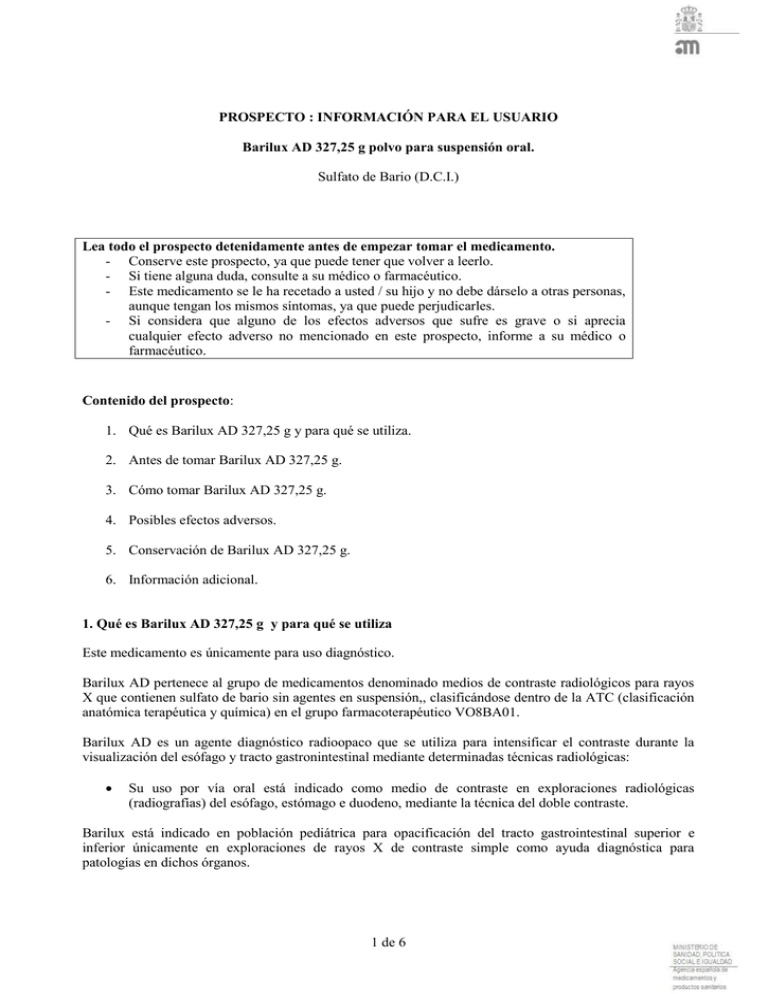
PROSPECTO : INFORMACIÓN PARA EL USUARIO
Barilux AD 327,25 g polvo para suspensión oral.
Sulfato de Bario (D.C.I.)
Lea todo el prospecto detenidamente antes de empezar tomar el medicamento.
|
Contenido del prospecto:
- Qué es Barilux AD 327,25 g y para qué se utiliza.
- Antes de tomar Barilux AD 327,25 g.
- Cómo tomar Barilux AD 327,25 g.
- Posibles efectos adversos.
- Conservación de Barilux AD 327,25 g.
- Información adicional.
1. Qué es Barilux AD 327,25 g y para qué se utiliza
Este medicamento es únicamente para uso diagnóstico.
Barilux AD pertenece al grupo de medicamentos denominado medios de contraste radiológicos para rayos X que contienen sulfato de bario sin agentes en suspensión,, clasificándose dentro de la ATC (clasificación anatómica terapéutica y química) en el grupo farmacoterapéutico VO8BA01.
Barilux AD es un agente diagnóstico radioopaco que se utiliza para intensificar el contraste durante la visualización del esófago y tracto gastronintestinal mediante determinadas técnicas radiológicas:
- Su uso por vía oral está indicado como medio de contraste en exploraciones radiológicas (radiografías) del esófago, estómago e duodeno, mediante la técnica del doble contraste.
Barilux está indicado en población pediátrica para opacificación del tracto gastrointestinal superior e inferior únicamente en exploraciones de rayos X de contraste simple como ayuda diagnóstica para patologías en dichos órganos.

2. Antes de tomar Barilux AD 327,25 g
No tome Barilux AD :
- si es alérgico (hipersensible) al principio activo o a cualquiera de los demás componentes de Barilux .
- si presenta una inflamación de las paredes de la cavidad abdominal (peritoneo irritado)
- si presenta o sospecha que presenta una obstrucción completa del tracto gastrointestinal.
- si presenta estrechamiento del piloro (estenosis pilórica).
- si presenta o sospecha que padece una perforación del tracto gastrointestinal.
- si presenta dehiscencia de sutura postoperatoria gastrointestinal (apertura de la sutura).
- si presenta un historial o sospecha de perforación intestinal.
- si presenta fistulas intestinales.
- si presenta fístulas traqueoesofágicas o bronquioesofágicas.
- si ha sufrido lesiones recientes o quemaduras químicas en el tracto esofago-gastrointestinal.
- si presenta un insuficiente riego sanguíneo (isquemia) de la pared intestinal.
- si presenta una enfermedad inflamatoria del intestino denominada "enterocolitis necrotizante"
- si está a punto de someterse a cirugía del tracto gastrointestinal
- durante los 7 días posteriores a una escisión endoscopica.
- durante 4 semanas después de la radioterapia concomitante.
Tenga especial cuidado con Barilux AD
Se deberá prestar atención especial al administrar Barilux:
- Si usted es una persona de edad avanzada que padece enfermedades, principalmente cardiovasculares, ya que el exámen puede ser estresante para usted.
- Si ueste padece estenosis (estrechamiento) de alto grado, especialmente las mas alejadas (distales) del estómago o afecciones y enfermedades con un elevado riesgo de perforación, tales como fistulas y carcinomas gastrointestinales conocidos, enfermedad inflamatoria intestinal, diverticulitis (inflamación de un divertículo), diverticulosis y amebiasis (infección causada por amebas), ya que en estos casos es necesario que se le realize una una valoración meticulosa del beneficio/riesgo.
Durante la realización del exámen radiológico se deberá impedir la penetración del sulfato de bario en áreas parenterales tales como tejidos, espacio vascular y cavidades corporales o en las vías respiratorias, para evitar las reacciones adversas potencialmente graves.
Tambien usted deberá asegurarse una hidratación adecuada después del procedimiento, para evitar el estreñimiento grave.
Para evitar las reacciones adversas potencialmente graves, durante el proceso diagnóstico, se debe impedir la penetración del sulfato de bario en áreas fuera del tracto gastrointestinal (parenterales) tales como tejidos, espacio vascular, y cavidades corporales o en las vías respiratorias.
En caso de que se produjese la aspiración masiva del producto, intravasación (penetración dentro de vasos sanguíneos) o perforación es necesario intervención médica especializada inmediata, medicina intensiva o incluso cirugía.
Durante la realización del examen radiológico, el sulfato de bario puede acumularse en los divertículos del colon, pudiendo favorecer y/o agravar procesos infecciosos en esta localización.
En el caso de que se formara coprolitos de sulfato de bario (bariolitos) debido al espesamiento del sulfato de bario, en este caso se recomienda la administración laxantes y/o purgantes salinos (con sales o minerales)
Uso de otros medicamentos
Informe a su médico o farmacéutico si está utilizando o ha utilizado recientemente otros medicamentos, incluso los adquiridos sin receta.
Ciertos medicamentos pueden interaccionar con Barilux AD, en estos casos puede resultar necesario cambiar la dosis o interrumpir el tratamiento con alguno de los medicamentos. Es especialmente importante que informe a su medico si utiliza alguno de los siguientes medicamentos:
- Medicamentos que reduzcan el peristaltismo intestinal (contracciones en forma de onda a lo largo del intestino): La toma de estos medicamemtos puede provocar un espesamiento de la suspensión de sulfato de bario y, lo que puede aumentar el riesgo de estreñimiento.
Embarazo y lactancia
Consulte a su médico o farmacéutico antes de utilizar cualquier medicamento.
No ha sido suficientemente demostrado que el empleo de medios de contraste de bario en pacientes embarazadas sea seguro. No deben llevarse a cabo exploraciones radiológicas en mujeres embarazadas a menos que sea estrictamente necesario o cuando el beneficio para la madre supere el riesgo para el feto. En cualquier caso, dado los efectos teratógenos de la exposición a la radiación durante el embarazo, independientemente del uso o no de un agente de contraste, se debe valorar con cuidado el beneficio del examen radiológico)
No se ha investigado la seguridad de Barilux en mujeres que estaban lactando a sus hijos. Los medios de contraste se eliminan por la leche materna en cantidades mínimas. No es previsible daño alguno para el lactante y su médico valorará el beneficio/riesgo antes de someterla a un examen.
El uso de Barilux AD no está contraindicado durante la lactancia
Conducción y uso de máquinas
Barilux AD no afecta a la conducción, ni al manejo de herramientas o máquinas.
Información importante sobre algunos de los componentes de Barilux AD
Los pacientes con dietas pobres en sodio deben tener en cuenta que este medicamento contiene 451 mg (19,6 mmol) de sodio por cada vaso de 340 g de Barilux.
Este medicamento contiene sorbitol. Si su médico le ha indicado que padece una intolerancia a ciertos azúcares, consulte con él antes de tomar/usar este medicamento.
Barilux AD , puede producir un ligero efecto laxante porque contiene 10,4 g de sorbitol por cada vaso de 340 g.
Valor calórico: 2,6 kcal/g de sorbitol.
3. Cómo tomar Barilux AD 327,25 g
Siga exactamente las instrucciones de administración de Barilux AD indicadas por su médico. Consulte a su médico o farmacéutico si tiene dudas.
El personal médico le administrará Barilux AD por via oral.
El médico determinará la cantidad y pauta de administración correcta del producto requerida para su examen radiográfico, dependiendo de su edad, peso y de la técnica a utilizar.
En lactantes y niños, la dosis será ajustada de forma conveniente por el médico en función de la edad, del peso corporal del niño y de las particularidades del radiodiagnóstico pediátrico.
Para los pacientes de edad avanzada, no hay recomendaciones especiales de dosificación.
Consulte a su médico si desea una aclaración con respecto al procedimiento del examen. Es importante seguir las instrucciones de su médico una vez terminado el examen.
Preparación del paciente
Deberá beber bastante agua después del examen para reducir el riesgo de estreñimiento.
Preparación del paciente para la exploración con rayos X del estómago:
Si se observa una abundante secreción ácida (acidez de estómago) en ayunas, es recomendable, en la medida de lo posible, aspirar la secreción gástrica o realizar el examen otro día (por la mañana, lo más temprano posible).
Algunos profesionales utilizan medicamentos inhibidores de la secreción ácida (que reducen la cantidad de ácido producido en el estomago) antes de realizar la exploración de rayos X, con el objetivo de aumentar la adherencia del medio de contraste a las paredes del estómago. El resultado de la prueba mejora si se administra adicionalmente, por vía intravenosa o intramuscular, un antiespasmódico que disminuye el tono del estómago, reduce el peristaltismo y retarda la evacuación del estómago.
Para extender las diferentes regiones del estómago, se recomienda administrar simultáneamente un medicamento con efecto de formación de dióxido de carbono.
Preparación del paciente para uso pediátrico:
Los pacientes recien nacidos (neonatos) no es necesario que estén en ayunas. En cuanto a los niños de 1-24 meses deben estár en ayunas desde 4 horas antes de realizar la prueba, 6 horas antes los niños de 2-4 años y 8 horas antes los niños de 4-14 años, aunque en este último caso podrán tomar un poco de agua hasta 3 horas antes del estudio.
En niños pequeños es recomendable no porporcionarles la ultima toma de alimento para facilitar la ingesta del contraste.
Pacientes con insuficiencia hepática:
No es necesario realizar un ajuste de la dosis (ver sección 2: Tenga especial cuidado con Barilux)
Pacientes con insuficiencia renal:
No es necesario realizar un ajuste de la dosis (ver sección 2: Tenga especial cuidado con Barilux)
Si usa más Barilux AD del que debiera
En raras ocasiones, la administración repetida de suspensiones de sulfato de bario puede dar lugar a espasmos de estómago y diarrea. Estas reacciones son transitorias y no se consideran graves.
En exploraciones en las que se administra altas dosis de enema de bario, puede producirse una alteración del equilibrio electrolítico en el suero sanguíneo debido a la gran cantidad de agua que retiene el contraste . En dichos casos, es posible reducir el riesgo si se añade cloruro de sodio al líquido del enema. El equilibrio electrolítico en el suero se restablece mediante una terapia de infusión adecuada.
En caso de sobredosis o ingestión accidental, consultar al Servicio de Información Toxicológica. Teléfono 91.562.04.20.
Si olvidó tomar Barilux AD
No tome una dosis doble para compensar las dosis olvidadas.
Si interrumpe el tratamiento con Barilux AD
Si tiene cualquier otra duda sobre el uso de este producto, pregunte a su médico o farmacéutico.

4. Posibles efectos adversos
Al igual que todos los medicamentos, Barilux AD puede producir efectos adversos, aunque no todas las personas los sufran.
Las reacciones adversas graves, notificadas con la administración de formulaciones de sulfato de bario, están generalmente asociadas con una técnica de administración defectuosa o con condiciones patológicas preexistentes.
Si considera que alguno de los efectos adversos que sufre es grave o si aprecia cualquier efecto adverso no mencionado en este prospecto, informe a su médico o farmacéutico.
Efectos adversos raros(es probable que los sufran entre 1 y 10 de cada 10.000 personas)
- reacciones alérgicas (urticaria, shock anafiláctico, erupciones cutáneas).
Efectos adversos muy raros(es probable que lo sufran menos de 1 de cada 10.000 personas)
- intravasación y embolización del bario.
- formacion de bariolitos que pueden provocar bloqueo del intestino grueso.
Efectos adversos de frecuencia no conocida
- Neumonitis por aspiración.
- Aumento o intensificación de la obstruccion intestinal.
5. Conservación de Barilux AD 327,25 g
Este medicamento no requiere ninguna temperatura especial de conservación
Conservar en el embalaje original para protegerlo de la humedad.
Mantener fuera del alcance y de la vista de los niños.
No utilice Barilux AD después de la fecha de caducidad que aparece en el envase. La fecha de caducidad es es el último día del mes que se indica.
Los medicamentos no se deben tirar por los desagües ni a la basura. Pregunte a su farmacéutico cómo deshacerse de los envases y de los medicamentos que no necesita. De esta forma ayudará a proteger el medio ambiente.
6. Información adicional
Composición de Barilux AD
- La sustancia activa es sulfato de bario. 100 g de polvo para suspensión contienen 96,25 g de sulfato de bario.
- 1 vaso monodosis de 340 g de polvo para suspensión contiene 327,25 g de sulfato de bario
- Los demás componentes son: sorbitol, citrato de sodio, dimeticona, sacarina sódica, 3-etoxi-4-hidroxibenzaldehído; etilvainillina; polisorbato 20.
Aspecto del producto y contenido del envase
Barilux AD está disponible en envases clínicos que contienen 23 vasos de 340 g de polvo para suspensión oral cada uno.
Titular de la autorización de comercialización y responsable de la fabricación
Titular de la autorización de comercialización:
Iberoinvesa Pharma S.L. Calle Zurbarán 18, 6º. 28010. Madrid. España.
Responsable de Fabricación:
Sanochemia Pharmazeutika AG. Landegger Str. 7. A-2491 Neufeld/Leitha. Austria.
Este prospecto ha sido aprobado en diciembre 2010.
-

- País de registro
- Forma farmacéuticaSOLUCIÓN/SUSPENSIÓN ORAL, 327,25 g
- Código ATCV08BA01
- Principio activo
- Requiere recetaSí
- Fabricante
- Esta información es de carácter general y no sustituye la consulta con un profesional sanitario.
- Alternativas a BARILUX AD 327,25 g POLVO PARA SUSPENSION ORALForma farmacéutica: LIQUIDO RECTAL, 97,4 gPrincipio activo: barium sulfate with suspending agentsFabricante: Laboratorios Ern S.A.Requiere recetaForma farmacéutica: SOLUCIÓN/SUSPENSIÓN ORAL, 98 gPrincipio activo: barium sulfate with suspending agentsFabricante: Laboratorios Ern S.A.Requiere recetaForma farmacéutica: SOLUCIÓN/SUSPENSIÓN ORAL, 10 g de sulfato de bario por sobrePrincipio activo: barium sulfate with suspending agentsFabricante: Laboratorios Ern S.A.Requiere receta


Médicos online para BARILUX AD 327,25 g POLVO PARA SUSPENSION ORAL
Comenta la dosis, los posibles efectos secundarios, interacciones, contraindicaciones o la revisión de receta de BARILUX AD 327,25 g POLVO PARA SUSPENSION ORAL, sujeto a valoración médica y a la normativa local.









Obtén una receta de BARILUX AD 327,25 g POLVO PARA SUSPENSION ORAL online
Rellena un formulario de 2 minutos
Cuéntanos tus síntomas, historial y el medicamento que necesitas.
Elige un médico o nosotros te asignamos uno
Escoge un especialista o te conectamos con el próximo médico disponible.
El médico revisa tu caso
Normalmente en 30 minutos. Puede hacerte preguntas adicionales por chat.
Recógela en cualquier farmacia
Receta electrónica enviada a tu correo, válida en toda España.
Preguntas frecuentes
BARILUX AD 327,25 g POLVO PARA SUSPENSION ORAL requires receta en España. Puedes confirmarlo con un médico online según tu caso.
El principio activo de BARILUX AD 327,25 g POLVO PARA SUSPENSION ORAL es barium sulfate with suspending agents. Esta información ayuda a identificar medicamentos con la misma composición pero con diferentes nombres comerciales.
BARILUX AD 327,25 g POLVO PARA SUSPENSION ORAL es fabricado por Iberoinvesa Pharma S.L.. La marca y el envase pueden variar según el distribuidor.
Los Médicos de familia, Psiquiatras, Dermatólogos, Cardiólogos, Endocrinólogos, Gastroenterólogos, Neumólogos, Nefrólogos, Reumatólogos, Hematólogos, Infectólogos, Alergólogos, Geriatras, Pediatras, Oncólogos pueden valorar la prescripción de BARILUX AD 327,25 g POLVO PARA SUSPENSION ORAL cuando esté clínicamente indicado. Puedes reservar una videoconsulta para comentar tu caso y las opciones de tratamiento.
España cuenta con una infraestructura sanitaria bien desarrollada en ciudades principales como Madrid, Barcelona, Valencia y Sevilla. Las farmacias están ampliamente disponibles y operan bajo estrictas regulaciones, garantizando el acceso a medicamentos con receta.
Puedes comprar BARILUX AD 327,25 g POLVO PARA SUSPENSION ORAL en Madrid, Barcelona, Sevilla o Valencia en cualquier farmacia local con una receta válida.
Para obtener una receta, puedes utilizar Oladoctor:
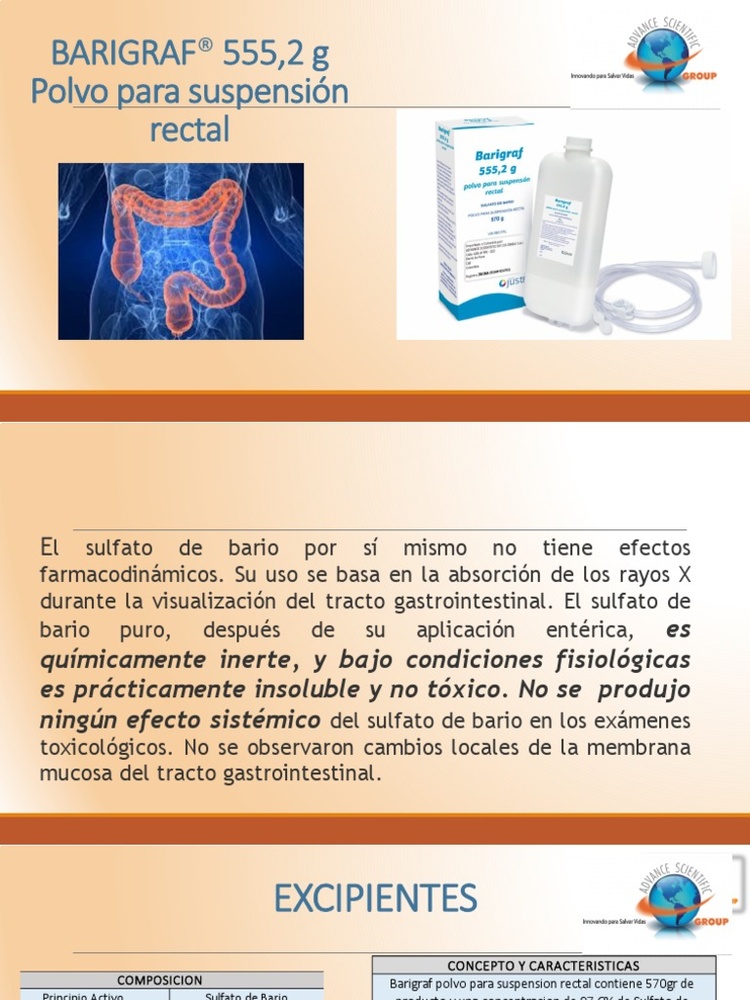
Otros medicamentos con el mismo principio activo (barium sulfate with suspending agents) incluyen BARIGRAF 555,2 g POLVO PARA SUSPENSION RECTAL, BARIGRAF AD 333,2 g POLVO PARA SUSPENSION ORAL, BARIGRAF TAC POLVO PARA SUSPENSION ORAL. Pueden tener diferentes nombres comerciales o formulaciones, pero contienen el mismo componente terapéutico. Consulta siempre con un médico antes de cambiar o iniciar un nuevo medicamento.
