


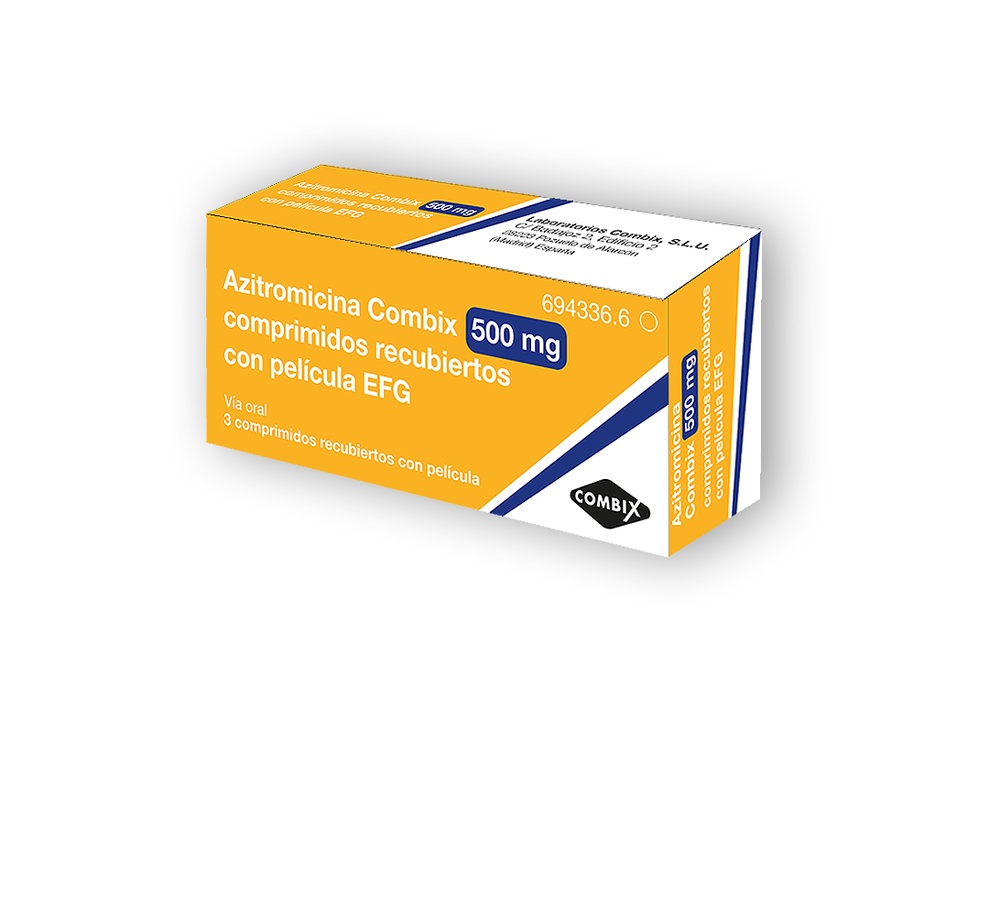
AZITROMICINA COMBIX 500 MG COMPRIMIDOS RECUBIERTOS CON PELICULA EFG



Cómo usar AZITROMICINA COMBIX 500 MG COMPRIMIDOS RECUBIERTOS CON PELICULA EFG
Traducción generada por IA
Este contenido ha sido traducido automáticamente y se ofrece solo con fines informativos. No sustituye la consulta con un profesional sanitario.
Ver originalContenido del prospecto
Introducción
PROSPECTO: INFORMACIÓN PARA EL USUARIO
Azitromicina Combix 500 mg comprimidos recubiertos con película EFG
Azitromicina (como dihidrato)
Lea todo el prospecto detenidamente antes de empezar a tomar este medicamento, porque contiene información importante para usted.
- Conserve este prospecto ya que puede tener que volver a leerlo.
- Si tiene dudas, pregunte a su médico o farmacéutico.
- Este medicamento se le ha recetado solamente a usted, y no debe dárselo a otras personas aunque tengan los mismos síntomas que usted, ya que puede perjudicarles.
- Si experimenta efectos adversos, consulte a su médico o farmacéutico, incluso si se trata de efectos adversos que no aparecen en este prospecto. Ver sección 4.
Contenido del prospecto:
- Qué es Azitromicina Combix y para qué se utiliza
- Qué necesita saber antes de empezar a tomar Azitromicina Combix
- Cómo tomar Azitromicina Combix
- Posibles efectos adversos
- Conservación de Azitromicina Combix
- Contenido del envase e información adicional
1. Qué es Azitromicina Combix y para qué se utiliza
Azitromicina pertenece a un grupo de medicamentos llamados antibióticos macrólidos. Se usa para tratar infecciones causadas por microorganismos como bacterias. Estas infecciones incluyen:
- Infecciones de pecho, como bronquitis y neumonía
- Infecciones de senos paranasales, garganta, amígdalas u oídos
- Infecciones leves o moderadas de la piel y de los tejidos blandos p.ej. infecciones de los folículos capilares (foliculitis), infecciones bacterianas de la piel y de las capas subcutáneas (celulitis), infecciones cutáneas con inflamación rojiza (erisipelas)
- Infecciones causadas por una bacteria llamada Chlamydia trachomatis. Pueden provocar inflamación en el conducto urinario que parte de la vejiga (uretra) o donde el útero se une a la vagina (cervix).

2. Qué necesita saber antes de empezar a tomar Azitromicina Combix
No tome Azitromicina Combix
- si es alérgico (hipersensible) a azitromicina o a cualquiera de los demás componentes de este medicamento (incluidos en la sección 6); o a otros antibióticos macrólidos, p.ej. eritromicina.
Advertencias y precauciones
Consulte a su médico o farmacéutico antes de empezar a tomar Azitromicina Combix.
Tenga especial cuidado con Azitromicina Combix
Antes de iniciar el tratamiento con este medicamento, informe a su médico si:
- alguna vez ha tenido una reacción alérgica grave caracterizada por presentar síntomas tales como hinchazón de la cara o la garganta, posiblemente con dificultad al respirar.
- tiene problemas graves de riñón, es posible que su médico le cambie la dosis.
- tiene problemas de hígado: su médico puede necesitar controlar su función hepática o decidir interrumpir la medicación
- sabe que alguna vez le han diagnosticado prolongación del intervalo QT (problema cardíaco): no se recomienda el uso de azitromicina
- sabe que tiene un pulso irregular o lento, o una función cardíaca reducida: no se recomienda el uso de azitromicina
- sabe que tiene niveles bajos de potasio o magnesio en sangre: no se recomienda el uso de azitromicina
- está tomando medicamentos conocidos como antiarrítmicos (usados para tratar el ritmo cardíaco anormal), cisaprida (usada para tratar problemas estomacales) o terfenadina (un antihistamínico usado para tratar alergias): no se recomienda el uso de azitromicina
- toma medicamentos llamados alcaloides ergóticos (como la ergotamina) usados para tratar la migraña: no se recomienda el uso de azitromicina (ver 'Uso de otros medicamentos’)
- alguna vez le han diagnosticado una enfermedad neurológica, que es una enfermedad del cerebro o del sistema nervioso
- tiene problemas mentales, emocionales o de comportamiento
Si experimenta diarrea grave o persistente durante o después del tratamiento, en particular si observa sangre o mucosidad, debe informar de ello a su médico inmediatamente.
Si los síntomas persisten después de finalizar el tratamiento con azitromicina, o si observa nuevos síntomas persistentes, póngase en contacto con su médico.
Uso de Azitromicina con otros medicamentos
Consulte con su médico si esta tomando alguno de los siguientes medicamentos:
- Antiácidos, p.ej. hidróxido de aluminio: tome azitromicina al menos 1 hora antes o 2 horas después de tomar el antiácido
- Derivados ergóticos, p.ej. ergotamina (usado para tratar la migraña): azitromicina no debe tomarse simultáneamente ya que puede aparecer ergotismo (una reacción adversa potencialmente grave con entumecimiento o sensación de hormigueo en las extremidades, calambres musculares, cefaleas, convulsiones, dolor torácico o abdominal)
- Derivados cumarínicos, p.ej. warfarina (usada para detener la coagulación sanguínea): puede aumentar el riesgo de hemorragias
- Digoxina (usada para tratar el fallo cardíaco): pueden aumentar los niveles de digoxina en sangre
- Colchicina (utilizada para la gota y la fiebre mediterránea familiar)
- Zidovudina (usada en el tratamiento del VIH): pueden aumentar los niveles de zidovudina
- Rifabutina (usada en el tratamiento del VIH e infecciones bacterianas incluyendo tuberculosis): los niveles tanto de rifabutina y azitromicina en sangre pueden verse afectados, con un posible descenso del número de glóbulos blancos
- Teofilina (usada para tratar el asma y otras enfermedades pulmonares): el efecto de teofilina puede incrementarse
- Quinidina (usada para controlar el ritmo cardíaco): los niveles de quinidina pueden aumentar
- Ciclosporina (un supresor del sistema inmunológico usado después de un trasplante): su médico deberá controlar sus niveles de ciclosporina en sangre
- Pimozida (usada para tratar la esquizofrenia u otros problemas mentales): los niveles de pimozida pueden incrementarse
- Cisaprida (usada para tratar problemas estomacales): pueden aparecer problemas cardíacos
- Astemizol, terfenadina (antihistamínicos usados para tratar reacciones alérgicas): pueden incrementarse los efectos
- Triazolam y midazolam (sedantes): sus efectos pueden verse incrementados
- Alfentanilo (un analgésico): el efecto de alfentanilo puede verse incrementado.
Informe a su médico o farmacéutico si está utilizando o ha utilizado recientemente otros medicamentos, incluso los adquiridos sin receta.
Embarazo y lactancia
La información existente sobre la seguridad de azitromicina durante el embarazo es insuficiente. Por lo tanto, no se recomienda tomar azitromicina si está embarazada o intentando quedarse embarazada. No obstante, su médico puede decidir recetárselo bajo circunstancias graves.
No debe dar el pecho mientras está tomando azitromicina, ya que puede provocar reacciones adversas en el lactante incluyendo diarrea e infecciones. Puede reanudar la lactancia dos días después de interrumpir el tratamiento con azitromicina.
Consulte a su médico o farmacéutico antes de utilizar cualquier medicamento.
Conducción y uso de máquinas
Azitromicina puede provocar mareo y convulsiones. Si es su caso, no conduzca ni utilice maquinaria.
Azitromicina Combix contiene lactosa.Si su médico le ha indicado que padece una intolerancia a ciertos azúcares, consulte con él antes de tomar este medicamento.
3. Cómo tomar Azitromicina Combix
Siga exactamente las instrucciones de administración de azitromicina indicadas por su médico. En caso de duda, consulte de nuevo a su médico o farmacéutico.
Los comprimidos deben tragarse preferiblemente con agua, pueden tomarse con o sin alimentos.
La dosis recomendada es:
Adultos (incluidos pacientes de edad avanzada) y niños de más de 45 kg de peso:
La dosis habitual es de 1.500 mg repartidos en 3 ó 5 días de la siguiente manera:
- Durante 3 días, 500 mg al día.
- Durante 5 días, 500 mg el primer día y luego 250 mg en los días 2 a 5.
- Inflamación de la uretra o cervix causada por Chlamydia: 1.000 mg tomados como una dosis única, durante un solo día.
Pacientes con alteraciones renales o hepáticos:
Debe informar a su médico inmediatamente si tiene problemas de riñón o de hígado ya que éste puede necesitar modificar la dosis habitual.
Uso en niños y adolescentes
Niños y adolescentes de menos de 45 kg de peso:
Los comprimidos no están indicados para estos pacientes. Pueden usarse otras formas farmacéuticas de medicamentos que contienen azitromicina (p.ej. suspensiones).
Si toma más Azitromicina Combix de la que debe
Si usted (u otra persona) ingiere muchos comprimidos juntos, o si cree que un niño ha ingerido alguno de los comprimidos, póngase en contacto con su médico o farmacéutico inmediatamente o llame al Servicio de Información Toxicológica, teléfono 91 562 04 20 indicando el medicamento y la cantidad utilizada. Se recomienda llevar el envase y prospecto al profesional sanitario. Una sobredosis puede generar una pérdida de audición reversible, náuseas intensas (sensación de mareo), vómitos y diarrea.
Si olvidó tomar Azitromicina Combix
Si olvidó tomar un comprimido, tómelo lo antes posible, a menos que sea casi la hora de la siguiente toma.
No tome una dosis doble para compensar las dosis olvidadas.
Si interrumpe el tratamiento con Azitromicina Combix
No deje de tomar el medicamento sin consultar antes con su médico, incluso si ya se siente mejor. Es importante que siga tomando azitromicina durante el periodo de tiempo indicado por su médico, si no es posible que se repita la infección.
Si tiene cualquier otra duda sobre el uso de este medicamento, consulte con su médico o farmacéutico.

4. Posibles efectos adversos
Al igual que todos los medicamentos, azitromicina puede provocar efectos adversos, aunque no todas las personas los sufran.
Si advierte alguno de estos efectos adversos, deje de tomar los comprimidos e informe a su médico inmediatamente o acuda al servicio de urgencias más cercano:
- Una reacción alérgica (hinchazón de los labios, la cara o el cuello que conduzcan a dificultades graves para respirar; erupción cutánea o urticaria)
- ampollas/hemorragias en labios, ojos, nariz, boca y genitales, que pueden ser causados por síndrome de Stevens-Johnson o necrólisis epidérmica tóxica, ambas condiciones son enfermedades graves
- pulso irregular
- diarrea prolongada con sangre o mucosidad.
Estos son efectos adversos raros pero muy graves. Puede que requiera atención médica urgente u hospitalización.
Se han notificado los siguientes efectos adversos:
Frecuentes (pueden afectar hasta 1 de cada 10 pacientes):
- Sensación de mareo, vómito, diarrea
- Dolor y calambres abdominales
Poco frecuentes (pueden afectar hasta 1 de cada 100 pacientes):
- Mareo, somnolencia, cefalea
- Convulsiones, alteración del olfato o el gusto
- Diarrea, flatulencia, problemas digestivos, pérdida del apetito
- Reacciones alérgicas como erupciones o picores
- Dolor en las articulaciones
- Inflamación de la vagina.
Raros (pueden afectar hasta 1 de cada 1.000 pacientes):
- Trastornos sanguíneos caracterizados por fiebre o escalofríos, dolor de garganta, úlceras en la boca o la garganta, hemorragias no habituales o hematomas inesperados, recuento sanguíneo bajo que provoca cansancio no habitual o debilidad
- Agresividad, inquietud, ansiedad, nerviosismo
- Sensación de irrealidad
- Confusión, especialmente en pacientes de edad avanzada
- Hormigueo o entumecimiento
- Desmayos, letargia, problemas para dormir, debilidad, hiperactividad
- Alteraciones en la audición incluyendo pérdida de oído, sordera y pitidos en los oídos, que normalmente desaparecen al terminar el tratamiento
- Cambios en el ritmo cardiaco, ritmo cardiaco o frecuencia cardiaca anormal, conciencia del latido(palpitaciones), tensión arterial baja (que puede estar asociada con debilidad, aturdimiento y desmayo)
- Estreñimiento, coloración de la lengua y los dientes, inflamación del páncreas que causa náuseas, vómitos, dolor abdominal, dolor de espalda
- Cambios en los enzimas hepáticos o hepatitis (inflamación del hígado), coloración amarillenta de la piel o del blanco de los ojos provocados por problemas del hígado o de la sangre, lesiones en el hígado, fallo hepático (rara vez con desenlace fatal)
- Problemas de riñón
- Infecciones fúngicas en la boca y la vagina (candidiasis)
- Enrojecimiento y ampollas en la piel durante la exposición solar.
- Erupción cutánea que se caracteriza por la rápida aparición de zonas de piel roja salpicadas de pequeñas pústulas (pequeñas ampollas llenas de un líquido blanco/amarillo).
La frecuencia de los siguientes efectos adversos es desconocida:
- Trastornos de la vista
- Dolor torácico e inflamación
- Indigestión, inflamación estomacal con dolor abdominal
- Erupción cutánea
- Dolor.
Comunicación de efectos adversos
Si experimenta cualquier tipo de efecto adverso, consulte a su médico, farmacéutico o enfermero, incluso si se trata de posibles efectos adversos que no aparecen en este prospecto. También puede comunicarlos directamente a través del Sistema Español de Farmacovigilancia de Medicamentos de Uso Humano: https://www.notificaram.es. Mediante la comunicación de efectos adversos usted puede contribuir a proporcionar más información sobre la seguridad de este medicamento.
5. Conservación de Azitromicina Combix
Mantener este medicamento fuera de la vista y del alcance de los niños.
Este medicamento no requiere condiciones especiales de conservación. No cambie los comprimidos a otro envase.
No utilice este medicamento después de la fecha de caducidad que aparece en el envase después de “Cad.”. La fecha de caducidad es el último día del mes que se indica.
Los medicamentos no se deben tirar por los desagües ni a la basura. Deposite los envases y los medicamentos que no necesita en el Punto SIGRE de la farmacia. En caso de duda pregunte a su farmacéutico cómo deshacerse de los envases y de los medicamentos que no necesita. De esta forma, ayudará a proteger el medio ambiente.
6. Información adicional
Composición de Azitromicina Combix
- El principio activo es azitromicina. Cada comprimido contiene 500 mg de azitromicina (como dihidrato de azitromicina).
- Los demás componentes son: almidón de maíz pregelatinizado, crospovidona, hidrogeno fosfato de calcio anhidro, laurilsulfato sódico, estearato magnésico, hipromelosa, dióxido de titanio (E- 171), lactosa monohidrato, gliceril triacetato.
Aspecto del producto y contenido del envase
Azitromicina Combix 500 mg se presenta en forma de comprimidos recubiertos con película de color blanco, oblongos, biconvexos, marcados por una cara.
Cada envase contiene blísters con 3 ó 150 comprimidos.
Es posible que no se comercialicen todos los tamaños.
Titular de la autorización de comercialización y responsable de la fabricación
Titular de la autorización de comercialización:
Laboratorios Combix, S.L.U.
C/ Badajoz 2, Edificio 2
28223- Pozuelo de Alarcon (Madrid)
España
Responsable de la fabricación:
Bluepharma - Indústria Farmacêutica, S.A.
- Martinho do Bispo. 3045-016 Coimbra
Portugal
Este prospecto ha sido aprobado en Marzo de 2018.
La información detallada y actualizada de este medicamento está disponible en la página web de la Agencia Española de Medicamentos y Productos Sanitarios (AEMPS) http://www.aemps.gob.es/
- País de registro
- Forma farmacéuticaCOMPRIMIDO, 500 MG
- Código ATCJ01FA10
- Precio medio en farmacia5.62 EUR
- Principio activo
- Requiere recetaSí
- Fabricante
- Esta información es de carácter general y no sustituye la consulta con un profesional sanitario.
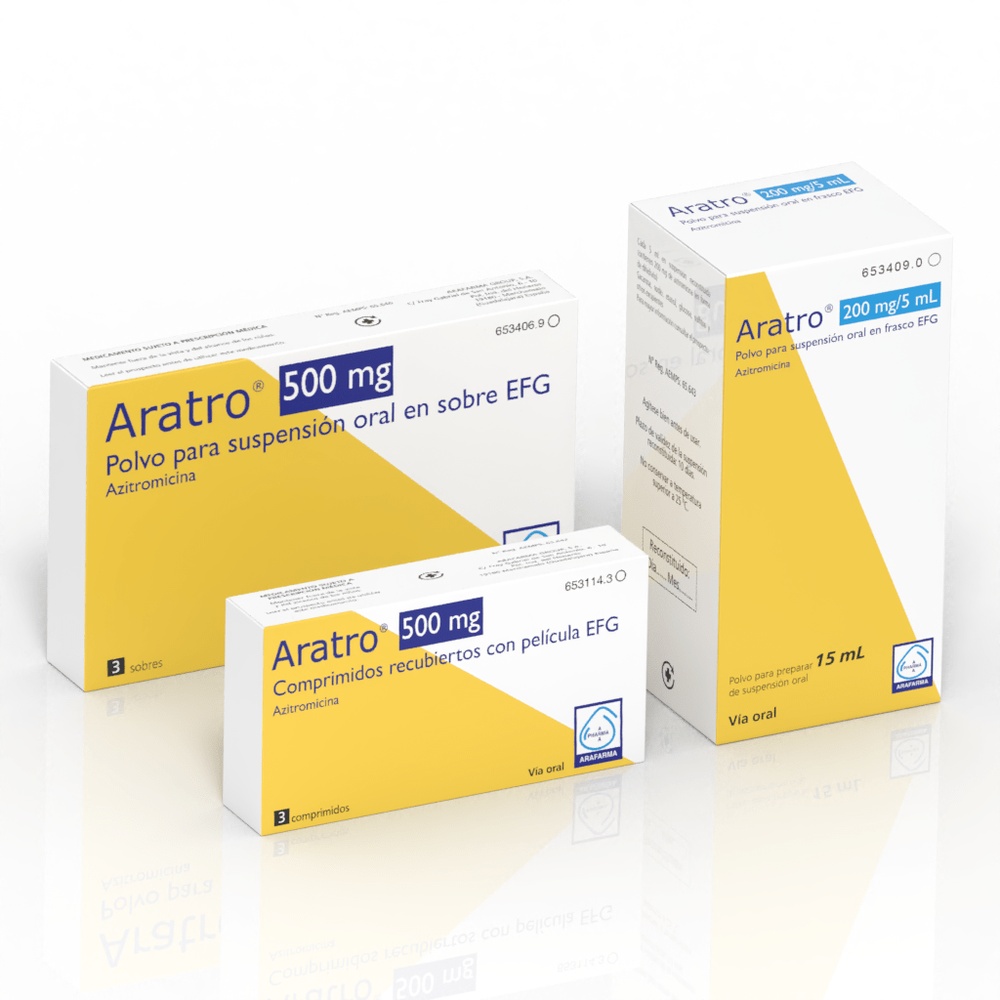
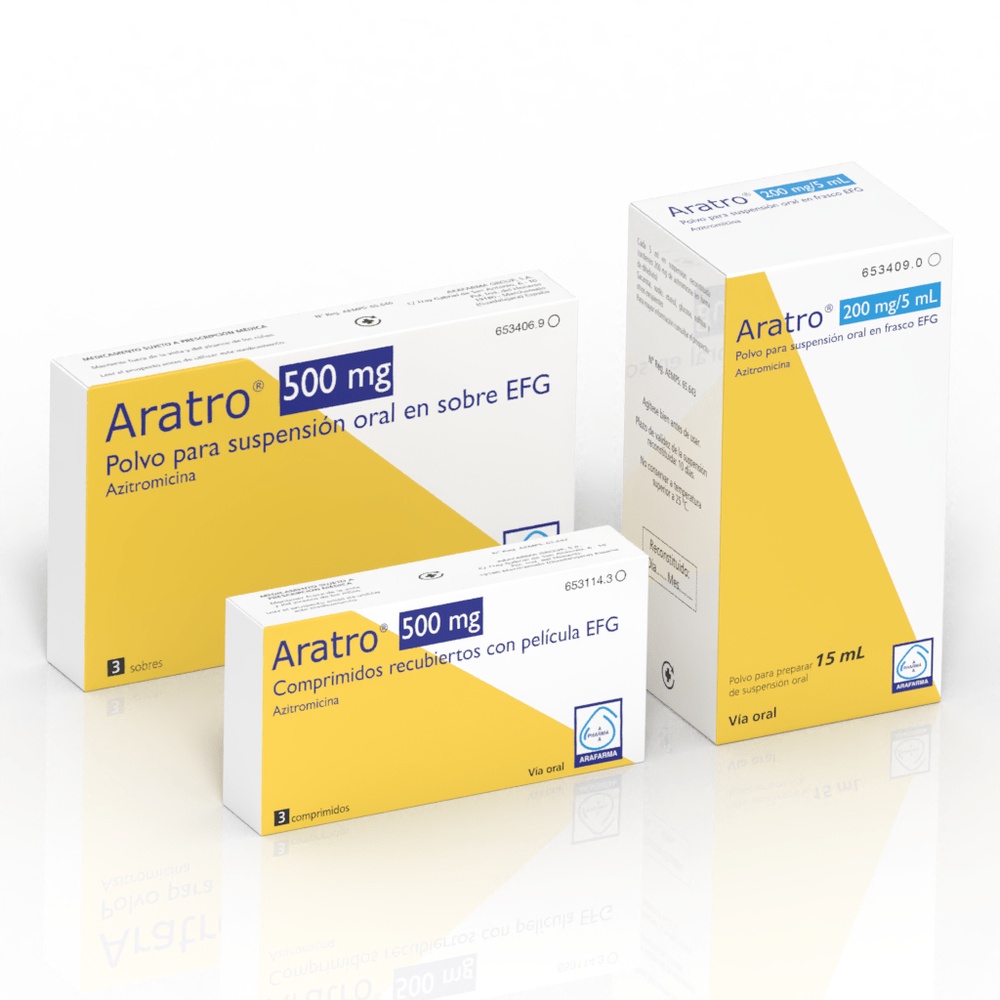
- Alternativas a AZITROMICINA COMBIX 500 MG COMPRIMIDOS RECUBIERTOS CON PELICULA EFGForma farmacéutica: SOLUCIÓN/SUSPENSIÓN ORAL, 200 mg azitromicina / 5 mlPrincipio activo: AzitromicinaFabricante: Arafarma Group S.A.Requiere recetaForma farmacéutica: COMPRIMIDO, 500 mgPrincipio activo: AzitromicinaFabricante: Arafarma Group S.A.Requiere recetaForma farmacéutica: SOLUCIÓN/SUSPENSIÓN ORAL, 500 mgPrincipio activo: AzitromicinaFabricante: Arafarma Group S.A.Requiere receta
Médicos online para AZITROMICINA COMBIX 500 MG COMPRIMIDOS RECUBIERTOS CON PELICULA EFG
Comenta la dosis, los posibles efectos secundarios, interacciones, contraindicaciones o la revisión de receta de AZITROMICINA COMBIX 500 MG COMPRIMIDOS RECUBIERTOS CON PELICULA EFG, sujeto a valoración médica y a la normativa local.








.jpg)


Preguntas frecuentes
