


Azacitidina Hikma 25 mg/ml polvo para suspensión inyectable

Revisión de receta online
Un médico revisará tu caso y determinará si la prescripción es médicamente apropiada.

Habla con un médico sobre este medicamento
Comenta tus síntomas y las opciones de tratamiento en una consulta online.



Cómo usar AZACITIDINA HIKMA 25 MG/ML POLVO PARA SUSPENSION INYECTABLE EFG
Contenido del prospecto
- Introducción
- Qué es Azacitidina Hikma y para qué se utiliza
- Qué necesita saber antes de empezar a usar Azacitidina Hikma
- Cómo usar Azacitidina Hikma
- Posibles efectos adversos
- Conservación de Azacitidina Hikma
- Contenido del envase e información adicional
Introducción
Prospecto: información para el usuario
Azacitidina Hikma 25 mg/ml polvo para suspensión inyectable EFG
Lea todo el prospecto detenidamente antes de empezar a usar este medicamento, porque contiene información importante para usted.
- Conserve este prospecto, ya que puede tener que volver a leerlo.
- Si tiene alguna duda, consulte a su médico, farmacéutico o enfermero.
- Si experimenta efectos adversos, consulte a su médico, farmacéutico o enfermero, incluso si se trata de efectos adversos que no aparecen en este prospecto. Ver sección 4.
Contenido del prospecto
- Qué es Azacitidina Hikma y para qué se utiliza
- Qué necesita saber antes de empezar a usar Azacitidina Hikma
- Cómo usar Azacitidina Hikma
- Posibles efectos adversos
5 Conservación de Azacitidina Hikma
- Contenido del envase e información adicional
1. Qué es Azacitidina Hikma y para qué se utiliza
Qué es Azacitidina Hikma
Azacitidina es un agente anticancerígeno que pertenece a un grupo de medicamentos llamados “antimetabolitos”. Este medicamento contiene el principio activo “azacitidina”.
Para qué se utiliza Azacitidina Hikma
Azacitidina se utiliza en adultos que no pueden recibir un trasplante de células madre para tratar:
- Síndromes mielodisplásicos (SMD) de mayor riesgo.
- Leucemia mielomonocítica crónica (LMMC).
- Leucemia mieloide aguda (LMA).
Estas enfermedades afectan a la médula ósea y pueden causar problemas en la producción normal de células de la sangre.
Cómo actúa Azacitidina Hikma
Azacitidina actúa impidiendo el crecimiento de las células cancerosas. Azacitidina se incorpora al material genético de las células (ácido ribonucleico [ARN] y ácido desoxirribonucleico [ADN]). Se cree que actúa alterando la forma en que las células activan o desactivan los genes al interferir en la producción de nuevo ARN y ADN. Se cree que estas acciones corrigen los problemas de maduración y crecimiento de las células sanguíneas sanas en la médula ósea que causan los trastornos mielodisplásicos, y que matan las células cancerosas en la leucemia.
Consulte a médico o enfermero si tiene alguna pregunta acerca de cómo actúa azacitidina o por qué se le ha recetado este medicamento.

¿No estás seguro de si este medicamento es adecuado para ti?
Comenta tus síntomas y tratamiento con un médico online.
2. Qué necesita saber antes de empezar a usar Azacitidina Hikma
Nouse Azacitidina Hikma
- Si es alérgico a azacitidina o a alguno de los demás componentes de este medicamento (incluidos en la sección 6).
- Si padece cáncer avanzado del hígado.
- Durante el periodo de lactancia.
Advertencias y precauciones
Consulte a su médico, farmacéutico o enfermero antes de empezar a usar azacitidina:
- Si tiene una disminución del recuento de plaquetas, glóbulos rojos o glóbulos blancos.
- Si tiene una enfermedad de los riñones.
- Si tiene una enfermedad del hígado.
- Si alguna vez ha tenido una enfermedad cardiaca o un infarto de miocardio, o tiene antecedentes de enfermedad pulmonar
Azacitidima Hikma puede provocar una reacción inmune grave llamada “síndrome de diferenciación” (ver sección 4).
Análisis de sangre
Antes de empezar el tratamiento con azacitidina y al inicio de cada periodo de tratamiento (llamado “ciclo”) le harán análisis de sangre. Esto se hace para comprobar que usted tiene una cantidad suficiente de células sanguíneas y que su hígado y riñones funcionan correctamente.
Niños y adolescentes
No se recomienda el uso de azacitidina en niños y adolescentes menores de 18 años.
Otros medicamentos y Azacitidina Hikma
Informe a su médico o farmacéutico si está utilizando, ha utilizado recientemente o pudiera tener que utilizar cualquier otro medicamento. Esto se debe a que azacitidina puede afectar a la manera en que otros medicamentos actúan. Asimismo, otros medicamentos pueden afectar a la manera en que azacitidina actúa.
Embarazo, lactancia y fertilidad
Embarazo
No debe usar azacitidina durante el embarazo porque puede ser perjudicial para el bebé.
Si es mujer y puede quedarse embarazada, debe utilizar un método anticonceptivo eficaz mientras tome azacitidina y durante 6 meses tras finalizar el tratamiento. Informe inmediatamente a su médico si se queda embarazada durante el tratamiento.
Si está embarazada o en periodo de lactancia, cree que podría estar embarazada o tiene intención de quedarse embarazada, consulte a su médico o farmacéutico antes de utilizar este medicamento.
Lactancia
Azacitidina no debe utilizarse durante la lactancia. Se desconoce si este medicamento se excreta en la leche materna.
Fertilidad
Los varones no deben concebir un niño mientras reciben tratamiento con Azacitidina. Los hombres deben utilizar un método anticonceptivo efectivo mientras tomen azacitidina y durante el tratamiento hasta 3 meses tras finalizar el tratamiento con este medicamento.
Consulte a su médico si desea preservar sus espermatozoides antes de que le administren este tratamiento.
Conducción y uso de máquinas
No conduzca ni utilice herramientas o máquinas si experimenta efectos adversos, tales como cansancio.
3. Cómo usar Azacitidina Hikma
Antes de administrarle Azacitidina, su médico le administrará otro medicamento para evitar las náuseas y los vómitos al principio de cada ciclo de tratamiento.
- La dosis recomendada es de 75 mg/m2 de superficie corporal. Su médico decidirá su dosis de este medicamento dependiendo de su estado general, su estatura y su peso. Su médico controlará su progreso y, si es necesario, puede cambiarle la dosis.
- Azacitidina se administra todos los días durante una semana, seguido de un periodo de reposo de tres semanas. Este “ciclo de tratamiento” se repetirá cada cuatro semanas. Usted recibirá, por lo general, al menos seis ciclos de tratamiento.
Un médico o enfermero le administrará este medicamento en forma de inyección debajo de la piel (vía subcutánea). Se puede administrar debajo de la piel del muslo, el abdomen o el brazo (por encima del codo).
Si tiene cualquier otra duda sobre el uso de este medicamento, pregunte a su médico, farmacéutico o enfermero.

¿Has empezado a tomar el medicamento y tienes preguntas?
Comenta tus síntomas y tratamiento con un médico online.
4. Posibles efectos adversos
Al igual que todos los medicamentos, este medicamento puede producir efectos adversos, aunque no todas las personas los sufran.
Informe inmediatamente a su médico si observa alguno de los siguientes efectos adversos:
- Somnolencia, temblores, ictericia, abotargamiento abdominal y facilidad para que salgan moratones. Pueden ser síntomas de insuficiencia hepática y puede ser potencialmente mortal.
- Hinchazón de piernas y pies, dolor de espalda, disminución de la orina expulsada, aumento de la sed, pulso rápido, mareos y náuseas, vómitos o disminución del apetito y sensación de confusión, inquietud o fatiga.Pueden ser síntomas de insuficiencia renal y puede ser potencialmente mortal.
- Fiebre.Podría deberse a una infección como consecuencia de tener cantidades bajas de glóbulos blancos, lo que puede ser potencialmente mortal.
- Dolor torácico o dificultad para respirar que puede acompañarse de fiebre.Puede deberse a una infección del pulmón conocida como “neumonía” y puede ser potencialmente mortal.
- Sangrado.Por ejemplo sangre en las heces, debido a un sangrado en el estómago o los intestinos, o sangrado en el interior de la cabeza. Estos pueden ser síntomas de tener niveles bajos de plaquetas en la sangre.
- Dificultad para respirar, hinchazón de los labios, picor o erupción cutánea.Pueden deberse a una reacción alérgica (hipersensibilidad).
Otros efectos adversos incluyen:
Efectos adversos muy frecuentes(pueden afectar a más de 1 de cada 10 personas)
- Disminución del recuento de glóbulos rojos (anemia). Puede sentirse cansado y pálido.
- Disminución del recuento de glóbulos blancos. Puede acompañarse de fiebre. Usted tiene también una mayor probabilidad de sufrir infecciones.
- Recuento bajo de plaquetas en la sangre (trombocitopenia). Usted es más propenso a las hemorragias y a los moratones.
- Estreñimiento, diarrea, náuseas, vómitos.
- Neumonía.
- Dolor en el pecho, dificultad para respirar.
- Cansancio (fatiga).
- Reacción en el lugar de la inyección, que incluye enrojecimiento, dolor o una reacción cutánea.
- Pérdida del apetito.
- Dolores de las articulaciones.
- Moratones.
- Erupción cutánea.
- Manchas rojas o moradas debajo de la piel.
- Dolor en el abdomen.
- Picor.
- Fiebre.
- Dolor de nariz y garganta.
- Mareos.
- Dolor de cabeza.
- Problemas para conciliar el sueño (insomnio).
- Hemorragia nasal (epistaxis).
- Dolores musculares.
- Debilidad (astenia).
- Pérdida de peso.
- Concentraciones bajas de potasio en la sangre.
Efectos adversos frecuentes(pueden afectar hasta 1 de cada 10 personas)
- Sangrado en el interior de la cabeza.
- Infección de la sangre causada por bacterias (sepsis). Puede deberse a cantidades bajas de glóbulos blancos en la sangre.
- Insuficiencia de médula ósea. Puede causar cantidades bajas de glóbulos rojos y blancos, y de plaquetas.
- Un tipo de anemia en la que hay disminución de los glóbulos rojos y blancos, y de las plaquetas.
- Infección de orina.
- Una infección vírica que causa lesiones de tipo herpes.
- Sangrado de las encías, sangrado del estómago o el intestino, sangrado alrededor del recto debido a hemorroides (sangrado hemorroidal), sangrado en los ojos, sangrado debajo de la piel o dentro de la piel (hematoma).
- Sangre en la orina.
- Úlceras en la boca o la lengua.
- Cambios en la piel, en el lugar de la inyección. Éstos pueden ser hinchazón, un bulto duro, moratón, sangrado hacia la piel (hematoma), erupción cutánea, picor y cambios en el color de la piel.
- Enrojecimiento de la piel.
- Infección de la piel (celulitis).
- Infección de nariz y garganta, o dolor de garganta.
- Dolor o secreción abundante de la nariz o los senos (sinusitis).
- Presión arterial alta o baja (hipertensión o hipotensión).
- Dificultad para respirar cuando se mueve.
- Dolor en la garganta y la laringe.
- Indigestión.
- Somnolencia (letargo).
- Sensación de malestar.
- Ansiedad.
- Sensación de confusión.
- Pérdida de pelo.
- Insuficiencia renal.
- Deshidratación.
- Capa blanca que cubre la lengua, el interior de las mejillas y, a veces, el paladar, las encías y las amígdalas (infección por hongos en la boca).
- Desmayo.
- Disminución de la tensión arterial al ponerse de pie (hipotensión ortostática) que produce mareos al ponerse de pie o sentarse.
- Sueño, modorra (somnolencia).
- Sangrado debido a la vía de un catéter.
- Una enfermedad que afecta al intestino que puede producir fiebre, vómitos y dolor de estómago (diverticulitis).
- Líquido alrededor de los pulmones (derrame pleural).
- Tiritera (escalofríos).
- Espasmos musculares.
- Erupción en la piel con picor (urticaria).
- Acumulación de líquido alrededor del corazón (derrame pericárdico).
Efectos adversos poco frecuentes(pueden afectar hasta 1 de cada 100 personas)
- Reacción alérgica (hipersensibilidad).
- Temblores.
- Insuficiencia hepática.
- Manchas dolorosas, grandes y abultadas, de color ciruela en la piel y fiebre.
- Úlceras dolorosas en la piel (pioderma gangrenoso).
- Inflamación del revestimiento que rodea el corazón (pericarditis).
Efectos adversos raros(pueden afectar hasta 1 de cada 1.000 personas)
- Tos seca.
- Hinchazón sin dolor de las yemas de los dedos (dedos en palillos de tambor).
- Síndrome de lisis tumoral – se pueden producir complicaciones metabólicas durante el tratamiento del cáncer y algunas veces incluso sin tratamiento. Estas complicaciones se producen como consecuencia del producto de las células tumorales que mueren y pueden incluir: cambios en la bioquímica sanguínea, niveles altos de potasio, fósforo, ácido úrico y niveles bajos de calcio que, por tanto, generan cambios en la función renal y el ritmo cardiaco, crisis convulsivas y, algunas veces, la muerte.
Frecuencia no conocida(no puede estimarse a partir de los datos disponibles)
- Infección de las capas profundas de la piel, que se extiende con rapidez dañando la piel y el tejido, lo que puede ser potencialmente mortal (fascitis necrosante).
- Reacción inmune grave (síndrome de diferenciación) que puede provocar fiebre, tos, dificultad para respirar, erupción cutánea, disminución de orina, presión arterial baja (hipotensión), hinchazón de los brazos o las piernas y aumento rápido de peso.
- Inflamación de vasos sanguíneos de la piel que puede provocar erupción cutánea (vasculitis cutánea).
Comunicación de efectos adversos
Si experimenta cualquier tipo de efecto adverso, consulte a su médico, farmacéutico o enfermero, incluso si se trata de posibles efectos adversos que no aparecen en este prospecto. También puede comunicarlos directamente a través del Sistema Español de Farmacovigilancia de Medicamentos de Uso Humano: https://www.notificaram.es. Mediante la comunicación de efectos adversos usted puede contribuir a proporcionar más información sobre la seguridad de este medicamento
5. Conservación de Azacitidina Hikma
Mantener este medicamento fuera de la vista y del alcance de los niños.
No utilice este medicamento después de la fecha de caducidad que aparece en la etiqueta del vial y en la caja, después de CAD. La fecha de caducidad es el último día del mes que se indica.
Su médico, farmacéutico o enfermero es responsable de la conservación de Azacitidina Hikma. También es responsable de la preparación y eliminación correctas del medicamento que no se utilice.
Los viales sin abrir de este medicamento no requieren condiciones especiales de conservación.
Cuando Azacitidina Hikma se reconstituye utilizando agua para preparaciones inyectables que no ha sido refrigerada, se ha demostrado la estabilidad química y física en uso del medicamento reconstituido a 25 °C durante 45 minutos y a 2 °C a 8 °C durante 8 horas.
La vida útil del medicamento reconstituido puede ampliarse reconstituyéndolo con agua refrigerada (2 °C a 8 °C) para preparaciones inyectables. Cuando Azacitidina Hikma se reconstituye utilizando agua refrigerada (2 °C a 8 °C) para preparaciones inyectables, se ha demostrado la estabilidad química y física en uso del medicamento reconstituido a 2 °C a 8 °C durante 22 horas.
Se debe esperar que la suspensión alcance la temperatura ambiente (20 °C-25 °C) durante 30 minutos antes de la administración.
La suspensión debe desecharse si contiene partículas grandes.
Los medicamentos no se deben tirar por los desagües ni a la basura. Pregunte a su farmacéutico cómo deshacerse de los envases y de los medicamentos que ya no necesita. De esta forma, ayudará a proteger el medio ambiente.
6. Contenido del envase e información adicional
Composición de Azacitidina Hikma
- El principio activo es azacitidina. Un vial contiene 100 mg de azacitidina. Después de la reconstitución con 4 ml de agua para preparaciones inyectables, la suspensión reconstituida contiene 25 mg/ml de azacitidina.
- El otro componente es manitol (E421).
Aspecto del producto y contenido del envase
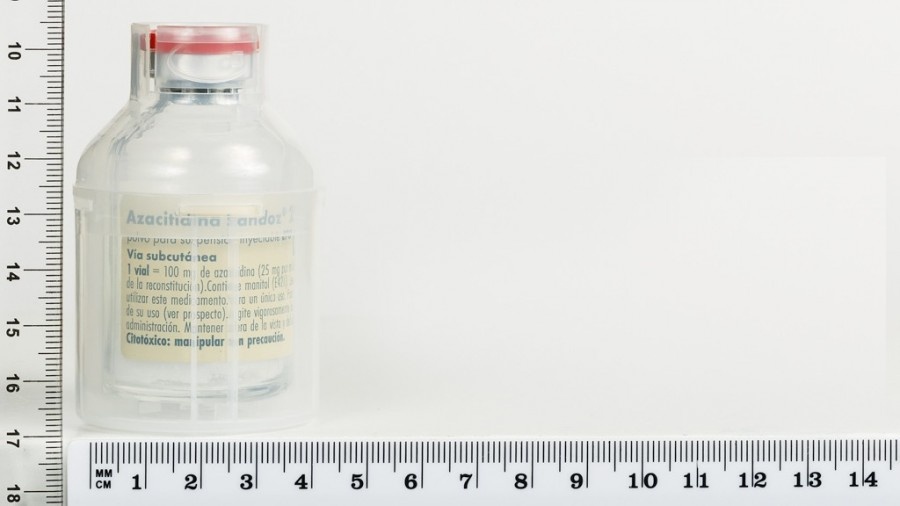
Azacitidina Hikma es un polvo blanco para suspensión inyectable y se suministra en un vial de vidrio incoloro que contiene 100 mg de azacitidina. Cada envase contiene un vial de Azacitidina.
Titular de la autorización de comercialización y responsable de la fabricación
Titular de la autorización
Hikma Farmacêutica (Portugal), S.A.
Estrada do Rio da Mó n.º 8, 8A e 8B, Fervença
2705-906 Terrugem SNT
Portugal
Responsable de la fabricación
Thymoorgan Pharmazie GMBH
Schiffgraben, 23, Vienenburg, Goslar, Lower Saxony
38690- Alemania
Pueden solicitar más información respecto a este medicamento dirigiéndose al representante local del titular de la autorización de comercialización:
Hikma España, S.L.U.
Calle Anabel Segura nº11, Edificio A, planta 1ª, oficina 2
28108 - Alcobendas, Madrid
España
Este medicamento está autorizado en los Estados miembros del Espacio Económico Europeo y en el Reino Unido (Irlanda del Norte) con los siguientes nombres:
Austria | Azacitidin Hikma 25 mg/ml Pulver zur Herstellung einer Injektionssuspension |
Alemania | Azacitidin Hikma 25 mg/ml Pulver zur Herstellung einer Injektionssuspension |
Bélgica | Azacitidine Hikma 25 mg/ml poeder voor suspensie voor injectie |
Dinamarca | Azacitidine Hikma |
España | Azacitidina Hikma 25 mg/ml polvo para suspensión inyectable EFG |
Finlandia | Acacitidine Hikma |
Francia | Azacitidine Hikma 25 mg/ml, poudre pour suspension injectable |
Italia | Azacitidina Hikma 25 MG/ML- Polvere per Sospensione Iniettabile |
Noruega | Acacitidine Hikma |
Países Bajos | Azacitidine Hikma 25 mg/ml poeder voor suspensie voor injectie |
Portugal | Azacitidina Hikma 25 mg/ml pó para suspensão injetável |
Reino Unido(Irlanda del Norte) | Azacitidine 25 mg/mL powder for suspension for injection |
Suecia | Azacitidine Hikma 25 mg/ml pulver till injektionsvätska, suspension |
Fecha de la última revisión de este prospecto:enero 2024
Otras fuentes de información
La información detallada y actualizada de este medicamento está disponible en la página web de la Agencia Española de Medicamentos y Productos Sanitarios (AEMPS) http://www.aemps.gob.es/
También existen enlaces a otras páginas web sobre enfermedades raras y medicamentos huérfanos.
Esta información está destinada únicamente a profesionales del sector sanitario:
Recomendaciones para una manipulación segura
Azacitidina Hikma es un medicamento citotóxico y, al igual que con otros compuestos potencialmente tóxicos, debe tenerse precaución al manipular y preparar suspensiones de azacitidina. Deben aplicarse los procedimientos para la manipulación y eliminación correctas de medicamentos contra el cáncer.
Si azacitidina reconstituída entra en contacto con la piel, la zona deberá lavarse inmediatamente y a fondo con agua y jabón. Si entra en contacto con membranas mucosas, debe lavarse a fondo con agua.
Incompatibilidades
Este medicamento no debe mezclarse con otros, excepto los mencionados más adelante (ver
“Procedimiento de reconstitución”).
Procedimiento de reconstitución
Azaditidina Hikma se debe reconstituir con agua para preparaciones inyectables. El periodo de validez del medicamento reconstituido puede prolongarse reconstituyéndolo con agua para preparaciones inyectables refrigerada (entre 2º C y 8º C). A continuación, se facilita información sobre la conservación del medicamento reconstituido.
- Deben montarse los siguientes elementos:
Vial/es de azacitidina; vial/es de agua para preparaciones inyectables; guantes quirúrgicos no estériles; toallitas humedecidas en alcohol; jeringas para inyección de 5 ml con agujas.
- Deben extraerse 4 ml de agua para preparaciones inyectables en la jeringa,
asegurándose de purgar el aire atrapado dentro de la jeringa.
- La aguja de la jeringa que contiene los 4 ml de agua para preparaciones inyectables debe introducirse a través del tapón de goma del vial de azacitidina; a continuación, se inyecta en el vial el agua para preparaciones inyectables.
- Después de extraer la jeringa y la aguja, el vial debe agitarse vigorosamente, hasta obtener una suspensión turbia uniforme. Después de la reconstitución, cada ml de suspensión contendrá 25 mg de azacitidina (100 mg/4 ml). El producto reconstituido es una suspensión turbia y homogénea, sin aglomerados. La suspensión debe desecharse si contiene partículas grandes o aglomerados. No filtrar la suspensión después de la reconstitución ya que esto podría eliminar el principio activo. Se debe tener en cuenta que algunos adaptadores, agujas para perfusión y sistemas cerrados contienen filtros; por lo tanto, no deben utilizarse dichos sistemas para la administración del medicamento después de la reconstitución.
- El tapón de goma debe limpiarse y se introduce una jeringa nueva con una aguja en el vial.
A continuación, el vial debe invertirse, asegurándose de que la punta de la aguja esté por debajo del nivel del líquido. Seguidamente, debe tirarse del émbolo hacia atrás para extraer la cantidad de medicamento necesaria para la dosis correcta, asegurándose de purgar el aire atrapado dentro de la jeringa. A continuación, debe extraerse del vial la jeringa con la aguja y la aguja debe desecharse.
- Seguidamente, debe ajustarse firmemente a la jeringa una aguja subcutánea nueva (se recomienda el calibre 25) para inyectables. La aguja no debe purgarse antes de la inyección, a fin de reducir la incidencia de reacciones locales en el lugar de la inyección.
- Cuando se necesite más de 1 vial, deben repetirse todos los pasos anteriores para la preparación de la suspensión. En el caso de dosis para las que se necesite más de 1 vial, la dosis se debe dividir en partes iguales, por ejemplo, dosis de 150 mg = 6 ml; dos jeringas con 3 ml en cada jeringa. Debido a la retención en el vial y la aguja, es posible que no se pueda extraer toda la suspensión del vial.
- El contenido de la jeringa de dosificación debe volver a resuspenderse inmediatamente antes de la administración. La temperatura de la suspensión en el momento de la inyeccion debe ser de aproximadamente 20 ºC a 25 ºC. Para volver a suspender, haga rodar vigorosamente la jeringa entre las palmas de las manos, hasta obtener una suspensión uniforme y turbia. La suspensión debe desecharse si contiene partículas grandes o aglomerados.
Conservación del medicamento reconstituído
Para uso inmediato
La suspensión de Azacitidina Hikma puede prepararse inmediatamente antes de su uso y la suspensión reconstituida debe administrarse en los siguientes 45 minutos. Si el tiempo transcurrido es superior a 45 minutos, la suspensión reconstituida debe desecharse correctamente y debe prepararse una dosis nueva.
Para uso posterior
Cuando se reconstituye con agua para preparaciones inyectables no refrigerada, la suspensión reconstituida debe colocarse en una nevera (temperatura entre 2º C y 8º C) inmediatamente después de la reconstitución, y debe mantenerse en la nevera durante 8 horas como máximo. Si el tiempo transcurrido en la nevera es superior a 8 horas, la suspensión debe desecharse correctamente y debe prepararse una dosis nueva.
Cuando se reconstituye con agua para preparaciones inyectables refrigerada (entre 2° C y 8° C), la suspensión reconstituida debe colocarse en una nevera (entre 2° C y 8° C) inmediatamente después de la reconstitución, y debe mantenerse en la nevera durante 22 horas como máximo. Si el tiempo transcurrido en la nevera es superior a 22 horas, la suspensión debe desecharse correctamente y debe prepararse una dosis nueva.
Debe permitirse que la jeringa cargada con la suspensión reconstituida alcance una temperatura de aproximadamente 20º C a 25º C durante un tiempo máximo de 30 minutos antes de la administración. Si el tiempo transcurrido es superior a 30 minutos, la suspensión debe desecharse correctamente y debe prepararse una dosis nueva.
Cálculo de una dosis individual
La dosis total, según la superficie corporal (SC), puede calcularse de la siguiente manera:
Dosis total (mg) = dosis (mg/m2) × SC (m2)
La siguiente tabla se presenta sólo como un ejemplo para calcular dosis individuales de azacitidina, basadas en un valor promedio de SC de 1,8 m2.
Dosis, mg/m2 (% de la dosis inicial recomendada) | Dosis total basada en un valor de SC de 1,8 m2 | Número de viales necesarios | Volumen total de suspensión reconstituida requerida |
75 mg/m2 (100%) | 135 mg | 2 viales | 5,4 ml |
37,5 mg/m2 (50%) | 67,5 mg | 1 vial | 2,7 ml |
25 mg/m2 (33%) | 45 mg | 1 vial | 1,8 ml |
Forma de administración
No filtrar la suspensión después de la reconstitución.
Azacitidina Hikma reconstituido debe inyectarse por vía subcutánea (introduzca la aguja con un ángulo de 45 a 90°), con una aguja de calibre 25, en el brazo, el muslo o el abdomen.
Las dosis superiores a 4 ml deben inyectarse en dos lugares separados.
Los lugares de inyección deben someterse a rotación. Las nuevas inyecciones deben administrarse como mínimo a 2,5 cm de distancia del lugar anterior y nunca en zonas sensibles, con equimosis, enrojecidas o endurecidas.
La eliminación del medicamento no utilizado y de todos los materiales que hayan estado en contacto con él se realizará de acuerdo con la normativa local.
- País de registro
- Forma farmacéuticaINYECTABLE, 25 mg/ml
- Código ATCL01BC07
- Principio activo
- Requiere recetaSí
- Fabricante
- ComposiciónMANITOL (E-421) (25 mg/ml mg)
- Esta información es de carácter general y no sustituye la consulta con un profesional sanitario.
- Alternativas a AZACITIDINA HIKMA 25 MG/ML POLVO PARA SUSPENSION INYECTABLE EFGForma farmacéutica: INYECTABLE, 25 mg/mlPrincipio activo: AzacitidinaFabricante: Accord Healthcare S.L.U.Requiere recetaForma farmacéutica: INYECTABLE, 25 mg/mlPrincipio activo: AzacitidinaFabricante: Betapharm Arzneimittel GmbhRequiere recetaForma farmacéutica: INYECTABLE, 25 mg/mlPrincipio activo: AzacitidinaFabricante: Eugia Pharma (Malta) LimitedRequiere receta
Médicos online para AZACITIDINA HIKMA 25 MG/ML POLVO PARA SUSPENSION INYECTABLE EFG
Comenta la dosis, los posibles efectos secundarios, interacciones, contraindicaciones o la revisión de receta de AZACITIDINA HIKMA 25 MG/ML POLVO PARA SUSPENSION INYECTABLE EFG, sujeto a valoración médica y a la normativa local.
Preguntas frecuentes
AZACITIDINA HIKMA 25 MG/ML POLVO PARA SUSPENSION INYECTABLE EFG requiere receta en España. Puedes confirmarlo con un médico online según tu caso.
El principio activo de AZACITIDINA HIKMA 25 MG/ML POLVO PARA SUSPENSION INYECTABLE EFG es Azacitidina. Esta información ayuda a identificar medicamentos con la misma composición pero con diferentes nombres comerciales.
AZACITIDINA HIKMA 25 MG/ML POLVO PARA SUSPENSION INYECTABLE EFG es fabricado por Hikma Farmaceutica (Portugal) S.A.. La marca y el envase pueden variar según el distribuidor.
Los Médicos de familia, Psiquiatras, Dermatólogos, Cardiólogos, Endocrinólogos, Gastroenterólogos, Neumólogos, Nefrólogos, Reumatólogos, Hematólogos, Infectólogos, Alergólogos, Geriatras, Pediatras, Oncólogos pueden valorar la prescripción de AZACITIDINA HIKMA 25 MG/ML POLVO PARA SUSPENSION INYECTABLE EFG cuando esté clínicamente indicado. Puedes reservar una videoconsulta para comentar tu caso y las opciones de tratamiento.
La receta la emite un médico tras valorar tu estado de salud. En España, AZACITIDINA HIKMA 25 MG/ML POLVO PARA SUSPENSION INYECTABLE EFG se dispensa en las farmacias con esa receta médica. Una consulta online no garantiza su emisión: la decisión corresponde siempre al médico.
Para solicitar una valoración puedes usar Oladoctor:
Otros medicamentos con el mismo principio activo (Azacitidina) incluyen AZACITIDINA ACCORD 25 MG/ML POLVO PARA SUSPENSION INYECTABLE EFG, AZACITIDINA BETAPHARM 25 MG/ML POLVO PARA SUSPENSION INYECTABLE EFG, AZACITIDINA EUGIA 25 MG/ML POLVO PARA SUSPENSION INYECTABLE EFG. Pueden tener diferentes nombres comerciales o formulaciones, pero contienen el mismo componente terapéutico. Consulta siempre con un médico antes de cambiar o iniciar un nuevo medicamento.
