



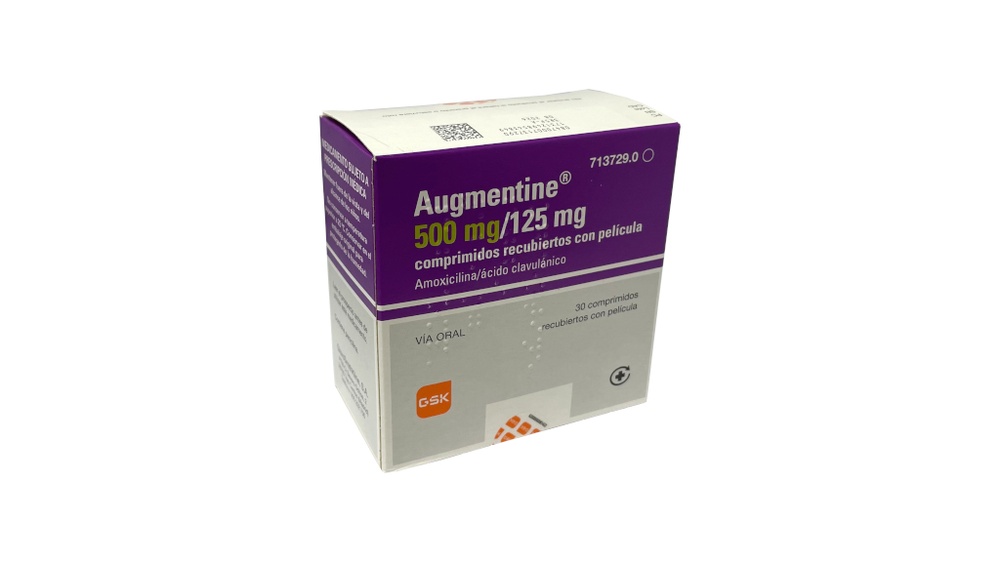
AUGMENTINE 500 mg/125 mg Comprimidos Recubiertos Con Película

Revisión de receta online
Un médico revisará tu caso y determinará si la prescripción es médicamente apropiada.

Habla con un médico sobre este medicamento
Comenta tus síntomas y las opciones de tratamiento en una consulta online.



Cómo usar AUGMENTINE 500 MG/125 MG COMPRIMIDOS RECUBIERTOS CON PELÍCULA.
Contenido del prospecto
- Introducción
- Qué es Augmentine y para qué se utiliza
- Qué necesita saber antes de empezar a tomar Augmentine
- Cómo tomar Augmentine
- Posibles efectos adversos
- Conservación de Augmentine
- Contenido del envase e información adicional
Introducción
Prospecto: información para el usuario
Augmentine 500 mg/125 mg comprimidos recubiertos con película
amoxicilina/ácido clavulánico
Lea todo el prospecto detenidamente antes de empezar a tomar este medicamento,porque contiene información importante para usted.
- Conserve este prospecto, ya que puede tener que volver a leerlo.
- Si tiene alguna duda, consulte a su médico o farmacéutico.
- Este medicamento se le ha recetado solamente a usted, y no debe dárselo a otras personas aunque tengan los mismos síntomas que usted, ya que puede perjudicarles.
- Si experimenta efectos adversos, consulte a su médico o farmacéutico, incluso si se trata de efectos adversos que no aparecen en este prospecto. Ver sección 4.
Contenido del prospecto
- Qué es Augmentine y para qué se utiliza
- Qué necesita saber antes de empezar a tomar Augmentine
- Cómo tomar Augmentine
- Posibles efectos adversos
- Conservación de Augmentine
- Contenido del envase e información adicional
1. Qué es Augmentine y para qué se utiliza
Augmentine es un antibiótico que elimina las bacterias que causan las infecciones. Contiene dos fármacos diferentes llamados amoxicilina y ácido clavulánico. La amoxicilina pertenece al grupo de medicamentos conocido como “penicilinas” que a veces puede perder su eficacia (se inactiva). El otro componente (ácido clavulánico) evita que esto ocurra.
Los antibióticos se utilizan para tratar infecciones bacterianas y no sirven para tratar infecciones víricas como la gripe o el catarro. Es importante que siga las instrucciones relativas a la dosis,el intervalo de administracióny la duración del tratamiento indicadas por su médico. No guarde ni reutilice este medicamento. Si una vez finalizado el tratamiento le sobra antibiótico, devuélvalo a la farmacia para su correcta eliminación. No debe tirar los medicamentos por el desagüe ni a la basura.
Augmentine se utiliza en adultos y niños para tratar las siguientes infecciones:
- infecciones del oído medio y de los senos paranasales
- infecciones del tracto respiratorio
- infecciones del tracto urinario
- infecciones de la piel y tejidos blandos incluyendo infecciones dentales
- infecciones de huesos y articulaciones.

¿No estás seguro de si este medicamento es adecuado para ti?
Comenta tus síntomas y tratamiento con un médico online.
2. Qué necesita saber antes de empezar a tomar Augmentine
No tome Augmentine:
- si es alérgico a amoxicilina, ácido clavulánico, a las penicilinas o a cualquiera de los demás componentes de este medicamento (ver sección 6)
- si alguna vez ha tenido una reacción alérgica grave a cualquier otro antibiótico. Esto podría incluir erupción cutánea o hinchazón de cara o garganta
- si alguna vez ha tenido problemas de hígado o ictericia (coloración amarillenta de la piel) al tomar un antibiótico.
?No tome Augmentinesi se incluye en alguno de los puntos anteriores. Antes de iniciar el tratamiento con Augmentine, si no está seguro, consulte con su médico o farmacéutico.
Advertencias y precauciones
Consulte a su médico o farmacéutico antes de empezar a tomar Augmentine si:
- tiene mononucleosis infecciosa
- está recibiendo tratamiento para problemas de hígado o riñón
- no orina regularmente.
Si no está seguro de si alguno de los anteriores síntomas le afectan, informe a su médico o
farmacéutico antes de tomar Augmentine.
En algunos casos, su médico puede investigar el tipo de bacteria que está causando su infección.
Dependiendo de los resultados, puede que le receten una presentación diferente de Augmentine u otro medicamento.
Síntomas a los que debe estar atento
Augmentine puede empeorar determinadas condiciones existentes o causar efectos adversos graves. Estos incluyen reacciones alérgicas, convulsiones e inflamación del intestino grueso. Debe estar atento a determinados síntomas mientras tome Augmentine para reducir el riesgo de problemas. Ver “Síntomas a los que debe estar atento”en la sección 4.
Análisis de sangre y orina
Si se le están realizando análisis sanguíneos (como estudios del estado de los glóbulos rojos o estudios de función hepática) o análisis de orina (para controlar los niveles de glucosa), informe a su médico o enfermera de que está tomando Augmentine. Esto es porque Augmentine puede alterar los resultados de estos tipos de análisis.
Uso deAugmentinecon otros medicamentos
Informe a su médico o farmacéutico si está tomando, ha tomado recientemente o pudiera tener que tomar cualquier otro medicamento.
Si está tomando alopurinol (usado para la gota) con Augmentine, puede ser más probable que sufra una reacción alérgica en la piel.
Si está tomando probenecid (usado para la gota) su médico puede que le ajuste la dosis de Augmentine.
Si se toman anticoagulantes (como la warfarina) con Augmentine se necesitarán más análisis sanguíneos.
Augmentine puede afectar la acción de metotrexato (medicamento empleado para tratar el cáncer o enfermedades reumáticas).
Augmentine puede afectar a la forma en que actúa micofenolato de mofetilo (un medicamento utilizado para prevenir el rechazo de órganos en pacientes trasplantados).
Embarazo, lactancia y fertilidad
Si está embarazada o en periodo de lactancia, cree que podría estar embarazada o tiene intención de quedarse embarazada, consulte a su médico o farmacéutico antes de utilizar este medicamento.
Conducción y uso de máquinas
Augmentine puede tener efectos adversos y los síntomas pueden hacer que no deba conducir.
No conduzca o maneje maquinaria a no ser que se encuentre bien.
Augmentine contiene sodio
Este medicamento contiene menos de 23 mg de sodio (1 mmol) por comprimido; esto es, esencialmente “exento de sodio”.
3. Cómo tomar Augmentine
Siga exactamente las instrucciones de administración de este medicamento indicadas por su médico o farmacéutico. En caso de duda, consulte de nuevo a su médico o farmacéutico.
Adultos y niños de 40 kg o más
La dosis recomendada es:
- 1 comprimido tres veces al día.
Niños de menos de 40 kg de peso
Es preferible tratar a los niños de 6 años o menos con la suspensión oral de Augmentine o los sobres.
Pida consejo a su médico o farmacéutico al administrar Augmentine comprimidos a niños que pesen menos de 40 kg. Los comprimidos no son adecuados para niños que pesen menos de 25 kg.
Pacientes con problemas de riñón e hígado
- Si tiene problemas de riñón puede que le cambien la dosis. Puede que su médico elija una presentación diferente u otro medicamento.
- Si tiene problemas de hígado se le harán análisis sanguíneos más frecuentemente para comprobar cómo funciona su hígado.
Cómo tomarAugmentine
- Tomar con las comidas.
- Trague los comprimidos enteros con un vaso de agua.
- Se puede partir el comprimido por la línea de rotura para que sea más fácil tragarlo. Debe tomar las dos partes del comprimido al mismo tiempo.
- Espacie las tomas durante el día, al menos 4 horas. No tome 2 dosis en 1 hora.
- No tome Augmentine durante más de 2 semanas. Si se sigue encontrando mal consulte a su médico.
Si toma másAugmentinedel quedebe
Si toma demasiado Augmentine, pueden aparecer síntomas como malestar de estómago (náuseas, vómitos o diarrea) o convulsiones. Consulte a su médico lo antes posible. Lleve el envase consigo para enseñárselo al médico.
En caso de sobredosis o ingestión accidental consulte inmediatamente a su médico o farmacéutico o llame al Servicio de Información Toxicológica, teléfono: 91 562 04 20, indicando el medicamento y la cantidad ingerida.
Si olvidó tomarAugmentine
Si olvida tomar una dosis, tómela tan pronto como se acuerde. No debe tomar la siguiente dosis demasiado pronto, espere al menos 4 horas antes de tomar la siguiente dosis. No tome una dosis doble para compensar las dosis olvidadas.
Siinterrumpe el tratamiento conAugmentine
Continúe tomando Augmentine hasta que termine el tratamiento, aunque se encuentre mejor. Necesita tomar el tratamiento completo para curar la infección. Si no lo hace, las bacterias que sobrevivan pueden hacer que vuelva a tener la infección.
Si tiene cualquier otra duda sobre el uso de este medicamento, pregunte a su médico o farmacéutico.

¿Has empezado a tomar el medicamento y tienes preguntas?
Comenta tus síntomas y tratamiento con un médico online.
4. Posibles efectos adversos
Al igual que todos los medicamentos, este medicamento puede producir efectos adversos, aunque no todas las personas los sufran.
Síntomas a los que debe estar atento
Reacciones alérgicas:
- erupción cutánea
- inflamación de los vasos sanguíneos (vasculitis) que puede aparecer como puntos rojos o morados en la piel, pero que puede afectar a otras partes del cuerpo
- fiebre, dolor de articulaciones, glándulas hinchadas en el cuello, axilas o ingles
- hinchazón, a veces de la cara o garganta (angioedema), que causa dificultad para respirar
- colapso
- dolor en el pecho en el contexto de reacciones alérgicas, que puede ser un síntoma de infarto cardíaco desencadenado por alergia (síndrome de Kounis).
- Contacte con su médico inmediatamentesi sufre cualquiera de estos síntomas. Deje de tomarAugmentine.
Inflamación del intestino grueso
Inflamación del intestino grueso, que causa diarrea acuosa, generalmente con sangre y moco, dolor de estómago y/o fiebre.
Síndrome de enterocolitis inducido por fármaco (DIES)
Se ha notificado DIES principalmente en niños que reciben amoxicilina/ácido clavulánico. Es un cierto tipo de reacción alérgica con el síntoma principal de vómitos repetitivos (de 1-4 horas después de administrar el medicamento). Otros síntomas pueden incluir dolor abdominal, letargia, diarrea y presión arterial baja.
Inflamación aguda del páncreas (pancreatitis aguda)
Si tiene dolor intenso y continuo en el área del estómago, esto podría ser un signo de pancreatitis aguda.
- Contacte con su médico inmediatamentesi sufre cualquiera de estos síntomas.
Efectos adversos muy frecuentes
Pueden afectar a más de 1 de cada 10 personas
- diarrea (en adultos).
Efectos adversos frecuentes
Pueden afectar hasta 1 de cada 10 personas
- aftas (Candida– infección por hongos en la vagina, boca o mucosas)
- náuseas, especialmente cuando se toman dosis elevadas
- si le ocurre esto tome Augmentine con las comidas
- vómitos
- diarrea (en niños).
Efectos adversos poco frecuentes
Pueden afectar hasta 1 de cada 100 personas
- erupción cutánea, picor
- erupción pruriginosa aumentada (habónurticarial)
- indigestión
- mareos
- dolor de cabeza.
Efectos adversos poco frecuentes que pueden aparecer en los análisis de sangre:
- aumento en algunas sustancias (enzimas) producidas por el hígado.
Efectos adversos raros
Pueden afectar hasta 1 de cada 1 000 personas
- erupción de la piel, que puede formar ampollas que parecen pequeñas dianas (punto central oscuro rodeado por un área más pálida, con un anillo oscuro alrededor del borde – eritema multiforme).
- Si tiene cualquiera de estos síntomas consulte a su médico urgentemente.
Efectos adversos raros que pueden aparecer en los análisis de sangre:
- bajo recuento de las células implicadas en la coagulación de la sangre
- bajo recuento de glóbulos blancos.
Frecuencia no conocida
La frecuencia no se puede estimar a partir de los datos disponibles.
- reacciones alérgicas (ver arriba)
- inflamación del intestino grueso (ver arriba)
- inflamación de las membranas que envuelven el cerebro y la médula espinal (meningitis aséptica)
- reacciones cutáneas graves:
- erupción generalizada con ampollas y descamación de la piel, particularmente alrededor de la boca, nariz, ojos y genitales (síndrome de Stevens-Johnson) y en su forma más grave, causando una descamación generalizada de la piel (más del 30% de la superficie corporal–necrólisis epidérmica tóxica)
- erupción generalizada con pequeñas ampollas con pus (dermatitis exfoliativa bullosa)
- erupción roja, con bultos debajo de la piel y ampollas (pustulosis exantemática)
- síntomas de tipo gripal con erupción cutánea, fiebre, inflamación de glándulas y resultados anormales en los análisis de sangre (como aumento de los leucocitos (eosinofilia) y elevación de las enzimas hepáticas) (Reacción medicamentosa con eosinofilia y síntomas sistémicos (DRESS))
- erupción roja observada normalmente en ambos lados de las nalgas, en la parte superior interna de los muslos, en las axilas, en el cuello (Exantema intertriginoso y flexural simétrico relacionado con fármacos (SDRIFE)).
- Contacte con un médico inmediatamente si tiene cualquiera de estos síntomas.
- erupción con ampollas dispuestas en círculo con costra central o como un collar de perlas (enfermedad por IgA lineal)
- inflamación del hígado (hepatitis)
- ictericia, causada por el aumento de bilirrubina en sangre (una sustancia producida por el hígado) que puede hacer que la piel y el blanco de los ojos se tornen amarillentos
- inflamación de los conductos de los riñones
- retardo en la coagulación de la sangre
- hiperactividad
- convulsiones (en pacientes que toman dosis elevadas de Augmentine o que tienen problemas renales)
- lengua negra que parece pilosa.
Efectos adversos que pueden aparecer en los análisis de sangre o de orina:
- reducción importante en el número de glóbulos blancos
- bajo recuento de glóbulos rojos (anemia hemolítica)
- cristales en la orina que provocan una lesión renal aguda.
Comunicación de efectos adversos:
Si experimenta cualquier tipo de efecto adverso, consulte a su médico o farmacéutico, incluso si se trata de posibles efectos adversos que no aparecen en este prospecto. También puede comunicarlos directamente a través del Sistema Español de Farmacovigilancia de Medicamentos de Uso Humano: www.notificaRAM.es.
Mediante la comunicación de efectos adversos usted puede contribuir a proporcionar más información sobre la seguridad de este medicamento.
5. Conservación de Augmentine
Mantener este medicamento fuera de la vista y del alcance de los niños.
No utilice este medicamento después de la fecha de caducidad (CAD) que aparece en el envase. La fecha de caducidad es el último día del mes que se indica.
No conservar a temperatura superior a 25 ºC. Conservar en el embalaje original para protegerlo de la humedad.
No usar si los comprimidos están rotos o dañados.
Los medicamentos no se deben tirar por los desagües ni a la basura. Deposite los envases y los medicamentos que no necesita en el Punto SIGRE  de la farmacia. En caso de duda pregunte a su farmacéutico cómo deshacerse de los envases y de los medicamentos que no necesita. De esta forma, ayudará a proteger el medio ambiente.
6. Contenido del envase e información adicional
Composición deAugmentine500 mg/125 mg comprimidos recubiertos con película
- Los principios activos son amoxicilina y ácido clavulánico. Cada comprimido contiene amoxicilina trihidrato equivalente a 500 mg de amoxicilina y clavulanato potásico equivalente a 125 mg de ácido clavulánico.
- Los demás componentes son: Núcleo - estearato de magnesio, carboximetilalmidón sódico (tipo A) (procedente de almidón de patata), sílice coloidal anhidra, celulosa microcristalina. Recubrimiento - dióxido de titanio (E171), hipromelosa, macrogol (4000, 6000) y dimeticona.
Aspecto del producto y contenido del envase
Comprimidos de forma ovalada de color blanco a blanquecino que llevan grabado “AC” en una cara. Envases conteniendo 30 comprimidos recubiertos con película.
Titular de la autorización de comercialización y responsable de la fabricación
Titular de la autorización de comercialización:
GlaxoSmithKline, S.A.
P.T.M. C/ Severo Ochoa, 2
28760 Tres Cantos (Madrid)
Tel: +34 900 202 700
Responsable de la fabricación:
Glaxo Wellcome Production
Z.I. de la Peyennière
53100 Mayenne (Francia)
Este medicamento está autorizado en los estados miembros del Espacio Económico Europeo con los siguientes nombres:
Alemania - Augmentan
Austria - Augmentin
Bélgica - Augmentin
Bulgaria - Augmentin
Chipre - Augmentin
República Checa - Augmentin
España - Augmentine
Estonia - Augmentin
Grecia - Augmentin
Hungría - Augmentin Duo
Irlanda - Augmentin
Letonia - Augmentin
Lituania - Augmentin
Luxemburgo - Augmentin
Malta - Augmentin
Noruega - Augmentin
Países Bajos - Augmentin
Polonia - Augmentin
Portugal - Augmentin
Rumanía - Augmentin
República Eslovaca - Augmentin
Eslovenia - Augmentin
Reino Unido - Augmentin
Fecha de la última revisión de este prospecto:mayo 2024.
La información detallada y actualizada de este medicamento está disponible en la página Web de la Agencia Española de Medicamentos y Productos Sanitarios (AEMPS) http://www.aemps.gob.es
- País de registro
- Forma farmacéuticaCOMPRIMIDO, 500/125 mg
- Código ATCJ01CR02
- Precio medio en farmacia5.84 EUR
- Principio activo
- Requiere recetaSí
- Fabricante
- Esta información es de carácter general y no sustituye la consulta con un profesional sanitario.
- Alternativas a AUGMENTINE 500 MG/125 MG COMPRIMIDOS RECUBIERTOS CON PELÍCULA.Forma farmacéutica: SOLUCIÓN/SUSPENSIÓN ORAL, 250 mg amoxicilina/62,5 mg acido clavulanicoPrincipio activo: amoxicillin and beta-lactamase inhibitorFabricante: Sandoz Farmaceutica S.A.Requiere recetaForma farmacéutica: INYECTABLE PERFUSION, 2 G./200 MG.Principio activo: amoxicillin and beta-lactamase inhibitorFabricante: Laboratorio Reig Jofre, S.A.Requiere recetaForma farmacéutica: COMPRIMIDO, 500 mg amoxicilina/125 mg acido clavulanicoPrincipio activo: amoxicillin and beta-lactamase inhibitorFabricante: Sun Pharmaceutical Industries (Europe) B.V.Requiere receta
Médicos online para AUGMENTINE 500 MG/125 MG COMPRIMIDOS RECUBIERTOS CON PELÍCULA.
Comenta la dosis, los posibles efectos secundarios, interacciones, contraindicaciones o la revisión de receta de AUGMENTINE 500 MG/125 MG COMPRIMIDOS RECUBIERTOS CON PELÍCULA., sujeto a valoración médica y a la normativa local.









Obtén una receta de AUGMENTINE 500 MG/125 MG COMPRIMIDOS RECUBIERTOS CON PELÍCULA. online
Rellena un formulario de 2 minutos
Cuéntanos tus síntomas, historial y el medicamento que necesitas.
Elige un médico o nosotros te asignamos uno
Escoge un especialista o te conectamos con el próximo médico disponible.
El médico revisa tu caso
Normalmente en 30 minutos. Puede hacerte preguntas adicionales por chat.
Recógela en cualquier farmacia
Receta electrónica enviada a tu correo, válida en toda España.
Preguntas frecuentes
AUGMENTINE 500 MG/125 MG COMPRIMIDOS RECUBIERTOS CON PELÍCULA. requiere receta en España. Puedes confirmarlo con un médico online según tu caso.
El principio activo de AUGMENTINE 500 MG/125 MG COMPRIMIDOS RECUBIERTOS CON PELÍCULA. es amoxicillin and beta-lactamase inhibitor. Esta información ayuda a identificar medicamentos con la misma composición pero con diferentes nombres comerciales.
El precio medio en farmacia de AUGMENTINE 500 MG/125 MG COMPRIMIDOS RECUBIERTOS CON PELÍCULA. es de aproximadamente 5.84 EUR. Puede variar según el fabricante y la forma farmacéutica.
AUGMENTINE 500 MG/125 MG COMPRIMIDOS RECUBIERTOS CON PELÍCULA. es fabricado por Glaxosmithkline S.A.. La marca y el envase pueden variar según el distribuidor.
Los Médicos de familia, Psiquiatras, Dermatólogos, Cardiólogos, Endocrinólogos, Gastroenterólogos, Neumólogos, Nefrólogos, Reumatólogos, Hematólogos, Infectólogos, Alergólogos, Geriatras, Pediatras, Oncólogos pueden valorar la prescripción de AUGMENTINE 500 MG/125 MG COMPRIMIDOS RECUBIERTOS CON PELÍCULA. cuando esté clínicamente indicado. Puedes reservar una videoconsulta para comentar tu caso y las opciones de tratamiento.
España cuenta con una infraestructura sanitaria bien desarrollada en ciudades principales como Madrid, Barcelona, Valencia y Sevilla. Las farmacias están ampliamente disponibles y operan bajo estrictas regulaciones, garantizando el acceso a medicamentos con receta.
Puedes comprar AUGMENTINE 500 MG/125 MG COMPRIMIDOS RECUBIERTOS CON PELÍCULA. en Madrid, Barcelona, Sevilla o Valencia en cualquier farmacia local con una receta válida.
Para obtener una receta, puedes utilizar Oladoctor:
Otros medicamentos con el mismo principio activo (amoxicillin and beta-lactamase inhibitor) incluyen AMOXICILINA / ACIDO CLAVULANICO SANDOZ 250 mg/62,5 mg/5 ml POLVO PARA SUSPENSION ORAL EFG, AMOXICILINA ACIDO CLAVULANICO SALA 2.000 mg/200 mg POLVO PARA SOLUCION PARA PERFUSION EFG, AMOXICILINA ACIDO CLAVULANICO SUN 500 MG/125 MG COMPRIMIDOS RECUBIERTOS CON PELICULA EFG. Pueden tener diferentes nombres comerciales o formulaciones, pero contienen el mismo componente terapéutico. Consulta siempre con un médico antes de cambiar o iniciar un nuevo medicamento.
