



ATARAX 25 mg Film-Coated Tablets

Prescription review online
A doctor will review your case and decide whether a prescription is medically appropriate.

Talk to a doctor about this medicine
Discuss your symptoms and possible next steps in a quick online consultation.



How to use ATARAX 25 mg FILM-COATED TABLETS
Contents of the leaflet
- Introduction
- What Atarax is and what it is used for
- What you need to know before you take Atarax
- How to take Atarax
- Possible side effects
- Storage of Atarax
- Contents of the pack and other information
Introduction
Package Leaflet: Information for the User
Atarax 25mg film-coated tablets
hydroxyzine dihydrochloride
Read all of this leaflet carefully before you start taking this medicine because it contains important information for you.
- Keep this leaflet, as you may need to read it again.
- If you have any further questions, ask your doctor or pharmacist.
- This medicine has been prescribed for you only. Do not pass it on to others. It may harm them, even if their signs of illness are the same as yours.
- If you get any side effects, talk to your doctor or pharmacist. This includes any possible side effects not listed in this leaflet. See section 4.
Contents of the pack
- What Atarax is and what it is used for
- What you need to know before you take Atarax
- How to take Atarax
- Possible side effects
- Storage of Atarax
- Contents of the pack and other information
1. What Atarax is and what it is used for
Atarax is an anxiolytic medicine that belongs to a class of compounds called diphenylmethanes.
Atarax is used in the:
- symptomatic treatment of anxiety in adults over 18 years of age;
- symptomatic treatment of pruritus in adults, adolescents, and children from 12 months of age.

Not sure if this medicine is right for you?
Discuss your symptoms and treatment with a doctor online.
2. What you need to know before you take Atarax
Do not take Atarax
- If you are allergic (hypersensitive) to hydroxyzine dihydrochloride or any of the other ingredients of Atarax, to cetirizine, to other piperazine derivatives, to aminophylline, or to ethylenediamine.
- If you have porphyria (a group of inherited disorders that affect the blood).
- If your ECG (electrocardiogram) shows a heart rhythm problem called "prolonged QT interval".
- If you have or have had a cardiovascular disease or if your heart rate is very low.
- If you have low levels of salts in your body (e.g., low potassium or magnesium levels).
- If you are taking certain medicines for heart rhythm problems or medicines that may affect the heart rhythm (see "Using Atarax with other medicines").
- If a close relative has died suddenly from heart problems.
- In case of pregnancy or breastfeeding.
Warnings and precautions
- If you have a high risk of seizures.
- If you have liver failure and if you have moderate or severe kidney failure. In these cases, the dose of Atarax should be reduced.
- If you suffer from glaucoma, urinary bladder outflow obstruction, decreased gastrointestinal motility, myasthenia gravis, or dementia.
- Atarax may be associated with an increased risk of heart rhythm disorders that can be life-threatening. Therefore, inform your doctor if you have any heart problems or if you are taking any other medicine, including those purchased without a prescription.
Seek medical attention immediately if, while being treated with Atarax, you experience heart problems such as palpitations, difficulty breathing, or loss of consciousness. Treatment with hydroxyzine should be discontinued.
Other medicines and Atarax
Tell your doctor or pharmacist if you are using, have recently used, or might use any other medicines. This includes any medicines purchased without a prescription. Atarax may affect or be affected by other medicines.
Atarax may enhance the depressant effect on the central nervous system if used in conjunction with other drugs with depressant or anticholinergic properties. In these cases, the dose should be adjusted for each patient.
Atarax antagonizes the effects of betahistine and anticholinesterase drugs.
Treatment with Atarax should be discontinued at least 5 days before performing an allergy test or a bronchial provocation test with methacholine, to avoid effects on the results.
Concomitant administration of Atarax with monoamine oxidase inhibitors should be avoided.
Atarax counteracts the pressor effect of adrenaline.
Concomitant administration with drugs that may cause arrhythmias may increase the risk of QT prolongation and Torsades de Pointes (alterations in electrocardiogram measurements).
Do not take Atarax if you are taking medicines to treat:
- bacterial infections (e.g., the antibiotics erythromycin, moxifloxacin, levofloxacin)
- fungal infections (e.g., pentamidine)
- heart problems or high blood pressure (e.g., amiodarone, quinidine, disopyramide, sotalol)
- psychosis (e.g., haloperidol)
- depression (e.g., citalopram, escitalopram)
- gastrointestinal disorders (e.g., prucalopride)
- allergy
- malaria (e.g., mefloquine and hydroxychloroquine)
- cancer (e.g., toremifene, vandetanib)
- drug abuse or severe pain (methadone)
To date, no further interactions with other medicines have been detected.
Taking Atarax with food, drinks, and alcohol
Do not drink alcohol while being treated with this medicine. Concomitant administration of hydroxyzine and alcohol may produce effects on the central nervous system.
Pregnancy and breastfeeding
Consult your doctor or pharmacist before taking any medicine. Atarax should not be taken during pregnancy.
Atarax should not be taken during breastfeeding. If treatment with Atarax is necessary, breastfeeding should be discontinued.
The following reactions may occur in newborn babies of mothers who have taken Atarax during the last stage of pregnancy and/or childbirth, which can be observed immediately or a few hours after birth: tremors, stiffness and/or muscle weakness, difficulty breathing, and urinary retention (urine retention).
Driving and using machines
Atarax may alter your ability to drive or operate machinery, as it may cause drowsiness, decrease your attention, or decrease your reaction ability. The occurrence of these effects is more likely at the start of treatment or when the dose is increased. Do not drive or operate machinery if you experience any of these effects.
Elderly patients
This medicine is not recommended for use in elderly patients, as the effect of the medicine may be prolonged and the risk of side effects may increase due to the lower elimination rate in these patients. If it is necessary to use this medicine in elderly patients, it is recommended to start treatment with half the recommended dose.
Atarax contains lactose
If your doctor has told you that you have an intolerance to certain sugars, consult with them before taking this medicine.
3. How to take Atarax
Follow exactly the administration instructions of this medicine indicated by your doctor. In case of doubt, consult your doctor or pharmacist again.
The lowest effective dose of Atarax should be administered and for the shortest possible duration.
Adults over 18 years of age:
- For the symptomatic treatment of anxiety: 2 tablets (50 mg) per day, divided into 3 doses. It is recommended to administer half a tablet in the morning, half a tablet at noon, and one tablet at night. Your doctor will indicate if you need to take a higher dose at night. In more severe cases, up to 4 tablets (100 mg) per day can be used. The maximum daily dose is 4 tablets (100 mg) per day.
- For the symptomatic treatment of pruritus: It is recommended to start with a dose of one tablet (25 mg) one hour before bedtime. If necessary, your doctor may increase the dose to one tablet (25 mg) 3 to 4 times a day. The maximum daily dose is 4 tablets (100 mg) per day.
Adolescents and children from 12 months of age:
Atarax film-coated tablets are not recommended for children under 6 years of age, as they may not be able to swallow the tablets.
Other pharmaceutical forms such as Atarax syrup may be more suitable for children from 12 months of age or in patients who cannot swallow tablets.
- For the symptomatic treatment of pruritus: 1 to 2 mg per kg per day, divided into several doses. In children up to 40 kg in weight, the maximum daily dose is 2 mg per kg per day. In children over 40 kg in weight, the maximum daily dose is 100 mg per day.
This medicine is not recommended for use in elderly patients (see section 2). If it is necessary to use this medicine, it is recommended to start treatment with half the recommended dose. Your doctor will prescribe the lowest possible dose. The maximum daily dose in these patients is 50 mg per day.
If you have kidney or liver problems, your doctor may indicate that you take a lower dose (see "Warnings and precautions").
The dose will be adjusted within the recommended dose range according to the patient's response to treatment.
If you think that the effect of Atarax is too strong or too weak, consult your doctor or pharmacist.
The tablets should be swallowed whole with the help of liquids and can be taken both on an empty stomach and with food.
The tablet can be divided into equal doses.
If you take more Atarax than you should
If you have taken too much Atarax, consult your doctor or pharmacist immediately or call the Toxicology Information Service, phone 915 620 420, especially if it is a child who has taken too much. In case of overdose, symptomatic treatment can be initiated. Electrocardiographic monitoring (ECG) can be performed due to the possibility of a heart rhythm problem, such as prolonged QT interval or Torsades de Pointes.
A significant overdose can cause nausea, vomiting, tachycardia, fever, drowsiness, altered pupillary reflex, tremor, confusion, hallucination, decreased level of consciousness, respiratory depression, seizures, decreased blood pressure, and cardiac arrhythmia, including bradycardia, which can lead to a deep coma and cardiopulmonary collapse.
If you forget to take Atarax
Remember to always take your medicine.
Do not take a double dose to make up for forgotten doses. Continue taking your normal dose when it is due.
If you stop taking Atarax
Your doctor will indicate the duration of your treatment with Atarax. Do not stop treatment before. If you have any other doubts about the use of this medicine, ask your doctor or pharmacist.

Started taking the medicine and have questions?
Discuss your symptoms and treatment with a doctor online.
4. Possible side effects
Like all medicines, this medicine can cause side effects, although not everybody gets them.
The following side effects have been reported in clinical trials:
- drowsiness, headache, fatigue, dry mouth.
The frequent side effect (that affects at least 1 in 100 patients) is sedation.
The uncommon side effects (that affect at least 1 in 1,000 patients) are: nausea, discomfort, fever, dizziness, insomnia, tremor, agitation, and confusion.
The rare side effects (that affect at least 1 in 10,000 patients) are: tachycardia, alterations in accommodation or vision, blurred vision, constipation, vomiting, hypersensitivity, abnormal liver function tests, seizures, involuntary abnormal movements (dyskinesia), disorientation, hallucinations, urinary retention, erythematous rash, maculopapular rash, dermatitis, itching, and hypotension.
The very rare side effects (that affect less than 1 in 10,000 patients) are: anaphylactic shock, bronchospasm (narrowing of the bronchi that causes difficulty breathing), angioneurotic edema (inflammation of the skin and mucous membranes), increased sweating, drug rash, acute generalized exanthematous pustulosis (a type of allergic reaction that appears in response to a medicine, infection, or disease), erythema multiforme, Stevens-Johnson syndrome (the last two are skin disorders due to an allergic reaction or infection).
The side effects of unknown frequency (that cannot be estimated from the available data) are: QT prolongation in the electrocardiogram, Torsades de Pointes (alteration of the electrocardiogram associated with tachycardias), hepatitis, loss of consciousness (syncope), bullous diseases (e.g., toxic epidermal necrolysis, pemphigus), and weight gain.
Stop taking this medicine and seek medical attention immediately if you experience any heart rhythm problems such as palpitations, difficulty breathing, or loss of consciousness.
The following side effects have been observed with cetirizine, the main metabolite of hydroxyzine: thrombocytopenia (decrease in the number of platelets), aggression, depression, tic, dystonia (muscle contractions), paresthesia (tingling sensation), oculogyric crisis (fixation of the eyes in a fixed position), diarrhea, dysuria (difficulty urinating), enuresis (urinary incontinence), asthenia, edema, and weight gain.
Reporting of side effects
If you experience any side effects, consult your doctor or pharmacist, even if it is a possible side effect that does not appear in this leaflet. You can also report them directly through the Spanish Medicines and Healthcare Products Agency's website: www.notificaram.es. By reporting side effects, you can help provide more information on the safety of this medicine.
5. Storage of Atarax
Keep this medicine out of the sight and reach of children.
Atarax should be stored in its carton box because the active ingredient hydroxyzine dihydrochloride is sensitive to light.
No special storage temperature is required.
Do not use Atarax after the expiration date that appears on the packaging after EXP. The expiration date is the last day of the month indicated.
Medicines should not be disposed of via wastewater or household waste. Place the packaging and any unused medicine in the pharmacy's SIGRE collection point. Ask your pharmacist how to dispose of the packaging and any unused medicine. This will help protect the environment.
6. Contents of the pack and other information
Composition of Atarax
- The active ingredient is hydroxyzine dihydrochloride. Each tablet contains 25 mg of hydroxyzine dihydrochloride.
- The excipients are: lactose monohydrate, microcrystalline cellulose, magnesium stearate, anhydrous colloidal silica, titanium dioxide (E171), HPMC 2910 5cP, polyethylene glycol 400, purified water.
Appearance and packaging of the product
Atarax is presented in the form of film-coated tablets in packs of 25 and 50 tablets.
Marketing authorization holder and manufacturer
Marketing authorization holder:
UCB Pharma, S.A.
Plaza de Manuel Gómez Moreno, s/n,
Edificio Bronce, Planta 5,
28020 Madrid
Spain
Manufacturer:
UCB S.A. Pharma Sector
Chemin du Foriest
B-1420 Braine l'Alleud
Belgium
Date of the last revision of this leaflet:January 2023
Detailed information about this medicine is available on the website of the Spanish Agency for Medicines and Healthcare Products (AEMPS) http://www.aemps.gob.es/
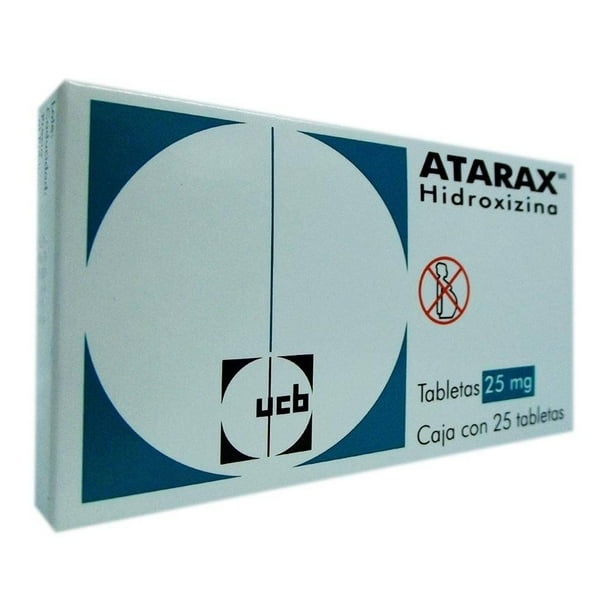
- Country of registration
- Dosage formTABLET, 25 mg hydroxyzine dihydrochloride
- ATC codeN05BB01
- Average pharmacy price1.81 EUR
- Active substance
- Prescription requiredYes
- Manufacturer
- CompositionLACTOSA (54,8 mg mg)
- This information is for reference only and does not constitute medical advice. Always consult a doctor before taking any medication. Oladoctor is not responsible for medical decisions based on this content.
- Alternatives to ATARAX 25 mg FILM-COATED TABLETSDosage form: ORAL SOLUTION/SUSPENSION, 200 mg hydroxyzine dihydrochloride/100 mlActive substance: hydroxyzineManufacturer: Ucb Pharma S.A.Prescription requiredDosage form: TABLET, 25 mgActive substance: hydroxyzineManufacturer: Bluefish Pharmaceuticals Ab (Publ)Prescription requiredDosage form: TABLET, 25 mgActive substance: hydroxyzineManufacturer: Neuraxpharm Spain S.L.Prescription required
Online doctors for ATARAX 25 mg FILM-COATED TABLETS
Discuss questions about ATARAX 25 mg FILM-COATED TABLETS, including use, safety considerations and prescription review, subject to medical assessment and local regulations.









Get ATARAX 25 mg FILM-COATED TABLETS Prescription Online
Fill in a 2-min form
Tell us your symptoms, history, and what medicine you're requesting.
Pick a doctor or let us assign
Choose a specialist or we'll match you with the next available doctor.
Doctor reviews your case
Usually within 30 minutes. They may ask follow-up questions via chat.
Collect from any pharmacy
Electronic prescription sent to your email — valid across Spain.
Frequently Asked Questions
ATARAX 25 mg FILM-COATED TABLETS requires a prescription in Spain. You can check with a doctor online whether this medicine may be appropriate for your situation.
The active ingredient in ATARAX 25 mg FILM-COATED TABLETS is hydroxyzine. This information helps identify medicines with the same composition but different brand names.
The average pharmacy price for ATARAX 25 mg FILM-COATED TABLETS is around 1.81 EUR. Prices may vary depending on the manufacturer and dosage form.
ATARAX 25 mg FILM-COATED TABLETS is manufactured by Ucb Pharma S.A.. Pharmacy brands and packaging may differ depending on the distributor.
Doctors such as Family doctors, Psychiatrists, Dermatologists, Cardiologists, Endocrinologists, Gastroenterologists, Pulmonologists, Nephrologists, Rheumatologists, Hematologists, Infectious disease physicians, Allergists, Geriatricians, Paediatricians, Oncologists may assess whether ATARAX 25 mg FILM-COATED TABLETS is appropriate, depending on your situation and local regulations. You can book an online consultation to discuss your symptoms and possible next steps.
Spain has a well-developed healthcare infrastructure across major cities such as Madrid, Barcelona, Valencia, and Seville. Pharmacies are widely available and operate under strict regulations, ensuring access to prescribed medications.
You can buy ATARAX 25 mg FILM-COATED TABLETS in Madrid, Barcelona, Seville, or Valencia at any local pharmacy with a valid prescription.
To obtain a prescription, you can use Oladoctor:
Other medicines with the same active substance (hydroxyzine) include ATARAX 2 mg/ml SYRUP, HYDROXYZINE BLUEFISH 25 mg FILM-COATED TABLETS, HYDROXYZINE QUALIGEN 25 mg FILM-COATED TABLETS. These may have different brand names or formulations but contain the same therapeutic ingredient. Always consult a doctor before switching or starting a new medicine.
