


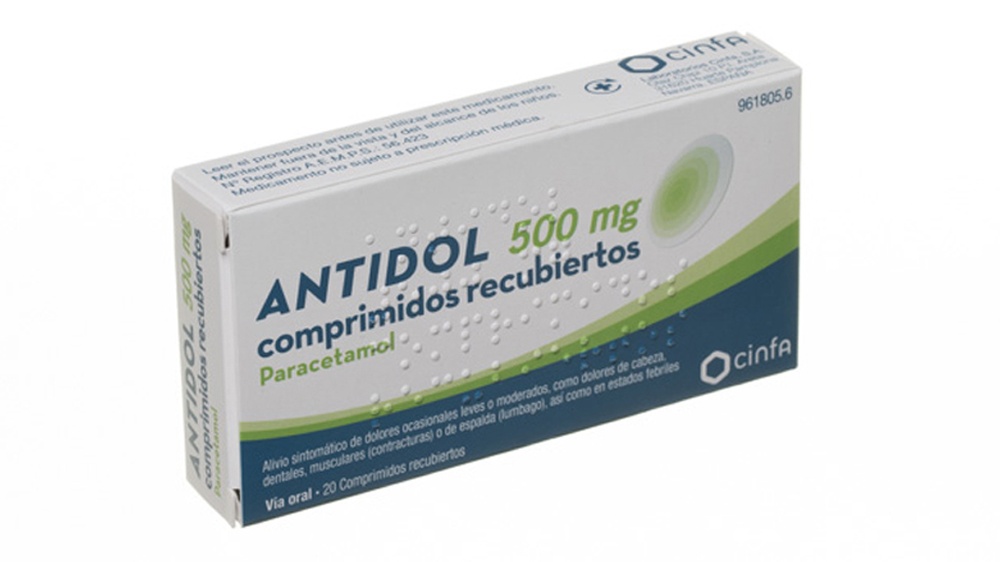
Antidol 500 mg comprimidos recubiertos

Solicitud de receta online
Un médico revisará tu caso y determinará si la prescripción es médicamente apropiada.

Habla con un médico sobre este medicamento
Comenta tus síntomas y las opciones de tratamiento en una consulta online.



Cómo usar ANTIDOL 500 mg COMPRIMIDOS RECUBIERTOS
Contenido del prospecto
- Introducción
- Qué es Antidol y para qué se utiliza
- Qué necesita saber antes de empezar a tomar Antidol
- Cómo tomar Antidol
- Posibles efectos adversos
- Conservación de Antidol
- Contenido del envase e información adicional
Introducción
Prospecto: información para el usuario
Antidol 500 mg comprimidos recubiertos
Paracetamol
Lea todo el prospecto detenidamente antes de empezar a tomar este medicamento, porque contiene información importante para usted.
Siga exactamente las instrucciones de administración del medicamento contenidas en este prospecto o las indicadas por su médico, farmacéutico o enfermero.
- Conserve este prospecto, ya que puede tener que volver a leerlo.
- Si necesita consejo o más información, consulte a su farmacéutico.
- Si experimenta efectos adversos, consulte a su médico o farmacéutico, incluso si se trata de efectos adversos que no aparecen en este prospecto. Ver sección 4.
- Debe consultar a un médico si empeora o si no mejora la fiebre después de 3 días o el dolor durante 5 días.
Contenido del prospecto
- Qué es Antidol y para qué se utiliza
- Qué necesita saber antes de empezar a tomar Antidol
- Cómo tomar Antidol
- Posibles efectos adversos
- Conservación de Antidol
- Contenido del envase e información adicional
1. Qué es Antidol y para qué se utiliza
El paracetamol es eficaz para reducir el dolor y la fiebre.
Este medicamento se utiliza para el alivio sintomático de dolores ocasionales leves o moderados, como dolores de cabeza, dentales, musculares (contracturas) o de espalda (lumbago), así como en estados febriles, en adultos y adolescentes mayores de 12 años.
Debe consultar a un médico si empeora o si persiste la fiebre después de 3 días o el dolor durante 5 días.

¿No estás seguro de si este medicamento es adecuado para ti?
Comenta tus síntomas y tratamiento con un médico online.
2. Qué necesita saber antes de empezar a tomar Antidol
No tome Antidol
- Si es alérgico al paracetamol o a alguno de los demás componentes de este medicamento (incluidos en la sección 6).
Advertencias y precauciones
Consulte a su médico o farmacéutico antes de empezar a tomar Antidol.
- No tomar más cantidad de medicamento que la recomendada en la sección 3 “Cómo tomar Antidol”.
- Debe evitarse el uso simultáneo de este medicamento con otros medicamentos que contengan paracetamol, por ejemplo, medicamentos para la gripe y el catarro, ya que las dosis altas pueden dar lugar a daño en el hígado. No use más de un medicamento que contenga paracetamol sin consultar al médico.
- Los alcohólicos crónicos deberán tener la precaución de no tomar más de 2 gramos (4 comprimidos) en 24 horas de paracetamol.
- Los pacientes con enfermedades del riñón, del hígado, del corazón o del pulmón y los pacientes con anemia, deberán consultar con el médico antes de tomar este medicamento.
- Cuando se está en tratamiento con algún medicamento para tratar la epilepsia debe consultar al médico antes de tomar este medicamento debido a que, cuando se usan al mismo tiempo, se disminuye la eficacia y se potencia la hepatotoxicidad del paracetamol, especialmente en tratamientos con dosis altas de paracetamol.
- Los pacientes asmáticos sensibles al ácido acetilsalicílico, deberán consultar con el médico antes de tomar este medicamento.
- Si tiene enfermedades graves, como insuficiencia renal grave o sepsis (cuando las bacterias y sus toxinas circulan en la sangre, lo que provoca daños en los órganos), o si padece malnutrición, alcoholismo crónico o si también está tomando flucloxacilina (un antibiótico). Se ha notificado una enfermedad grave denominada acidosis metabólica (una anomalía en la sangre y los líquidos) en pacientes en estas situaciones cuando se utiliza paracetamol a dosis regulares durante un período prolongado o cuando se toma paracetamol junto con flucloxacilina. Los síntomas de acidosis metabólica pueden incluir: dificultad respiratoria grave con respiración profunda y rápida, somnolencia, sensación de malestar (náuseas) y vómitos.
Interferencias con pruebas analíticas
Si le van a hacer alguna prueba analítica (incluidos análisis de sangre, orina, etc.) comunique a su médico que está tomando este medicamento, ya que puede alterar los resultados.
Niños
Debido a la cantidad de paracetamol que contiene, los niños (menores de 12 años) no pueden tomar este medicamento.
Otros medicamentos y Antidol
Informe a su médico o farmacéutico si está tomando, ha tomado recientemente o pudiera tener que tomar cualquier otro medicamento.
En particular, si está utilizando alguno de los siguientes medicamentos, ya que puede ser necesario modificar la dosis de alguno de ellos o la interrupción del tratamiento:
- Medicamentos para evitar coágulos en la sangre: anticoagulantes orales (acenocumarol, warfarina).
- Medicamentos para tratar la epilepsia: antiepilépticos (lamotrigina, fenitoína u otras hidantoínas, fenobarbital, metilfenobarbital, primidona, carbamazepina).
- Medicamentos para tratar la tuberculosis: isoniazida, rifampicina.
- Medicamentos para tratar la depresión y las convulsiones: barbitúricos (utilizados como hipnóticos, sedantes y anticonvulsivantes).
- Medicamentos para disminuir los niveles de colesterol en sangre: colestiramina.
- Medicamentos utilizados para aumentar la eliminación de orina (diuréticos del asa como los del grupo furosemida).
- Medicamentos utilizados para el tratamiento de la gota: probenecid y sulfinpirazona.
- Medicamentos utilizados para evitar náuseas y vómitos: metoclopramida y domperidona.
- Medicamentos utilizados en el tratamiento de la tensión arterial alta (hipertensión) y las alteraciones del ritmo del corazón (arritmias cardiacas): propanolol.
- El uso simultáneo de más de un medicamento que contiene paracetamol, puede dar lugar a cuadros de intoxicación.
Informe también a su médico o farmacéutico si está tomando:
- Flucloxacilina (antiobiótico), debido a un riesgo grave de alteración de la sangre y los fluidos (denominada acidosis metabólica con alto desequilibrio aniónico) que debe ser tratada urgentemente (véase la sección 2).
Toma de Antidol con alimentos, bebidas y alcohol
La utilización de paracetamol en pacientes que consumen habitualmente alcohol (3 o más bebidas alcohólicas: cerveza, vino, licor ..., al día) puede provocar daño en el hígado.
La toma de este medicamento con alimentos no afecta a la eficacia del mismo.
Embarazo y lactancia
Si está embarazada o en periodo de lactancia, cree que podría estar embarazada o tiene intención de quedarse embarazada, consulte a su médico o farmacéutico antes de utilizar este medicamento.
En caso necesario, se puede utilizar Antidol durante el embarazo. Debe utilizar la dosis más baja posible que reduzca el dolor o la fiebre y utilizarla durante el menor tiempo posible. Contacte con su médico si el dolor o la fiebre no disminuyen o si necesita tomar el medicamento con más frecuencia.
El paracetamol pasa a la leche materna, por lo que las mujeres en período de lactancia deben consultar a su médico o farmacéutico antes de tomar este medicamento.
Conducción y uso de máquinas
La influencia de este medicamento sobre la capacidad para conducir y utilizar máquinas es nula o insignificante.
Antidol contiene aceite de ricino hidrogenado.
Este medicamento puede producir molestias de estómago y diarrea porque contiene aceite de ricino hidrogenado.
Antidol contiene sodio.
Este medicamento contiene menos de 23 mg de sodio (1mmol) por comprimido; esto es, esencialmente “exento de sodio”.
3. Cómo tomar Antidol
Siga exactamente las instrucciones de administración del medicamento contenidas en este prospecto o las indicadas por su médico o farmacéutico. En caso de duda, pregunte a su médico o farmacéutico.
Se debe evitar el uso de dosis diarias altas de paracetamol durante periodos prolongados de tiempo ya que se incrementa el riesgo de sufrir efectos adversos tales como daño en el hígado.
Las dosis deben repetirse mientras duren los síntomas. Este medicamento está destinado al tratamiento del dolor o de la fiebre. A medida que éstos desaparezcan debe suspenderse esta medicación.
Si el dolor se mantiene durante más de 5 días (2 días para el dolor de garganta), la fiebre durante más de 3 días o bien el dolor o la fiebre empeoran o aparecen otros síntomas, debe interrumpir el tratamiento y consultar a su médico.
Adultos:
La dosis recomendada es de 1 comprimido cada 4-6 horas según necesidad. En caso necesario se pueden tomar 2 comprimidos cada 6-8 horas, hasta un máximo de 6 comprimidos al día. No tomar más de 3 gramos de paracetamol en 24 horas.
Adolescentes de 12 años a 18 años (de 43 – 65 kg):
La dosis recomendada es de 1 comprimido cada 4 – 6 horas, según necesidad, hasta un máximo de 5 comprimidos al día.
Pacientes con enfermedades del hígado: antes de tomar este medicamento tienen que consultar a su médico. Deben tomar la cantidad de medicamento prescrita por su médico con un intervalo mínimo entre cada toma de 8 h. No deben tomar más de 2 gramos o 4 comprimidos de 500 mg de paracetamol en 24 horas.
Pacientes con enfermedades del riñón: antes de tomar este medicamento tienen que consultar a su médico que le indicará si el intervalo mínimo entre cada administración debe ser de 6 u 8h. Debe tomar como máximo un comprimido por toma (500 mg de paracetamol).
Pacientes de edad avanzada: deben consultar a su médico.
Tomar siempre la dosis menor que sea efectiva.
Cuando se requiera la administración de dosis inferiores a 500 mg de paracetamol por toma se deberán emplear otras presentaciones de paracetamol que se adapten a la dosificación requerida.
Este medicamento se administra por vía oral. Los comprimidos deben tomarse con un vaso de líquido, preferentemente agua. Se pueden tomar tanto con alimentos como sin ellos. Para un alivio rápido del dolor, tomar el medicamento sin alimentos.
La ranura sirve únicamente para partir el comprimido si le resulta difícil tragarlo entero.
Si se estima que la acción de este medicamento es demasiado fuerte o débil, comuníqueselo a su médico o farmacéutico.
Uso en niños y adolescentes
Los niños y adolescentes menores de 12 años no pueden tomar este medicamento.
Si toma más Antidol del que debe
Los síntomas de sobredosis pueden ser: mareos, vómitos, pérdida de apetito, coloración amarillenta de la piel y los ojos (ictericia) y dolor abdominal.
Si ha tomado una sobredosis, debe acudir inmediatamente a un centro médico aunque no note los síntomas, ya que a menudo éstos no se manifiestan hasta pasados 3 días desde la toma de la sobredosis, incluso en casos de intoxicación grave.
El tratamiento de la sobredosis es más eficaz si se inicia dentro de las 4 horas siguientes a la toma excesiva del medicamento.
Los pacientes en tratamiento con barbitúricos o los alcohólicos crónicos, pueden ser más susceptibles a la toxicidad de una sobredosis de paracetamol.
En caso de sobredosis o ingestión accidental consulte inmediatamente a su médico o farmacéutico o llame al Servicio de Información Toxicológica, teléfono: 91 562 04 20, indicando el medicamento y la cantidad ingerida.
Si olvidó tomar Antidol
No tome una dosis doble para compensar las dosis olvidadas.

¿Has empezado a tomar el medicamento y tienes preguntas?
Comenta tus síntomas y tratamiento con un médico online.
4. Posibles efectos adversos
Al igual que todos los medicamentos, este medicamento puede producir efectos adversos, aunque no todas las personas los sufran.
Los posibles efectos adversos de Antidol son:
Raros(pueden afectar hasta 1 de cada 1.000 personas): malestar, hipotensión (bajada de la tensión), y aumento de los niveles de transaminasas en sangre.
Muy raros(pueden afectar hasta 1 de cada 10.000 personas): enfermedades del riñón, orina turbia, dermatitis alérgica (erupción cutánea), ictericia (coloración amarillenta de la piel), alteraciones sanguíneas (agranulocitosis, leucopenia, neutropenia, anemia hemolítica) e hipoglucemia (bajada de azúcar en sangre).
Se han notificado muy raramente casos de reacciones graves en la piel.
Frecuencia no conocida(no puede estimarse a partir de los datos disponibles): dolor de cabeza inducido por el abuso de analgésicos;una enfermedad grave que puede hacer que la sangre sea más ácida (denominada acidosis metabólica) en pacientes con enfermedad grave que utilizan paracetamol (ver sección 2).
El paracetamol puede dañar el hígado cuando se toma en dosis altas o en tratamientos prolongados.
Comunicación de efectos adversos
Si experimenta cualquier tipo de efecto adverso, consulte a su médico o farmacéutico, incluso si se trata de posibles efectos adversos que no aparecen en este prospecto. También puede comunicarlos directamente a través del Sistema Español de Farmacovigilancia de Medicamentos de Uso Humano: https://www.notificaram.es. Mediante la comunicación de efectos adversos usted puede contribuir a proporcionar más información sobre la seguridad de este medicamento.
5. Conservación de Antidol
Mantener este medicamento fuera de la vista y del alcance de los niños.
No utilice este medicamento después de la fecha de caducidad que aparece en el envase después de CAD. La fecha de caducidad es el último día del mes que se indica.
Este medicamento no requiere condiciones especiales de conservación.
Los medicamentos no se deben tirar por los desagües ni a la basura. Deposite los envases y los medicamentos que no necesita en el Punto SIGRE de la farmacia. En caso de duda, pregunte a su farmacéutico cómo deshacerse de los envases y de los medicamentos que no necesita. De esta forma, ayudará a proteger el medio ambiente.
6. Contenido del envase e información adicional
Composición de Antidol
- El principio activo es paracetamol. Cada comprimido contiene 500 mg de paracetamol.
- Los demás componentes son:
Núcleo:estearato de magnesio, povidona (E-1201), almidón de maíz, sílice coloidal anhidra, celulosa microcristalina (E-460), aceite de ricino hidrogenado y carboximetilalmidón de sodio (tipo A) (de patata).
Recubrimiento:hipromelosa 606 (E-464), hipromelosa 615 (E-464), y macrogol 6000.
Aspecto de Antidol y contenido del envase
Comprimidos oblongos, recubiertos, de color blanco, ranurados por una cara y por la otra marcados con el código “antidol”.
Se presentan en blísteres de PVC/ALU.
Cada envase contiene 10 y 20 comprimidos recubiertos.
Puede que solamente estén comercializados algunos tamaños de envases.
Titular de la autorización de comercialización y responsable de la fabricación
Laboratorios Cinfa, S.A.
Carretera Olaz-Chipi, 10. Polígono Industrial Areta
31620 Huarte (Navarra) – España
Fecha de la última revisión de este prospecto:Abril 2025
La información detallada y actualizada de este medicamento está disponible en la página web de la Agencia Española de Medicamentos y Productos Sanitarios (AEMPS) http://www.aemps.gob.es/
- País de registro
- Forma farmacéuticaCOMPRIMIDO, 500 mg paracetamol
- Código ATCN02BE01
- Principio activo
- Requiere recetaNo
- Fabricante
- Esta información es de carácter general y no sustituye la consulta con un profesional sanitario.
- Alternativas a ANTIDOL 500 mg COMPRIMIDOS RECUBIERTOSForma farmacéutica: COMPRIMIDO, 1 gPrincipio activo: ParacetamolFabricante: Uxa Farma S.A.Requiere recetaForma farmacéutica: COMPRIMIDO, 1 gPrincipio activo: ParacetamolFabricante: Laboratorios Cinfa S.A.No requiere recetaForma farmacéutica: COMPRIMIDO, 1 gPrincipio activo: ParacetamolFabricante: Laboratorios Cinfa S.A.No requiere receta
Médicos online para ANTIDOL 500 mg COMPRIMIDOS RECUBIERTOS
Comenta la dosis, los posibles efectos secundarios, interacciones, contraindicaciones o si una receta es apropiada para ANTIDOL 500 mg COMPRIMIDOS RECUBIERTOS, sujeto a valoración médica y a la normativa local.









Preguntas frecuentes
ANTIDOL 500 mg COMPRIMIDOS RECUBIERTOS no requiere receta en España. Puedes confirmarlo con un médico online según tu caso.
El principio activo de ANTIDOL 500 mg COMPRIMIDOS RECUBIERTOS es Paracetamol. Esta información ayuda a identificar medicamentos con la misma composición pero con diferentes nombres comerciales.
ANTIDOL 500 mg COMPRIMIDOS RECUBIERTOS es fabricado por Laboratorios Cinfa S.A.. La marca y el envase pueden variar según el distribuidor.
Los Médicos de familia, Psiquiatras, Dermatólogos, Cardiólogos, Endocrinólogos, Gastroenterólogos, Neumólogos, Nefrólogos, Reumatólogos, Hematólogos, Infectólogos, Alergólogos, Geriatras, Pediatras, Oncólogos pueden valorar la prescripción de ANTIDOL 500 mg COMPRIMIDOS RECUBIERTOS cuando esté clínicamente indicado. Puedes reservar una videoconsulta para comentar tu caso y las opciones de tratamiento.
La receta la emite un médico tras valorar tu estado de salud. En España, ANTIDOL 500 mg COMPRIMIDOS RECUBIERTOS se dispensa en las farmacias con esa receta médica. Una consulta online no garantiza su emisión: la decisión corresponde siempre al médico.
Para solicitar una valoración puedes usar Oladoctor:
Otros medicamentos con el mismo principio activo (Paracetamol) incluyen ABEZEN 1 G COMPRIMIDOS RECUBIERTOS CON PELICULA, ANTIDOL 1 G COMPRIMIDOS RECUBIERTOS, ANTIDOL 1 G COMPRIMIDOS. Pueden tener diferentes nombres comerciales o formulaciones, pero contienen el mismo componente terapéutico. Consulta siempre con un médico antes de cambiar o iniciar un nuevo medicamento.
