



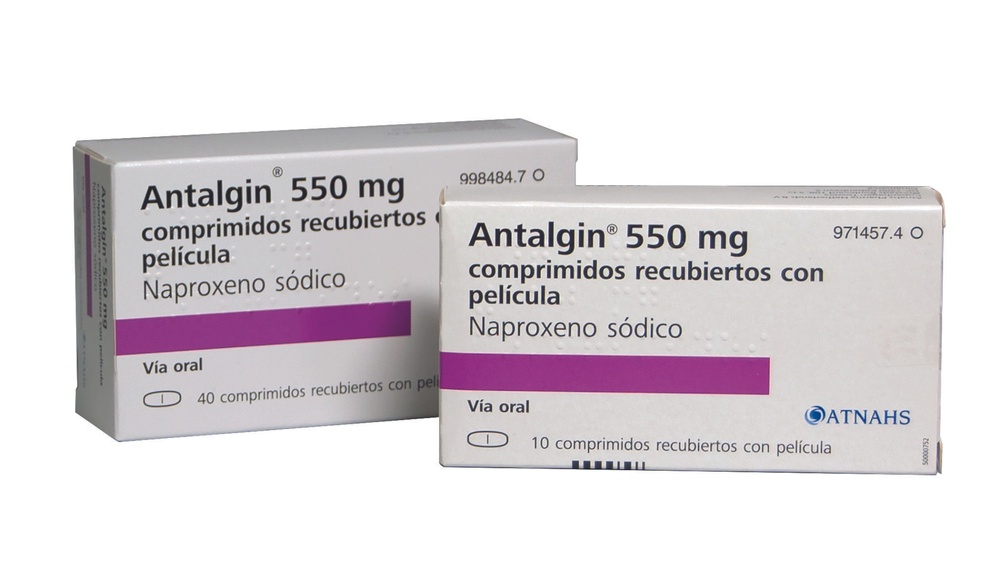
ANTALGIN 550 mg Comprimidos Recubiertos Con Película

Revisión de receta online
Un médico revisará tu caso y determinará si la prescripción es médicamente apropiada.

Habla con un médico sobre este medicamento
Comenta tus síntomas y las opciones de tratamiento en una consulta online.



Cómo usar ANTALGIN 550 mg COMPRIMIDOS RECUBIERTOS CON PELICULA
Contenido del prospecto
- Introducción
- Qué es Antalgin y para qué se utiliza
- Qué necesita saber antes de empezar a tomar Antalgin
- Cómo tomar Antalgin
- Posibles efectos adversos
- Conservación de Antalgin
- Contenido del envase e información adicional
Introducción
Prospecto: información para elpaciente
Antalgin 550mg comprimidosrecubiertos con película
Naproxeno sódico
Lea todo el prospecto detenidamente antes deempezar atomareste medicamento, porque contiene información importante para usted.
- Conserve este prospecto, ya que puede tener que volver a leerlo.
- Si tiene alguna duda, consulte a su médico o farmacéutico.
- Este medicamento se le ha recetado solamente a usted y no debe dárselo a otras personas, aunque tengan los mismos síntomas que usted, ya que puede perjudicarles.
- Si experimenta efectos adversos, consulte a su médico o farmacéutico, incluso si se trata de efectos adversos que no aparecen en este prospecto. Ver sección 4.
Contenido del prospecto
- Qué es Antalgin y para qué se utiliza
- Qué necesita saber antes de empezar a tomar Antalgin
- Cómo tomar Antalgin
- Posibles efectos adversos
- Conservación de Antalgin
- Contenido del envase e información adicional
1. Qué es Antalgin y para qué se utiliza
Antalgin contiene como principio activo naproxeno sódico, sustancia que pertenece al grupo de medicamentos denominados antiinflamatorios no esteroideos (AINEs).
Antalgin está indicado para el tratamiento del:
- Dolor de intensidad leve o moderado, tratamiento de los síntomas de artritis reumatoide, (inflamación de las articulaciones, incluyendo habitualmente las de manos y pies, dando lugar a hinchazón y dolor), artrosis (trastorno de carácter crónico que ocasiona el daño del cartílago), episodios agudos de gota y espondilitis anquilosante (inflamación que afecta las articulaciones de la columna vertebral),
- Dolor menstrual.
- Alivio del dolor de las crisis agudas de migraña.
- Dolor secundario debido a sangrados asociados a dispositivos intrauterinos (D.I.U.).

¿No estás seguro de si este medicamento es adecuado para ti?
Comenta tus síntomas y tratamiento con un médico online.
2. Qué necesita saber antes de empezar a tomar Antalgin
Es importante que utilice la dosis más pequeña que alivie/controle el dolor y no debe tomar Antalgin más tiempo del necesario para controlar sus síntomas.
No tome Antalgin
- Si es alérgico (hipersensible) al naproxeno o al naproxeno sódico, o a cualquiera de los demás componentes de este medicamento (incluidos en la sección 6)
- Si sabe que es alérgico (hipersensible) al ácido acetilsalicílico o a otros antiinflamatorios no esteroideos y/o le producen reacciones alérgicas graves tales como: asma, rinitis o pólipos nasales,
- Si está tomando otros medicamentos de este tipo (antiinflamatorios no esteroideos),
- Si padece actualmente o ha padecido en más de una ocasión: una úlcera o una hemorragia de estómago o duodeno,
- Si ha tenido anteriormente una hemorragia de estómago o duodeno o ha sufrido una perforación del aparato digestivo mientras tomaba un medicamento anti-inflamatorio no esteroideo,
- Si padece colitis ulcerosa (una enfermedad intestinal),
- Si padece insuficiencia hepática (alteraciones en el hígado) o renal (alteraciones en el riñón) grave,
- Si se encuentra en el tercer trimestre del embarazo.
- Si padece una insuficiencia cardiaca grave
Advertencias y precauciones
Consulte a su médico o farmacéutico antes de empezar a tomar Antalgin.
Se han notificado reacciones graves en la piel con el uso de anti-inflamatorios no esteroideos que aparecen como manchas rojizas, enrojecimiento generalizado de la piel, úlceras o erupción extendida acompañados de síntomas similares a los de la gripe, incluyendo fiebre (ver sección 4). La erupción puede progresar a ampollas generalizadas o descamación de la piel. El mayor riesgo de que ocurran estas reacciones graves en la piel es durante las primeras semanas de tratamiento, pero podrían empezar a desarrollarse hasta varios meses desde la administración del medicamento (ver sección 4). Si usted ha desarrollado alguna de las reacciones graves de la piel con el uso de Antalgin no debe volver a iniciar el tratamiento con Antalgin en ningún momento. Si desarrolla una erupción cutánea o estos síntomas en la piel, deje de tomar Antalgin y contacte con su médico o busque atención médica inmediatamente.
Tenga precaución en las siguientes situaciones:
- Es importante que utilice la dosis más pequeña que alivie/controle el dolor y no debe tomar este medicamento más tiempo del necesario para controlar sus síntomas.
- Si ha tenido o desarrolla una úlcera, hemorragia o perforación en el estómago o en el duodeno, pudiéndose manifestar por un dolor abdominal intenso o persistente y/o por heces de color negro, o incluso sin síntomas previos de alerta.
- Si ha tenido anteriormente una hemorragia de estómago o duodeno o ha sufrido una perforación del aparato digestivo mientras tomaba un medicamento anti-inflamatorio no esteroideo,
- Este riesgo es mayor cuando se utilizan dosis altas y tratamientos prolongados, en pacientes con antecedentes de úlcera péptica y en los ancianos. En estos casos su médico considerará la posibilidad de asociar un medicamento protector del estómago.
- Si padece o ha padecido problemas del estómago, puesto que Antalgin puede provocar irritación, hemorragias o úlceras de estómago. Su médico le recomendará la dosis más adecuada,
- Si padece la enfermedad de Crohn o una colitis ulcerosa pues los medicamentos del tipo Antalgin pueden empeorar estas patologías,
- Si padece asma o trastornos alérgicos (como rinitis o pólipos nasales), puesto que Antalgin puede provocar dificultades en la respiración (broncoespasmo),
- Si tiene problemas de riñón graves, del hígado o del corazón,
- Si toma simultáneamente medicamentos que alteran la coagulación de la sangre o aumentan el riesgo de úlceras, como anticoagulantes orales, o antiagregantes plaquetarios del tipo del ácido acetilsalicílico. También debe comentarle la utilización de otros medicamentos que podrían aumentar el riesgo de dichas hemorragias como los corticoides y los antidepresivos inhibidores selectivos de la recaptación de serotonina,
- Si tiene o sospecha que tiene una infección, puesto que Antalgin puede enmascarar los signos y síntomas habituales de los procesos infecciosos,
- Si al tomar Antalgin siente dolores de estómago y/o observa que las heces aparecen de coloración negra, deberá interrumpir el tratamiento con Antalgin,
- Si experimenta trastornos de la visión durante el tratamiento,
- Este medicamento debe usarse con precaución en pacientes que tengan una dieta baja en sal y antecedentes de problemas digestivos,
- Si desea quedarse embarazada, puesto que Antalgin puede afectar a la fertilidad.
Precauciones cardiovasculares
Los medicamentos como Antalgin se pueden asociar con un moderado aumento del riesgo de sufrir ataques cardiacos (“infartos de miocardio”) o cerebrales. Dicho riesgo es más probable que ocurra cuando se emplean dosis altas y tratamientos prolongados. No exceda la dosis ni la duración del tratamiento recomendado.
Si usted tiene problemas cardiacos, antecedentes de ataques cerebrales, o piensa que podría tener riesgo para sufrir estas patologías (por ejemplo, tiene alta la tensión arterial, diabetes, aumento del colesterol, o es fumador) debe consultar este tratamiento con su médico o farmacéutico.
Asimismo, este tipo de medicamentos puede producir retención de líquidos, especialmente en pacientes con insuficiencia cardiaca y/o tensión arterial elevada (hipertensión).
Otros medicamentos y Antalgin
Informe a su médico o farmacéutico si está tomando, ha tomado recientemente o podría tener que tomar cualquier otro medicamento.
Esto es muy importante puesto que Antalgin puede alterar el modo en que actúan otros medicamentos. Es importante que informe a su médico si toma alguno de los siguientes fármacos:
- Antiácidos o colestiramina, porque pueden retardar la acción de Antalgin, pero no afecta al efecto total,
- Ácido acetilsalicílico para prevenir coágulos de sangre,
- Hidantoínas (fármacos usados preferentemente para la epilepsia),
- Sulfonilureas (medicamentos para la diabetes),
- Sulfonamidas (un tipo de medicamentos diuréticos),
- Metotrexato (un medicamento inmunosupresor),
- Beta-bloqueantes (medicamento anti-hipertensivo),
- Furosemida (medicamento con efecto natriurético),
- Litio. Puede provocar un aumento de la concentración de litio en plasma,
- Esteroides, Antalgin puede interferir en pruebas de función suprarrenales,
- IECAS (Inhibidores de la enzima convertidora de Angiotensina, medicamento anti-hipertensivo).
- Antagonistas o bloqueantes del receptor de la angiotensina (medicamentos anti-hipertensivos)
Puede ser necesario que su médico modifique la dosis de uno de los dos fármacos. Consulte a su médico si tiene alguna duda sobre estos puntos.
Toma de Antalgin con alimentos y bebidas
Se recomienda tomar los comprimidos durante las comidas o inmediatamente después de comer, para reducir así la posibilidad de que se produzcan molestias en el estómago.
Embarazo, lactancia y fertilidad
Si está embarazada o en periodo de lactancia, cree que podría estar embarazada o tiene intención de quedarse embarazada, consulte a su médico o farmacéutico antes de utilizar este medicamento
Antalgin no debe administrarse durante el embarazo, parto, ni durante la lactancia.
No tome Antalgin si se encuentra en los últimos 3 meses de embarazo, ya que podría perjudicar al feto o provocar problemas durante el parto. Puede provocar problemas renales y cardíacos a su feto. Puede afectar a su tendencia y la de su bebé a sangrar y retrasar o alargar el parto más de lo esperado.
Debido a que la administración de medicamentos del tipo Antalgin se ha asociado a un aumento del riesgo de sufrir anomalías congénitas/abortos no debe tomar Antalgin durante el primer y segundo trimestre del embarazo a no ser que se considere estrictamente necesario y se lo indique su médico. Si necesita tratamiento durante este periodo o mientras trata de quedarse embarazada, deberá tomar la dosis mínima durante el menor tiempo posible. A partir de la semana 20 de embarazo, Antalgin puede provocar problemas renales a su feto si se toma durante más de unos días, lo que puede provocar niveles bajos del líquido amniótico que rodea al bebé (oligohidramnios). Si necesita tratamiento durante un periodo superior a unos días, su médico podría recomendar controles adicionales.
Para las pacientes en edad fértil se debe tener en cuenta que los medicamentos del tipo Antalgin se han asociado con una disminución de la capacidad para concebir.
Conducción y uso de máquinas
Antalgin debe utilizarse con precaución en pacientes cuya actividad requiera atención y que hayan observado vértigo o alteraciones visuales durante el tratamiento con este fármaco.
Antalgin contiene sodio
Este medicamento contiene 50 mg de sodio (componente principal de la sal de mesa/para cocinar) en cada comprimido. Esto equivale al 2,5% de la ingesta diaria máxima de sodio recomendada para un adulto.
3. Cómo tomar Antalgin
Siga exactamente las instrucciones de administración de este medicamento indicadas por su médico o farmacéutico. En caso de duda, consulte de nuevo a su médico o farmacéutico.
Su médico le indicará la duración de su tratamiento con Antalgin.
La dosis recomendada es:
Adultos
La dosis diaria es habitualmente de 1 ó 2 comprimidos (550 mg ó 1100 mg de naproxeno sódico). Como dosis inicial se recomienda administrar 1 comprimido (550 mg de naproxeno sódico) seguido de medio comprimido (275 mg de naproxeno sódico) cada 6 u 8 horas, según la intensidad del proceso. Estas dosis pueden ser modificadas por indicación de su médico.
Para el tratamiento de la artritis reumatoide, artrosisy espondilitis anquilosante: la dosis inicial es habitualmente de 1 comprimido (550 mg de naproxeno sódico) tomado dos veces al día (por la mañana y por la noche) ó 2 comprimidos (1100 mg de naproxeno sódico) tomados una sola vez al día.
Para el tratamiento de los episodios agudos de gota: la dosis inicial es habitualmente de 1 comprimido y medio (825 mg de naproxeno sódico) seguida de medio comprimido (275 mg de naproxeno sódico) cada 8 horas hasta que no sienta dolor. Consulte con su médico la duración del tratamiento.
Para el tratamiento de la dismenorrea(dolor menstrual): la dosis inicial es habitualmente de 1 comprimido (550 mg de naproxeno sódico) seguida de medio comprimido (275 mg de naproxeno sódico) cada 6 u 8 horas.
Para el tratamiento de las crisis de migraña: la dosis inicial es de 1 comprimido y medio (825 mg de naproxeno sódico) cuando presente los primeros síntomas, seguida de medio comprimido (275 mg de naproxeno sódico) cuando haya transcurrido media hora de la toma inicial.
Para el tratamiento de la menorragia(dolor asociado a sangrado menstrual excesivo): la dosis inicial durante el primer día de la menstruación es entre 1 comprimido y medio y 2 comprimidos y medio (825 mg y 1375 mg de naproxeno sódico) repartidos en dos tomas al día. Continuar con una dosis de 1 ó 2 comprimidos al día (550 mg ó 1.100 mg de naproxeno sódico) repartidos en dos tomas al día, durante los siguientes 4 días como máximo.
Uso en mayores de 65 años oenpacientes con enfermad de los riñones y/o del hígado
En pacientes mayores de 65 años o si sufre alguna enfermedad de riñóno del hígadose recomienda reducir la dosis y utilizar la menor dosis eficaz durante el menor tiempo posible. Consulte a su médico.
Uso en niños y adolescentes
No se recomienda el uso de este medicamento en niños menores de 16 años.
Forma de administración:
Este medicamento se toma por vía oral.
El comprimido se puede partir en dosis iguales.
Trague los comprimidos con una cantidad suficiente de líquido, un vaso de agua u otro líquido, preferentemente durante o después de las comidas.
Tomar siempre la dosis menor que sea efectiva
Si toma más Antalgin del que debe
Si usted ha tomado más Antalgin del que debiera, consulte inmediatamente a su médico o a su farmacéutico.
Los síntomas por sobredosis se caracterizan por somnolencia, ardor de estómago, indigestión, nauseas, vómitos y en algunos casos convulsiones.
Ante una sobredosis accidental o voluntaria, debe procederse a lavado gástrico e instaurar un tratamiento sintomático. La administración rápida de 50-100 gr de carbón activado en forma de suspensión acuosa reduce la absorción del medicamento.
En caso de sobredosis o ingestión accidental, consultar al Servicio de Información Toxicológica, Teléfono (91) 562.04.20.
Si olvidó tomarAntalgin
No tome una dosis doble para compensar las dosis olvidadas, tome la dosis en el momento en que se acuerde y continúe con la dosis siguiente.

¿Has empezado a tomar el medicamento y tienes preguntas?
Comenta tus síntomas y tratamiento con un médico online.
4. Posibles efectos adversos
Al igual que todos los medicamentos, este medicamento puede producir efectos adversos, aunque no todas las personas los sufran.
Los efectos adversos que pueden producirse durante el tratamiento con este medicamento, y que se han observado con una frecuencia muy rara (en menos de 1 de cada 10.000 pacientes) son:
Trastornos gastrointestinales:los efectos adversos más frecuentes observados con Antalgin son de naturaleza gastrointestinal (afectan al estómago e intestino).
Puede producirse inflamación, sangrado (en algunos casos mortales, especialmente en los ancianos), úlceras pépticas, perforación y obstrucción de la parte superior o inferior del tracto gastrointestinal (aparato digestivo). Se han observado casos de esofagitis (inflamación del esófago), gastritis (inflamación de la mucosa del estómago), pancreatitis (inflamación del páncreas), estomatitis (inflamación de la mucosa bucal) y empeoramiento de colitis ulcerosa y enfermedad de Crohn. También se han observado casos de acidez del estómago, dispepsia (trastornos en la digestión), molestias abdominales, náuseas, vómitos, diarreas, estreñimiento, flatulencia (gases), hematemesis (vómito de sangre) y melena (heces de color negruzco).
Trastornos de la sangre y del sistema linfático:agranulocitosis (aumento/disminución de ciertos glóbulos blancos), anemia aplásica y hemolítica (reducción del número de glóbulos rojos, glóbulos blancos y plaquetas en sangre), eosinofilia (aumento de ciertos glóbulos blancos en sangre), leucopenia (disminución del número de leucocitos en sangre), trombocitopenia (disminución del número de plaquetas), agrandamiento de los ganglios linfáticos y afectación a otros órganos del cuerpo (reacción a fármaco con eosinofilia y síntomas sistémicos conocidos también como DRESS). Ver también sección 2.
Trastornos del sistema inmunológico:reacciones anafilactoides (reacción alérgica aguda), edema angioneurótico (inflamación en la piel, mucosa y vísceras), temperatura corporal elevada.
Trastornos del metabolismo y de la nutrición:hipercalcemia (aumento de la concentración de calcio en sangre).
Trastornos psiquiátricos:dificultad para concentrarse, depresión, alteraciones del sueño.
Trastornos del sistema nervioso:mareos, somnolencia, cefaleas, sensación de mareo, vértigo, disfunción cognoscitiva, meningitis aséptica (inflamación de las meninges), convulsiones, insomnio.
Trastornos oculares:trastornos de la visión, opacidad corneal, papilitis (inflamación de la papila), neuritis óptica retrobulbar (inflamación del nervio óptico) y edema de la papila.
Trastornos del oído y del laberinto:alteraciones en la audición, tinnitus (zumbido en los oídos), hipoacusia (disminución en la audición).
Trastornos cardiacos:palpitaciones, insuficiencia cardiaca congestiva (incapacidad del corazón para realizar su función de bombeo), hipertensión (tensión arterial alta). Los medicamentos como Antalgin, pueden asociarse con un moderado aumento de riesgo de sufrir un ataque cardiaco (“infarto de miocardio”) o cerebral.
Trastornos vasculares:vasculitis (inflamación de los vasos sanguíneos), edema.
Trastornos respiratorios, torácicos y mediastínicos:asma, neumonitis eosinofílica, disnea (falta de aire), edema pulmonar.
Infecciones e infestaciones:meningitis aséptica.
Trastornos hepatobiliares:hepatitis (inflamación de hígado), ictericia (coloración amarilla de la piel) y altos niveles de enzimas hepáticos. Los medicamentos como Antalgin pueden asociarse en raras ocasiones a lesiones del hígado.
Trastornos de la piel y del tejido subcutáneo:hemorragia cutánea, picor, hemorragia capilar, erupciones cutáneas generalizadas, sudoración, alopecia, descamación de la piel, liquen plano (enfermedad cutánea de pequeños nódulos planos), reacción de vesículas de pus, enrojecimiento de la piel, lupus eritematoso sistémico (enfermedad autoinmune con signos cutáneos típicos, erupción y enrojecimiento de la piel), reacciones ampollosas muy graves como el síndrome de Stevens-Johnson (erupción cutánea de aspecto de mapa) y la necrolisis epidérmica tóxica, alergia, reacciones de fotosensibilidad incluyendo casos raros en que la piel toma un aspecto de porfiria cutánea tarda, pseudoporfiria (defecto de las enzimas del hígado) o de epidermólisis ampollosa. Si se produce fragilidad cutánea, formación de ampollas u otros síntomas indicativos de pseudoporfiria, debe suspenderse el tratamiento y vigilar al paciente.
Trastornos musculoesqueléticos, del tejido conjuntivo y de los huesos:dolor muscular, astenia muscular.
Trastornos renales y urinarios:sangre en la orina, nefritis intersticial (inflamación renal con decoloración pardo-amarillenta), síndrome nefrótico, renopatía (enfermedad del riñón), insuficiencia renal, necrosis papilar renal (muerte de las células que forman las papilas del riñón por alteración del metabolismo).
Trastornos del aparato reproductor y de la mama:infertilidad.
Trastornos generales y alteraciones en el lugar de administración:malestar general, pirexia (escalofríos y fiebre), sed, dolor de garganta, una reacción alérgica cutánea característica conocida como erupción fija medicamentosa, que generalmente reaparece en el mismo sitio al volver a exponerse al medicamento y puede verse como manchas rojizas redondas u ovaladas e hinchazón de la piel, ampollas (urticaria) y picor.
Exploraciones complementarias:valores anómalos de pruebas funcionales hepáticas, creatinina sérica elevada, hiperpotasemia.
Si experimenta efectos adversos, consulte a su médico o farmacéutico, incluso si se trata de efectos adversos que no aparecen en este prospecto.
Comunicación de efectos adversos
Si experimenta cualquier tipo de efecto adverso, consulte a su médico o farmacéutico, incluso si se trata de posibles efectos adversos que no aparecen en este prospecto. También puede comunicarlos directamente a través del Sistema Español de Farmacovigilancia de Medicamentos de Uso Humano: www.notificaRAM.es/. Mediante la comunicación de efectos adversos usted puede contribuir a proporcionar más información sobre la seguridad de este medicamento.
5. Conservación de Antalgin
Mantener este medicamento fuera de la vista y del alcance de los niños.
No utilice Antalgin después de la fecha de caducidad que aparece en el envase después de CAD. La fecha de caducidad es el último día del mes que se indica.
No requiere condiciones especiales de conservación.
Los medicamentos no se deben tirar por los desagües ni a la basura. Deposite los envases y los medicamentos que no necesita en el Punto SIGRE de la farmacia. En caso de duda pregunte a su farmacéutico cómo deshacerse de los envases y de los medicamentos que no necesita. De esta forma ayudará a proteger el medio ambiente.
6. Contenido del envase e información adicional
Composición de Antalgin
- El principio activo es naproxeno sódico. Cada comprimido contiene 550 mg de naproxeno sódico (equivalentes a 500 mg de naproxeno)
- Los demás componentes (excipientes) son: celulosa microcristalina, povidona, talco, estearato de magnesio, hipromelosa (E464), macrogol, dióxido de titanio (E-171), laca de indigotina (E-132) y agua purificada.
Aspecto del producto y contenido del envase
Antalgin son comprimidos recubiertos con película, con forma ovalada, de color azul y con la inscripción NPS 550 en una de las caras del comprimido. El comprimido es fraccionable (se puede dividir en dos dosis iguales).
Se presenta en envases de 10 y 40 comprimidos recubiertos con película.
Titular de la autorización de comercialización:
Atnahs Pharma Netherlands B.V.
Copenhagen Towers
Ørestads Boulevard 108, 5.tv
DK-2300 København S
Dinamarca
Responsable de la fabricación:
RECIPHARM LEGANÉS S.L.U.
C/ Severo Ochoa, 13.Pol. Ind. Leganés
28914 Madrid
RECIPHARM FONTAINE SAS
Rue des Près Potets
21121 Fontaine-Lès-Dijon – Francia
Atnahs Pharma Denmark ApS
Copenhagen Towers
Ørestads Boulevard 108, 5.tv
DK-2300 København S
Dinamarca
Misom Labs Ltd
Malta Life Sciences Park
LS2.01.06
Industrial Estate
San Gwann, SGN 3000, Malta
Representante local
Laboratorios Rubió, S.A.
Industria, 29 - Pol. Ind. Comte de Sert
08755 Castellbisbal (Barcelona)
España
Fecha de la última revisión de este prospecto:Febrero 2025
“La información detallada y actualizada de este medicamento está disponible en la página Web de la Agencia Española de Medicamentos y Productos Sanitarios (AEMPS)http://www.aemps.gob.es/”
- País de registro
- Forma farmacéuticaCOMPRIMIDO, 550 mg naproxeno sodico
- Código ATCM01AE02
- Precio medio en farmacia2.22 EUR
- Principio activo
- Requiere recetaSí
- Fabricante
- Esta información es de carácter general y no sustituye la consulta con un profesional sanitario.
- Alternativas a ANTALGIN 550 mg COMPRIMIDOS RECUBIERTOS CON PELICULAForma farmacéutica: COMPRIMIDO LIBERACION MODIFICADA, 660 mgPrincipio activo: naproxenFabricante: Bayer Hispania S.L.No requiere recetaForma farmacéutica: COMPRIMIDO, 500 mgPrincipio activo: naproxenFabricante: Aristo Pharma Iberia S.L.Requiere recetaForma farmacéutica: CAPSULA, 250 mg naproxenoPrincipio activo: naproxenFabricante: Industria Quimica Y Farmaceutica Vir S.A.Requiere receta
Médicos online para ANTALGIN 550 mg COMPRIMIDOS RECUBIERTOS CON PELICULA
Comenta la dosis, los posibles efectos secundarios, interacciones, contraindicaciones o la revisión de receta de ANTALGIN 550 mg COMPRIMIDOS RECUBIERTOS CON PELICULA, sujeto a valoración médica y a la normativa local.









Obtén una receta de ANTALGIN 550 mg COMPRIMIDOS RECUBIERTOS CON PELICULA online
Rellena un formulario de 2 minutos
Cuéntanos tus síntomas, historial y el medicamento que necesitas.
Elige un médico o nosotros te asignamos uno
Escoge un especialista o te conectamos con el próximo médico disponible.
El médico revisa tu caso
Normalmente en 30 minutos. Puede hacerte preguntas adicionales por chat.
Recógela en cualquier farmacia
Receta electrónica enviada a tu correo, válida en toda España.
Preguntas frecuentes
ANTALGIN 550 mg COMPRIMIDOS RECUBIERTOS CON PELICULA requiere receta en España. Puedes confirmarlo con un médico online según tu caso.
El principio activo de ANTALGIN 550 mg COMPRIMIDOS RECUBIERTOS CON PELICULA es naproxen. Esta información ayuda a identificar medicamentos con la misma composición pero con diferentes nombres comerciales.
El precio medio en farmacia de ANTALGIN 550 mg COMPRIMIDOS RECUBIERTOS CON PELICULA es de aproximadamente 2.22 EUR. Puede variar según el fabricante y la forma farmacéutica.
ANTALGIN 550 mg COMPRIMIDOS RECUBIERTOS CON PELICULA es fabricado por Atnahs Pharma Netherlands Bv.. La marca y el envase pueden variar según el distribuidor.
Los Médicos de familia, Psiquiatras, Dermatólogos, Cardiólogos, Endocrinólogos, Gastroenterólogos, Neumólogos, Nefrólogos, Reumatólogos, Hematólogos, Infectólogos, Alergólogos, Geriatras, Pediatras, Oncólogos pueden valorar la prescripción de ANTALGIN 550 mg COMPRIMIDOS RECUBIERTOS CON PELICULA cuando esté clínicamente indicado. Puedes reservar una videoconsulta para comentar tu caso y las opciones de tratamiento.
España cuenta con una infraestructura sanitaria bien desarrollada en ciudades principales como Madrid, Barcelona, Valencia y Sevilla. Las farmacias están ampliamente disponibles y operan bajo estrictas regulaciones, garantizando el acceso a medicamentos con receta.
Puedes comprar ANTALGIN 550 mg COMPRIMIDOS RECUBIERTOS CON PELICULA en Madrid, Barcelona, Sevilla o Valencia en cualquier farmacia local con una receta válida.
Para obtener una receta, puedes utilizar Oladoctor:
Otros medicamentos con el mismo principio activo (naproxen) incluyen ACTROMADOL 660 MG COMPRIMIDOS DE LIBERACIÓN MODIFICADA, LIDET 500 MG COMPRIMIDOS GASTRORRESISTENTES EFG, LUNDIRAN 250 mg Cápsulas duras. Pueden tener diferentes nombres comerciales o formulaciones, pero contienen el mismo componente terapéutico. Consulta siempre con un médico antes de cambiar o iniciar un nuevo medicamento.
