



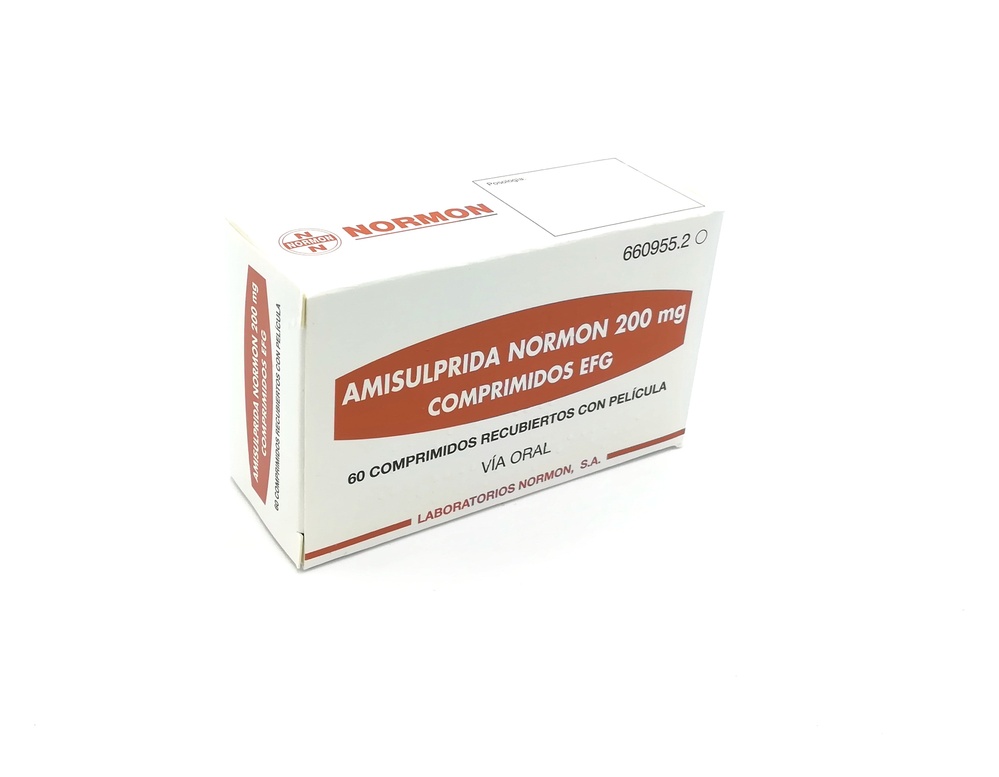
AMISULPRIDA 200 mg Comprimidos Recubiertos Con Película

Revisión de receta online
Un médico revisará tu caso y determinará si la prescripción es médicamente apropiada.

Habla con un médico sobre este medicamento
Comenta tus síntomas y las opciones de tratamiento en una consulta online.



Cómo usar AMISULPRIDA NORMON 200 MG COMPRIMIDOS RECUBIERTOS CON PELICULA EFG
Contenido del prospecto
- Introducción
- Qué es Amisulprida Normon y para qué se utiliza
- Qué necesita saber antes de empezar a tomar Amisulprida Normon
- Cómo tomar Amisulprida Normon
- Posibles efectos adversos
- Conservación de Amisulprida Normon
- Contenido del envase e información adicional
Introducción
Prospecto: información para el usuario
Amisulprida Normon 200 mg comprimidos recubiertos con película EFG
Lea todo el prospecto detenidamente antes de empezar a tomar este medicamento, porque contiene información importante para usted.
- Conserve este prospecto, ya que puede tener que volver a leerlo.
- Si tiene alguna duda, consulte a su médico o farmacéutico.
- Este medicamento se le ha recetado solamente a usted, y no debe dárselo a otras personas, aunque tengan los mismos síntomas que usted, ya que puede perjudicarles.
- Si experimenta efectos adversos, consulte a su médico o farmacéutico, incluso si se trata de efectos adversos que no aparecen en este prospecto. Ver sección 4.
Contenido del prospecto
- Qué es Amisulprida Normon y para qué se utiliza
- Qué necesita saber antes de empezar a tomar Amisulprida Normon
- Cómo tomar Amisulprida Normon
- Posibles efectos adversos
- Conservación de Amisulprida Normon
- Contenido del envase e información adicional
1. Qué es Amisulprida Normon y para qué se utiliza
Amisulprida pertenece a un grupo de medicamentos denominados antipsicóticos.
Amisulprida Normon está indicado para el tratamiento de la esquizofrenia.

¿No estás seguro de si este medicamento es adecuado para ti?
Comenta tus síntomas y tratamiento con un médico online.
2. Qué necesita saber antes de empezar a tomar Amisulprida Normon
No tome Amisulprida Normon
- Si es alérgico a amisulprida o a cualquiera de los demás componentes de este medicamento (incluidos en la sección 6).
- Si tiene algún tumor dependiente de prolactina (hormona segregada por la adenohipófisis y que estimula la producción de leche en las glándulas mamarias), por ejemplo, prolactinomas hipofisarios o cáncer de mama.
- Si tiene feocromocitoma (tumor de la glándula suprarrenal).
- Si es un niño, hasta la pubertad.
- Si está en tratamiento con levodopa.
Advertencias y precauciones
Consulte a su médico, farmacéutico o enfermero antes de empezar a tomar Amisulprida Normon.
- Al igual que con otros medicamentos antipsicóticos puede producirse síndrome neuroléptico maligno (una complicación que puede ser mortal) caracterizado por fiebre alta, rigidez muscular, alteración del sistema nervioso (inestabilidad autónoma), alteración de la conciencia (obnubilación), rabdomiólisis (rotura de los músculos asociada con dolor muscular) y aumento de una enzima denominada creatinfosfoquinasa (CPK). En el caso de fiebre alta sobre todo cuando se utilizan dosis altas deben suprimirse todos los
 medicamentos antipsicóticos incluyendo amisulprida.
También se ha observado rabdomiólisis en pacientes sin síndrome neuroléptico maligno.
- Si padece enfermedad de Parkinson.
- Si padece enfermedad cardiovascular conocida o tiene antecedentes en su familia de prolongación de intervalo QT, y debe evitarse el uso de medicamentos neurolépticos.
- Si tiene factores de riesgo de sufrir infarto cerebral.
- En pacientes ancianos con psicosis relacionada con demencia, que estén en tratamiento con antipsicóticos (posibilidad de presentar un mayor riesgo de muerte).
- En pacientes con factores de riesgo de tromboembolismo (ver apartado “Posibles efectos adversos”).
- Si tiene historia o antecedentes familiares de cáncer de mama.
- Si se confirma el diagnóstico de tumor pituitario, el tratamiento con amisulprida debe interrumpirse.
- Si tiene diagnóstico establecido de diabetes mellitus o factores de riesgo de diabetes.
- Si tiene antecedentes de crisis convulsivas.
- Si padece insuficiencia renal.
- Se han descrito síntomas de retirada (náuseas, vómitos o insomnio) después de la interrupción brusca del tratamiento a dosis altas. También pueden volver a aparecer síntomas psicóticos y trastornos del movimiento involuntarios de forma repentina como acatisia (incapacidad para permanecer sentado tranquilo), distonía (contracciones involuntarias permanentes de los músculos de una o más partes del cuerpo) y discinesia (incoordinación de movimientos). Por ello se aconseja una retirada gradual.
- Al igual que con otros medicamentos antipsicóticos puede aparecer leucopenia, neutropenia y agranulocitosis. La aparición de fiebre o infecciones sin explicación alguna pueden evidenciar estos trastornos en la sangre (discrasias) (ver apartado “Posibles efectos adversos”) y necesitar la realización de un análisis de sangre inmediato.
- Se han notificado problemas hepáticos graves con amisulprida. Consulte a su médico inmediatamente si experimenta fatiga, pérdida de apetito, náuseas, vómitos, dolor abdominal o decoloración amarilla de ojos o piel.
Uso de Amisulprida Normon con otros medicamentos
Informe a su médico o farmacéutico si está tomando, ha tomado recientemente o pudiera tener que tomar cualquier otro medicamento.
Ciertos medicamentos utilizados pueden modificar el efecto de Amisulprida Normon y, por tanto, su médico podrá cambiar la dosis durante el tratamiento conjunto.
Está contraindicado el uso de Amisulprida Normon con levodopa.
Amisulprida puede oponerse al efecto de los agonistas dopaminérgicos (p. ej., bromocriptina, ropinirol).
No se recomienda el uso de medicamentos que contengan alcohol junto con Amisulprida Normon, ya que amisulprida puede potenciar los efectos centrales del alcohol.
Es importante que informe a su médico si actualmente está tomando alguno de los siguientes medicamentos:
- Depresores del sistema nervioso central incluyendo narcóticos, analgésicos, antihistamínicos sedantes H1, barbitúricos, benzodiazepinas y otros ansiolíticos, clonidina y derivados.
- Medicamentos para disminuir la presión arterial.
- Clozapina.
- Medicamentos que prolongan el intervalo QT tales como: medicamentos antiarrítmicos (quinidina, disopiramida, amiodarona y sotalol), algunos antihistamínicos, otros antipsicóticos y algunos medicamentos para el tratamiento de la malaria (mefloquina).
- Sales de litio.
- Sucralfato.
- Antiácidos.
Toma de Amisulprida Normon con alimentos y bebidas
Este medicamento puede potenciar los efectos del alcohol, por lo que no se recomienda tomar bebidas alcohólicas durante el tratamiento.
Embarazo, lactancia y fertilidad
Si está embarazada o en periodo de lactancia, cree que pudiera estar embarazada o tiene intención de quedarse embarazada, consulte a su médico o farmacéutico antes de tomar este medicamento.
Embarazo:
Amisulprida Normon no se recomienda durante el embarazo ni en mujeres fértiles que no utilicen métodos anticonceptivos.
Si toma Amisulprida Normon durante los últimos tres meses de embarazo, su bebé podría padecer agitación, rigidez muscular y/o debilidad muscular, temblores involuntarios, adormecimiento, problemas al respirar, o dificultad en la lactancia. Si su bebé desarrolla cualquiera de estos síntomas, debe ponerse en contacto con su médico.
Lactancia:
No debe amamantar durante el tratamiento con Amisulprida Normon. Consulte con su médico acerca de la mejor forma de alimentar a su bebé si está tomando Amisulprida Normon.
Uso en niños
La seguridad y eficacia de amisulprida no ha sido establecida entre la pubertad y los 18 años: los datos disponibles sobre el uso de amisulprida en adolescentes con esquizofrenia, son limitados. Por lo tanto no se recomienda el uso de amisulprida entre la pubertad y los 18 años. En niños, hasta la pubertad amisulprida está contraindicada.
Conducción y uso de máquinas
Amisulprida Normon puede producir síntomas tales como somnolencia, mareo, alteraciones en la vista, visión borrosa y disminuir la capacidad de reacción. Estos efectos así como la propia enfermedad pueden dificultar su capacidad para conducir vehículos o manejar máquinas. Por lo tanto no conduzca, ni maneje máquinas, ni practique otras actividades que requieran especial atención, hasta que su médico valore su respuesta a este medicamento.
Amisulprida Normoncontiene lactosa y sodio
Este medicamento contiene lactosa. Si su médico le ha indicado que padece una intolerancia a ciertos azúcares, consulte con él antes de tomar este medicamento.
Este medicamento contiene menos de 1 mmol de sodio (23 mg) por comprimido; esto es, esencialmente “exento de sodio”.
3. Cómo tomar Amisulprida Normon
Siga exactamente las instrucciones de administración de este medicamento indicadas por su médico o farmacéutico. En caso de duda, consulte de nuevo a su médico o farmacéutico.
Recuerde tomar su medicamento. Su médico le indicará la duración del tratamiento así como la forma de incrementar la dosis. No suspenda bruscamente el tratamiento, podrían reaparecer los síntomas de su enfermedad.
Amisulprida Normon son comprimidos para administración por vía oral.
Adultos:
La dosis debe ajustarse de acuerdo con su respuesta clínica y tolerabilidad al tratamiento. Se recomienda una dosis entre 400 mg/día y 800 mg/día. En casos individuales, la dosis diaria puede aumentarse hasta 1200 mg/día.
La dosis diaria se debe administrar en una sola toma, o repartida en dos tomas en caso de dosis superiores a 400 mg/día.
Pacientes de edad avanzada:
Este medicamento debe utilizarse con especial precaución debido al posible riesgo de hipotensión (disminución anormal de la presión arterial) y sedación. Su médico ajustará la dosis debido a insuficiencia renal.
Pacientes con insuficiencia renal:
Su médico ajustará la dosis.
Si toma más Amisulprida Normon del que debe
En caso de sobredosis o ingestión accidental, consulte inmediatamente con su médico o farmacéutico, acuda al hospital más próximo o llame al Servicio de Información Toxicológica, teléfono 91 562 04 20 indicando el medicamento y la cantidad tomada.
En caso de tomar más dosis de la debida podrían aparecer síntomas como somnolencia, sedación e incluso coma, disminución de la tensión arterial, así como movimientos anormales. Se han informado casos de muerte principalmente en combinación con otros agentes psicotrópicos.
Si olvidó tomar Amisulprida Normon
No tome una dosis doble para compensar las dosis olvidadas.
Si tiene cualquier otra duda sobre el uso de este medicamento, pregunte a su médico o farmacéutico.

¿Has empezado a tomar el medicamento y tienes preguntas?
Comenta tus síntomas y tratamiento con un médico online.
4. Posibles efectos adversos
Al igual que todos los medicamentos, Amisulprida Normon puede producir efectos adversos, aunque no todas las personas los sufran.
Si experimenta efectos adversos, consulte a su médico o farmacéutico, incluso si se trata de efectos adversos que no aparecen en este prospecto.
Los efectos adversos observados según su frecuencia de presentación: muy frecuentes (pueden afectar a más de 1 de cada 10 pacientes); frecuentes (pueden afectar hasta 1 de cada 10 pacientes); poco frecuentes (pueden afectar hasta 1 de cada 100 pacientes); raros (pueden afectar hasta 1 de cada 1.000 pacientes); muy raros (pueden afectar hasta 1 de cada 10.000 pacientes); frecuencia no conocida (no puede estimarse a partir de los datos disponibles), han sido:
Trastornos de la sangre y del sistema linfático:
Poco frecuentes: leucopenia (disminución del número de glóbulos blancos) y neutropenia (disminución de un tipo de glóbulos blancos, los neutrófilos) (ver apartado “Advertencias y precauciones”).
Raros: agranulocitosis (disminución de un tipo de glóbulos blancos, los granulocitos) (ver apartado “Advertencias y precauciones”).
Trastornos del sistema inmunológico:
Poco frecuentes: reacciones alérgicas.
Trastornos endocrinos:
Frecuentes: secreción de leche, ausencia de regla, crecimiento de las mamas (en varones), dolor en las mamas y disfunción eréctil.
Raros: tumor benigno pituitario como prolactinoma (ver apartados “No tome Amisulprida Normon” y “Advertencias y precauciones”).
Trastornos del metabolismo y nutrición:
Poco frecuentes: hiperglucemia (aumento de los niveles de glucosa en sangre) (ver apartado “Advertencias y precauciones”), aumento de triglicéridos y colesterol en sangre.
Raros: hiponatremia y síndrome de secreción inadecuada de la hormona antidiurética.
Trastornos psiquiátricos:
Frecuentes: insomnio, ansiedad, agitación, disfunción orgásmica.
Poco frecuentes: confusión.
Trastornos del sistema nervioso:
Muy frecuentes: temblor, rigidez, pobreza de movimientos, aumento de la salivación e incapacidad para permanecer sentado tranquilo, incoordinación de movimientos.
Frecuentes:distonía aguda (tortícolis, crisis oculógiras (desviación involuntaria de la mirada hacia un lado), contracción de los músculos masticatorios) y somnolencia.
Poco frecuentes: movimientos rítmicos, involuntarios en la lengua y/o cara, después de administraciones a largo plazo y crisis epilépticas.
Raros: síndrome neuroléptico maligno que es una complicación potencialmente mortal (ver apartado “Advertencias y precauciones”).
Frecuencia no conocida:síndrome de piernas inquietas (sensación desagradable en las piernas, que se alivia temporalmente con el movimiento y los síntomas empeoran al final del día).
Trastornos oculares:
Frecuentes:visión borrosa (ver apartado “Conducción y uso de máquinas”).
Trastornos cardiacos:
Poco frecuentes: bradicardia (enlentecimiento de la frecuencia cardíaca).
Raros: prolongación del intervalo QT, arritmias ventriculares como torsades de pointes, taquicardia ventricular, que puede dar lugar a fibrilación ventricular o paro cardíaco, muerte súbita (ver apartado “Advertencias y precauciones”).
Trastornos vasculares:
Frecuentes: hipotensión.
Poco frecuentes: aumento de la presión sanguínea.
Raros: tromboembolismo venoso (proceso caracterizado por la coagulación de la sangre en las venas), incluyendo embolismo pulmonar, a veces mortal y trombosis venosa profunda (ver apartado “Advertencias y precauciones”).
 Trastornos respiratorios, torácicos y mediastínicos:
Poco frecuentes: congestión nasal y neumonia aspirativa (principalmente asociada a otros antipsicóticos y depresores del sistema nervioso central).
Trastornos gastrointestinales:
Frecuentes: estreñimiento, náuseas, vómitos, sequedad de boca.
Trastornos hepatobiliares:
Poco frecuentes: daño del tejido hepático.
Trastornos de la piel y del tejido subcutáneo:
Raros: angioedema (urticaria generalizada acompañada de inflamación de pies, manos, garganta, labios y vías respiratorias) y urticaria.
Frecuencia no conocida:aumento de la sensibilidad de su piel al sol y a la luz ultravioleta (fotosensibilidad).
Trastornos musculoesqueléticos y del tejido conjuntivo:
Poco frecuentes:alteraciones de los huesos (osteopenia, osteoporosis).
Frecuencia no conocida:rabdomiólisis (ruptura de los músculos asociada con dolor muscular).
Trastornos renales y urinarios:
Poco frecuentes: retención urinaria.
Embarazo, puerperio y enfermedades perinatales:
Frecuencia no conocida: síndrome de retirada en recién nacidos (ver apartado “Embarazo y lactancia”).
Exploraciones complementarias:
Frecuentes:aumento de peso.
Poco frecuentes: elevación de las enzimas del hígado, principalmente transaminasas.
Frecuencia no conocida:niveles elevados de creatina fosfoquinasa (análisis de sangre que indica daño muscular).
Lesiones traumáticas, intoxicaciones y complicaciones de procedimientos terapéuticos:
Frecuencia no conocida:Caídas debido a un equilibrio corporal reducido, que a veces ocasiona fracturas.
Importante: debe acudir al médico inmediatamente:
- Si durante el tratamiento con Amisulprida Normon comprimidos se presentase alguno de los siguientes síntomas: fiebre alta, rigidez muscular generalizada, respiración rápida, sudoración anormal o disminución de la alerta mental, una complicación potencialmente mortal, denominada síndrome neuroléptico maligno (ver apartado “Advertencias y precauciones”).
- O nota su ritmo cardíaco alterado, sufre mareo, vértigo, dificultad para respirar o dolor de pecho, ya que de forma aislada se han notificado casos de: arritmias ventriculares graves como torsade de pointes, taquicardia ventricular que puede dar lugar a fibrilación auricular o paro cardíaco, y desenlace mortal (ver apartado “Advertencias y precauciones”).
Comunicación de efectos adversos
Si experimenta cualquier tipo de efecto adverso, consulte a su médico o farmacéutico, incluso si se trata de posibles efectos adversos que no aparecen en este prospecto. También puede comunicarlos directamente a través del Sistema Español de Farmacovigilancia de Medicamentos de Uso Humano: https://www.notificaram.es. Mediante la comunicación de efectos adversos usted puede contribuir a proporcionar más información sobre la seguridad de este medicamento.
5. Conservación de Amisulprida Normon
Mantener fuera del alcance y de la vista de los niños.
No requiere condiciones especiales de conservación.
No utilice Amisulprida Normon después de la fecha de caducidad que aparece en el envase después de CAD. La fecha de caducidad es el último día del mes que se indica.
Los medicamentos no se deben tirar por los desagües ni a la basura. Deposite los envases y los medicamentos que no necesita en el Punto SIGRE de la farmacia. En caso de duda pregunte a su farmacéutico cómo deshacerse de los envases y de los medicamentos que no necesita. De esta forma, ayudará a proteger el medio ambiente.
6. Contenido del envase e información adicional
Composición de Amisulprida Normon 200 mg comprimidos
El principio activo es amisulprida. Cada comprimido recubierto con película contiene 200 mg de amisulprida.
Los demás componentes (excipientes) son:
- Núcleo: lactosa monohidrato, celulosa microcristalina, carmelosa de sodio, carboximetilalmidón sódico tipo A (de patata), sílice coloidal anhidra, talco, ácido esteárico y estearato de magnesio.
- Recubrimiento: hipromelosa, dióxido de titanio y macrogol 6000.
Aspecto del producto y contenido del envase
Amisulprida Normon 200 mg se presenta en forma de comprimidos recubiertos con película de color blanco o casi blanco, redondos y con serigrafía.
Cada envase contiene 60 comprimidos recubiertos con película.
Titular de la autorización de comercialización y responsable de la fabricación
LABORATORIOS NORMON, S.A.
Ronda de Valdecarrizo, 6 – 28760 Tres Cantos – Madrid (ESPAÑA)
Fecha de la última revisión de este prospecto:septiembre 2024
La información detallada de este medicamento está disponible en la página web de la Agencia Española de Medicamentos y Productos Sanitarios (AEMPS) http://www.aemps.gob.es/
- País de registro
- Forma farmacéuticaCOMPRIMIDO, 200 mg amisulprida
- Código ATCN05AL05
- Precio medio en farmacia39.87 EUR
- Principio activo
- Requiere recetaSí
- Fabricante
- ComposiciónLACTOSA MONOHIDRATO (85 mg mg), CARMELOSA SODICA (4 mg mg)
- Esta información es de carácter general y no sustituye la consulta con un profesional sanitario.
- Alternativas a AMISULPRIDA NORMON 200 MG COMPRIMIDOS RECUBIERTOS CON PELICULA EFGForma farmacéutica: COMPRIMIDO, 100 mgPrincipio activo: amisulpridaFabricante: Aurovitas Spain, S.A.U.Requiere recetaForma farmacéutica: COMPRIMIDO, 200 mgPrincipio activo: amisulpridaFabricante: Aurovitas Spain, S.A.U.Requiere recetaForma farmacéutica: COMPRIMIDO, 400 mgPrincipio activo: amisulpridaFabricante: Aurovitas Spain, S.A.U.Requiere receta
Médicos online para AMISULPRIDA NORMON 200 MG COMPRIMIDOS RECUBIERTOS CON PELICULA EFG
Comenta la dosis, los posibles efectos secundarios, interacciones, contraindicaciones o la revisión de receta de AMISULPRIDA NORMON 200 MG COMPRIMIDOS RECUBIERTOS CON PELICULA EFG, sujeto a valoración médica y a la normativa local.







Obtén una receta de AMISULPRIDA NORMON 200 MG COMPRIMIDOS RECUBIERTOS CON PELICULA EFG online
Rellena un formulario de 2 minutos
Cuéntanos tus síntomas, historial y el medicamento que necesitas.
Elige un médico o nosotros te asignamos uno
Escoge un especialista o te conectamos con el próximo médico disponible.
El médico revisa tu caso
Normalmente en 30 minutos. Puede hacerte preguntas adicionales por chat.
Recógela en cualquier farmacia
Receta electrónica enviada a tu correo, válida en toda España.
Preguntas frecuentes
AMISULPRIDA NORMON 200 MG COMPRIMIDOS RECUBIERTOS CON PELICULA EFG requiere receta en España. Puedes confirmarlo con un médico online según tu caso.
El principio activo de AMISULPRIDA NORMON 200 MG COMPRIMIDOS RECUBIERTOS CON PELICULA EFG es amisulprida. Esta información ayuda a identificar medicamentos con la misma composición pero con diferentes nombres comerciales.
El precio medio en farmacia de AMISULPRIDA NORMON 200 MG COMPRIMIDOS RECUBIERTOS CON PELICULA EFG es de aproximadamente 39.87 EUR. Puede variar según el fabricante y la forma farmacéutica.
AMISULPRIDA NORMON 200 MG COMPRIMIDOS RECUBIERTOS CON PELICULA EFG es fabricado por Laboratorios Normon S.A.. La marca y el envase pueden variar según el distribuidor.
Los Médicos de familia, Psiquiatras, Dermatólogos, Cardiólogos, Endocrinólogos, Gastroenterólogos, Neumólogos, Nefrólogos, Reumatólogos, Hematólogos, Infectólogos, Alergólogos, Geriatras, Pediatras, Oncólogos pueden valorar la prescripción de AMISULPRIDA NORMON 200 MG COMPRIMIDOS RECUBIERTOS CON PELICULA EFG cuando esté clínicamente indicado. Puedes reservar una videoconsulta para comentar tu caso y las opciones de tratamiento.
España cuenta con una infraestructura sanitaria bien desarrollada en ciudades principales como Madrid, Barcelona, Valencia y Sevilla. Las farmacias están ampliamente disponibles y operan bajo estrictas regulaciones, garantizando el acceso a medicamentos con receta.
Puedes comprar AMISULPRIDA NORMON 200 MG COMPRIMIDOS RECUBIERTOS CON PELICULA EFG en Madrid, Barcelona, Sevilla o Valencia en cualquier farmacia local con una receta válida.
Para obtener una receta, puedes utilizar Oladoctor:
Otros medicamentos con el mismo principio activo (amisulprida) incluyen AMISULPRIDA AUROVITAS 100 MG COMPRIMIDOS EFG, AMISULPRIDA AUROVITAS 200 MG COMPRIMIDOS EFG, AMISULPRIDA AUROVITAS 400 MG COMPRIMIDOS RECUBIERTOS CON PELICULA EFG. Pueden tener diferentes nombres comerciales o formulaciones, pero contienen el mismo componente terapéutico. Consulta siempre con un médico antes de cambiar o iniciar un nuevo medicamento.
