



ALPRAZOLAM 0,25 mg Comprimidos

Revisión de receta online
Un médico revisará tu caso y determinará si la prescripción es médicamente apropiada.

Habla con un médico sobre este medicamento
Comenta tus síntomas y las opciones de tratamiento en una consulta online.



Cómo usar ALPRAZOLAM COMBIX 0,25 MG COMPRIMIDOS EFG
Contenido del prospecto
- Introducción
- Qué es Alprazolam Combix y para qué se utiliza
- Qué necesita saber antes de empezar a tomar Alprazolam Combix
- Cómo tomar Alprazolam Combix
- Posibles efectos adversos
- Conservación de Alprazolam Combix
- Contenido del envase e información adicional
Introducción
Prospecto: información para el paciente
Alprazolam Combix 0,25 mg comprimidos EFG
Lea todo el prospecto detenidamente antes de empezar a tomar este medicamento, porque contiene información importante para usted.
- Conserve este prospecto, ya que puede tener que volver a leerlo.Si tiene alguna duda, consulte a su médico o farmacéutico.
- Este medicamento se le ha recetado solamente a usted,y no debe dárselo a otras personas aunque tengan los mismos síntomas que usted, ya que puede perjudicarles.
- Si experimenta efectos adversos, consulte a su médico o farmacéutico, incluso si se trata de efectos adversos que no aparecen en este prospecto. Ver sección 4.
Contenido del prospecto
- Qué es Alprazolam Combix y para qué se utiliza
- Qué necesita saber antes de empezar a tomar Alprazolam Combix
- Cómo tomar Alprazolam Combix
- Posibles efectos adversos
- Conservación de Alprazolam Combix
- Contenido del envase e información adicional
1. Qué es Alprazolam Combix y para qué se utiliza
Alprazolam pertenece al grupo de medicamentos denominados tranquilizantes (ansiolíticos) derivados de las benzodiazepinas.
Está indicado en el tratamiento de:
- Estados de ansiedad generalizada y ansiedad asociada a síntomas de depresión.
- Trastornos por angustia con o sin agorafobia (miedo a lugares donde puede resultar difícil o embarazoso escapar o disponer de ayuda).
Las benzodiazepinas sólo están indicadas para el tratamiento de un trastorno grave, que limita la actividad del paciente o lo somete a una situación de estrés extrema.
Las benzodiazepinas no deben utilizarse solas para el tratamiento de la ansiedad asociada a depresión. Alprazolam no está recomendado para el tratamiento de la depresión.

¿No estás seguro de si este medicamento es adecuado para ti?
Comenta tus síntomas y tratamiento con un médico online.
2. Qué necesita saber antes de empezar a tomar Alprazolam Combix
No tome Alprazolam Combix
- si es alérgico al alprazolam, a las benzodiazepinas o a alguno de los demás componentes de este medicamento (incluidos en la sección 6)
- si padece dificultades respiratorias relacionadas o no con el sueño (apnea del sueño)
- si padece una enfermedad llamada miastenia gravis que se caracteriza por debilidad muscular
- si padece alteraciones graves del hígado.
Advertencias y precauciones
Consulte a su médico o farmacéutico antes de empezar a tomar Alprazolam Combix
- Si tiene algún problema de pulmón, de riñón o de hígado.
- Si se ha sentido o se siente tan deprimido que ha tenido pensamientos o ideas de suicidio.
- Después del uso continuado de alprazolam puede detectarse cierta pérdida de eficacia (tolerancia).
- Existe el riesgo de desarrollar adicción/dependencia cuando se utiliza alprazolam.
- Si durante el tratamiento nota síntomas de manía (estado de sobreexcitación, sensación de euforia o hiperirritabilidad) o hipomanía (estado de excitación y actividad exagerada).
- El tratamiento con benzodiazepinas, entre ellas alprazolam, puede causar dependencia, principalmente tras la toma de forma ininterrumpida del medicamento durante largo tiempo.
Para reducir al máximo el riesgo de dependencia deben tenerse en cuenta estas precauciones:
- La toma de benzodiazepinas se hará sólo bajo prescripción médica (nunca porque hayan dado resultado en otros pacientes) y nunca se aconsejarán a otras personas.
- No aumentar en absoluto las dosis prescritas por el médico, ni prolongar el tratamiento más tiempo del recomendado.
- Consultar al médico regularmente para que decida si usted debe continuar con el tratamiento.
- No combinar varias benzodiazepinas independientemente de su indicación.
- Al cesar el tratamiento con alprazolam pueden aparecer síntomas parecidos a los que le llevaron a comenzar el tratamiento con alprazolam (efecto rebote). Para evitar esto se recomienda no interrumpir bruscamente el tratamiento, sino reducir gradualmente la dosis, de acuerdo con las instrucciones del médico (ver sección “Si interrumpe el tratamiento con Alprazolam Combix”).
- El uso de alprazolam junto con medicamentos del tipo opioides, puede provocar sedación profunda, depresión respiratoria, coma y muerte.
- Las benzodiazepinas pueden ocasionar una pérdida de memoria y reacciones tales como:
intranquilidad, agitación, irritabilidad, agresividad, delirios, ataques de ira, pesadillas, alucinaciones, psicosis, comportamiento inadecuado y otros efectos adversos sobre la conducta. En caso de que esto ocurriera, deberá suspender el tratamiento y consultar a su médico.
- Es muy importante que informe a su médico si tiene antecedentes de consumo de drogas y alcohol.
Otros medicamentos y Alprazolam Combix
Informe a su médico o farmacéutico si está tomando, ha tomado recientemente o pudiera tener que tomar cualquier otro medicamento.
Alprazolam puede interaccionar con otros medicamentos. Comunique a su médico o farmacéutico si está tomando alguno de los medicamentos siguientes:
- Depresores del sistema nervioso central, ya que pueden potenciar el efecto sedante de alprazolam:
- Tranquilizantes mayores (antipsicóticos).
- Inductores del sueño (hipnóticos).
- Medicamentos usados para tratar la depresión.
- Medicamentos para el tratamiento de la epilepsia (antiepilépticos).
- Analgésicos narcóticos y opioides (derivados de la morfina), debido a que pueden aumentar la sensación de euforia, lo que puede llevar a aumentar la dependencia psíquica.
- Medicamentos usados para el tratamiento de la ansiedad (ansiolíticos/sedantes).
- Anestésicos.
- Antihistamínicos (medicamentos para tratar alergias) sedantes.
- El uso concomitante de alprazolam y opioides (analgésicos potentes, medicamentos para terapia de sustitución (tratamiento de la adicción a opioides) y algunos medicamentos para la tos) aumenta el riesgo de somnolencia, dificultad para respirar (depresión respiratoria), coma y puede ser potencialmente mortal. Debido a esto, el uso concomitante solo debe considerarse cuando otras
opciones de tratamiento no son posibles.
- Sin embargo, si su médico le prescribe alprazolam junto con opioides, la dosis y la duración del tratamiento concomitante deben ser limitadas por su médico.
- Informe a su médico sobre todos los medicamentos opioides que esté tomando y siga de cerca la recomendación de la dosis de su médico. Puede ser útil informar a amigos o familiares para que
estén al tanto de los signos y síntomas indicados anteriormente. Póngase en contacto con su médico si experimenta alguno de estos síntomas.
- Hay unos grupos de medicamentos que por su acción en el organismo (inhibidores del citocromo P450) pueden interaccionar con alprazolam y en algunos casos aumentar su actividad. Algunos de los medicamentos que pueden interaccionar con alprazolam son:
- Medicamentos utilizados para el tratamiento de infecciones por hongos como ketoconazol, itraconazol, posaconazol o voriconazol. No se recomienda tomarlos al mismo tiempo que alprazolam.
- Los siguientes antidepresivos: nefazodona, fluvoxamina y fluoxetina.
- Protectores gástricos como la cimetidina.
- Dextropropoxifeno (analgésico narcótico).
- Anticonceptivos orales.
- Diltiazem (antihipertensivo).
- Antibióticos macrólidos como eritromicina, troleandomicina, claritromicina y telitromicina.
- Medicamentos utilizados para el tratamiento del SIDA como ritonavir, etc.
- Digoxina (medicamento utilizado para suprimir o prevenir las alteraciones del ritmo del corazón).
Toma de Alprazolam Combix con los alimentos, bebidas y alcohol
Durante el tratamiento evite las bebidas alcohólicas. El efecto del alcohol puede potenciar la sedación, y esto puede afectar a su estado de alerta (ver sección “Conducción y uso de máquinas”).
Embarazo, lactancia y fertilidad
Si está embarazada o en periodo de lactancia, cree que podría estar embarazada o tiene intención de quedarse embarazada, consulte a su médico o farmacéutico antes de utilizar este medicamento.
No se recomienda utilizar alprazolam durante el embarazo ni tampoco durante la lactancia salvo que, a criterio médico, el beneficio supere el riesgo para el niño.
Si por decisión del médico, se administra alprazolam durante una fase tardía del embarazo o durante el parto, podrán aparecer efectos sobre el recién nacido tales como disminución de la temperatura corporal (hipotermia), disminución del tono muscular (hipotonía) y depresión respiratoria moderada.
Los niños nacidos de madres que toman benzodiazepinas de forma crónica durante el último periodo del embarazo pueden desarrollar dependencia física, pudiendo desencadenarse un síndrome de abstinencia en el periodo postnatal.
Uso en niños y adolescentes (menores de 18 años)
Alprazolam no está recomendado en niños y adolescentes menores de 18 años. Las benzodiazepinas no deben administrarse a los niños a no ser que sea estrictamente necesario y sea prescrito por el médico. No se ha establecido la eficacia y seguridad de alprazolam en menores de 18 años.
Uso en pacientes de edad avanzada (mayores de 65 años)
Alprazolam puede afectar más a este grupo de pacientes que a los pacientes jóvenes. Si usted pertenece a él, su médico puede reducir la dosis y comprobar su respuesta al tratamiento. Por favor, siga cuidadosamente sus instrucciones (ver la sección “Cómo tomar Alprazolam Combix”).
Las benzodiazepinas y productos relacionados deben usarse con precaución en pacientes de edad avanzada, debido al riesgo de sedación y/o debilidad musculoesquelética que puede provocar caídas, a menudo con consecuencias graves en esta población.
Grupos especiales de pacientes
Si su hígado o riñones no funcionan bien diríjase a su médico, quien podría aconsejarle que utilice una dosis menor de alprazolam.
Si padece trastornos respiratorios, póngalo en conocimiento de su médico.
Conducción y uso de máquinas
Alprazolam puede alterar su capacidad para conducir o manejar maquinaria, ya que puede producir somnolencia, disminuir su atención o disminuir su capacidad de reacción. La aparición de estos efectos es más probable al inicio del tratamiento o cuando se aumenta la dosis. No conduzca ni utilice máquinas si experimenta alguno de estos efectos.
Estos efectos pueden potenciarse si simultáneamente se consume alcohol.
Alprazolam Combix contiene lactosa monohidrato y benzoato de sodio (E-211)
Si su médico le ha indicado que padece una intolerancia a ciertos azúcares, consulte con él antes de tomar este medicamento.
Este medicamento contiene 0,15 mg de benzoato de sodio (E-211) en cada comprimido.
Si necesita información adicional sobre este punto consulte a su médico o farmacéutico.
3. Cómo tomar Alprazolam Combix
Siga exactamente las instrucciones de administración de este medicamento indicadas por su médico. En caso de duda, consulte de nuevo a su médico o farmacéutico.
Dosificación:
El comprimido o su parte se ingerirán sin masticar, con la ayuda de un poco de líquido. Su médico le prescribirá la presentación de alprazolam más adecuada, según la dosis que usted necesite.
La dosis recomendada es:
- Para el tratamiento de los estados de ansiedad y ansiedad asociada a síntomas de depresión:
- La dosis inicial es de 0,25 mg a 0,5 mg de alprazolam tres veces al día.
- La dosis habitual oscila entre 0,5 mg y un máximo de 4 mg al día repartidos en 3 ó 4 tomas.
- Para el tratamiento de los trastornos por angustia:
- Se recomienda una dosis inicial de 0,5 mg a 1 mg de alprazolam al acostarse.
- Posteriormente su médico ajustará la dosis en función de su respuesta al tratamiento. Los ajustes de dosis deben realizarse mediante aumentos no superiores a 1 mg cada 3 ó 4 días. Pueden añadirse dosis adicionales hasta alcanzarse el esquema posológico de 3 ó 4 veces al día.
En pacientes de edad avanzada, con insuficiencia respiratoria crónica, alteración del hígado o riñón la dosis recomendada inicialmente es de 0,25 mg de alprazolam, 2 ó 3 veces al día, siendo la cantidad de alprazolam ingerida al día de 0,5 mg a 0,75 mg en dosis divididas, pudiendo ser aumentado de manera gradual siempre que sea necesario y bien tolerado.
Cada dosis individual no debe rebasar los límites indicados y la dosis diaria total tampoco, a menos que su médico se lo indique expresamente.
Duración y supresión del tratamiento:
La duración del tratamiento debe ser la más corta posible (no debe ser superior a 12 semanas, incluyendo el periodo de retirada del tratamiento). Si su médico considera que en su caso es necesario prolongar el tratamiento, lo hará durante períodos limitados y le hará un seguimiento frecuente de su situación.
Nunca debe interrumpir el tratamiento de forma brusca. Su médico le indicará la duración del mismo dependiendo de la evolución de su enfermedad y le explicará cómo debe disminuir progresivamente la dosis hasta finalizar su tratamiento.
Si estima que la acción de alprazolam es demasiado fuerte o débil, comuníqueselo a su médico o farmacéutico.
Si toma más Alprazolam Combix del que debe
Si usted ha tomado más alprazolam de lo que debe, consulte inmediatamente a su médico o su farmacéutico o acuda al hospital más próximo llevando este prospecto.
La sobredosis con benzodiazepinas se manifiesta generalmente por distintos grados de depresión del sistema nervioso central, que pueden ir desde somnolencia hasta coma. Los síntomas incluyen somnolencia (adormecimiento), trastornos del habla (disartria), alteraciones de la coordinación, confusión, letargia (estado de somnolencia profunda y prolongada), disminución del tono muscular (hipotonía), descenso de la tensión arterial, depresión respiratoria, raramente coma y muy raramente muerte. Las secuelas serias son raras, a menos que alprazolam se tome junto con otros fármacos o alcohol.
En caso de sobredosis o ingestión accidental, consulte al Servicio de Información Toxicológica, teléfono 91 562 04 20 indicando el medicamento y la cantidad ingerida.
Si olvidó tomar Alprazolam Combix
No tome una dosis doble para compensar las dosis olvidadas. Si la toma olvidada es reciente tome su dosis inmediatamente y si no, espere a la siguiente dosis sin tomar una dosis doble para compensar.
Si interrumpe el tratamiento con Alprazolam Combix
El tratamiento con alprazolam puede producir dependencia, por ello al interrumpir la administración de alprazolam de forma brusca pueden aparecer síntomas de retirada.
Los síntomas de retirada que se pueden presentar son: dolor de cabeza, dolores musculares, ansiedad, tensión, intranquilidad, confusión, irritabilidad, estado general de disgusto (disforia), insomnio, intolerancia a la luz, a los sonidos y al contacto físico, hormigueos y calambres en las extremidades y en el abdomen, vómitos, sudoración, temblor, despersonalización, alucinaciones y convulsiones. En caso de que esto ocurriera, deberá consultar inmediatamente a su médico.
Si tiene cualquier otra duda sobre el uso de este medicamento, pregunte a su médico o farmacéutico.

¿Has empezado a tomar el medicamento y tienes preguntas?
Comenta tus síntomas y tratamiento con un médico online.
4. Posibles efectos adversos
Al igual que todos los medicamentos, este medicamento puede producir efectos adversos, aunque no todas las personas los sufran.
Los efectos adversos que pueden aparecer durante el tratamiento con alprazolam ocurren predominantemente al comienzo del tratamiento y generalmente desaparecen con la administración continuada o tras una reducción de la dosis.
Efectos adversos muy frecuentes (pueden afectar a más de 1 de cada 10 personas):
- Depresión.
- Sedación, somnolencia, trastorno de la coordinación (ataxia), alteración de la memoria, dificultad para articular palabras (disartria), mareo, dolor de cabeza.
- Estreñimiento, boca seca.
- Fatiga, irritabilidad.
Efectos adversos frecuentes (pueden afectar hasta 1 de cada 10 personas):
- Sensación de confusión, desorientación, alteración del deseo sexual (libido), ansiedad, dificultad para dormir (insomnio), nerviosismo.
- Coordinación anormal, alteración del equilibrio, dificultad para concentrarse, sueño excesivo (hipersomnia), estado de somnolencia profunda y prolongada (letargia), temblor.
- Náuseas, disminución del apetito.
- Visión borrosa.
- Dermatitis.
- Disfunción sexual.
- Cambios de peso.
Efectos adversos poco frecuentes (pueden afectar hasta 1 de cada 100 personas):
- Trastornos mentales y del comportamiento (manía), alucinaciones, reacciones de ira, agitación, dependencia.
- Pérdida de memoria (amnesia).
- Pérdida de fuerza en los músculos.
- Incapacidad para retener la orina en la vejiga (incontinencia urinaria).
- Menstruación irregular.
- Síntomas de abstinencia.
Frecuencia no conocida (no puede estimarse a partir de los datos disponibles):
- Aumento de los niveles de prolactina en la sangre (hormona encargada de estimular y mantener la lactancia después del parto).
- Trastornos mentales y del comportamiento (hipomanía), agresividad, hostilidad, pensamiento anormal, hiperactividad psicomotora, abuso de drogas.
- Desequilibrio del sistema nervioso autónomo, contracciones involuntarias de los músculos (distonía).
- Trastorno gastrointestinal, hepatitis, alteración de la función del hígado, coloración amarillenta de la piel y del blanco de los ojos (ictericia).
- Edema periférico.
- Angioedema (hinchazón bajo la superficie de la piel).
- Fotosensibilidad (respuesta exagerada a la luz).
- Retención de orina en la vejiga.
- Presión intraocular elevada.
Con el uso de las benzodiazepinas pueden aparecer:
- Somnolencia, falta de reacción ante estímulos emocionales (embotamiento afectivo), reducción del estado de alerta, confusión, fatiga, dolor de cabeza, mareo, debilidad muscular, ataxia o visión doble. Estos fenómenos ocurren predominantemente al comienzo del tratamiento y generalmente desaparecen con la administración continuada. Pueden ocurrir ocasionalmente alteraciones gastrointestinales, cambios en el deseo sexual o reacciones en la piel.
- Puede desarrollarse una pérdida de memoria (amnesia) que puede asociarse a conductas inadecuadas.
- La utilización de benzodiazepinas puede desenmascarar una depresión ya existente.
- Al utilizar benzodiazepinas o compuestos similares pueden aparecer reacciones tales como intranquilidad, agitación, irritabilidad, agresividad, delirio, ataques de ira, pesadillas, alucinaciones, psicosis, comportamiento inadecuado y otras alteraciones de la conducta. Dichas reacciones pueden ser severas y aparecen más frecuentemente en niños y ancianos.
- La administración del producto (incluso a dosis habituales) puede conducir al desarrollo de dependencia física. La interrupción del tratamiento puede conducir al desarrollo de fenómenos de retirada o rebote. Puede producirse dependencia psíquica. Se han comunicado casos de abuso.
Comunicación de efectos adversos
Si experimenta cualquier tipo de efecto adverso, consulte a su médico o farmacéutico, incluso si se trata de posibles efectos adversos que no aparecen en este prospecto. También puede comunicarlos directamente a través del Sistema Español de Farmacovigilancia de Medicamentos de Uso Humano https://www.notificaram.es. Mediante la comunicación de efectos adversos usted puede contribuir a proporcionar más información sobre la seguridad de este medicamento.
5. Conservación de Alprazolam Combix
Mantener este medicamento fuera de la vista y del alcance de los niños.
Este medicamento no requiere condiciones especiales de conservación.
No utilice este medicamento después de la fecha de caducidad que aparece en el envase después de CAD. La fecha de caducidad es el último día del mes que se indica.
Los medicamentos no se deben tirar por los desagües ni a la basura. Deposite los envases y los medicamentos que no necesita en el Punto SIGRE de la farmacia. En caso de duda, pregunte a su farmacéutico cómo deshacerse de los envases y de los medicamentos que no necesita. De esta forma ayudará a proteger el medio ambiente.
6. Contenido del envase e información adicional
Composición de Alprazolam Combix 0,25 mg comprimidos EFG
- El principio activo es alprazolam, cada comprimido contiene 0,25 mg.
- Los demás componentes son: lactosa monohidrato, celulosa microcristalina, almidón pregelatinizado de maíz, docusato de sodio, benzoato de sodio (E-211), sílice coloidal anhidra, estearato de magnesio y colorante amarillo PB-22877 (compuesto por lactosa monohidrato y amarillo de quinoleina (E-104)).
Aspecto del producto y contenido del envase
Alprazolam Combix 0,25 mg son comprimidos sin recubrir de color amarillo, biconvexos, redondos y ranurados en uno de los lados.
Los comprimidos se presentan en blísteres de PVC-Aluminio en cajas de 30 comprimidos.
Titular de la autorización de comercialización y responsable de la fabricación
Titular de la autorización de comercialización
Laboratorios Combix, S.L.U.
C/ Badajoz 2, Edificio 2
28223 Pozuelo de Alarcón (Madrid)
España
Responsable de la fabricación
Bluepharma - Indústria Farmacêutica, S.A.
- Martinho do Bispo
3045-016 Coimbra
Portugal
Fecha de la última revisión de este prospecto: Febrero 2022
La información detallada y actualizada de este medicamento está disponible en la página Web de la Agencia Española de Medicamentos y Productos Sanitarios (AEMPS) http://www.aemps.gob.es/
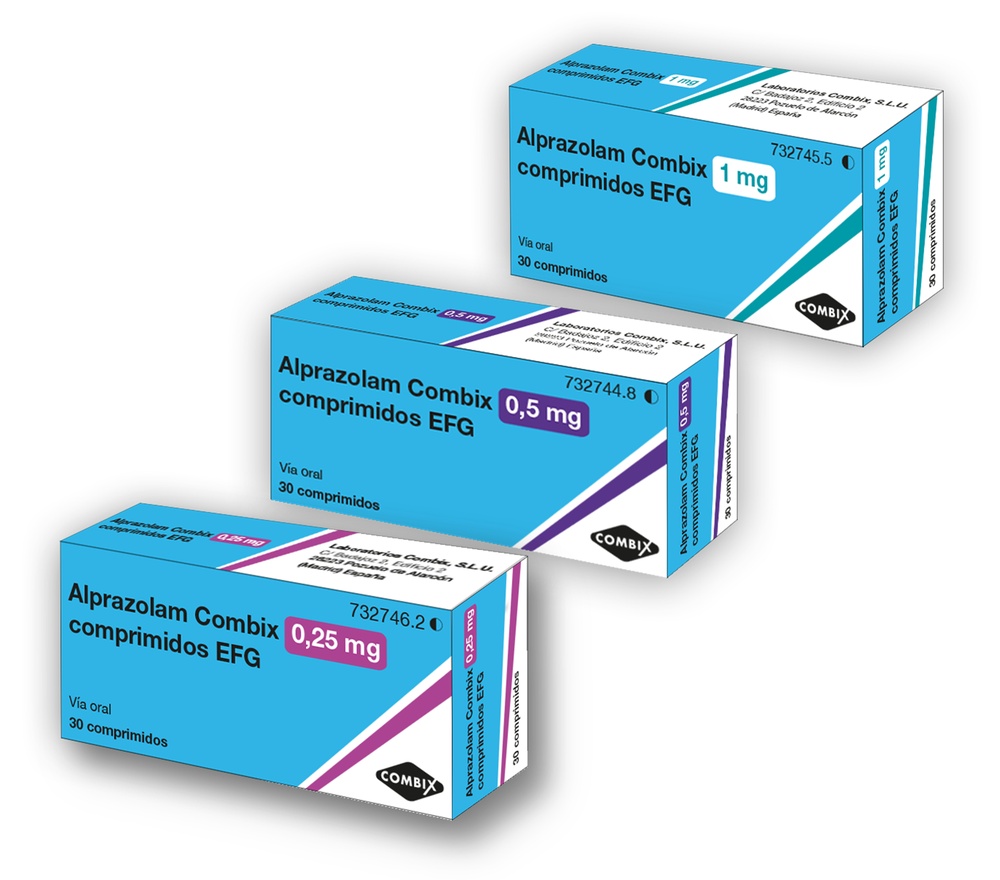
- País de registro
- Forma farmacéuticaCOMPRIMIDO, 0,25 mg
- Código ATCN05BA12
- Precio medio en farmacia1.64 EUR
- Principio activo
- Requiere recetaSí
- Fabricante
- ComposiciónDOCUSATO DE SODIO (0,85 mg mg), LACTOSA MONOHIDRATO (98,5 mg mg), LACTOSA MONOHIDRATO (0,45 mg mg), BENZOATO DE SODIO (E 211) (0,15 mg mg)
- Esta información es de carácter general y no sustituye la consulta con un profesional sanitario.
- Alternativas a ALPRAZOLAM COMBIX 0,25 MG COMPRIMIDOS EFGForma farmacéutica: COMPRIMIDO, 0,25 mgPrincipio activo: alprazolamFabricante: Laboratorios Alter S.A.Requiere recetaForma farmacéutica: COMPRIMIDO, 0,5 mgPrincipio activo: alprazolamFabricante: Laboratorios Alter S.A.Requiere recetaForma farmacéutica: COMPRIMIDO, 1 mgPrincipio activo: alprazolamFabricante: Laboratorios Alter S.A.Requiere receta
Médicos online para ALPRAZOLAM COMBIX 0,25 MG COMPRIMIDOS EFG
Comenta la dosis, los posibles efectos secundarios, interacciones, contraindicaciones o la revisión de receta de ALPRAZOLAM COMBIX 0,25 MG COMPRIMIDOS EFG, sujeto a valoración médica y a la normativa local.







Obtén una receta de ALPRAZOLAM COMBIX 0,25 MG COMPRIMIDOS EFG online
Rellena un formulario de 2 minutos
Cuéntanos tus síntomas, historial y el medicamento que necesitas.
Elige un médico o nosotros te asignamos uno
Escoge un especialista o te conectamos con el próximo médico disponible.
El médico revisa tu caso
Normalmente en 30 minutos. Puede hacerte preguntas adicionales por chat.
Recógela en cualquier farmacia
Receta electrónica enviada a tu correo, válida en toda España.
Preguntas frecuentes
ALPRAZOLAM COMBIX 0,25 MG COMPRIMIDOS EFG requiere receta en España. Puedes confirmarlo con un médico online según tu caso.
El principio activo de ALPRAZOLAM COMBIX 0,25 MG COMPRIMIDOS EFG es alprazolam. Esta información ayuda a identificar medicamentos con la misma composición pero con diferentes nombres comerciales.
El precio medio en farmacia de ALPRAZOLAM COMBIX 0,25 MG COMPRIMIDOS EFG es de aproximadamente 1.64 EUR. Puede variar según el fabricante y la forma farmacéutica.
ALPRAZOLAM COMBIX 0,25 MG COMPRIMIDOS EFG es fabricado por Laboratorios Combix S.L.U.. La marca y el envase pueden variar según el distribuidor.
Los Médicos de familia, Psiquiatras, Dermatólogos, Cardiólogos, Endocrinólogos, Gastroenterólogos, Neumólogos, Nefrólogos, Reumatólogos, Hematólogos, Infectólogos, Alergólogos, Geriatras, Pediatras, Oncólogos pueden valorar la prescripción de ALPRAZOLAM COMBIX 0,25 MG COMPRIMIDOS EFG cuando esté clínicamente indicado. Puedes reservar una videoconsulta para comentar tu caso y las opciones de tratamiento.
España cuenta con una infraestructura sanitaria bien desarrollada en ciudades principales como Madrid, Barcelona, Valencia y Sevilla. Las farmacias están ampliamente disponibles y operan bajo estrictas regulaciones, garantizando el acceso a medicamentos con receta.
Puedes comprar ALPRAZOLAM COMBIX 0,25 MG COMPRIMIDOS EFG en Madrid, Barcelona, Sevilla o Valencia en cualquier farmacia local con una receta válida.
Para obtener una receta, puedes utilizar Oladoctor:
Otros medicamentos con el mismo principio activo (alprazolam) incluyen ALPRAZOLAM ALTER 0,25 MG COMPRIMIDOS EFG, ALPRAZOLAM ALTER 0,50 MG COMPRIMIDOS EFG, ALPRAZOLAM ALTER 1 MG COMPRIMIDOS EFG. Pueden tener diferentes nombres comerciales o formulaciones, pero contienen el mismo componente terapéutico. Consulta siempre con un médico antes de cambiar o iniciar un nuevo medicamento.
