



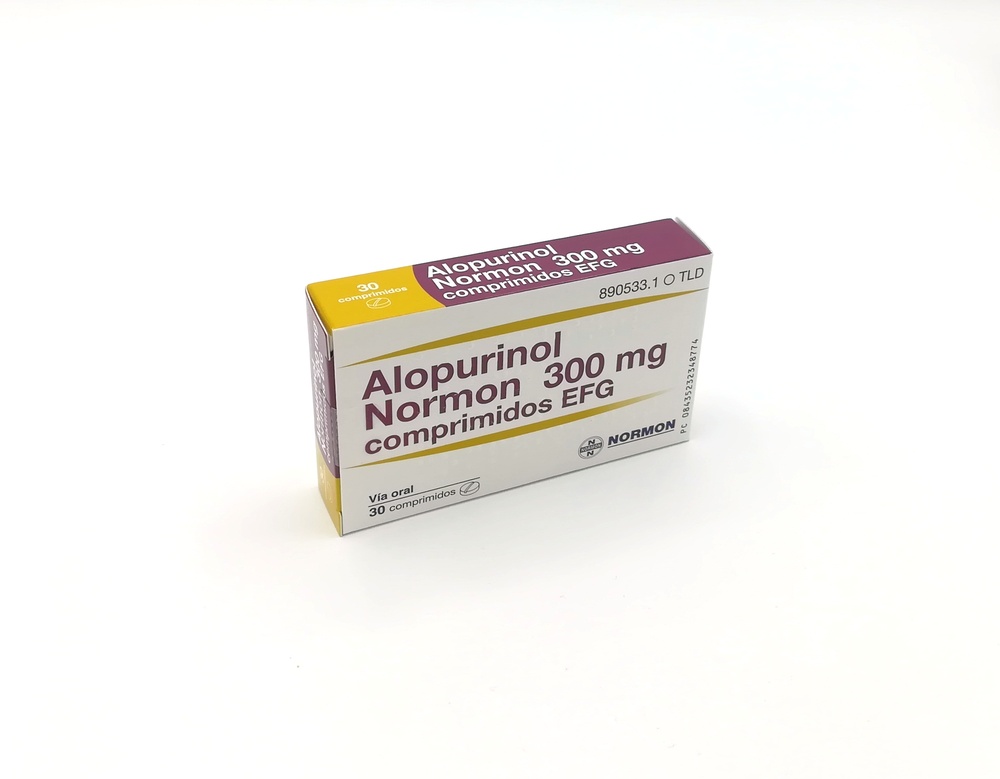
ALOPURINOL 300 mg Comprimidos

Revisión de receta online
Un médico revisará tu caso y determinará si la prescripción es médicamente apropiada.

Habla con un médico sobre este medicamento
Comenta tus síntomas y las opciones de tratamiento en una consulta online.



Cómo usar ALOPURINOL NORMON 300 mg COMPRIMIDOS EFG
Contenido del prospecto
- Introducción
- Qué es Alopurinol Normon y para qué se utiliza
- Qué necesita saber antes de empezar a tomar Alopurinol Normon
- Cómo tomar Alopurinol Normon
- Posibles efectos adversos
- Conservación de Alopurinol Normon
- Contenido del envase e información adicinal
Introducción
Prospecto: información para el usuario
Alopurinol Normon 300 mg comprimidos EFG
Lea todo el prospecto detenidamente antes de empezar a tomar el medicamento, porque contiene información importante para usted
- Conserve este prospecto ya que puede tener que volver a leerlo.
- Si tiene alguna duda, consulte a su médico o farmacéutico.
- Este medicamento se le ha recetado solamente a usted, y no debe dárselo a otras personas aunque tengan los mismos síntomas que usted, ya que puede perjudicarles.
- Si experimenta efectos adversos, consulte a su médico o farmacéutico, incluso si se trata de efectos adversos que no aparecen en este prospecto.
Contenido del prospecto:
- Qué es Alopurinol Normon y para qué se utiliza
- Qué necesita saber antes de empezar a tomar Alopurinol Normon
- Cómo tomar Alopurinol Normon
- Posibles efectos adversos
- Conservación de Alopurinol Normon
- Contenido del envase e información adicional
1. Qué es Alopurinol Normon y para qué se utiliza
Alopurinol pertenece a un grupo de medicamentos llamados inhibidores enzimáticos, que actúan controlando la velocidad a la que un determinado proceso químico ocurre en el cuerpo, en este caso lo que se produce es una disminución del nivel de ácido úrico en plasma y en orina.
Alopurinol se utiliza para prevenir la aparición de gota y otras situaciones producidas por el exceso de ácido úrico en el organismo, como por ejemplo piedras en el riñón y ciertos tipos de enfermedades renales o metabólicas.

¿No estás seguro de si este medicamento es adecuado para ti?
Comenta tus síntomas y tratamiento con un médico online.
2. Qué necesita saber antes de empezar a tomar Alopurinol Normon
Se han notificado reacciones cutáneas graves (síndrome de hipersensibilidad, síndrome de Stevens Johnson, necrólisis epidérmica tóxica) con el uso de alopurinol. Con frecuencia, la erupción puede incluir úlceras en la boca, la garganta, la nariz, los genitales y conjuntivitis (inflamación y enrojecimiento de los ojos). Estas erupciones cutáneas graves son a menudo precedidas por síntomas de gripe como fiebre, dolor de cabeza, dolor corporal. La erupción puede progresar a la formación de ampollas y descamación generalizada de la piel.
Estas reacciones graves de la piel pueden ser más frecuentes en personas de origen chino han, tailandés o coreano. Además padecer insuficiencia renal crónica puede aumentar el riesgo en estos pacientes. Si usted desarrolla una erupción cutánea o estos síntomas en la piel, deje de tomar alopurinol y consulte con el médico.
No tome Alopurinol Normon
- si es alérgico al alopurinol o a cualquiera de los demás componentes de este medicamento (incluidos en la sección 6).
Advertencias y precauciones
Consulte a su médico o farmacéutico antes de empezar a tomar Alopurinol Normon
- si usted padece un ataque agudo de gota.
- si usted está embarazada, cree que pudiera estarlo o está dando de mamar a su hijo.
- si usted padece o ha padecido alguna enfermedad de riñón o hígado.
- Si está usted tomando o va a comenzar a tomar algún medicamento para enfermedades del corazón o para la presión arterial alta.
- si nota que le salen moratones más fácilmente que antes o si le aparece dolor de garganta u otros signos de una infección.
- si aparece una erupción cutánea, descamación de la piel, ampollas, o llagas en los labios o en la boca, garganta, nariz, genitales y conjuntivitis (ojos hinchados y rojos), respiración sibilante (pitos), palpitaciones u opresión en el pecho, pérdida de conocimiento: ESTOS SÍNTOMAS PUEDEN SIGNIFICAR QUE USTED ES ALÉRGICO a alopurinol. Suspenda su tratamiento y contacte inmediatamente con su médico.
Las erupciones cutáneas que pueden amenazar la vida del paciente (síndrome de Stevens Johnson y necrólisis epidérmica tóxica) con el uso de alopurinol, inicialmente aparecen como puntos o manchas circulares rojizos, a menudo con una ampolla central.
El periodo de mayor riesgo de aparición de reacciones cutáneas graves es durante las primeras semanas de tratamiento.
Si usted desarrolla síndrome de Stevens Johnson o Necrólisis Epidérmica Tóxica con el uso de alopurinol,no debe utilizar alopurinol de nuevo en ningún momento.
Si no está seguro consulte a su médico.
Deberá suspender su tratamiento y contactar con su médico tan pronto como sea posible si, mientras usted está tomando alopurinol presenta alguno de los síntomas descritos a continuación:
- Fiebre alta.
- Dolor en las articulaciones o hinchazón dolorosa de las ingles, axilas o cuello.
- Ictericia (coloración amarilla de la piel y de los ojos).
- Náuseas o vómitos (que pueden ser con sangre).
- Sensación de malestar general.
- Debilidad, entumecimiento o pérdida de conciencia.
- Dolor de cabeza, somnolencia, mareos, alteraciones de la visión.
- Dolor en el tórax, presión sanguínea alta o enlentecimiento del pulso.
- Hinchazón (edemas) de los tobillos.
- Sensación de sed, cansancio y pérdida de peso.
- Aparición de forúnculos.
- Aparición de sangre en orina.
Es posible que al inicio del tratamiento con alopurinol se precipite un ataque agudo de gota. Su médico le recomendará el uso de ciertos medicamentos para evitarlo. En caso de que se produjera un ataque de gota, no es necesario suspender el tratamiento con alopurinol siempre que conjuntamente se utilice un medicamento antiinflamatorio adecuado.
Niños
El uso en niños está raramente indicado, excepto en algunos tipos de cáncer (especialmente leucemia) y algunas patologías enzimáticas como el síndrome Lesch-Nyhan.
Otros medicamentos y Alopurinol Normon
Informe a su médico o farmacéutico si está utilizando, o ha utilizado recientemente otros medicamentos, incluso los adquiridos sin receta.
Es especialmente importante que informe a su médico si está tomando alguno de los medicamentos que se enumeran más abajo. Es posible que su médico tenga que reducir la dosis de su medicamento o vigilarle más estrechamente debido a que hay un mayor riesgo de efectos secundarios cuando Alopurinol se toma al mismo tiempo que:
- 6-mercaptopurina (utilizado en el tratamiento de cáncer de la sangre).
- Azatioprina, ciclosporina (utilizados para inhibir el sistema inmunitario). Tenga en cuenta que los efectos adversos a ciclosporina pueden ocurrir con mayor frecuencia.
- Vidarabina (utilizado en el tratamiento del herpes). Tenga en cuenta que los efectos adversos a vidarabina pueden ocurrir con mayor frecuencia. Tenga especial precaución si esto le ocurre.
- Salicilatos (utilizados para reducir el dolor, la fiebre o la inflamación; p.ej. aspirina).
- Probenecid (utilizado para el tratamiento de la gota).
- Clorpropamida (utilizado para tratar la diabetes). Puede ser necesario reducir la dosis de clorpropamida, especialmente en pacientes con función renal reducida.
- Warfarina, fenprocumón, acenocumarol (anticoagulantes). Su médico vigilará con mayor frecuencia sus valores de los controles hematológicos y, en caso necesario, reducirá la dosis de estos medicamentos.
- Fenitoína (utilizado para tratar la epilepsia).
- Teofilina (utilizado para el tratamiento del asma y otras enfermedades respiratorias). Su médico medirá los niveles de teofilina en sangre, especialmente cuando comience el tratamiento con alopurinol, o siguiendo algún cambio de dosis.
- Ampicilina o amoxicilina (utilizado para tratar infecciones bacterianas). Cuando sea posible, los pacientes deben recibir otros antibióticos ya que es más probable que aparezcan reacciones alérgicas.
- Medicamentos para tratar tumores agresivos como:
- Ciclofosfamida
- Doxorubicina
- Bleomicina
- Procarbazina
- Mecloretamina
Su médico monitorizará sus controles hematológicos con frecuencia.
- Didanosina (utilizado para tratar la infección por VIH).
- Inhibidores de la ECA (por ejemplo captopril) o diuréticos (utilizados para tratar la presión arterial elevada). El riesgo de padecer reacciones cutáneas puede aumentar, especialmente en pacientes con limitaciones crónicas de la función renal.
Se debe evitar la administración de 6-mercaptopurina o azatioprina junto con alopurinol. Cuando 6-mercaptopurina o azatioprina se administran junto con Alopurinol Normon, se debe reducir la dosis de 6-mercaptopurina o azatioprina porque se prolongará su actividad. Esto podría aumentar el riesgo de trastornos sanguíneos graves. En este caso, su médico vigilará estrechamente su hemograma durante el tratamiento.
Acuda al médico inmediatamente si observa que tiene algún hematoma inexplicable, hemorragia, fiebre o dolor de garganta.
Si se toma hidróxido de aluminio de manera concomitante, alopurinol puede tener un efecto atenuado por lo que se debe dejar un intervalo de al menos 3 horas entre la toma de ambos medicamentos.
En la administración de alopurinol en combinación con citostáticos (p.ej. ciclofosfamida, doxorubicina, bleomicina, procarbacina, halogenuros de alquilo), las discrasias sanguíneas se producen con más frecuencia que cuando estos principios activos se administran solos.
Por lo tanto, se deben realizar controles hematológicos periódicos.
Embarazo lactancia y fertilidad:
No se recomienda el uso de alopurinol si está embarazada.
Alopurinol pasa a la leche materna. No se recomienda el uso de alopurinol durante el periodo de
lactancia.
Consulte a su médico o farmacéutico antes de utilizar cualquier medicamento.
Conducción y uso de máquinas:
Debido a sus efectos secundarios (somnolencia, mareos y afectación de la coordinación), Este medicamento puede perjudicar su capacidad de conducir vehículos.
No conduzca, no maneje herramientas o máquinas hasta que esté razonablemente seguro de que el medicamento no limita sus capacidades.
Alopurinol Normon contiene lactosa
Este medicamento contiene lactosa. Si su médico le ha indicado que padece una intolerancia a ciertos azúcares, consulte con él antes de tomar este medicamento.
3. Cómo tomar Alopurinol Normon
Siga exactamente las instrucciones de administración de este medicamento indicadas por su médico. Consulte a su médico o farmacéutico si tiene dudas.
Vía oral exclusivamente.
Trague el comprimido entero con la ayuda de un poco de agua. Se suele tomar una sola vez al día, generalmente después de la comida.
Por lo general, su médico iniciará el tratamiento con alopurinol a una dosis baja (p. ej., 100 mg/día), para reducir el riesgo de posibles efectos adversos. Su dosis se aumentará si fuera necesario.
La dosis recomendada es:
Adultos:
La dosis recomendada de inicio es de 100 a 300 mg. La dosis se puede aumentar hasta 900 mg al día, dependiendo de su caso. En este caso y si apareciesen molestias de estómago, es recomendable repartir la dosis en varias tomas al día y acompañarlas de alimentos.
Niños menores de 15 años:
La dosis recomendada de este medicamento en niños es de 100 a 400 mg diarios.
Edad avanzada
Su médico le recomendará la dosis más baja posible de alopurinol para conseguir reducir los niveles de ácido úrico y controlar sus síntomas.
Uso en pacientes con alteración de la función del hígado o del riñón:
Si usted tiene problemas del hígado o del riñón, su médico le recetará la dosis más baja posible de alopurinol que consiga reducir los niveles de ácido úrico y controlar sus síntomas. En caso de insuficiencia del riñón, su médico puede aconsejarle tomar menos de 100 mg por día o decirle que tome dosis únicas de 100 mg a intervalos mayores de un día. Si usted está en diálisis 2 ó 3 veces a la semana, su médico le puede prescribir una dosis de 300- 400 mg inmediatamente después de cada sesión de diálisis.
Si toma más Alopurinol Normon del que debe
En este caso consulte al Servicio de Información Toxicológica. Teléfono 91 562 04 20 o bien acuda a su médico.
En caso de ingestión accidental de mucho medicamento acuda a su médico sin tardanza o al servicio de urgencias del hospital más próximo. Lleve este prospecto con usted.
Si olvidó tomar Alopurinol Normon
En caso de que se le olvide tomar una dosis, vuelva a tomar la siguiente dosis tan pronto como se acuerde. Después, continúe de la forma que lo hacía habitualmente. No tome una dosis doble para compensar las dosis olvidadas.
Si olvida varias dosis, lo mejor es que contacte con su médico para que él decida que debe hacer usted a partir de ese momento.
Si interrumpe el tratamiento con Alopurinol Normon
Su médico le indicará la duración del tratamiento con alopurinol. No suspenda el tratamiento antes, aunque se encuentre mejor.
Si tiene cualquier otra duda sobre el uso de este medicamento, pregunte a su médico o farmacéutico.

¿Has empezado a tomar el medicamento y tienes preguntas?
Comenta tus síntomas y tratamiento con un médico online.
4. Posibles efectos adversos
Al igual que todos los medicamentos, este medicamento puede producir efectos adversos, aunque no todas las personas los sufran.
La probabilidad de que se produzcan es mayor cuando existen alteraciones del riñón y/o del hígado.
La frecuencia de los efectos adversos se clasifican en:
Muy frecuente (a menos 1 de cada 10 pacientes)
Frecuente (a menos 1 de cada 100 pacientes)
Poco frecuente (a menos 1 de cada 1.000 pacientes)
Raras (a menos 1 de cada 10.000 pacientes)
Muy raras (menos de 1 por cada 10.000 pacientes)
Frecuencia no conocida(no puede estimarse a partir de los datos disponibles)
Infecciones e infestaciones
Muy rara: Infección del folículo piloso.
Trastornos de la sangre y del sistema linfático
Muy raras:Disminución del número de glóbulos blancos leucopenia (aumenta el riesgo de infecciones), glóbulos rojos (puede producirle cansancio, fatiga), plaquetas (células que intervienen en la coagulación de la sangre, con aparición de moratones o sangrado, más fácilmente de lo habitual).
En ocasiones, los comprimidos de alopurinol pueden producir efectos sobre la sangre que se manifiestan con la aparición de hematomas más habituales de lo normal, dolor de garganta u otros signos de infección. Estos efectos suelen producirse en personas con problemas renales o hepáticos. Informe a su médico lo antes posible si tiene cualquiera de estos síntomas.
Trastornos del sistema inmunológico
Poco frecuente:Reacciones de hipersensibilidad (alergia: posible aparición de erupción cutánea, descamación de la piel, ampollas o llagas en los labios o en la boca).
Raras:Reacciones de hipersensibilidad graves, asociadas con exfoliación, fiebre, dolor en las articulaciones o hinchazón dolorosa de las ingles, axilas o cuello, ictericia (coloración amarilla de la piel y de los ojos), y otras alteraciones de la piel y de los tejidos subcutáneos (ver más adelante).
Muy raras:Linfadenopatía angioinmunoblástica (cursa con pérdida de peso, fiebre, inflamación en los gánglios de axilas, cuello, ingles) , reacción alérgica grave potencialmente mortal.
Muy raramente pueden producirse convulsiones, respiración sibilante (pitos), palpitaciones, opresión en el pecho o pérdida de conocimiento.
Trastornos del metabolismo y de la nutrición
Muy raras:Diabetes mellitus (niveles de de glucosa en sangre elevados), aumento de los niveles de lípidos en sangre, aumento de ácido úrico en sangre.
Trastornos psiquiátricos
Muy raras:Depresión.
Trastornos del sistema nervioso
Muy raras:Debilidad, entumecimiento o pérdida de la conciencia, parálisis, incoordinación motora (falta de coordinación de los movimientos) , alteración de la sensibilidad normal (neuropatía), somnolencia, dolor de cabeza, alteración en el gusto.
Frecuencia no conocida:Meningitis aséptica (inflamación de las membranas que rodean el cerebro y la médula espinal): los síntomas incluyen rigidez de cuello, dolor de cabeza, náuseas, fiebre u obnubilación de la conciencia. Si presenta cualquiera de estos síntomas busque atención médica urgente.
Trastornos oculares
Muy raras:Cataratas, alteraciones visuales.
Trastornos del oído y del laberinto
Muy raras:Vértigo.
Trastornos cardíacos
Muy raras:Dolor en el tórax o enlentecimiento del pulso.
Trastornos vasculares
Muy raras:Presión sanguínea alta.
Trastornos gastrointestinales
Poco frecuentes: Náuseas, vómitos, diarrea.
Muy raras: Aparición de sangre en los vómitos, exceso de grasa en las heces, infecciones de la boca, cambios en los hábitos intestinales.
Trastornos hepatobiliares
Poco frecuentes: Aumentos asintomáticos en las pruebas de funcionalidad del hígado.
Raras:Hepatitis
Trastornos de la piel y del tejido subcutáneo
Frecuentes:Erupción cutánea.
Muy raras:Ronchas, erupciones cutáneas de tipo medicamentoso que pueden amenazar la vida del paciente (síndrome de Stevens Johnson y necrólisis epidérmica tóxica) (ver sección 2), pérdida o decoloración del cabello, reacción alérgica grave que causa hinchazón de la cara o la garganta.
Frecuencia no conocida(no puede estimarse a partir de los datos disponibles): Erupción cutánea liquenoide (erupción cutánea rojiza-violácea con picor o líneas filiformes blanco-grisáceas en las mucosas).
Trastornos del riñón y urinarios
Muy raras: Aparición de sangre en la orina.
Trastornos del aparato reproductor y de la mama
Muy raras:Infertilidad masculina, impotencia, crecimiento de los pechos.
Trastornos generales y alteraciones en el lugar de administración
Muy raras:Hinchazón (edema) de los tobillos, malestar general, fatiga, fiebre.
Si usted experimenta alguno de los siguientes síntomas, deje de tomar el medicamento e informe a su médico inmediatamente:
Raros (afectan a menos de 1 de cada 1000 personas)
- Fiebre y escalofríos, dolor de cabeza, dolor muscular (síntomas de gripe) y malestar general.
- Cualquier cambio en su piel, por ejemplo úlceras en la boca, la garganta, la nariz, los genitales y conjuntivitis (inflamación y enrojecimiento de los ojos), ampollas o descamación generalizada.
- Reacciones de hipersensibilidad grave, con fiebre, erupción cutánea, dolor en las articulaciones, y alteraciones en la sangre y pruebas hepáticas (éstos pueden ser síntomas de trastorno de hipersensibilidad multiorgánico).
Exploraciones complementarias
FrecuentesValores elevados de la hormona estimulante del tiroides en sangre.
Se han comunicado casos de fiebre con o sin signos o síntomas evidentes de una hipersensibilidad generalizada a alopurinol (ver Trastornos del sistema inmunológico).
No se alarme por esta lista de reacciones adversas ya que es posible que en su caso no aparezca ninguna de ellas.
Comunicación de efectos adversos
Si experimenta cualquier tipo de efecto adverso consulte a su médico o farmacéutico, incluso si se trata de posibles efectos adversos que no aparecen en este prospecto. También puede comunicarlos directamente a través del Sistema Español de Farmacovigilancia de Medicamentos de Uso Humano: https://www.notificaRAM.es/. Mediante la comunicación de efectos adversos usted puede contribuir a proporcionar más información sobre la seguridad de este medicamento.
5. Conservación de Alopurinol Normon
Mantener este medicamento fuera de la vista y del alcance de los niños.
No requiere condiciones especiales de conservación.
No utilice este medicamento después de la fecha de caducidad que aparece en el envase después de “CAD”. La fecha de caducidad es el último día del mes que se indica.
No utilice este medicamento si observa indicios visibles de deterioro.
Los medicamentos no se deben tirar por los desagües ni a la basura. Deposite los envases y los medicamentos que no necesite en el Punto SIGRE de la farmacia. En caso de duda pregunte a su farmacéutico cómo deshacerse de los envases y de los medicamentos que no necesita. De esta forma ayudará a proteger el medio ambiente.
6. Contenido del envase e información adicinal
Composición de Alopurinol Normon
El principio activo es alopurinol. Cada comprimido contiene 300 mg de alopurinol.
Los demás componentes son: lactosa monohidrato, almidón de maíz, povidona y estearato de magnesio.
Aspecto de Alopurinol Normon y contenido del envase
Comprimidos de color blanco o ligeramente crema, redondos, biconvexos, ranurados y serigrafíados con A/L en una cara.
Se presenta en un envase conteniendo 30 comprimidos en blísteres PVC-Aluminio y un prospecto.
Titular de la autorización de comercialización y responsable de la fabricación
LABORATORIOS NORMON, S.A.
Ronda de Valdecarrizo, 6 – 28760
Tres Cantos- Madrid
España
Fecha de la última revisión de este prospecto: agosto2025
La información detallada de este medicamento está disponible en la página web de la Agencia Española de Medicamentos y Productos Sanitarios (AEMPS) http://www.aemps.gob.es/
Puede acceder a información detallada y actualizada sobre este medicamento escaneando con su teléfono móvil (smartphone) el código QR incluido en el prospecto y cartonaje. También puede acceder a esta información en la siguiente dirección de internet:
https://cima.aemps.es/cima/dochtml/p/63222/P_63222.html
- País de registro
- Forma farmacéuticaCOMPRIMIDO, 300 mg
- Código ATCM04AA01
- Precio medio en farmacia2.81 EUR
- Principio activo
- Requiere recetaSí
- Fabricante
- ComposiciónLACTOSA MONOHIDRATO (160,00 mg mg)
- Esta información es de carácter general y no sustituye la consulta con un profesional sanitario.
- Alternativas a ALOPURINOL NORMON 300 mg COMPRIMIDOS EFGForma farmacéutica: COMPRIMIDO, 100 mgPrincipio activo: alopurinolFabricante: Aurovitas Spain, S.A.U.Requiere recetaForma farmacéutica: COMPRIMIDO, 300 mgPrincipio activo: alopurinolFabricante: Aurovitas Spain, S.A.U.Requiere recetaForma farmacéutica: COMPRIMIDO, 100 mgPrincipio activo: alopurinolFabricante: Bluefish Pharmaceuticals Ab (Publ)Requiere receta
Médicos online para ALOPURINOL NORMON 300 mg COMPRIMIDOS EFG
Comenta la dosis, los posibles efectos secundarios, interacciones, contraindicaciones o la revisión de receta de ALOPURINOL NORMON 300 mg COMPRIMIDOS EFG, sujeto a valoración médica y a la normativa local.
Obtén una receta de ALOPURINOL NORMON 300 mg COMPRIMIDOS EFG online
Rellena un formulario de 2 minutos
Cuéntanos tus síntomas, historial y el medicamento que necesitas.
Elige un médico o nosotros te asignamos uno
Escoge un especialista o te conectamos con el próximo médico disponible.
El médico revisa tu caso
Normalmente en 30 minutos. Puede hacerte preguntas adicionales por chat.
Recógela en cualquier farmacia
Receta electrónica enviada a tu correo, válida en toda España.
Preguntas frecuentes
ALOPURINOL NORMON 300 mg COMPRIMIDOS EFG requiere receta en España. Puedes confirmarlo con un médico online según tu caso.
El principio activo de ALOPURINOL NORMON 300 mg COMPRIMIDOS EFG es alopurinol. Esta información ayuda a identificar medicamentos con la misma composición pero con diferentes nombres comerciales.
El precio medio en farmacia de ALOPURINOL NORMON 300 mg COMPRIMIDOS EFG es de aproximadamente 2.81 EUR. Puede variar según el fabricante y la forma farmacéutica.
ALOPURINOL NORMON 300 mg COMPRIMIDOS EFG es fabricado por Laboratorios Normon S.A.. La marca y el envase pueden variar según el distribuidor.
Los Médicos de familia, Psiquiatras, Dermatólogos, Cardiólogos, Endocrinólogos, Gastroenterólogos, Neumólogos, Nefrólogos, Reumatólogos, Hematólogos, Infectólogos, Alergólogos, Geriatras, Pediatras, Oncólogos pueden valorar la prescripción de ALOPURINOL NORMON 300 mg COMPRIMIDOS EFG cuando esté clínicamente indicado. Puedes reservar una videoconsulta para comentar tu caso y las opciones de tratamiento.
España cuenta con una infraestructura sanitaria bien desarrollada en ciudades principales como Madrid, Barcelona, Valencia y Sevilla. Las farmacias están ampliamente disponibles y operan bajo estrictas regulaciones, garantizando el acceso a medicamentos con receta.
Puedes comprar ALOPURINOL NORMON 300 mg COMPRIMIDOS EFG en Madrid, Barcelona, Sevilla o Valencia en cualquier farmacia local con una receta válida.
Para obtener una receta, puedes utilizar Oladoctor:
Otros medicamentos con el mismo principio activo (alopurinol) incluyen ALOPURINOL AUROVITAS 100 MG COMPRIMIDOS EFG, ALOPURINOL AUROVITAS 300 MG COMPRIMIDOS EFG, ALOPURINOL BLUEFISH 100 MG COMPRIMIDOS EFG. Pueden tener diferentes nombres comerciales o formulaciones, pero contienen el mismo componente terapéutico. Consulta siempre con un médico antes de cambiar o iniciar un nuevo medicamento.
