



AGNUCASTON 20 mg Film-Coated Tablets

Prescription review online
A doctor will review your case and decide whether a prescription is medically appropriate.

Talk to a doctor about this medicine
Discuss your symptoms and possible next steps in a quick online consultation.



How to use AGNUCASTON 20 mg FILM-COATED TABLETS
Contents of the leaflet
- Introduction
- What is Agnucaston and what is it used for
- What you need to know before taking Agnucaston
- How to take Agnucaston
- Possible side effects
- Storage of Agnucaston
- Package contents and additional information
Introduction
PATIENT INFORMATION LEAFLET
Agnucaston 20 mg coated tablets
Dry extract of Vitex agnus castus fruit
Read this leaflet carefully before you start taking this medicine because it contains important information for you.
Follow exactly the administration instructions of the medicine contained in this leaflet or as indicated by your doctor or pharmacist.
- Keep this leaflet, you may need to read it again.
- If you need advice or more information, consult your pharmacist.
- If you experience side effects, consult your doctor or pharmacist, even if they are not listed in this leaflet. See section 4.
- You should consult a doctor if your symptoms worsen or do not improve after 3 months.
Contents of the leaflet
- What is Agnucaston and what is it used for
- What you need to know before taking Agnucaston
- How to take Agnucaston
- Possible side effects
- Storage of Agnucaston
- Package contents and additional information
1. What is Agnucaston and what is it used for
Agnucaston is a herbal medicine for the treatment of premenstrual syndrome (monthly discomfort that occurs before regular menstrual bleeding) in adult women aged 18 years or older.

Not sure if this medicine is right for you?
Discuss your symptoms and treatment with a doctor online.
2. What you need to know before taking Agnucaston
Do not take Agnucaston
- if you are allergic to the active substance or to any of the other components of this medicine (listed in section 6).
Warnings and precautions
Consult your doctor before taking Agnucaston:
- if you have or have had an estrogen-dependent cancer.
- if you are using dopamine agonists (e.g., some medications used for Parkinson's disease), dopamine antagonists (some medications used to treat schizophrenia, bipolar disorders, nausea, or vomiting), estrogens (e.g., used for hormone replacement therapy), and/or anti-estrogens (e.g., some medications used to treat breast cancer).
- if you have had pituitary gland disorders.
Talk to your doctor if your symptoms worsen during treatment with Agnucaston.
If signs of an allergic reaction are observed, you should stop taking this medicine and contact your doctor immediately (see section 4).
Children and adolescents
There are no relevant reasons for the use of Agnucaston in prepubertal children. Use in pubertal and adolescent children under 18 years is not recommended due to the lack of adequate information.
Other medicines and Agnucaston
Interactions between Agnucaston and dopamine agonists (e.g., some medications used for Parkinson's disease), dopamine antagonists (some medications used to treat schizophrenia, bipolar disorders, nausea, or vomiting), estrogens (e.g., used for hormone replacement therapy), and/or anti-estrogens (e.g., some medications used to treat breast cancer) cannot be ruled out.
Inform your doctor or pharmacist if you are taking, have recently taken, or might take any other medicine. If you visit your doctor or any other healthcare professional, remember to inform them if you are taking or have recently taken any non-prescription medicine.
Pregnancy and breastfeeding
There are no reasons for the use of this medicine during pregnancy. Agnucaston is not recommended during pregnancy. Due to the lack of sufficient data on the use of Agnucaston during breastfeeding, its use is not recommended during breastfeeding.
If you are pregnant or breastfeeding, think you might be pregnant, or plan to become pregnant, consult your doctor or pharmacist before using this medicine.
Driving and using machines
No studies have been conducted on the effects on the ability to drive and use machines. To date, there is no evidence that the ability to drive and use machines is impaired by the use of Agnucaston. However, the ability to drive and use machines may be impaired in patients who experience dizziness.
Agnucaston contains lactose
If your doctor has told you that you have an intolerance to certain sugars, consult them before taking this medicine.
Agnucaston contains sodium
This medicine contains less than 23 mg of sodium (1 mmol) per coated tablet; it is essentially "sodium-free".
3. How to take Agnucaston
Follow exactly the administration instructions of this medicine contained in this leaflet or as indicated by your doctor or pharmacist. In case of doubt, consult your doctor or pharmacist again.
The recommended dose for adult women over 18 years is 1 coated tablet once a day.
Method of administration
For oral use: Swallow the coated tablets with a sufficient amount of liquid (e.g., a glass of water). Do not chew the tablets.
To achieve an optimal effect with the treatment, continuous use for more than 3 months (even during menstruation) is recommended.
If symptoms persist after continuous use for more than three months, consult a doctor, pharmacist, or qualified healthcare professional.
Pediatric population
There are no relevant reasons for the use of Agnucaston in prepubertal children. Use in pubertal and adolescent children under 18 years is not recommended due to the lack of adequate information (see section 2).
Special populations
No data are available on dosage administration instructions for patients with hepatic or renal impairment. Talk to your doctor before taking Agnucaston in case of renal or hepatic dysfunction.
If you take more Agnucaston than you should
If you have taken more Agnucaston than you should, or if a child has taken this medicine by accident, please contact your doctor or hospital for further instructions.
If you forget to take Agnucaston
Do not take a double dose to make up for forgotten doses.

Started taking the medicine and have questions?
Discuss your symptoms and treatment with a doctor online.
4. Possible side effects
Like all medicines, this medicine can cause side effects, although not everybody gets them.
There is a risk of serious allergic reactions such as facial swelling, dyspnea (difficulty breathing), and difficulty swallowing. If you experience any signs of an allergic reaction, stop treatment with Agnucaston and contact your doctor immediately (see section 2).
Other side effects that may occur
(Allergy) skin reactions (such as rash and urticaria), acne, headache, dizziness, gastrointestinal disorders (such as nausea, abdominal pain), menstrual disorders.
The frequency of these side effects is unknown (the frequency cannot be estimated from the available data).
If you experience any other side effects not mentioned above, consult a doctor or pharmacist.
Reporting side effects
If you experience any side effects, consult your doctor or pharmacist, even if they are not listed in this leaflet. You can also report them directly through the Spanish Medicines Agency's online platform: www.notificaRAM.es. By reporting side effects, you can help provide more information on the safety of this medicine.
5. Storage of Agnucaston
Keep this medicine out of the sight and reach of children.
This medicine does not require any special storage conditions.
Do not use this medicine after the expiry date stated on the packaging after EXP. The expiry date is the last day of the month indicated.
6. Package contents and additional information
Composition of Agnucaston
- One coated tablet contains 20 mg of extract (as dry extract) of Vitex agnus castusL., fructus (Agnus castus fruit) (7-11:1). Extraction solvent: ethanol 70% (v/v).
- The other components are: Povidone 30, Silica, colloidal anhydrous, Potato starch, Lactose monohydrate, Microcrystalline cellulose, Sodium croscarmellose, Vegetable magnesium stearate, Opadry amb II (which consists of polyvinyl alcohol, talc, titanium dioxide (E171), glycerol monocaprylocaprate, and sodium lauryl sulfate.
Appearance of Agnucaston and package contents
Packages with 30 coated tablets
Packages with 60 coated tablets
Packages with 90 coated tablets
Not all pack sizes may be marketed.
The Agnucaston coated tablet is white-gray, round, biconvex, and has a smooth surface. The tablet has a diameter of 9.0 - 9.2 mm.
Marketing authorization holder and manufacturer
BIONORICA SE
Kerschensteinerstraße 11-15
92318 Neumarkt
Germany
Tel 09181 / 231-90
Fax 09181 / 231-265
This medicine has been authorized in the EEA member states with the following names:
Austria Agnucaston forte Filmtabletten
Bulgaria, Denmark Cyclodynon forte
Croatia, France, Poland, Slovenia, Sweden Cyclodynon
Czech Republic Agnucaston pro ženy
Estonia Agnucaston intens
Germany, Luxembourg Agnucaston 20 mg
Hungary Agnucaston Forte 20 mg filmtabletta
Italy Agnucaston
Latvia Agnucaston 20 mg apvalkotas tabletes
Lithuania Agnucaston intens plévele dengtos tabletés
Romania Cyclodynon comprimate filmate
Slovakia Agnucaston forte
Spain Agnucaston 20 mg coated tablets
Date of the last revision of this leaflet: August 2021.
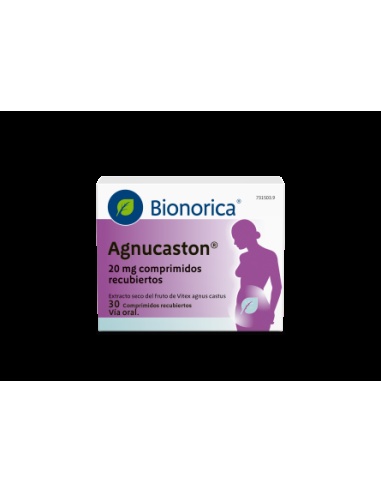
- Country of registration
- Dosage formTABLET, 20 mg
- ATC codeG02CX03
- Active substance
- Prescription requiredNo
- Manufacturer
- CompositionCROSCARMELOSA SODICA (3 mg mg), LACTOSA MONOHIDRATO (50 mg mg), GLICEROL, MONOCAPRILOCAPRATO DE (0,61 mg mg), LAURILSULFATO DE SODIO (0,45 mg mg)
- This information is for reference only and does not constitute medical advice. Always consult a doctor before taking any medication. Oladoctor is not responsible for medical decisions based on this content.
- Alternatives to AGNUCASTON 20 mg FILM-COATED TABLETSDosage form: CAPSULE, 4 mgActive substance: Agni casti fructusManufacturer: Kern Pharma S.L.Prescription not requiredDosage form: INJECTABLE PERFUSION, 7.5 mg/mlActive substance: atosibanManufacturer: Altan Pharmaceuticals SaPrescription requiredDosage form: INJECTABLE, 7.5 mg/mlActive substance: atosibanManufacturer: Altan Pharmaceuticals SaPrescription required
Online doctors for AGNUCASTON 20 mg FILM-COATED TABLETS
Discuss questions about AGNUCASTON 20 mg FILM-COATED TABLETS, including use, safety considerations and prescription review, subject to medical assessment and local regulations.
Get AGNUCASTON 20 mg FILM-COATED TABLETS Prescription Online
Fill in a 2-min form
Tell us your symptoms, history, and what medicine you're requesting.
Pick a doctor or let us assign
Choose a specialist or we'll match you with the next available doctor.
Doctor reviews your case
Usually within 30 minutes. They may ask follow-up questions via chat.
Collect from any pharmacy
Electronic prescription sent to your email — valid across Spain.
Frequently Asked Questions
AGNUCASTON 20 mg FILM-COATED TABLETS does not require a prescription in Spain. You can check with a doctor online whether this medicine may be appropriate for your situation.
The active ingredient in AGNUCASTON 20 mg FILM-COATED TABLETS is Agni casti fructus. This information helps identify medicines with the same composition but different brand names.
AGNUCASTON 20 mg FILM-COATED TABLETS is manufactured by Bionorica Se. Pharmacy brands and packaging may differ depending on the distributor.
Doctors such as Family doctors, Psychiatrists, Dermatologists, Cardiologists, Endocrinologists, Gastroenterologists, Pulmonologists, Nephrologists, Rheumatologists, Hematologists, Infectious disease physicians, Allergists, Geriatricians, Paediatricians, Oncologists may assess whether AGNUCASTON 20 mg FILM-COATED TABLETS is appropriate, depending on your situation and local regulations. You can book an online consultation to discuss your symptoms and possible next steps.
Spain has a well-developed healthcare infrastructure across major cities such as Madrid, Barcelona, Valencia, and Seville. Pharmacies are widely available and operate under strict regulations, ensuring access to prescribed medications.
You can buy AGNUCASTON 20 mg FILM-COATED TABLETS in Madrid, Barcelona, Seville, or Valencia at any local pharmacy with a valid prescription.
To obtain a prescription, you can use Oladoctor:
Other medicines with the same active substance (Agni casti fructus) include DISMEGYN CAPSULES, ATOSIBAN ALTAN 37.5 mg/5 ml CONCENTRATE FOR INFUSION SOLUTION, ATOSIBAN ALTAN 6.75 mg/0.9 mL Injectable Solution. These may have different brand names or formulations but contain the same therapeutic ingredient. Always consult a doctor before switching or starting a new medicine.
