


Ácido Quenodesoxicólico Leadiant 250 mg cápsulas duras

Revisión de receta online
Un médico revisará tu caso y determinará si la prescripción es médicamente apropiada.

Habla con un médico sobre este medicamento
Comenta tus síntomas y las opciones de tratamiento en una consulta online.



Cómo usar ÁCIDO QUENODESOXICÓLICO LEADIANT 250 MG CÁPSULAS DURAS
Contenido del prospecto
- Introducción
- Qué es Ácido quenodesoxicólico Leadiant y para qué se utiliza
- Qué necesita saber antes de empezar a tomar Ácido quenodesoxicólico Leadiant
- Cómo tomar Ácido quenodesoxicólico Leadiant
- Posibles efectos adversos
- Conservación de Ácido quenodesoxicólico Leadiant
- Contenido del envase e información adicional
Introducción
Prospecto: Información para el usuario
Ácido quenodesoxicólico Leadiant 250 mg cápsulas duras
Ácido quenodesoxicólico
Este medicamento está sujeto a seguimiento adicional, lo que agilizará la detección de nueva información sobre su seguridad. Puede contribuir comunicando los efectos adversos que pudiera usted tener. La parte final de la sección 4 incluye información sobre cómo comunicar estos efectos adversos.
Lea todo el prospecto detenidamente antes de empezar a tomar este medicamento, porque
contiene información importante para usted.
- Conserve este prospecto, ya que puede tener que volver a leerlo.
- Si tiene alguna duda, consulte a su médico o farmacéutico.
- Este medicamento se le ha recetado solamente a usted, y no debe dárselo a otras personas aunque tengan los mismos síntomas que usted, ya que puede perjudicarles.
- Si experimenta efectos adversos, consulte a su médico o farmacéutico, incluso si se trata de efectos adversos que no aparecen en este prospecto. Ver sección 4.
Contenido del prospecto
- Qué es Ácido quenodesoxicólico Leadiant y para qué se utiliza
- Qué necesita saber antes de empezar a tomar Ácido quenodesoxicólico Leadiant
- Cómo tomar Ácido quenodesoxicólico Leadiant
- Posibles efectos adversos
- Conservación de Ácido quenodesoxicólico Leadiant
- Contenido del envase e información adicional
1. Qué es Ácido quenodesoxicólico Leadiant y para qué se utiliza
Las cápsulas de Ácido quenodesoxicólico Leadiant contienen una sustancia denominada ácido quenodesoxicólico. Esta sustancia se produce normalmente en el hígado, a partir del colesterol. Forma parte de la bilis, un líquido que ayuda a digerir las grasas y las vitaminas de los alimentos. Los pacientes que padecen una enfermedad rara denominada xantomatosis cerebrotendinosa (XCT) no pueden producir ácido quenodesoxicólico, lo que causa una acumulación de depósitos de ácidos grasos en varias partes del organismo. Esta acumulación puede causar daños en las zonas afectadas.
Las cápsulas de Ácido quenodesoxicólico Leadiant tratan la XCT reponiendo el ácido quenodesoxicólico, evitando por tanto la acumulación de depósitos de ácidos grasos.
Las cápsulas de Ácido quenodesoxicólico Leadiant se pueden usar a partir del primer mes de vida y los pacientes con XCT requieren tratamiento durante el resto de su vida.

¿No estás seguro de si este medicamento es adecuado para ti?
Comenta tus síntomas y tratamiento con un médico online.
2. Qué necesita saber antes de empezar a tomar Ácido quenodesoxicólico Leadiant
No tome Ácido quenodesoxicólico Leadiant
- si es alérgico al ácido quenodesoxicólico o a alguno de los demás componentes de este medicamento (incluidos en la sección 6).
Advertencias y precauciones
Ácido quenodesoxicólico Leadiant se debe usar bajo supervisión médica. Durante el tratamiento, su médico le hará análisis de sangre y orina para vigilar su respuesta a este medicamento y para ajustar la dosis si fuera necesario. Su médico le avisará si hubiera alguna razón por la que tuviera que suspender el tratamiento con Ácido quenodesoxicólico Leadiant.
Lactantes
No se ha estudiado la seguridad y la eficacia de Ácido quenodesoxicólico Leadiant en lactantes de menos de un mes de edad.
Toma de Ácido quenodesoxicólico Leadiant con otros medicamentos
Informe a su médico o farmacéutico si está tomando, ha tomado recientemente o pudiera tener que tomar cualquier otro medicamento.
Los siguientes medicamentos pueden afectar a los niveles de Ácido quenodesoxicólico Leadiant:
- ciclosporina y sirolimus (medicamentos utilizados para inhibir el sistema inmunitario)
- fenobarbital (un medicamento para la epilepsia)
Si su médico considera necesario que tome ciclosporina, sirolimus o fenobarbital, le harán un seguimiento estrecho de los resultados de los análisis de sangre y orina, y ajustarán la dosis de Ácido quenodesoxicólico Leadiant si fuera necesario.
Los anticonceptivos orales pueden influir en el funcionamiento de Ácido quenodesoxicólico Leadiant haciéndolo menos eficaz. No se recomienda tomar anticonceptivos orales durante el tratamiento con Ácido quenodesoxicólico Leadiant. Consulte con su médico sobre otros métodos anticonceptivos adecuados.
Los siguientes medicamentos pueden reducir el efecto de Ácido quenodesoxicólico Leadiant :
- colestiramina, colestipol (denominados secuestradores de ácidos biliares)
- los medicamentos para tratar el ardor de estómago (antiácidos) que contienen hidróxido de aluminio y/o esmectita (óxido de aluminio)
En caso de tener que tomar colestiramina, tome Ácido quenodesoxicólico Leadiant una hora antes de la colestiramina o entre 4 y 6 horas después.
Los demás medicamentos citados se deben tomar 2 horas antes o 2 horas después de tomar Ácido quenodesoxicólico Leadiant.
Consulte con su médico si está tomando alguno de estos medicamentos.
Embarazo y lactancia
Si está embarazada o en periodo de lactancia, cree que podría estar embarazada o tiene intención de quedarse embarazada, consulte a su médico o farmacéutico antes de utilizar este medicamento.
No se recomienda tomar Ácido quenodesoxicólico Leadiant durante el embarazo y la lactancia. No se sabe si Ácido quenodesoxicólico Leadiant pasa a la leche materna.
Las mujeres deben usar un método anticonceptivo eficaz mientras estén en tratamiento con Ácido quenodesoxicólico Leadiant. No se recomiendan los anticonceptivos orales. Consulte con su médico sobre otros métodos anticonceptivos adecuados.
Conducción y uso de máquinas
No se prevé que Ácido quenodesoxicólico Leadiant afecte a su capacidad para conducir o usar máquinas.
3. Cómo tomar Ácido quenodesoxicólico Leadiant
Siga exactamente las instrucciones de administración de este medicamento indicadas por su médico.
En caso de duda, consulte de nuevo a su médico. La dosis inicial habitual es de una cápsula de 250 mg tres veces al día.
La dosis máxima es de una cápsula de 250 mg tres veces al día. La dosis máxima es de una cápsula de 250 mg cuatro veces al día. Las cápsulas deben tomarse enteras y con agua, aproximadamente a la misma hora todos los días. Las cápsulas se pueden tomar con o sin alimentos. El médico puede decidir aumentarle la dosis dependiendo de cómo su organismo responda al tratamiento. El médico le indicará cuántas cápsulas necesita tomar y cuándo debe tomarlas.
Uso en niños y adolescentes (de un mes a 18 años)
En lactantes y niños la dosis se debe calcular en función del peso. La dosis inicial será de 5 mg por kg al día. La dosis máxima para niños es de 15 mg por kg al día. El médico decidirá el número y la frecuencia de las tomas para cubrir la dosis total diaria del niño. El médico puede decidir cambiar la dosis dependiendo de cómo el organismo del niño responda al tratamiento.
Para lactantes, niños y adultos que no puedan tragar cápsulas y/o necesiten tomar una dosis de menos de 250 mg, estas se pueden abrir y mezclar con una solución de bicarbonato de sodio al 8,4 %. El principio activo se disuelve en la solución de bicarbonato de sodio pero no todos los componentes de la cápsula son solubles por lo que aparecerá como una mezcla. Esta mezcla la realizarán en la farmacia. El médico o el farmacéutico le darán instrucciones sobre la cantidad y la frecuencia con la que debe administrar la mezcla al niño.
Si toma más Ácido quenodesoxicólico Leadiant del que debe
Ácido quenodesoxicólico Leadiant tiene muy baja probabilidad de causar efectos adversos graves. Si usted, o el niño, ha tomado más cantidad de la prescrita, póngase en contacto con su médico.
Si olvidó tomar Ácido quenodesoxicólico Leadiant
Tómese la siguiente dosis a la hora habitual. No tome una dosis doble para compensar las dosis olvidadas.
Si interrumpe el tratamiento con Ácido quenodesoxicólico Leadiant
Este medicamento es para uso a largo plazo. No deje de tomar Ácido quenodesoxicólico Leadiant sin consultar primero con el médico. Si deja de tomar este medicamento sus síntomas podrían empeorar.
Si tiene cualquier otra duda sobre el uso de este medicamento, pregunte a su médico o farmacéutico.

¿Has empezado a tomar el medicamento y tienes preguntas?
Comenta tus síntomas y tratamiento con un médico online.
4. Posibles efectos adversos
Al igual que todos los medicamentos, este medicamento puede producir efectos adversos, aunque no todas las personas los sufran.
Reacciones adversas de frecuencia no conocida (no puede estimarse a partir de los datos disponibles)
- Estreñimiento
- Valores anómalos en los análisis de la actividad hepática
Comunicación de efectos adversos
Si experimenta efectos adversos, consulte a su médico o farmacéutico, incluso si se trata de efectos adversos que no aparecen en este prospecto. También puede comunicarlos directamente a través del sistema nacional de notificación incluido en el Apéndice V. Mediante la comunicación de efectos adversos usted puede contribuir a proporcionar más información sobre la seguridad de este medicamento.
5. Conservación de Ácido quenodesoxicólico Leadiant
Mantener este medicamento fuera de la vista y del alcance de los niños.
No utilice este medicamento después de la fecha de caducidad que aparece en la caja y en los blísters después de “CAD”. La fecha de caducidad es el último día del mes que se indica.
Los medicamentos no se deben tirar por los desagües ni a la basura. Pregunte a su farmacéutico cómo deshacerse de los envases y de los medicamentos que ya no necesita. De esta forma, ayudará a proteger el medio ambiente.
6. Contenido del envase e información adicional
- Qué contiene Ácido quenodesoxicólico Leadiant
- El principio activo es ácido quenodesoxicólico.
- Cada cápsula contiene 250 mg de ácido quenodesoxicólico.
- Los demás componentes son:
Cada cápsula contiene: almidón de maíz, estearato de magnesio, sílice coloidal anhidra, agua Cubierta de la cápsula: gelatina, dióxido de titanio (E 171), amarillo de quinoleína (E 104), eritrosina (E 127)
Aspecto del producto y contenido del envase
Ácido quenodesoxicólico Leadiant se presenta en cápsulas duras. Las cápsulas están formadas por un cuerpo amarillo y una tapa naranja que contiene un polvo blanco comprimido.
Ácido quenodesoxicólico Leadiant está disponible en blísters que contienen 100 cápsulas duras.
Titular de la autorización de comercialización
Leadiant GmbH
Liebherrstr. 22
80538 Munich
Alemania
Correo electrónico: [email protected]
Fabricante
Pharmaloop S.L.
C/Bolivia, no 15 Polígono Industrial Azque
Alcalá de Henares
Madrid 28806
España
Fecha de la última revisión de este prospecto: <{MM/AAAA}>.
Otras fuentes de información
La información detallada de este medicamento está disponible en la página web de la Agencia Europea de Medicamentos: http://www.ema.europa.eu. También existen enlaces a otras páginas web sobre enfermedades raras y medicamentos huérfanos.
--------------------------------------------------------------------------------------------------------------------
Información para profesionales sanitarios
Pacientes que no pueden tragar las cápsulas
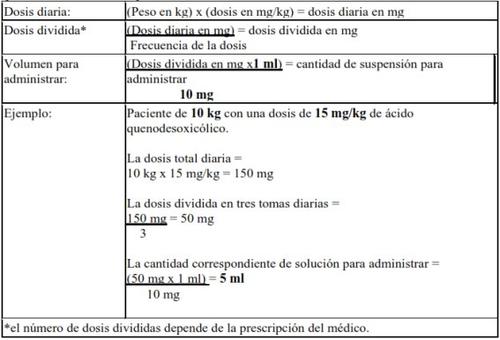
Para los niños, adolescentes y adultos que no pueden tragar las cápsulas, o que necesitan tomar dosis inferiores a 250 mg, estas se pueden abrir para añadir su contenido a 25 ml de bicarbonato de sodio (solución al 8,4 %, 1 mmol/ml) para producir una suspensión que contiene 10 mg/ml de ácido quenodesoxicólico.
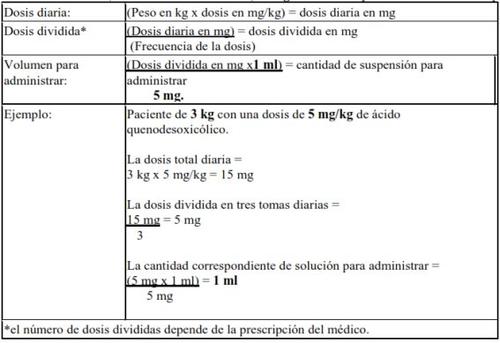
Para lactantes: las cápsulas se pueden abrir para añadir su contenido a 50 ml de bicarbonato de sodio (solución al 8,4 %, 1 mmol/ml) para producir una suspensión que contiene 5 mg/ml de ácido quenodesoxicólico.
Remueva la mezcla hasta que todo el polvo quede en suspensión. Asegúrese de introducir dentro del vaso de mezcla todo el polvo que haya quedado en los bordes y remueva el contenido (durante unos 5 minutos) hasta que la mezcla quede homogénea sin residuos de polvo visibles. La mezcla estará lista cuando no queden residuos de polvo visibles.
La suspensión resultante contiene 22,9 mg de sodio por ml, lo que se debe tener en cuenta en pacientes con dietas bajas en sodio.
La suspensión se forma fácilmente y está lista cuando no queden residuos de polvo visibles. Se recomienda que esta suspensión se prepare en la farmacia y que se proporcione las instrucciones a los padres sobre la forma de administrarla.
La suspensión debe conservarse en un envase de cristal. No refrigerar ni congelar. La suspensión permanece estable durante un máximo de 7 días.
En la farmacia le podrán suministran jeringas para la dosificación oral del volumen y graduación adecuados para administrar la suspensión. Es preferible que las jeringas para administración oral lleven marcados los volúmenes correctos.
En el recipiente debe colocarse una etiqueta de la farmacia que incluya el nombre del paciente, las instrucciones para las dosis, la fecha de caducidad, el nombre del medicamento y cualquier otra información requerida por la normativa local de las farmacias.
El médico debe proporcionar información sobre la dosis que se debe administrar al niño basándose en su peso. El intervalo de dosis en niños es de 5-15 mg/kg al día.
Cálculo de la dosis (niños de 1 a 12 años, adolescentes de 12 a 18 años y adultos):10 mg/mlde ácido quenodesoxicólico en suspensión
Cálculo de la dosis (lactantes de 1 mes a 1 año):5 mg/mlde ácido quenodesoxicólico en suspensión
- País de registro
- Forma farmacéuticaCAPSULA, 250 mg
- Código ATCA05AA01
- Principio activo
- Requiere recetaSí
- Fabricante
- Esta información es de carácter general y no sustituye la consulta con un profesional sanitario.
- Alternativas a ÁCIDO QUENODESOXICÓLICO LEADIANT 250 MG CÁPSULAS DURASForma farmacéutica: CAPSULA, 250 mgPrincipio activo: ácido ursodesoxicólicoFabricante: Grindeks AsRequiere recetaForma farmacéutica: COMPRIMIDO, 150 mgPrincipio activo: ácido ursodesoxicólicoFabricante: Glenmark Arzneimittel GmbhRequiere recetaForma farmacéutica: CAPSULA, 250 MGPrincipio activo: ácido ursodesoxicólicoFabricante: Glenmark Arzneimittel GmbhRequiere receta
Médicos online para ÁCIDO QUENODESOXICÓLICO LEADIANT 250 MG CÁPSULAS DURAS
Comenta la dosis, los posibles efectos secundarios, interacciones, contraindicaciones o la revisión de receta de ÁCIDO QUENODESOXICÓLICO LEADIANT 250 MG CÁPSULAS DURAS, sujeto a valoración médica y a la normativa local.









Preguntas frecuentes
ÁCIDO QUENODESOXICÓLICO LEADIANT 250 MG CÁPSULAS DURAS requiere receta en España. Puedes confirmarlo con un médico online según tu caso.
El principio activo de ÁCIDO QUENODESOXICÓLICO LEADIANT 250 MG CÁPSULAS DURAS es chenodeoxycholic acid. Esta información ayuda a identificar medicamentos con la misma composición pero con diferentes nombres comerciales.
ÁCIDO QUENODESOXICÓLICO LEADIANT 250 MG CÁPSULAS DURAS es fabricado por Leadiant Gmbh. La marca y el envase pueden variar según el distribuidor.
Los Médicos de familia, Psiquiatras, Dermatólogos, Cardiólogos, Endocrinólogos, Gastroenterólogos, Neumólogos, Nefrólogos, Reumatólogos, Hematólogos, Infectólogos, Alergólogos, Geriatras, Pediatras, Oncólogos pueden valorar la prescripción de ÁCIDO QUENODESOXICÓLICO LEADIANT 250 MG CÁPSULAS DURAS cuando esté clínicamente indicado. Puedes reservar una videoconsulta para comentar tu caso y las opciones de tratamiento.
La receta la emite un médico tras valorar tu estado de salud. En España, ÁCIDO QUENODESOXICÓLICO LEADIANT 250 MG CÁPSULAS DURAS se dispensa en las farmacias con esa receta médica. Una consulta online no garantiza su emisión: la decisión corresponde siempre al médico.
Para solicitar una valoración puedes usar Oladoctor:
Otros medicamentos con el mismo principio activo (chenodeoxycholic acid) incluyen ACIDO URSODESOXICOLICO GRINDEKS 250 MG CAPSULAS DURAS EFG, ADISOCOL 150 MG COMPRIMIDOS EFG, ADISOCOL 250 MG CAPSULAS DURAS EFG. Pueden tener diferentes nombres comerciales o formulaciones, pero contienen el mismo componente terapéutico. Consulta siempre con un médico antes de cambiar o iniciar un nuevo medicamento.
