


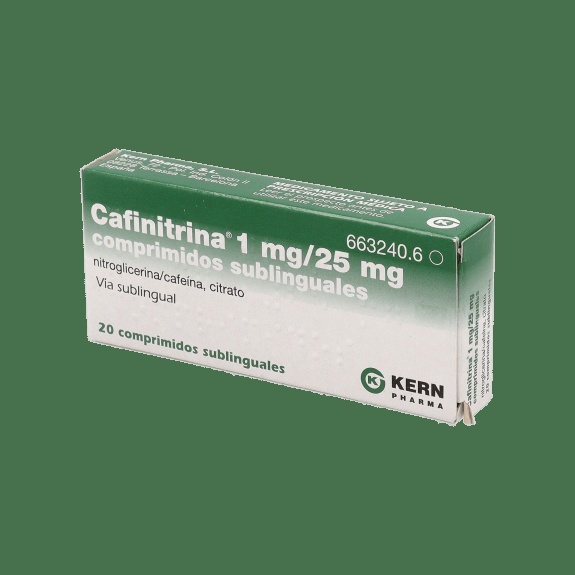
CAFINITRINA 1 MG/25 MG COMPRIMIDOS SUBLINGUALES



Cómo usar CAFINITRINA 1 MG/25 MG COMPRIMIDOS SUBLINGUALES
Traducción generada por IA
Este contenido ha sido traducido automáticamente y se ofrece solo con fines informativos. No sustituye la consulta con un profesional sanitario.
Ver originalContenido del prospecto
Introducción
Prospecto: Información para el paciente

Cafinitrina 1 mg/25 mg comprimidos sublinguales
nitroglicerina/citrato de cafeína
Lea todo el prospecto detenidamente antes de empezar a tomar este medicamento, porque contiene información importante para usted.
- Conserve este prospecto, ya que puede tener que volver a leerlo.
- Si tiene alguna duda, consulte a su médico o farmacéutico.
- Este medicamento se le ha recetado solamente a usted, y no debe dárselo a otras personas aunque tengan los mismos síntomas que usted, ya que puede perjudicarles.
- Si experimenta efectos adversos, consulte a su médico o farmacéutico, incluso si se trata de efectos adversos que no aparecen en este prospecto. Ver sección 4.
Contenido del prospecto:
- Qué es Cafinitrina y para qué se utiliza
- Qué necesita saber antes de empezar a tomar Cafinitrina
- Cómo tomar Cafinitrina
- Posibles efectos adversos
- Conservación de Cafinitrina
- Contenido del envase e información adicional
1. Qué es Cafinitrina y para qué se utiliza
Cafinitrina pertenece al grupo de medicamentos denominados vasodilatadores usados en enfermedades cardíacas, que aumentan el flujo de la sangre que llega al corazón y mejoran el rendimiento del mismo cuando hay menor riego en las arterias coronarias (arterias que llevan sangre al corazón).
Cafinitrina se administra debajo de la lengua para:
- Tratar de urgencia los ataques agudos de angina de pecho, que consisten en la aparición brusca de dolor u opresión en el pecho, aunque puede sentirse en el cuello o en el brazo, debido a la falta de riego en las arterias coronarias.
- Prevenir el dolor por angina de pecho cuando se va a emprender una actividad física o situación que pueda desencadenar dicho dolor.

2. Qué necesita saber antes de empezar a tomar Cafinitrina
No tome Cafinitrina
- Si es alérgico a la nitroglicerina, a los derivados de la nitroglicerina y/o al citrato de cafeína o a cualquiera de los demás componentes de este medicamento (incluidos en la sección 6).
- En caso de anemia grave, hemorragia cerebral o lesiones cerebrales que cursan con aumento de la presión intracraneal.
- Si padece una disminución no corregida del volumen total de sangre o presión arterial muy baja.
- Si padece un incremento de la presión intraocular.
- Si se le ha diagnosticado miocardiopatía obstructiva (una enfermedad no inflamatoria del corazón) especialmente si se asocia a estenosis aórtica o mitral o a pericarditis constrictiva (problemas de las válvulas del corazón).
- Si se encuentra en tratamiento con sildenafilo u otros medicamentos de acción similar utilizados para las alteraciones de la erección del pene.
- Si está tomando estimuladores de la guanilato ciclasa soluble (por ejemplo riociguat) utilizados en el tratamiento de la hipertensión pulmonar, ya que aumentan el riesgo de hipotensión.
Advertencias y precauciones
Consulte con su médico o farmacéutico antes de empezar a tomar Cafinitrina:
- Si padece insuficiencia cardíaca isquémica o isquemia cerebral severa (problemas de circulación cardíaca o cerebral) ya que la disminución del aporte de oxígeno podría disminuir el efecto de la nitroglicerina.
- Si está siendo dializado, ya que existe riesgo de hipotensión.
- Si tiene problemas de glaucoma incipiente (enfermedad en el ojo causada por alta presión en el mismo), ya que los nitratos orgánicos y nitritos pueden aumentar la presión intraocular.
- Si recientemente ha padecido un infarto agudo de miocardio o padece insuficiencia cardíaca aguda, dado que puede precisar cuidadoso control médico.
Debe tener en cuenta que en tratamientos crónicos con dosis elevadas pueden disminuir los efectos de la nitroglicerina.
Debe evitarse el abandono repentino del tratamiento.
Niños y adolescentes
No se recomienda el uso de este medicamento.
Otros medicamentos y Cafinitrina
- La administración de inhibidores de la 5 fosfodiesterasa (sildenafilo u otros medicamentos similares para el tratamiento de la disfunción eréctil) o de estimuladores de la guanilato ciclasa soluble (riociguat), puede potenciar el efecto hipotensor (disminución de la presión arterial) ocasionalmente asociado a la toma de nitroglicerina. Ver sección 2 “No tome Cafinitrina”.
- Debe evitarse el uso de este medicamento con ergotamina o medicamentos relacionados, ya que puede disminuir el efecto de ambos medicamentos.
- Se recomienda adoptar precauciones si administra este medicamente simultáneamente con otros medicamentos vasodilatadores (papaverina, vincamina, etc.), antihipertensivos (por ejemplo, antagonistas de los canales calcio, betabloqueantes, los diuréticos, etc.), antidepresivos tricíclicos, neurolépticos y alcohol, ya que pueden potenciar el efecto hipotensor (disminución de la presión arterial) de la nitroglicerina.
- La toma de ácido acetilsalicílico y de otras sustancias antiinflamatorias no esteroideas (analgésicos con efectos anti-inflamatorios) puede disminuir la respuesta a la nitroglicerina.
Informe a su médico o farmacéutico si está utilizando, ha utilizado recientemente o pudiera tener que utilizar cualquier otro medicamento.
Toma de Cafinitrina con alimentos, bebidas y alcohol
Evite la ingesta de bebidas alcohólicas.
Embarazo, lactancia y fertilidad
Si está embarazada o en periodo de lactancia, cree que podría estar embarazada o tiene intención de quedarse embarazada, consulte a su médico antes de utilizar este medicamento.
Embarazo:
Su médico decidirá la conveniencia de que tome o no Cafinitrina tras considerar el beneficio para la madre y el riesgo para el feto.
Lactancia
Su médico decidirá si es necesario interrumpir la lactancia o interrumpir el tratamiento.
Conducción y uso de máquinas
Cafinitrina puede producir sofocos, vértigo o disminución de la presión arterial, especialmente al inicio del tratamiento. Si nota alguno de estos efectos adversos evite conducir vehículos o utilizar máquinas.
Cafinitrina contiene sacarosa y lactosa
Este medicamento contiene sacarosa. Si su médico le ha indicado que padece una intolerancia a ciertos azúcares, consulte con él antes de tomar este medicamento. Puede producir caries.
Este medicamento contiene lactosa. Si su médico le ha indicado que padece una intolerancia a ciertos azúcares, consulte con él antes de tomar este medicamento.
3. Cómo tomar Cafinitrina
Siga exactamente las instrucciones de administración de este medicamento indicadas por su médico. En caso de duda, consulte de nuevo a su médico o farmacéutico.
Recuerde tomar su medicamento.
Introduzca un comprimido en la boca, mastíquelo seguidamente sin tragarlo y sitúelo debajo de la lengua.
La dosis recomendada es:
Tratamiento de los ataques agudos de angina de pecho
Tome 1 comprimido ante el primer síntoma o signo de dolor anginoso. Si el dolor no desaparece completamente, se puede repetir la toma tres o cuatro veces, en cortos intervalos de 10 minutos.
Prevención de la crisis dolorosa por angina de pecho
Tome 1 comprimido, entre 5 y 10 minutos antes de emprender/exponerse a actividades/situaciones conocidas que puede desencadenar dolor anginoso.
Su médico le indicará la duración de su tratamiento con Cafinitrina
Uso en niños y adolescentes
No se recomienda el uso de este medicamento.
Si toma más Cafinitrina del que debe
Se puede producir un cuadro de disminución de la presión arterial, shock y coloración azulada de la piel.
En caso de sobredosis o ingesta accidental, consulte inmediatamente a su médico o farmacéutico o llame al Servicio de Información Toxicológica, Teléfono 91 562 04 20, indicando el medicamento y la cantidad ingerida. O bien acuda al servicio de urgencias más próximo. Lleve este prospecto con usted.
Si olvidó tomar Cafinitrina
No tome una dosis doble para compensar la dosis olvidada.
Si interrumpe el tratamiento con Cafinitrina
No suspenda el tratamiento bruscamente, ya que se podría producir una posible reacción de retirada del tratamiento o efecto rebote. En tal caso podría producirse precipitación de angina de pecho o infarto de miocardio. Por ello, se recomienda disminuir progresivamente la dosis durante un periodo de 4-6 semanas.
Si tiene cualquier otra duda sobre el uso de este medicamento, pregunte a su médico o farmacéutico.
4. Posibles efectos adversos
Al igual que todos los medicamentos, este medicamento puede producir efectos adversos, aunque no todas las personas los sufran.
A continuación, se muestra una lista de efectos adversos. Es importante que informe a su médico si nota cualquier molestia.
Muy frecuentes (pueden afectar a más de 1 persona de cada 10):
- Dolor de cabeza
Frecuentes (pueden afectar hasta 1 de cada 10 personas de cada 100):
- Mareos, somnolencia
- Latidos rápidos del corazón
- Mareo al incorporarse o ponerse de pie
- Cansancio
- Baja tensión arterial
Poco frecuentes (pueden afectar entre 1 y 10 personas de cada 1.000):
- Síncope
- Empeoramiento de la angina de pecho, latidos lentos del corazón, piel azulada
- Enrojecimiento de la piel, insuficiencia circulatoria
- Náuseas, vómitos
Reacciones adversas muy raras (pueden afectar hasta 1 persona de cada 10.000):
- Alteración de la hemoglobina (metahemoglobinemia)
- Inquietud
- Falta de riego en el cerebro
- Alteración de la respiración
- Ardor de estómago, mal aliento
- Reacción cutánea grave (dermatitis exfoliativa), erupción
Efectos adversos de frecuencia no conocida:
- Vértigo
- Palpitaciones
- Palidez
- Sudoración excesiva, urticaria
Comunicación de efectos adversos
Si experimenta cualquier tipo de efecto adverso, consulte con su médico o farmacéutico, incluso si se trata de posibles efectos adversos que no aparecen en este prospecto. También puede comunicarlos directamente a través del Sistema Español de Farmacovigilancia de Medicamentos de uso humano: www.notificaRAM.es. Mediante la comunicación de efectos adversos puede contribuir a proporcionar más información sobre la seguridad de este medicamento.
5. Conservación de Cafinitrina
Mantener este medicamento fuera de la vista y del alcance de los niños.
No conservar a temperatura superior a 25ºC.
No utilice este medicamento después de la fecha de caducidad que aparece en el envase después de “CAD:”. La fecha de caducidad es el último día del mes que se indica.
Si usted lleva consigo una pequeña cantidad de comprimidos, utilice un envase adecuado y guárdelos en él sin sacarlos del alvéolo en que cada uno va incluido. Evite llevar el envase cerca del cuerpo porque el propio calor corporal puede afectar al medicamento.
De no cumplirse estas precauciones, el medicamento no mantendrá su actividad hasta la fecha de caducidad indicada en el envase.
Los medicamentos no se deben tirar por los desagües ni a la basura. Deposite los envases y los medicamentos que no necesita en el Punto SIGRE de la farmacia. En caso de duda pregunte a su farmacéutico cómo deshacerse de los envases y de los medicamentos que no necesita. De esta forma ayudará a proteger el medio ambiente.
6. Contenido del envase e información adicional
Composición de Cafinitrina
- Los principios activos son nitroglicerina y citrato de cafeína. Cada comprimido contiene 1 mg de nitroglicerina y 25 mg de citrato de cafeína.
- Los demás componentes son:
- núcleo:sílice coloidal, talco, sacarosa, lactosa, almidón de maíz, glicéridos semisintéticos sólidos,
- recubrimiento:almidón de maíz, talco, sacarosa, dióxido de titanio (E-171) y cera ester E.
Aspecto del producto y contenido del envase
Envase conteniendo 20 comprimidos sublinguales recubiertos con película en blisters de PVC/Aluminio.
Titular de la autorización de comercialización
Kern Pharma, S.L.
Venus, 72 - Pol. Ind. Colón II
08228 Terrassa - Barcelona
España
Responsable de la fabricación
Industrias Farmacéuticas Almirall Prodesfarma, S.L.
Ctra. Nacional II, Km 593
08740 Sant Andreu de la Barca - Barcelona (España)
ó
Kern Pharma, S.L.
Venus, 72 - Pol. Ind. Colón II
08228 Terrassa - Barcelona
España
Fecha de la última revisión de este prospecto: Agosto 2022
La información detallada y actualizada de este medicamento está disponible en la página Web de la Agencia Española de Medicamentos y Productos Sanitarios (AEMPS) http://www.aemps.gob.es/
- País de registro
- Forma farmacéuticaCOMPRIMIDO SUBLINGUAL, 1 mg nitroglicerina + 25 mg cafeina citrato
- Código ATCC01DA52
- Precio medio en farmacia3.09 EUR
- Principio activo
- Requiere recetaSí
- Fabricante
- Esta información es de carácter general y no sustituye la consulta con un profesional sanitario.
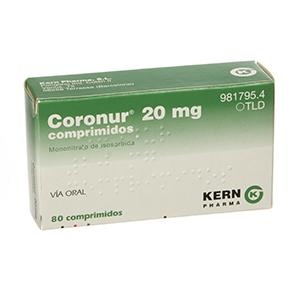
- Alternativas a CAFINITRINA 1 MG/25 MG COMPRIMIDOS SUBLINGUALESForma farmacéutica: PARCHE TRANSDERMICO, 37,4 mg nitroglicerinaPrincipio activo: Trinitrato de gliceriloFabricante: Merus Labs Luxco Ii S.À.R.L.Requiere recetaForma farmacéutica: PARCHE TRANSDERMICO, 18,7 mg nitroglicerinaPrincipio activo: Trinitrato de gliceriloFabricante: Merus Labs Luxco Ii S.À.R.L.Requiere recetaForma farmacéutica: COMPRIMIDO, 20 mgPrincipio activo: isosorbide mononitratoFabricante: Kern Pharma S.L.Requiere receta

Médicos online para CAFINITRINA 1 MG/25 MG COMPRIMIDOS SUBLINGUALES
Comenta la dosis, los posibles efectos secundarios, interacciones, contraindicaciones o la revisión de receta de CAFINITRINA 1 MG/25 MG COMPRIMIDOS SUBLINGUALES, sujeto a valoración médica y a la normativa local.





Obtén una receta de CAFINITRINA 1 MG/25 MG COMPRIMIDOS SUBLINGUALES online
Rellena un formulario de 2 minutos
Cuéntanos tus síntomas, historial y el medicamento que necesitas.
Elige un médico o nosotros te asignamos uno
Escoge un especialista o te conectamos con el próximo médico disponible.
El médico revisa tu caso
Normalmente en 30 minutos. Puede hacerte preguntas adicionales por chat.
Recógela en cualquier farmacia
Receta electrónica enviada a tu correo, válida en toda España.
Preguntas frecuentes
