


Sarclisa 20 mg/ml concentrate for infusion solution

Prescription request online
A doctor will review your case and decide whether a prescription is medically appropriate.

Talk to a doctor about this medicine
Discuss your symptoms and possible next steps in a quick online consultation.



How to use SARCLISA 20 mg/mL concentrate for infusion solution
Contents of the leaflet
- Introduction
- What is Sarclisa and what is it used for
- What you need to know before you use Sarclisa
- How Sarclisa is administered
- Possible side effects
- Storage of Sarclisa
- Container contents and additional information
Introduction
Package Leaflet: Information for the Patient
Sarclisa 20 mg/ml concentrate for solution for infusion
isatuximab
Read all of this leaflet carefully before you start using this medicine because it contains important information for you.
- Keep this leaflet, you may need to read it again.
- If you have any further questions, ask your doctor, pharmacist, or nurse.
- If you get any side effects, talk to your doctor, pharmacist, or nurse. This includes any possible side effects not listed in this leaflet. See section 4.
Contents of the pack
- What is Sarclisa and what is it used for
- What you need to know before you use Sarclisa
- How Sarclisa is administered
- Possible side effects
- Storage of Sarclisa
- Contents of the pack and further information
1. What is Sarclisa and what is it used for
What is Sarclisa
Sarclisa is a cancer medicine that contains the active substance isatuximab, which belongs to a group of medicines called “monoclonal antibodies”.
Monoclonal antibodies, such as Sarclisa, are proteins designed to recognize and bind to a target substance. In the case of Sarclisa, the target is a substance called CD38, which is found on multiple myeloma cells, a type of bone marrow cancer. The medicine binds to multiple myeloma cells, helping your body's natural defenses (immune system) to identify and destroy them.
What Sarclisa is used for
Sarclisa is used to treat multiple myeloma.
It is used in combination with two other medicines in patients who have received previous treatments for multiple myeloma:
- pomalidomide and dexamethasone or
- carfilzomib and dexamethasone
It is used in combination with three other medicines in patients with newly diagnosed multiple myeloma:
- bortezomib, lenalidomide, and dexamethasone.
If you have any questions about how Sarclisa works or about your treatment with Sarclisa, ask your doctor.

Not sure if this medicine is right for you?
Discuss your symptoms and treatment with a doctor online.
2. What you need to know before you use Sarclisa
Do not use Sarclisa
- if you are allergic to isatuximab or any of the other ingredients of this medicine (listed in section 6).
Warnings and precautions
Talk to your doctor or nurse before starting treatment with Sarclisa and follow their instructions carefully.
Infusion reactions
Tell your doctor or nurse immediately if you have signs of infusion reactions during or after the infusion of Sarclisa- see section 4 “Possible side effects” for a list of signs of "Infusion reactions".
- Before starting the infusion of Sarclisa, you may be given medicines to reduce infusion reactions (see section 3 “How Sarclisa is administered”).
- Infusion reactions can occur during the infusion of Sarclisa or after the infusion and can be severe. These reactions are reversible. Hospital staff will closely monitor you during treatment.
If you have an infusion reaction, your doctor or nurse may give you additional medicines to treat your symptoms and prevent complications. They may also temporarily stop treatment, reduce the rate, or completely stop the infusion of Sarclisa.
Fever and low white blood cell count
Tell your doctor or nurse immediately if you experience fever, as it may be a sign of infection. Sarclisa may reduce the number of white blood cells, which are important for fighting infections.
Your doctor or nurse will check your blood cell counts during treatment with Sarclisa. Your doctor may prescribe an antibiotic or antiviral medicine (e.g., for herpes zoster [shingles]) to help prevent infections or a medicine to help increase your white blood cell count during treatment with Sarclisa.
Heart problems
Talk to your doctor or nurse before using Sarclisa in combination with carfilzomib and dexamethasone if you have heart problems or if you have ever taken a heart medicine. Tell your doctor or nurse immediately if you have any difficulty breathing, coughing, or swelling of the legs.
Risk of new cancers
New cancers have occurred in patients during treatment with Sarclisa when given with pomalidomide and dexamethasone or with carfilzomib and dexamethasone, or with bortezomib, lenalidomide, and dexamethasone. Your doctor or nurse will monitor you for new cancers during treatment.
Tumor lysis syndrome
A rapid breakdown of cancer cells (tumor lysis syndrome) can occur. Symptoms may include irregular heartbeats, seizures (fits), confusion, muscle cramps, or decreased urine production. Contact your doctor immediately if you experience any of these symptoms.
Blood transfusion
If you need a blood transfusion, you will first have a blood test to determine your blood type.
Tell the person doing the blood test that you are being treated with Sarclisa. This is because it could affect the results of this blood test for at least 6 months after your last dose of Sarclisa.
Children and adolescents
Sarclisa is not recommended for children and adolescents under 18 years of age, as the efficacy of Sarclisa has not been established in pediatric patients.
Other medicines and Sarclisa
Tell your doctor, pharmacist, or nurse if you are taking, have recently taken, or might take any other medicines. This includes medicines obtained without a prescription and herbal medicines.
Tell your doctor or nurse before receiving Sarclisa if you have ever taken a heart medicine.
Sarclisa is used in combination with two or three other medicines to treat multiple myeloma:
- pomalidomide and dexamethasone or
- carfilzomib and dexamethasone or
- bortezomib, lenalidomide, and dexamethasone
For information about these other medicines used with Sarclisa, see their package leaflets.
Pregnancy
Ask your doctor, pharmacist, or nurse for advice before using Sarclisa.
Sarclisa is not recommended during pregnancy. If you are pregnant or breast-feeding, think you may be pregnant, or are planning to have a baby, ask your doctor for advice before taking this medicine.
For information about pregnancy and other medicines taken with Sarclisa, see the package leaflet of these other medicines.
Breast-feeding
Ask your doctor, pharmacist, or nurse for advice before using this medicine.
- This is because Sarclisa may pass into breast milk. It is not known how it could affect the baby.
- You and your doctor will decide if the benefit of breast-feeding is greater than the risk to your baby.
Contraception
Women who receive Sarclisa and can become pregnant must use an effective method of contraception. Talk to your doctor about the method of contraception you should use during this time. Use contraceptives during treatment and for 5 months after the last dose of Sarclisa.
Driving and using machines
Sarclisa is unlikely to affect your ability to drive or use machines. However, Sarclisa is used with other medicines that may affect your ability to drive or use machines. Please see the package leaflet of the other medicines you take with Sarclisa.
Sarclisa contains polysorbate 80
This medicine contains 0.2 mg of polysorbate 80 in each ml of isatuximab concentrate for solution for infusion, which is equivalent to 0.1 mg/kg body weight.
Polysorbates may cause allergic reactions. Tell your doctor if you have any known allergy.
3. How Sarclisa is administered
How much Sarclisa you will receive
The amount of Sarclisa you will be given is based on your body weight. The recommended dose is 10 mg of Sarclisa per kilogram of body weight.
How Sarclisa is administered
Your doctor or nurse will give you Sarclisa by infusion into a vein (intravenous infusion).
How often Sarclisa is administered
When Sarclisa is used in combination with two other medicines, either pomalidomide and dexamethasone or carfilzomib and dexamethasone, the treatment cycles last 28 days (4 weeks).
- In cycle 1: Sarclisa is administered once a week on days 1, 8, 15, and 22
- In cycle 2 and subsequent cycles: Sarclisa is administered every 2 weeks, on days 1 and 15
When Sarclisa is used with three other medicines, bortezomib, lenalidomide, and dexamethasone:
- For patients who are not eligible for autologous stem cell transplant (from their own stem cells):
treatment cycles last 42 days (6 weeks) from cycle 1 to 4 and last 28 days (4 weeks) from cycle 5 onwards.
- In cycle 1: Sarclisa is administered on days 1, 8, 15, 22, and 29,
- From cycle 2 to 4: Sarclisa is administered every 2 weeks - on days 1, 15, and 29,
- From cycle 5 to 17: Sarclisa is administered every 2 weeks - on days 1 and 15,
- From cycle 18 onwards: Sarclisa is administered every 4 weeks - on day 1.
- For patients who are eligible for autologous stem cell transplant (from their own stem cells):
treatment cycles last 42 days (6 weeks) from cycle 1 to 3.
- In cycle 1: Sarclisa is administered on days 1, 8, 15, 22, and 29.
- From cycle 2 to cycle 3: Sarclisa is administered every 2 weeks, on days 1, 15, and 29.
Your doctor will continue to treat you with Sarclisa as long as it is beneficial for you and the side effects are acceptable.
Medicines used before Sarclisa
You will be given the following medicines before the infusion of Sarclisa. This is to help reduce your chances of having an infusion reaction:
- medicines to reduce allergic reactions (antihistamines)
- medicines to reduce inflammation (corticosteroids)
- medicines to reduce pain and fever
If you miss a dose of Sarclisa
It is very important that you attend all your appointments to make sure you receive your treatment on time for it to work properly. If you miss any appointment, call your doctor or nurse as soon as possible to reschedule your appointment.
Your doctor or nurse will decide how you should continue your treatment.
If you receive more Sarclisa than you should
Your doctor or nurse will give you Sarclisa. If you are accidentally given too much (overdose), your doctor will treat and monitor your side effects.
If you stop treatment with Sarclisa
Do not stop treatment with Sarclisa unless you have talked to your doctor.
If you have any questions about the use of this medicine, ask your doctor, pharmacist, or nurse.

Started taking the medicine and have questions?
Discuss your symptoms and treatment with a doctor online.
4. Possible side effects
Like all medicines, this medicine can cause side effects, although not everybody gets them.
Your doctor will discuss the side effects of Sarclisa with you and explain the risks and benefits of your treatment with Sarclisa.
Hospital staff will closely monitor your condition during treatment. Tell them immediately if you notice any of the following effects:
Infusion reactions – Very common(may affect more than 1 in 10 people):
Tell your doctor or nurse immediately if you do not feel well during or after the infusion of Sarclisa.
Severe signs of infusion reaction include:
- high blood pressure (hypertension)
- shortness of breath
- severe allergic reaction (anaphylactic reaction that affects up to 1 in 100 people) with difficulty breathing and swelling of the face, mouth, throat, lips, or tongue.
Common signs of infusion reaction include:
- shortness of breath
- coughing
- chills
- nausea
You may also have other side effects during the infusion. Your doctor or nurse may decide to temporarily stop, reduce the rate, or completely stop the infusion of Sarclisa. They may also give you additional medicines to treat your symptoms and prevent complications.
Tell your doctor or nurse immediately if you feel unwell during or after the infusion of Sarclisa.
Other side effects
Tell your doctor, pharmacist, or nurse immediately if you have any of the following side effects:
Very common(may affect more than 1 in 10 people):
- low number of some white blood cells (neutrophils), which are important for fighting infections
- low number of a type of blood cell called platelets, which help the blood to clot (thrombocytopenia). Tell your doctor or nurse if you have any bruising or unusual bleeding
- lung infection (pneumonia)
- infection of the respiratory tract (such as the nose, sinuses, or throat)
- diarrhea
- bronchitis
- shortness of breath
- nausea
- vomiting
- high blood pressure (hypertension)
- coughing
- fatigue (tiredness)
- decreased appetite
- COVID-19
- eye clouding (cataract)
Common(may affect up to 1 in 10 people):
- heart problems, which may present as difficulty breathing, coughing, or swelling of the legs when Sarclisa is given with carfilzomib and dexamethasone
- fever with a severe decrease in some white blood cells (febrile neutropenia) (see section 2 “What you need to know before you use Sarclisa” for more information)
- low number of red blood cells (anemia)
- weight loss
- irregular heartbeat (atrial fibrillation)
- herpes zoster (shingles)
- low number of some white blood cells (lymphocytes) which are important for fighting infections
If you experience any of the above side effects, or are not sure, talk to your doctor, pharmacist, or nurse immediately.
Reporting of side effects
If you experience any side effects, talk to your doctor, pharmacist, or nurse, even if they are not listed in this leaflet. You can also report side effects directly via the national reporting system listed in Appendix V.
By reporting side effects, you can help provide more information on the safety of this medicine.
5. Storage of Sarclisa
Sarclisa should be stored in the hospital or clinic.
Keep this medicine out of the sight and reach of children.
Do not use this medicine after the expiry date which is stated on the carton and vial after “EXP”. The expiry date is the last day of the month shown.
Store in a refrigerator (2°C to 8°C). Do not freeze.
Store in the original package to protect from light.
Medicines should not be disposed of via wastewater or household waste. Ask your pharmacist how to dispose of medicines no longer required. These measures will help protect the environment.
6. Container contents and additional information
Composition of Sarclisa
- The active substance of Sarclisa is isatuximab.
- One milliliter of concentrate contains 20 mg of isatuximab.
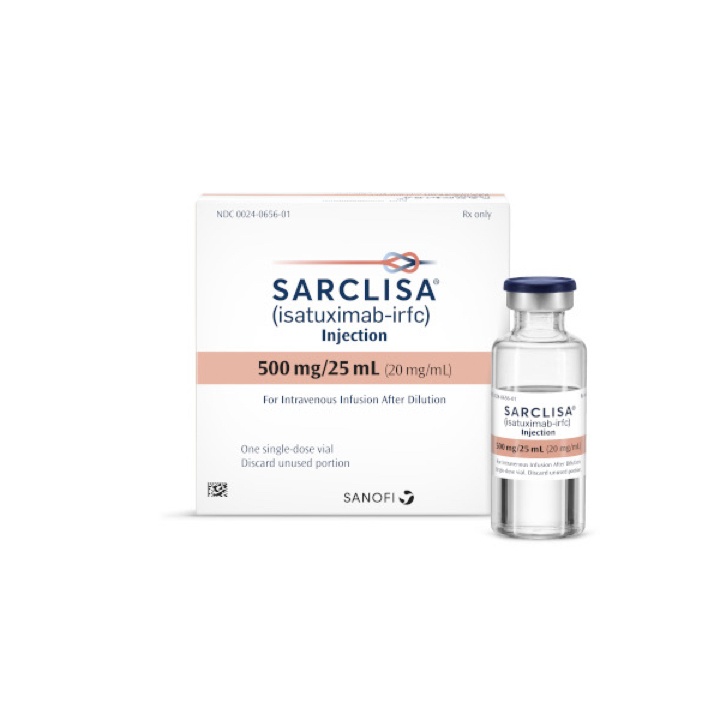
- Each vial of concentrate contains 100 mg of isatuximab in 5 ml of concentrate or 500 mg of isatuximab in 25 ml of concentrate.
- The other components (excipients) are sucrose, histidine hydrochloride monohydrate, histidine, polysorbate 80, and water for injectable preparations.
Appearance and container contents of the product
Sarclisa is a concentrate for solution for infusion. It is a colorless to slightly yellow liquid, essentially free of visible particles.
Container size:
100 mg of isatuximab in 5 ml of concentrate (100 mg/5 ml): Each box contains 1 or 3 vials.
500 mg of isatuximab in 25 ml of concentrate (500 mg/25 ml): Each box contains 1 vial.
Not all container sizes may be marketed.
Marketing authorization holder
Sanofi Winthrop Industrie
82 avenue Raspail
94250 Gentilly
France
Manufacturer
Sanofi-Aventis Deutschland GmbH
Industriepark Hoechst Brueningstrasse 50
65926 Frankfurt am Main
Germany
You can request more information about this medicinal product by contacting the local representative of the marketing authorization holder:
België/Belgique/Belgien Sanofi Belgium Tél/Tel: +32 (0)2 710 54 00 | Lietuva Swixx Biopharma UAB Tel: +370 5 236 91 40 |
| Luxembourg/Luxemburg Sanofi Belgium Tél/Tel: +32 (0)2 710 54 00 (Belgique/Belgien) |
Ceská republika Sanofi s.r.o. Tel: +420 233 086 111 | Magyarország SANOFI-AVENTIS Zrt. Tel.: +36 1 505 0050 |
Danmark Sanofi A/S Tlf: +45 45 16 70 00 | Malta Sanofi S.r.l. Tel: +39 02 39394275 |
Sanofi-Aventis Deutschland GmbH Tel.: 0800 04 36 996 Tel. from abroad: +49 69 305 70 13 | Nederland Sanofi B.V. Tel: +31 20 245 4000 |
Eesti Swixx Biopharma OÜ Tel: +372 640 10 30 | Norge sanofi-aventis Norge AS Tlf: +47 67 10 71 00 |
Ελλάδα Sanofi-Aventis Μονοπρóσωπη ΑΕΒΕ Τηλ: +30 210 900 16 00 | Österreich sanofi-aventis GmbH Tel: +43 1 80 185 – 0 |
España sanofi-aventis, S.A. Tel: +34 93 485 94 00 | Polska Sanofi Sp. z o.o. Tel.: +48 22 280 00 00 |
France Sanofi Winthrop Industrie Tél: 0 800 222 555 Call from abroad: +33 1 57 63 23 23 | Portugal Sanofi - Produtos Farmacêuticos, Lda. Tel: +351 21 35 89 400 |
Hrvatska Swixx Biopharma d.o.o. Tel: +385 1 2078 500 | România Sanofi Romania SRL Tel: +40 (0) 21 317 31 36 |
Ireland sanofi-aventis Ireland Ltd. T/A SANOFI Tel: +353 (0) 1 403 56 00 | Slovenija Swixx Biopharma d.o.o. Tel: +386 1 235 51 00 |
Ísland Vistor hf. Sími: +354 535 7000 | Slovenská republika Swixx Biopharma s.r.o. Tel: +421 2 208 33 600 |
Italia Sanofi S.r.l. Tel: 800.536 389 | Suomi/Finland Sanofi Oy Puh/Tel: +358 (0) 201 200 300 |
Κύπρος C.A. Papaellinas Ltd. Τηλ: +357 22 741741 | Sverige Sanofi AB Tel: +46 (0)8 634 50 00 |
Latvija Swixx Biopharma SIA Tel: +371 6 616 47 50 | United Kingdom(Northern Ireland) sanofi-aventis Ireland Ltd. T/A SANOFI Tel: +44 (0) 800 035 2525 |
Date of last revision of this leaflet:
Detailed information on this medicinal product is available on the European Medicines Agency website: http://www.ema.europa.eu. There are also links to other websites on rare diseases and treatments.
This leaflet can be found in all languages of the European Union/European Economic Area on the European Medicines Agency website.
--------------------------------------------------------------------------------------------------------------------
The following information is intended for healthcare professionals only:
The vials of SARCLISA are for single use. The infusion solution should be prepared under aseptic conditions and administered by a healthcare professional in an environment where resuscitation equipment is available.
Preparation and administration of SARCLISA
- Calculate the dose (mg) of SARCLISA concentrate required, and determine the number of vials needed for the dose of 10 mg/kg, based on the patient's weight. More than one vial may be required.
- Visually inspect the SARCLISA concentrate before dilution to rule out the presence of particles and discoloration.
- Remove the volume of diluent equivalent to the required volume of SARCLISA concentrate from a bag of diluent containing 250 ml of sodium chloride 9 mg/ml (0.9%) injectable solution or a 5% glucose solution.
- Withdraw the appropriate volume of SARCLISA concentrate from the SARCLISA vial and dilute it in the infusion bag containing 250 ml of sodium chloride 9 mg/ml (0.9%) injectable solution or a 5% glucose solution.
- The infusion bag should be made of polyolefins (PO), polyethylene (PE), polypropylene (PP), polyvinyl chloride (PVC) with di(2-ethylhexyl) phthalate (DEHP) or ethylene-vinyl acetate (EVA).
- Gently invert the bag to homogenize the diluted solution. Do not shake.
- Administer the infusion solution through intravenous infusion using intravenous tubing equipment (PE, PVC with or without DEHP, polybutadiene (PBD), or polyurethane (PU)) with an in-line filter of 0.22 microns (polyethersulfone (PES), polysulfone, or nylon).
- Administer the infusion solution over a period of time that will depend on the infusion rate (see section 4.2 of the Summary of Product Characteristics "Posology and method of administration").
- The prepared SARCLISA infusion solution should be used immediately. If not used immediately, the in-use storage times and conditions before use are the responsibility of the user and should not normally exceed 24 hours at 2-8°C, unless the dilution has been performed under controlled and validated aseptic conditions.
- No protection from light is required for the prepared infusion bag in a standard artificial light environment.
- SARCLISA should not be administered with other medicinal products through the same intravenous line.
Discard any unused solution. All materials used for dilution and administration should be disposed of in accordance with standard procedures.
- Country of registration
- Dosage formINJECTABLE PERFUSION, 20 mg/ml
- ATC codeL01FC02
- Active substance
- Prescription requiredYes
- Manufacturer
- CompositionSACAROSA (100 mg mg), POLISORBATO 80 (0,2 mg mg)
- This information is for reference only and does not constitute medical advice. Always consult a doctor before taking any medication. Oladoctor is not responsible for medical decisions based on this content.
- Alternatives to SARCLISA 20 mg/mL concentrate for infusion solutionDosage form: INJECTABLE, 1800 mgActive substance: daratumumabManufacturer: Janssen-Cilag International N.VPrescription requiredDosage form: INJECTABLE PERFUSION, 20 mg/mlActive substance: daratumumabManufacturer: Janssen-Cilag International N.VPrescription requiredDosage form: INJECTABLE PERFUSION, 20 mg/mlActive substance: daratumumabManufacturer: Janssen-Cilag International N.VPrescription required
Online doctors for SARCLISA 20 mg/mL concentrate for infusion solution
Discuss questions about SARCLISA 20 mg/mL concentrate for infusion solution, including use, safety considerations and whether a prescription is appropriate, subject to medical assessment and local regulations.
Frequently Asked Questions
SARCLISA 20 mg/mL concentrate for infusion solution requires a prescription in Spain. You can check with a doctor online whether this medicine may be appropriate for your situation.
The active ingredient in SARCLISA 20 mg/mL concentrate for infusion solution is isatuximab. This information helps identify medicines with the same composition but different brand names.
SARCLISA 20 mg/mL concentrate for infusion solution is manufactured by Sanofi Winthrop Industrie. Pharmacy brands and packaging may differ depending on the distributor.
Doctors such as Family doctors, Psychiatrists, Dermatologists, Cardiologists, Endocrinologists, Gastroenterologists, Pulmonologists, Nephrologists, Rheumatologists, Hematologists, Infectious disease physicians, Allergists, Geriatricians, Paediatricians, Oncologists may assess whether SARCLISA 20 mg/mL concentrate for infusion solution is appropriate, depending on your situation and local regulations. You can book an online consultation to discuss your symptoms and possible next steps.
The prescription is issued by a doctor after assessing your health. In Spain, SARCLISA 20 mg/mL concentrate for infusion solution is then dispensed in pharmacies with that prescription. An online consultation does not guarantee that a prescription will be issued: the decision always rests with the doctor.
To request an assessment, you can use Oladoctor:
Other medicines with the same active substance (isatuximab) include DARZALEX 1.800 mg INJECTABLE SOLUTION, DARZALEX 20 mg/mL concentrate for infusion solution, DARZALEX 20 mg/mL concentrate for infusion solution. These may have different brand names or formulations but contain the same therapeutic ingredient. Always consult a doctor before switching or starting a new medicine.
