



DARZALEX 1800 mg Injectable Solution

Prescription review online
A doctor will review your case and decide whether a prescription is medically appropriate.

Talk to a doctor about this medicine
Discuss your symptoms and possible next steps in a quick online consultation.



How to use DARZALEX 1.800 mg INJECTABLE SOLUTION
Contents of the leaflet
- Introduction
- What is DARZALEX and what is it used for
- What you need to know before you receive DARZALEX
- How DARZALEX is administered
- Possible side effects
- Storage of DARZALEX
- Container Contents and Additional Information
Introduction
Package Leaflet: Information for the Patient
DARZALEX 1800mg solution for injection
daratumumab
Read all of this leaflet carefully before you start receiving this medicine because it contains important information for you.
- Keep this leaflet, you may need to read it again.
- If you have any further questions, ask your doctor or nurse.
- If you experience any side effects, talk to your doctor or nurse, even if they are not listed in this leaflet. See section 4.
Contents of the pack
- What is DARZALEX and what is it used for
- What you need to know before you receive DARZALEX
- How DARZALEX is administered
- Possible side effects
- Storage of DARZALEX
- Contents of the pack and further information
1. What is DARZALEX and what is it used for
What is DARZALEX
DARZALEX is a medicine that contains the active substance daratumumab. It belongs to a group of medicines called “monoclonal antibodies”. Monoclonal antibodies are proteins whose function is to recognize and bind to specific targets in the body. Daratumumab is designed to bind to specific abnormal blood cells in the body, allowing the immune system to destroy them.
What DARZALEX is used for
DARZALEX is used in adults aged 18 years or older who have a type of cancer called “multiple myeloma”. This is a cancer of the bone marrow.
DARZALEX is also used in adults aged 18 years or older who have a type of blood disorder called “AL amyloidosis”. In AL amyloidosis, abnormal blood cells produce excessive amounts of abnormal proteins that accumulate in various organs, causing them to not function properly.

Not sure if this medicine is right for you?
Discuss your symptoms and treatment with a doctor online.
2. What you need to know before you receive DARZALEX
Do not receive DARZALEX
- if you are allergic to daratumumab or any of the other ingredients of this medicine (listed in section 6).
Do not receive DARZALEX if you meet the above criterion. If you are not sure, consult your doctor or nurse before receiving DARZALEX.
Warnings and precautions
Consult your doctor or nurse before receiving DARZALEX.
Infusion-related reactions
DARZALEX is administered as a subcutaneous injection using a small needle to inject the medicine under your skin. Before and after each injection, you will be given medicines that help reduce the likelihood of you experiencing infusion-related reactions (see the section “Medicines administered during treatment with DARZALEX” in section 3). These reactions occur mainly with the first injection and most occur on the day of injection. If you have already experienced an infusion-related reaction, it is less likely to happen again. However, delayed reactions can occur up to 3-4 days after injection. If you have a severe reaction after injection, your doctor may decide not to use DARZALEX.
In some cases, you may experience a severe allergic reaction that can include swelling of the face, lips, mouth, tongue, or throat, difficulty swallowing or breathing, or an itchy rash (urticaria). See section 4.
Inform your doctor or nurse immediately if you experience any of the infusion-related reactions or symptoms indicated at the beginning of section 4. If you experience infusion-related reactions, you may need other medicines to treat your symptoms, or it may be necessary to interrupt or stop the injections. When these reactions disappear or improve, the injection can be administered again.
Decrease in blood cell count
DARZALEX may reduce the number of white blood cells, which help fight infections, and other blood cells called platelets, which help blood clot. Inform your healthcare professional if you experience any symptoms of infection, such as fever, or any symptoms of a low platelet count, such as bruising or bleeding.
Blood transfusions
If you need a blood transfusion, a blood test will be performed to determine your blood type. DARZALEX may affect the results of this blood test. Inform the person performing the test that you are using DARZALEX.
Hepatitis B
Inform your doctor if you have ever been or may currently be infected with the hepatitis B virus. This is because DARZALEX could cause the hepatitis B virus to reactivate. Your doctor will examine you for signs of this infection before, during, and sometime after treatment with DARZALEX. Inform your doctor immediately if you experience worsening fatigue, or if you experience yellowing of the skin or the white part of the eyes.
Children and adolescents
Do not administer DARZALEX to children or adolescents under 18 years of age, as it is not known how the medicine will affect them.
Other medicines and DARZALEX
Inform your doctor or nurse if you are taking, have recently taken, or may need to take any other medicines. This includes medicines obtained without a prescription and herbal medicines.
Pregnancy
If you are pregnant, think you may be pregnant, or plan to become pregnant, consult your doctor before receiving this medicine.
If you become pregnant during treatment with this medicine, inform your doctor or nurse immediately. You and your doctor will decide if the benefit of receiving the medicine is greater than the risk to the fetus.
Contraception
Women receiving DARZALEX must use an effective contraceptive method during treatment and for 3 months after treatment.
Breast-feeding
You and your doctor will decide if the benefit of breast-feeding is greater than the risk to your baby, as this medicine may pass into breast milk and it is not known how it may affect your baby.
Driving and using machines
You may feel tired after using DARZALEX, which may affect your ability to drive or use machines.
DARZALEX solution for injection subcutaneously contains sodium
This medicine contains less than 1 mmol (23 mg) of sodium per 15 ml, which is essentially “sodium-free”.
DARZALEX solution for injection subcutaneously contains sorbitol
Sorbitol is a source of fructose. If your doctor has told you that you have an intolerance to some sugars or if you have been diagnosed with hereditary fructose intolerance (HFI), a rare genetic disorder in which you cannot break down fructose, consult your doctor before you receive this medicine.
3. How DARZALEX is administered
Dose administered
The dose of DARZALEX solution for injection subcutaneously is 1800 mg.
DARZALEX can be administered alone or with other medicines used to treat multiple myeloma or with other medicines used to treat AL amyloidosis. DARZALEX is usually administered as follows:
- once a week for the first 8 weeks
- then once every 2 weeks for 16 weeks
- after this, once every 4 weeks while the disease does not worsen.
When DARZALEX is administered with other medicines, your doctor may modify the time between doses as well as the number of treatments you receive.
How the medicine is administered
A doctor or nurse will administer DARZALEX as an injection under the skin (subcutaneous injection) over approximately 3-5 minutes. It is administered in the stomach area (abdomen), not in other areas of the body, and not in areas of the abdomen where the skin is red, bruised, sensitive, hardened, or scarred.
If you experience pain during the injection, the doctor or nurse may interrupt the injection and administer the rest of the injection in another area of your abdomen.
Medicines administered during treatment with DARZALEX
You may be given medicines to reduce the likelihood of you contracting herpes zoster.
Before each DARZALEX injection, you will be given medicines that help reduce the likelihood of you experiencing infusion-related reactions. These may include:
- medicines to treat allergic reactions (antihistamines)
- medicines to treat inflammation (corticosteroids)
- medicines to treat fever (such as paracetamol).
After each DARZALEX injection, you will be given medicines (such as corticosteroids) to reduce the likelihood of you experiencing infusion-related reactions.
People with respiratory problems
If you have respiratory problems, such as asthma or Chronic Obstructive Pulmonary Disease (COPD), you will be given inhaled medicines that help treat respiratory problems:
- medicines to keep the airways in the lungs open (bronchodilators)
- medicines to reduce inflammation and irritation of the lungs (corticosteroids).
If you receive more DARZALEX than you should
Your doctor or nurse will administer this medicine. In the unlikely event that you are given too much (overdose), your doctor will check if you experience any side effects.
If you miss your appointment to receive DARZALEX
It is very important that you attend all your appointments to ensure that the treatment works. If you miss an appointment, make another one as soon as possible.
If you have any other questions about the use of this medicine, ask your doctor or nurse.

Started taking the medicine and have questions?
Discuss your symptoms and treatment with a doctor online.
4. Possible side effects
Like all medicines, this medicine can cause side effects, although not everybody gets them.
Infusion-related reactions
Inform your doctor or nurse immediately if you experience any of the following symptoms during the 3-4 days after injection. You may need other medicines, or it may be necessary to interrupt or stop the injections.
These reactions include the following symptoms:
Very common (may affect more than 1 in 10 people):
- chills
- sore throat, cough
- feeling sick (nausea)
- vomiting
- itching, runny or stuffy nose
- difficulty breathing or other breathing problems.
Common (may affect up to 1 in 10 people):
- chest pain
- dizziness or lightheadedness (hypotension)
- itching
- wheezing.
Rare (may affect up to 1 in 1000 people):
- severe allergic reaction, which can include swelling of the face, lips, mouth, tongue, or throat, difficulty swallowing or breathing, or an itchy rash (urticaria). See section 2.
- eye pain
- blurred vision
If you experience any of the above infusion-related reactions, inform your doctor or nurse immediately.
Reactions at the injection site
Reactions can occur on the skin at the injection site or nearby (local reactions), including injection site reactions, with DARZALEX solution for injection subcutaneously. These reactions are common (may affect up to 1 in 10 people). Injection site symptoms can include redness of the skin, itching, swelling, pain, bruising, rash, bleeding.
Other side effects
Very common(may affect more than 1 in 10 people):
- fever
- feeling very tired
- diarrhea
- constipation
- decreased appetite
- difficulty sleeping
- headache
- nerve damage that can cause tingling, numbness, or pain
- rash
- muscle spasms
- joint pain
- swelling of the hands, ankles, or feet
- weakness
- back pain
- lung infection (pneumonia)
- bronchitis
- infection of the respiratory tract, such as the nose, sinuses, or throat
- low number of red blood cells, which carry oxygen in the blood (anemia)
- low number of white blood cells, which help fight infections (neutropenia, lymphopenia, leucopenia)
- low number of a type of blood cell called platelets, which help blood clot (thrombocytopenia).
Common(may affect up to 1 in 10 people):
- irregular heartbeat (atrial fibrillation)
- fluid accumulation in the lungs, which can cause difficulty breathing
- urinary tract infection
- severe infection throughout the body (sepsis)
- dehydration
- high blood sugar levels
- low calcium levels in the blood
- low levels of antibodies called ‘immunoglobulins’ in the blood, which help fight infections (hypogammaglobulinemia)
- feeling dizzy
- fainting
- chest muscle pain
- flu
- chills
- itching
- strange sensations in the skin (such as tingling or numbness)
- pancreatitis
- high blood pressure
- COVID-19.
Uncommon(may affect up to 1 in 100 people):
- inflammation of the liver (hepatitis)
- infection with a type of herpes virus (cytomegalovirus infection).
Reporting of side effects
If you experience any side effects, talk to your doctor or nurse, even if they are not listed in this leaflet. You can also report side effects directly through the national reporting system listed in Appendix V. By reporting side effects, you can help provide more information on the safety of this medicine.
5. Storage of DARZALEX
DARZALEX solution for injection subcutaneously will be stored in the hospital or clinic.
Keep this medicine out of the sight and reach of children.
Do not use this medicine after the expiry date which is stated on the carton and on the label of the vial after “EXP”. The expiry date is the last day of the month stated.
Store in a refrigerator (between 2°C and 8°C). Do not freeze.
Store in the original packaging to protect from light.
Medicines should not be disposed of via wastewater or household waste. Your healthcare professional will dispose of any unused medicines. This will help protect the environment.
6. Container Contents and Additional Information
DARZALEX Composition
- The active substance is daratumumab. One ml of solution contains 120 mg of daratumumab. Each 15 ml vial of injectable solution contains 1800 mg of daratumumab.
- The other components are recombinant human hyaluronidase (rHuPH20), L-histidine, L-histidine hydrochloride monohydrate, L-methionine, polysorbate 20, sorbitol (E420), and water for injectable preparations (see the section "DARZALEX contains sodium and sorbitol" in section 2).
Product Appearance and Container Contents
DARZALEX subcutaneous injectable solution is a colorless to yellow liquid.
DARZALEX subcutaneous injectable solution is supplied in a box containing 1 single-dose glass vial.
Marketing Authorization Holder
Janssen-Cilag International NV
Turnhoutseweg 30
B-2340 Beerse
Belgium
Manufacturer
Janssen Biologics B.V.
Einsteinweg 101
NL-2333 CB Leiden
Netherlands
For further information, please contact the local representative of the marketing authorization holder:
België/Belgique/Belgien Janssen-Cilag NV Tel/Tél: +32 14 64 94 11 | Lietuva UAB "JOHNSON & JOHNSON" Tel: +370 5 278 68 88 |
България „Джонсън енд Джонсън“ ЕООД Тел.: +359 2 489 94 00 | Luxembourg/Luxemburg Janssen-Cilag NV Tél/Tel: +32 14 64 94 11 |
Česká republika Janssen-Cilag s.r.o. Tel: +420 227 012 227 | Magyarország Janssen-Cilag Kft. Tel.: +36 1 884 2858 |
Danmark Janssen-Cilag A/S Tlf: +45 4594 8282 | Malta AM MANGION LTD Tel: +356 2397 6000 |
Deutschland Janssen-Cilag GmbH Tel: +49 2137 955 955 | Nederland Janssen-Cilag B.V. Tel: +31 76 711 1111 |
Eesti UAB "JOHNSON & JOHNSON" Eesti filiaal Tel: +372 617 7410 | Norge Janssen-Cilag AS Tlf: +47 24 12 65 00 |
Ελλάδα Janssen-Cilag Φαρμακευτική Α.Ε.Β.Ε. Τηλ: +30 210 80 90 000 | Österreich Janssen-Cilag Pharma GmbH Tel: +43 1 610 300 |
España Janssen-Cilag, S.A. Tel: +34 91 722 81 00 | Polska Janssen-Cilag Polska Sp. z o.o. Tel.: +48 22 237 60 00 |
France Janssen-Cilag Tél: 0 800 25 50 75 / +33 1 55 00 40 03 | Portugal Janssen-Cilag Farmacêutica, Lda. Tel: +351 214 368 600 |
Hrvatska Johnson & Johnson S.E. d.o.o. Tel: +385 1 6610 700 | România Johnson & Johnson România SRL Tel: +40 21 207 1800 |
Ireland Janssen Sciences Ireland UC Tel: 1 800 709 122 | Slovenija Johnson & Johnson d.o.o. Tel: +386 1 401 18 00 |
Ísland Janssen-Cilag AB c/o Vistor hf. Sími: +354 535 7000 | Slovenská republika Johnson & Johnson, s.r.o. Tel: +421 232 408 400 |
Italia Janssen-Cilag SpA Tel: 800.688.777 / +39 02 2510 1 | Suomi/Finland Janssen-Cilag Oy Puh/Tel: +358 207 531 300 |
Κύπρος Βαρνάβας Χατζηπαναγής Λτδ Τηλ: +357 22 207 700 | Sverige Janssen-Cilag AB Tfn: +46 8 626 50 00 |
Latvija UAB "JOHNSON & JOHNSON" filiale Latvija Tel: +371 678 93561 | United Kingdom (Northern Ireland) Janssen Sciences Ireland UC Tel: +44 1 494 567 444 |
Date of Last Revision of this Leaflet:
Other Sources of Information
Detailed information on this medicinal product is available on the European Medicines Agency website: http://www.ema.europa.eu.
---------------------------------------------------------------------------------------------------------------------------
This information is intended only for healthcare professionals:
DARZALEX subcutaneous injectable solution should be administered by a healthcare professional.
To avoid medication errors, it is essential to check the vial labels to ensure that the correct formulation (intravenous or subcutaneous formulation) is administered and that the dose is administered to the patient as prescribed. DARZALEX injectable solution should only be administered by subcutaneous injection at the specified dose. DARZALEX subcutaneous formulation is not intended for intravenous administration.
DARZALEX subcutaneous injectable solution is for single use and is presented ready to use.
- DARZALEX subcutaneous injectable solution is compatible with polypropylene or polyethylene syringes; subcutaneous infusion sets made of polypropylene, polyethylene, or polyvinyl chloride (PVC); and stainless steel injection and transfer needles.
- DARZALEX subcutaneous injectable solution should be a clear to opalescent, colorless to yellow solution. Do not use if it contains opaque particles, color changes, or foreign particles.
- Remove the DARZALEX subcutaneous injectable solution vial from the refrigerator (2 °C – 8 °C) and equilibrate to room temperature (15 °C–30 °C). The unopened vial can be stored at room temperature and light for up to 24 hours in the original packaging to protect it from light. Protect from direct sunlight. Do not shake.
- Prepare the administration syringe under aseptic, controlled, and validated conditions.
- To avoid clogging the needle, attach the hypodermic needle or subcutaneous infusion set to the syringe immediately before injection.
Storage of the Prepared Syringe
- If the DARZALEX syringe is not used immediately, store the DARZALEX solution for up to 24 hours in refrigerated conditions followed by up to 12 hours at 15 °C-25 °C and room light. If stored in the refrigerator, allow the solution to reach room temperature before administration.
Administration
- Inject 15 ml of DARZALEX subcutaneous injectable solution into the subcutaneous tissue of the abdomen, approximately 7.5 cm to the right or left of the navel, over approximately 3-5 minutes. Do not inject DARZALEX subcutaneous injectable solution into other areas of the body, as there are no available data.
- Alternate injection sites for subsequent injections.
- DARZALEX subcutaneous injectable solution should never be injected into areas of the skin that show redness, bruising, sensitivity, induration, or scarring.
- Pause or reduce the administration rate if the patient experiences pain. If the pain does not resolve with a reduced injection rate, consider administering the remaining dose in a second injection site on the opposite side of the abdomen.
- During treatment with DARZALEX subcutaneous injectable solution, do not administer other medications by subcutaneous injection at the same site as DARZALEX.
- Disposal of unused medicinal products and all materials that have come into contact with them should be done in accordance with local regulations.
Traceability
In order to improve the traceability of biological medicinal products, the name and batch number of the administered product should be clearly recorded.
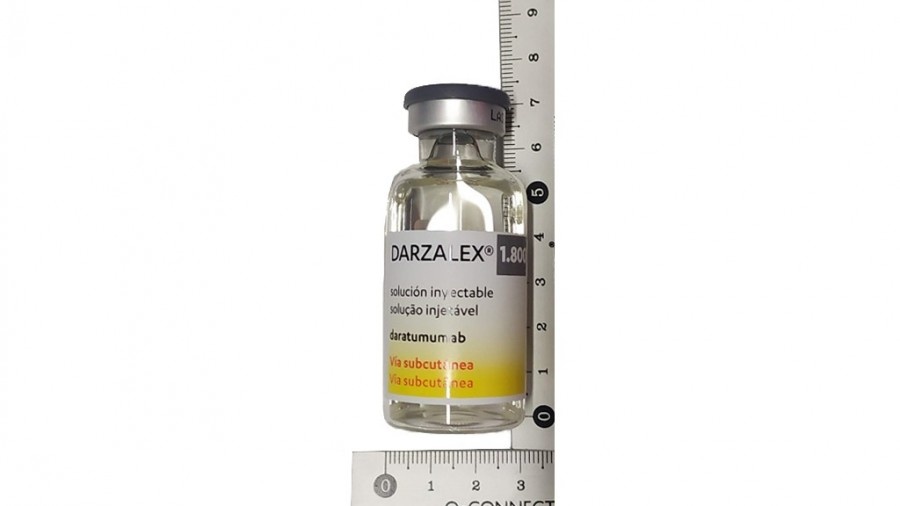
- Country of registration
- Dosage formINJECTABLE, 1800 mg
- ATC codeL01FC01
- Active substance
- Prescription requiredYes
- Manufacturer
- CompositionSORBITOL (735,1 mg mg), POLISORBATO 20 (6 mg mg)
- This information is for reference only and does not constitute medical advice. Always consult a doctor before taking any medication. Oladoctor is not responsible for medical decisions based on this content.
- Alternatives to DARZALEX 1.800 mg INJECTABLE SOLUTIONDosage form: INJECTABLE PERFUSION, 20 mg/mlActive substance: daratumumabManufacturer: Janssen-Cilag International N.VPrescription requiredDosage form: INJECTABLE PERFUSION, 20 mg/mlActive substance: daratumumabManufacturer: Janssen-Cilag International N.VPrescription requiredDosage form: INJECTABLE PERFUSION, 20 mg/mlActive substance: isatuximabManufacturer: Sanofi Winthrop IndustriePrescription required
Online doctors for DARZALEX 1.800 mg INJECTABLE SOLUTION
Discuss questions about DARZALEX 1.800 mg INJECTABLE SOLUTION, including use, safety considerations and prescription review, subject to medical assessment and local regulations.
Get DARZALEX 1.800 mg INJECTABLE SOLUTION Prescription Online
Fill in a 2-min form
Tell us your symptoms, history, and what medicine you're requesting.
Pick a doctor or let us assign
Choose a specialist or we'll match you with the next available doctor.
Doctor reviews your case
Usually within 30 minutes. They may ask follow-up questions via chat.
Collect from any pharmacy
Electronic prescription sent to your email — valid across Spain.
Frequently Asked Questions
DARZALEX 1.800 mg INJECTABLE SOLUTION requires a prescription in Spain. You can check with a doctor online whether this medicine may be appropriate for your situation.
The active ingredient in DARZALEX 1.800 mg INJECTABLE SOLUTION is daratumumab. This information helps identify medicines with the same composition but different brand names.
DARZALEX 1.800 mg INJECTABLE SOLUTION is manufactured by Janssen-Cilag International N.V. Pharmacy brands and packaging may differ depending on the distributor.
Doctors such as Family doctors, Psychiatrists, Dermatologists, Cardiologists, Endocrinologists, Gastroenterologists, Pulmonologists, Nephrologists, Rheumatologists, Hematologists, Infectious disease physicians, Allergists, Geriatricians, Paediatricians, Oncologists may assess whether DARZALEX 1.800 mg INJECTABLE SOLUTION is appropriate, depending on your situation and local regulations. You can book an online consultation to discuss your symptoms and possible next steps.
Spain has a well-developed healthcare infrastructure across major cities such as Madrid, Barcelona, Valencia, and Seville. Pharmacies are widely available and operate under strict regulations, ensuring access to prescribed medications.
You can buy DARZALEX 1.800 mg INJECTABLE SOLUTION in Madrid, Barcelona, Seville, or Valencia at any local pharmacy with a valid prescription.
To obtain a prescription, you can use Oladoctor:
Other medicines with the same active substance (daratumumab) include DARZALEX 20 mg/mL concentrate for infusion solution, DARZALEX 20 mg/mL concentrate for infusion solution, SARCLISA 20 mg/mL concentrate for infusion solution. These may have different brand names or formulations but contain the same therapeutic ingredient. Always consult a doctor before switching or starting a new medicine.
