



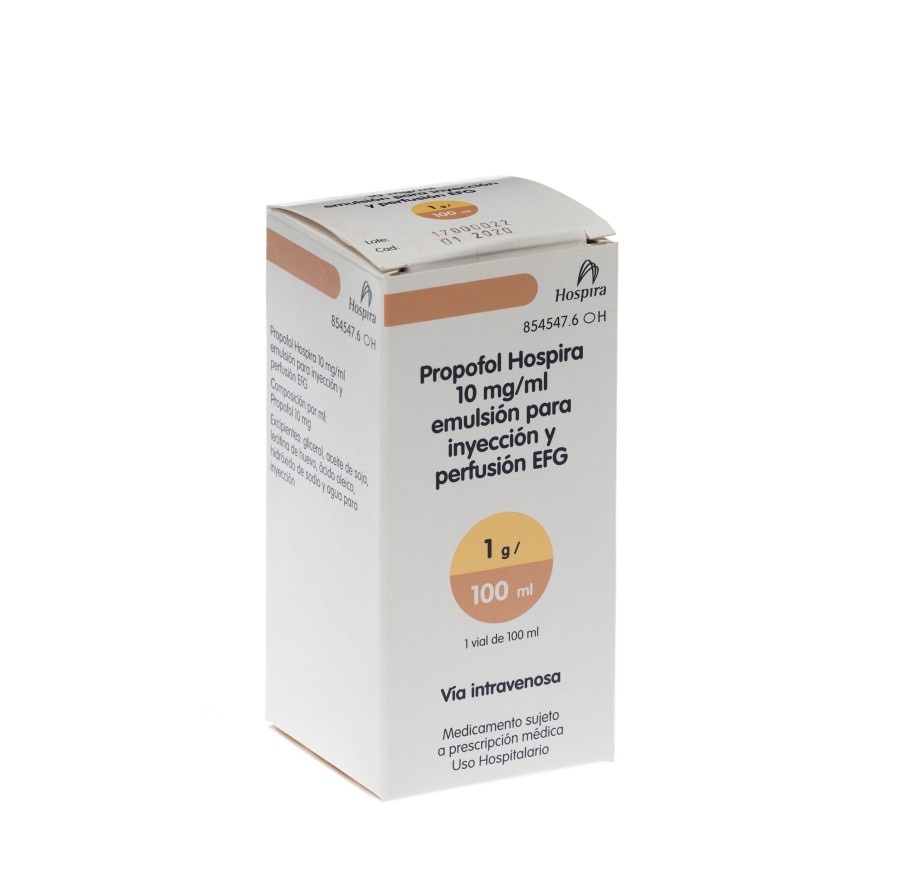
PROPOFOL 10 mg /Ml Injectable Emulsion For Infusion

Prescription review online
A doctor will review your case and decide whether a prescription is medically appropriate.

Talk to a doctor about this medicine
Discuss your symptoms and possible next steps in a quick online consultation.



How to use PROPOFOL FARMAK 10 mg/ml Injectable Emulsion for Infusion
Contents of the leaflet
- Introduction
- What Propofol Farmak is and what it is used for
- What you need to know before you are given Propofol Farmak
- How to use Propofol Farmak
- Possible side effects
- Storage of Propofol Farmak
- Container Content and Additional Information
Introduction
Package Leaflet: Information for the User
Propofol Farmak 10mg/ml emulsion for injection and infusion EFG
Read all of this leaflet carefully before you are given this medicine because it contains important information for you.
- Keep this leaflet, you may need to read it again.
- If you have any further questions, ask your doctor, pharmacist or nurse.
- If you experience any side effects, talk to your doctor, pharmacist or nurse, even if they are not listed in this leaflet. See section 4.
Contents of the pack
- What Propofol Farmak is and what it is used for
- What you need to know before you are given Propofol Farmak
- How to use Propofol Farmak
- Possible side effects
- Storage of Propofol Farmak
- Contents of the pack and other information
1. What Propofol Farmak is and what it is used for
Propofol Farmak contains the active substance propofol. It belongs to a group of medicines called ‘general anaesthetics’. General anaesthetics are used to produce unconsciousness (sleep) so that surgical operations or other procedures can be performed. They can also be used to sedate you (to make you drowsy but not completely asleep).
Propofol Farmak will be given to you by injection or infusion by a doctor.
Propofol Farmak 10 mg/ml is used for:
- induction and maintenance of general anaesthesia in adults, adolescents and children over 1 month.
- sedation of patients over 16 years old who are receiving artificial respiration in intensive care.
- sedation of adults, adolescents and children over 1 month during diagnostic and surgical procedures, alone or in combination with local or regional anaesthesia.

Not sure if this medicine is right for you?
Discuss your symptoms and treatment with a doctor online.
2. What you need to know before you are given Propofol Farmak
Propofol Farmak must not be used:
- If you are allergic to propofol, peanut or soya or any of the other ingredients of this medicine (listed in section 6).
- If you are 16 years old or younger for sedation in intensive care.
Warnings and precautions
Tell your doctor or anaesthetist before Propofol Farmak is given to you and if any of the following apply to you or have applied in the past.
Propofol should be given with extreme caution and under close supervision, if you:
- have advanced heart failure.
- have any other severe heart disease.
- are receiving electroconvulsive therapy (ECT, a treatment for psychiatric problems).
Generally, propofol should be given with caution to elderly or weak patients.
Before Propofol Farmak is given to you, tell your anaesthetist or intensive care doctor if you have:
- heart disease.
- lung disease.
- kidney disease.
- liver disease.
- seizures (epilepsy).
- high pressure inside the skull (increased intracranial pressure). In combination with low blood pressure, this can reduce the amount of blood reaching the brain.
- altered fat levels in the blood. If you are receiving total parenteral nutrition (nutrition through a vein), blood fat levels should be monitored.
- if your body has lost a lot of water (you are hypovolaemic).
If you have any of the following conditions, you should be treated before Propofol Farmak is given to you:
- heart failure
- when not enough blood is reaching the tissues (circulatory failure)
- severe breathing problems (respiratory failure)
- dehydration (hypovolaemia)
- seizures (epilepsy)
Propofol may increase the risk of
- seizures.
- a nervous reflex that slows down the heart rate (vagotonia, bradycardia).
- changes in blood flow to the body's organs (haemodynamic effects on the cardiovascular system) if you are overweight and receive high doses of propofol.
Involuntary movements may occur during sedation with propofol. Doctors will take into account how this may affect surgical procedures performed under sedation and will take necessary precautions.
Very rarely, after anaesthesia, there may be a period of unconsciousness associated with muscle stiffness. This requires observation by healthcare professionals, but no other treatment is needed. It will resolve on its own.
The injection of Propofol Farmak can be painful. Local anaesthesia may be used to reduce the pain, but it may have its own side effects.
You will not be able to leave the hospital until you are fully awake.
If you are able to go home shortly after receiving propofol, you should not do so unaccompanied.
Children and adolescents
The use of Propofol Farmak 10 mg/ml emulsion for injection and infusion EFG is not indicated in newborns or children under 1 month.
Propofol must not be given to children and adolescents under 16 years for sedation in the intensive care unit, as its safety has not been established in this patient group for this indication.
Other medicines and Propofol Farmak
Tell your doctor if you are taking, have recently taken or might take any other medicines. This includes medicines that you buy without a prescription and herbal medicines.
In particular, tell your doctor, anaesthetist or nurse if you are taking any of the following medicines:
- rifampicin (for tuberculosis, TB)
- midazolam (used to induce sedation (a very relaxed state of calm, drowsiness or sleep) and to relieve anxiety and muscle tension).
You should be careful if you are also taking or receiving any of the following medicines:
- pre-anaesthetic medication (your anaesthetist will know which medicines may be affected by propofol)
- other anaesthetics, including general, regional, local and inhalational anaesthetics (lower doses of propofol may be needed. Your anaesthetist will know).
- sedatives (analgesics)
- strong sedatives (fentanyl or opioids)
- parasympatholytic medicines (medicines used to treat, for example, painful spasms of organs, asthma or Parkinson's disease).
- benzodiazepines (medicines used to treat anxiety)
- suxamethonium (muscle relaxant)
- medicines that affect many of the body's internal functions, such as heart rate, for example, atropine.
- medicines or drinks that contain alcohol
- neostigmine (a medicine used to treat a disease called myasthenia gravis)
- ciclosporin (a medicine used to prevent transplant rejection)
- valproate (a medicine used to treat epilepsy or mental disorders)
Propofol Farmak with food, drinks and alcohol
After you have been given this medicine, you should not eat, drink or consume alcohol until you are fully recovered.
Pregnancy, breast-feeding and fertility
If you are pregnant or breast-feeding, think you may be pregnant or are planning to have a baby, ask your doctor for advice before taking this medicine.
The safety of propofol during pregnancy has not been established. Animal studies have shown reproductive toxicity.
Propofol should not be used during pregnancy unless absolutely necessary. However, propofol may be used during induced abortion.
Propofol crosses the placenta and may cause neonatal depression (neonatal depression syndrome due to drugs). You should stop breast-feeding and discard any expressed breast milk for 24 hours after receiving propofol.
Driving and using machines
After receiving propofol, you may still feel drowsy for some time.
Do not drive or use tools or machines until you are sure that the effects have worn off.
If you are able to go home shortly after receiving propofol, do not drive or go home unaccompanied, or use tools or machines.
Ask your doctor when you can resume these activities and return to work.
Propofol Farmak contains soya oil and sodium
Propofol Farmak contains soya oil. If you are allergic to peanut or soya, do not use this medicine.
This medicine contains less than 1 mmol of sodium (23 mg) per 100 ml, i.e. it is essentially ‘sodium-free’.
3. How to use Propofol Farmak
Propofol will only be given to you in hospitals or suitable therapeutic units by or under the direct supervision of your anaesthetist or intensive care doctor.
Dose
The dose of propofol varies from one patient to another. The amount of propofol you need depends on your age, size and physical condition. Your doctor will give you the correct dose to induce and maintain anaesthesia or to achieve the necessary level of sedation, carefully observing your responses and vital signs (pulse, blood pressure, breathing, etc.).
You may need several different medicines to keep you asleep or sedated, pain-free, breathing healthily and to keep your blood pressure stable. Your doctor will decide which medicines you need and when you need them.
Use in children and adolescents
Propofol Farmak 10 mg/ml emulsion for injection and infusion EFG for use in children and adolescents over 1 month of age
The use of Propofol Farmak 10 mg/ml emulsion for injection and infusion EFG is not indicated in children under 1 month.
Propofol must not be given to children and adolescents under 16 years for sedation in the intensive care unit, as its safety has not been established in this patient group for this indication.
Method of administration
Propofol Farmak is for intravenous use. Your anaesthetist may use a needle or a cannula. Propofol Farmak will be injected into a vein either manually or using electric pumps.
Before use, the rubber membrane should be cleaned with an alcohol spray or an alcohol swab.
Duration of treatment
When used for sedation, propofol should not be given for more than 7 days.
If you have been given too much propofol
Circulatory and respiratory depression may occur. In case of respiratory arrest, artificial respiration is required; in case of low blood pressure, usual measures are required, such as placing the patient's head in a low position, possibly plasma substitutes (blood volume expanders) and, if necessary, vasoconstrictor agents.
Your doctor will make sure that you receive the correct amount of propofol for you and for the procedure you are undergoing.
However, each person needs a different dose, and if you receive a dose that is too high for you, your anaesthetist may need to take measures to ensure that your heart and breathing receive the necessary support.
If you have any further questions on the use of this medicine, ask your doctor, pharmacist or nurse.

Started taking the medicine and have questions?
Discuss your symptoms and treatment with a doctor online.
4. Possible side effects
Like all medicines, this medicine can cause side effects, although not everybody gets them.
Side effects that may occur during anaesthesia
The following side effects may occur during anaesthesia (while you are being given the injection or when you are drowsy or asleep). Your doctor will be watching for them. If they occur, your doctor will give you the necessary treatment.
Very common (may affect more than 1 in 10 people)
- Pain at the injection site (while the injection is being given, before you fall asleep).
Common (may affect up to 1 in 10 people)
- Slow or fast heart beats.
- Low blood pressure.
- Changes in breathing pattern (low breathing frequency, respiratory arrest).
- Hiccup.
- Cough (may also occur when waking up).
Uncommon (may affect up to 1 in 100 people)
- Swelling and redness or blood clots in the vein along the injection site.
Rare (may affect up to 1 in 1,000 people)
- Muscle twitching and body shaking, or a seizure (may also occur when waking up).
Very rare (may affect up to 1 in 10,000 people)
- Severe allergic reaction causing difficulty breathing, swollen and red skin, flushing. Fluid accumulation in the lungs that can make you very short of breath (may also occur when waking up).
- Unusual urine colour (may also occur when waking up).
Frequency not known (cannot be estimated from the available data)
- Involuntary movements.
- Severe skin and tissue reaction after accidental application outside the vein.
- Prolonged, often painful erection (priapism).
Side effects that may occur after anaesthesia
The following side effects may occur after anaesthesia (when you are waking up or after you have woken up).
Common (may affect up to 1 in 10 people)
- Headache.
- Feeling sick (nausea), being sick (vomiting).
- Cough.
Rare (may affect up to 1 in 1,000 people)
- Dizziness, shivering and feeling cold.
- Excitement.
Very rare (may affect up to 1 in 10,000 people)
- Being unconscious after the operation (when this has occurred, patients have recovered without problems).
- Pancreatitis (inflammation of the pancreas) causing severe stomach pain (a causal relationship has not been established).
- Post-operative fever.
Frequency not known (cannot be estimated from the available data)
- Feeling of euphoria.
- Feeling of sexual excitement.
- Irregular heart beats.
- Changes in ECG (ECG type Brugada).
- Increased liver size.
- Kidney failure.
- Breakdown of muscle cells (rhabdomyolysis), increased blood acidity, high levels of potassium and fat in the blood, heart failure.
- Drug abuse, especially by healthcare professionals.
- Prolonged, often painful erection (priapism).
- Hepatitis (inflammation of the liver), acute liver failure (symptoms may include yellowing of the skin and eyes, itching, dark urine, stomach pain and sensitivity of the liver (indicated by pain below the front of the ribcage on the right side), sometimes with loss of appetite).
When Propofol Farmak is given in combination with lidocaine (a local anaesthetic used to reduce pain at the injection site), the following side effects may rarely occur:
- dizziness
- vomiting
- drowsiness
- seizures
- slow heart rate (bradycardia)
- irregular heart rhythm (cardiac arrhythmias)
- shock
Reporting of side effects
If you experience any side effects, talk to your doctor, pharmacist or nurse, even if they are not listed in this leaflet.
You can also report side effects directly to the Spanish Medicines Monitoring System for Human Use: https://www.notificaram.es. By reporting side effects, you can help provide more information on the safety of this medicine.
5. Storage of Propofol Farmak
Keep this medicine out of the sight and reach of children.
Do not use this medicine after the expiry date which is stated on the ampoule/vial and on the outer packaging after EXP. The expiry date is the last day of the month shown.
Do not store above 25°C. Do not freeze.
Once opened, the medicine should be used immediately.
Medicines should not be disposed of via wastewater or household waste. Ask your pharmacist how to dispose of medicines no longer required. This will help protect the environment.
6. Container Content and Additional Information
Composition of:
Propofol Farmak 10 mg/ml injectable emulsion and perfusion EFG
- The active ingredient is propofol.
1 ml of emulsion contains 10 mg of propofol.
1 ampoule/vial of 20 ml contains 200 mg of propofol.
1 vial of 50 ml contains 500 mg of propofol.
1 vial of 100 ml contains 1,000 mg of propofol.
- The other components are soybean oil, egg phospholipids, glycerol, sodium hydroxide, disodium edetate, and water for injectable preparations.
Appearance of Propofol Farmak and Container Content
Injectable and perfusion emulsion.
Propofol Farmak is a white or almost white, homogeneous emulsion.
Propofol Farmak 10 mg/ml is available in
- colorless glass ampoules of 20 ml. 5 ampoules in a cardboard package.
- colorless glass vials of 20 ml with a bromobutyl rubber stopper and aluminum cap. 5 vials in a cardboard package.
- glass vials of 50 ml and 100 ml with a bromobutyl rubber stopper and aluminum cap. 1 vial in a cardboard package.
Only some package sizes may be marketed.
Marketing Authorization Holder and Manufacturer
Marketing Authorization Holder
Farmak International Sp. z o.o.
ul. Koszykowa, 65
00-667 Warsaw
Poland
Manufacturer
Farmak International Sp. z o.o.
Pilsudskiego 141, lodzkie
92-318, Lódz
Poland
This medicinal product is authorized in the Member States of the European Economic Area under the following names:
Germany: Propofol Farmak 10 mg/ml injectable emulsion/perfusion
Poland: Propofol Farmak 10 mg/ml injectable emulsion/perfusion
Spain: Propofol Farmak 10 mg/ml injectable emulsion and perfusion EFG
Date of the Last Revision of this Leaflet:
Other Sources of Information
Detailed information on this medicinal product is available on the website of the Spanish Agency for Medicines and Health Products (AEMPS): http://www.aemps.gob.es/
- Country of registration
- Dosage formINJECTABLE, 10 mg/mL
- ATC codeN01AX10
- Active substance
- Prescription requiredYes
- Manufacturer
- CompositionSOJA, ACEITE DE, REFINADO (100 mg mg), GLICEROL (E 422) (22,5 mg mg), EDETATO DE DISODIO (0,05 mg mg), HIDROXIDO DE SODIO (E 524) (0,05 mg mg)
- This information is for reference only and does not constitute medical advice. Always consult a doctor before taking any medication. Oladoctor is not responsible for medical decisions based on this content.
- Alternatives to PROPOFOL FARMAK 10 mg/ml Injectable Emulsion for InfusionDosage form: INJECTABLE, 1% propofolActive substance: propofolManufacturer: Aspen Pharma Trading LimitedPrescription requiredDosage form: INJECTABLE, 20 mg propofol/ mlActive substance: propofolManufacturer: Aspen Pharma Trading LimitedPrescription requiredDosage form: INJECTABLE, 10 mg/mlActive substance: propofolManufacturer: Baxter Holding B.V.Prescription required
Online doctors for PROPOFOL FARMAK 10 mg/ml Injectable Emulsion for Infusion
Discuss questions about PROPOFOL FARMAK 10 mg/ml Injectable Emulsion for Infusion, including use, safety considerations and prescription review, subject to medical assessment and local regulations.









Get PROPOFOL FARMAK 10 mg/ml Injectable Emulsion for Infusion Prescription Online
Fill in a 2-min form
Tell us your symptoms, history, and what medicine you're requesting.
Pick a doctor or let us assign
Choose a specialist or we'll match you with the next available doctor.
Doctor reviews your case
Usually within 30 minutes. They may ask follow-up questions via chat.
Collect from any pharmacy
Electronic prescription sent to your email — valid across Spain.
Frequently Asked Questions
PROPOFOL FARMAK 10 mg/ml Injectable Emulsion for Infusion requires a prescription in Spain. You can check with a doctor online whether this medicine may be appropriate for your situation.
The active ingredient in PROPOFOL FARMAK 10 mg/ml Injectable Emulsion for Infusion is propofol. This information helps identify medicines with the same composition but different brand names.
PROPOFOL FARMAK 10 mg/ml Injectable Emulsion for Infusion is manufactured by Farmak International Sp. Z O.O.. Pharmacy brands and packaging may differ depending on the distributor.
Doctors such as Family doctors, Psychiatrists, Dermatologists, Cardiologists, Endocrinologists, Gastroenterologists, Pulmonologists, Nephrologists, Rheumatologists, Hematologists, Infectious disease physicians, Allergists, Geriatricians, Paediatricians, Oncologists may assess whether PROPOFOL FARMAK 10 mg/ml Injectable Emulsion for Infusion is appropriate, depending on your situation and local regulations. You can book an online consultation to discuss your symptoms and possible next steps.
Spain has a well-developed healthcare infrastructure across major cities such as Madrid, Barcelona, Valencia, and Seville. Pharmacies are widely available and operate under strict regulations, ensuring access to prescribed medications.
You can buy PROPOFOL FARMAK 10 mg/ml Injectable Emulsion for Infusion in Madrid, Barcelona, Seville, or Valencia at any local pharmacy with a valid prescription.
To obtain a prescription, you can use Oladoctor:
Other medicines with the same active substance (propofol) include DIPRIVAN 10 mg/ml Injectable Emulsion for Infusion, DIPRIVAN 20 mg/ml EMULSION FOR INFUSION, PROPOFOL BAXTER 10mg/ml Injectable Emulsion for Infusion. These may have different brand names or formulations but contain the same therapeutic ingredient. Always consult a doctor before switching or starting a new medicine.
