



DIPRIVAN 20 mg /Ml Injectable

Prescription review online
A doctor will review your case and decide whether a prescription is medically appropriate.

Talk to a doctor about this medicine
Discuss your symptoms and possible next steps in a quick online consultation.



How to use DIPRIVAN 20 mg/ml EMULSION FOR INFUSION
Contents of the leaflet
- Introduction
- What is Diprivan and what is it used for
- What you need to know before you use Diprivan
- How to use Diprivan
- Possible side effects
- Storage of Diprivan
- Further information
Introduction
Package Leaflet: Information for the User
Diprivan 20 mg/ml emulsion for infusion
Propofol
Read all of this leaflet carefully before you start using this medicine because it contains important information for you.
Keep this leaflet. You may need to read it again.
If you have any further questions, ask your doctor, pharmacist, or nurse.
If you get any side effects, talk to your doctor, pharmacist, or nurse. This includes any possible side effects not listed in this leaflet. See section 4.
- Keep this leaflet, you may need to read it again.
- If you have any further questions, ask your doctor, pharmacist, or nurse.
- If you get any side effects, talk to your doctor, pharmacist, or nurse. This includes any possible side effects not listed in this leaflet. See section 4.
Contents of the pack:
- What is Diprivan and what is it used for
- What you need to know before you use Diprivan
- How to use Diprivan
- Possible side effects
- Storage of Diprivan
- Further information
1. What is Diprivan and what is it used for
Diprivan belongs to a group of medicines called “general anaesthetics”. General anaesthetics are used to produce unconsciousness (sleep) while surgery or other procedures are carried out. It can also be used to sedate you (make you feel drowsy but not completely asleep).
Diprivan 20 mg/ml is used for:
- induction and maintenance of general anaesthesia in adults and children over 3 years of age.
- sedation of patients over 16 years of age with assisted ventilation in intensive care.
- sedation of adults and children over 3 years of age during diagnostic and surgical procedures, alone or in combination with local or regional anaesthesia.

Not sure if this medicine is right for you?
Discuss your symptoms and treatment with a doctor online.
2. What you need to know before you use Diprivan
Before you are given the anaesthetic, the anaesthetist, surgeon, or intensive care doctor will assess your medical condition and any treatment you are currently receiving.
Do not use Diprivan
- If you are allergic (hypersensitive) to propofol or any of the other ingredients of this medicine (listed in section 6).
- If you are allergic to soya or peanuts. This is because Diprivan contains soya oil.
- In patients 16 years or younger for sedation in intensive care.
Warnings and precautions
Tell your doctor, pharmacist, or nurse before you start using Diprivan if:
- you have ever had a fit or convulsion,
- you have ever been told you have very high levels of fat in your blood or problems absorbing fats. In these cases, your doctor may need to check your blood fat levels,
- you have any other health problems, such as heart, breathing, kidney, or liver problems, or if you have been feeling unwell for a long time,
- you are taking any other medicines, including those you have bought without a prescription
- your body has lost a lot of water (hypovolaemia),
- you have had prolonged and/or intense diarrhoea,
- you have ever been told you have a disease called “mitochondrial disease”,
- you are elderly or debilitated,
- you have had a head injury together with a high pressure in your head.
Before you have surgery or any other procedure that requires the administration of any type of anaesthesia, it is essential that you inform your doctor if you have a disease called “acute porphyria”.
In rare cases, if you are given propofol for a long time, you may develop a disease called propofol infusion syndrome (PRIS). This disease can damage the heart, muscles, or kidneys, cause other serious problems, and can even be fatal. However, your doctor will closely monitor you and take the necessary measures to prevent this from happening.
Children and adolescents
Diprivan is not recommended for use in newborns.
Diprivan 20 mg/ml is not recommended for use in children under 3 years of age.
Other medicines and Diprivan
Tell your doctor, pharmacist, or nurse if you are taking or have recently taken or might take any other medicines.
Tell your doctor before using Diprivan if you are taking any of the following medicines:
- strong painkillers (opioid analgesics) for intense pain relief
- medicines called “parasympatholytics” (e.g. medicines used to treat cramps, asthma, Parkinson's disease, and other medicines in this group)
- benzodiazepines (medicines used to treat anxiety)
- neostigmine (medicine used to treat a disease called myasthenia gravis)
- ciclosporin (medicine used to prevent organ rejection in transplants)
- rifampicin (medicine used to treat tuberculosis)
- corticosteroids (medicines used to treat asthma, arthritis, immune system diseases, skin diseases, and other diseases)
- medicines that strengthen the heart, such as digoxin (for the treatment of heart failure)
- medicines used to treat epilepsy, such as phenytoin, phenobarbital, and others.
- suxamethonium (muscle relaxant)
- Midazolam (used to induce sedation [a very relaxed state of calm, drowsiness, or sleep] and to relieve anxiety and muscle tension).
Using Diprivan with food, drinks, and alcohol
You should avoid drinking alcohol for at least 8 hours before and after the administration of Diprivan.
Pregnancy and breastfeeding
If you are pregnant or breastfeeding, think you may be pregnant, or are planning to have a baby, ask your doctor, pharmacist, or nurse for advice before you are given Diprivan.
Diprivan should not be given to pregnant women unless absolutely necessary.
If you are breastfeeding, you should not breastfeed while you are being given Diprivan and you should discard breast milk for 24 hours after the administration of Diprivan.
Driving and using machines
Diprivan may affect your ability to react. Your doctor or anaesthetist will tell you how long you should wait before driving or using machines and will advise you to be accompanied when returning home. The effects of propofol usually disappear within 12 hours after the end of administration.
Diprivan contains soya oil
Diprivan contains soya oil. Do not use this medicine if you are allergic to peanuts or soya.
Diprivan contains sodium
This medicine contains less than 1 mmol of sodium (23 mg) per dose; this is essentially “sodium-free”.
3. How to use Diprivan
- Diprivan will be given to you by, or under the supervision of, your anaesthetist or intensive care doctor.
- Diprivan is given by infusion (drip) into a vein, usually in the back of the hand or in the forearm. A needle or a thin plastic tube called a cannula may be used. For long surgical operations and in intensive care, an electric pump may be used to control the rate of administration.
The dose of Diprivan will vary depending on your age, weight, and physical condition. Your doctor will give you the correct dose to induce and maintain anaesthesia or to achieve the required level of sedation, carefully monitoring your responses and vital signs (pulse, blood pressure, breathing, etc.)
You may need to be given several medicines to make you sleep or feel drowsy, pain-free, breathing healthily, and with stable blood pressure. Your anaesthetist or intensive care doctor will decide which medicine to use and when it is necessary and will adjust the dose of Diprivan according to the medicines used.

Started taking the medicine and have questions?
Discuss your symptoms and treatment with a doctor online.
4. Possible side effects
Like all medicines, this medicine can cause side effects, although not everybody gets them.
During induction and maintenance of anaesthesia or sedation with Diprivan, the following side effects may occur (while you are being given the injection or infusion or when you are drowsy or asleep). Your doctor will be monitoring you for the occurrence of side effects and, if they happen, will give you the appropriate treatment.
Very common: may affect more than 1 in 10 people
Pain at the injection site (while you are being given the injection, before you fall asleep).
Common: may affect up to 1 in 10 people
- Headache during the recovery phase.
- A slower heart rate.
- Decrease in blood pressure (hypotension).
- Changes in your breathing pattern during induction.
- Nausea and vomiting during the recovery phase.
Uncommon: may affect up to 1 in 100 people
- Thrombosis and phlebitis.
- Coughing during maintenance of anaesthesia.
Rare: may affect up to 1 in 1,000 people
- Tics and contractions of your body or spasms that may occur during induction, maintenance, and recovery of anaesthesia.
- Coughing during induction of anaesthesia.
Very rare: may affect up to 1 in 10,000 people
- Severe allergic reaction, including anaphylactic shock.
- Unconsciousness after surgery.
- Fluid accumulation in the lungs.
- Pancreatitis (inflammation of the pancreas).
- Discoloration of urine.
- Sexual excitement.
- Fever after surgery.
- Tissue damage (necrosis) at the injection site.
Frequency not known (cannot be estimated from the available data):
- Metabolic acidosis, increased potassium levels, increased blood fat levels.
- Euphoria, abuse, and dependence on the medicine.
- Involuntary movements.
- Abnormal heart rhythm, loss of heart strength (heart failure), abnormal nerve signal to your heart detected on an electrocardiogram.
- Increased liver size.
- Muscle cell breakdown (rhabdomyolysis).
- Breathing difficulties.
- Prolonged and often painful erection (priapism).
- Pain and inflammation at the injection site when Diprivan is administered outside the vein.
- Kidney failure.
- Hepatitis (liver inflammation), acute liver failure (symptoms can include yellowing of the skin and eyes, itching, dark urine, stomach pain, and liver tenderness [indicated by pain below the front edge of the right rib cage], sometimes with loss of appetite).
Reporting of side effects
If you get any side effects, talk to your doctor, pharmacist, or nurse. This includes any possible side effects not listed in this leaflet. You can also report side effects directly via the Spanish Medicines and Healthcare Products Agency (AEMPS) website: https://www.notificaram.es/. By reporting side effects, you can help provide more information on the safety of this medicine.
5. Storage of Diprivan
Do not store above 25°C. Do not freeze.
Keep out of the sight and reach of children.
Do not use this medicine after the expiry date which is stated on the carton after EXP. The expiry date refers to the last day of the month shown.
After dilution: use within 6 hours.
Medicines should not be disposed of via wastewater or household waste. Ask your pharmacist how to dispose of medicines no longer required. These measures will help protect the environment.
6. Further information
Composition of Diprivan 20 mg/ml
- The active substance is propofol.
- The other ingredients are refined soya oil, purified egg phosphatide, glycerol, sodium hydroxide, nitrogen, water for injection, and disodium edetate.
Appearance and packaging
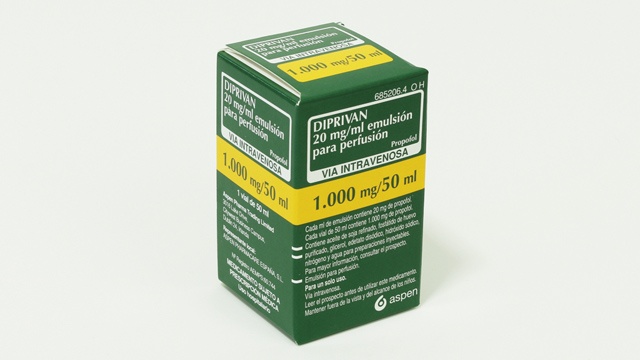
This medicinal product is presented in boxes of one vial with 50 ml of emulsion.
Marketing authorisation holder and manufacturer
Marketing authorisation holder:
Aspen Pharma Trading Limited
3016 Lake Drive,
Citywest Business Campus,
Dublin 24, Ireland
Tel: +34 952 010 137
Manufacturer:
Corden Pharma S.P.A.
Caponago
Milan (Italy)
Local representative:
ASPEN PHARMACARE ESPAÑA, S.L.
Avenida Diagonal, 512,
Planta Interior 1, Oficina 4,
Barcelona, 08006, Spain
Date of last revision of this leaflet: 08/2024
Detailed and up-to-date information on this medicine is available on the website of the Spanish Medicines and Healthcare Products Agency (AEMPS) http://www.aemps.gob.es/
- Country of registration
- Dosage formINJECTABLE, 20 mg propofol/ ml
- ATC codeN01AX10
- Active substance
- Prescription requiredYes
- Manufacturer
- CompositionEDETATO DE DISODIO (55,4 µg mg), GLICEROL (E 422) (22,5 mg mg), HIDROXIDO DE SODIO (E 524) (0,06 mg mg), ACEITE DE SOJA (100 mg mg)
- This information is for reference only and does not constitute medical advice. Always consult a doctor before taking any medication. Oladoctor is not responsible for medical decisions based on this content.
- Alternatives to DIPRIVAN 20 mg/ml EMULSION FOR INFUSIONDosage form: INJECTABLE, 1% propofolActive substance: propofolManufacturer: Aspen Pharma Trading LimitedPrescription requiredDosage form: INJECTABLE, 10 mg/mlActive substance: propofolManufacturer: Baxter Holding B.V.Prescription requiredDosage form: INJECTABLE, 20 mg/mlActive substance: propofolManufacturer: Baxter Holding B.V.Prescription required
Online doctors for DIPRIVAN 20 mg/ml EMULSION FOR INFUSION
Discuss questions about DIPRIVAN 20 mg/ml EMULSION FOR INFUSION, including use, safety considerations and prescription review, subject to medical assessment and local regulations.









Get DIPRIVAN 20 mg/ml EMULSION FOR INFUSION Prescription Online
Fill in a 2-min form
Tell us your symptoms, history, and what medicine you're requesting.
Pick a doctor or let us assign
Choose a specialist or we'll match you with the next available doctor.
Doctor reviews your case
Usually within 30 minutes. They may ask follow-up questions via chat.
Collect from any pharmacy
Electronic prescription sent to your email — valid across Spain.
Frequently Asked Questions
DIPRIVAN 20 mg/ml EMULSION FOR INFUSION requires a prescription in Spain. You can check with a doctor online whether this medicine may be appropriate for your situation.
The active ingredient in DIPRIVAN 20 mg/ml EMULSION FOR INFUSION is propofol. This information helps identify medicines with the same composition but different brand names.
DIPRIVAN 20 mg/ml EMULSION FOR INFUSION is manufactured by Aspen Pharma Trading Limited. Pharmacy brands and packaging may differ depending on the distributor.
Doctors such as Family doctors, Psychiatrists, Dermatologists, Cardiologists, Endocrinologists, Gastroenterologists, Pulmonologists, Nephrologists, Rheumatologists, Hematologists, Infectious disease physicians, Allergists, Geriatricians, Paediatricians, Oncologists may assess whether DIPRIVAN 20 mg/ml EMULSION FOR INFUSION is appropriate, depending on your situation and local regulations. You can book an online consultation to discuss your symptoms and possible next steps.
Spain has a well-developed healthcare infrastructure across major cities such as Madrid, Barcelona, Valencia, and Seville. Pharmacies are widely available and operate under strict regulations, ensuring access to prescribed medications.
You can buy DIPRIVAN 20 mg/ml EMULSION FOR INFUSION in Madrid, Barcelona, Seville, or Valencia at any local pharmacy with a valid prescription.
To obtain a prescription, you can use Oladoctor:
Other medicines with the same active substance (propofol) include DIPRIVAN 10 mg/ml Injectable Emulsion for Infusion, PROPOFOL BAXTER 10mg/ml Injectable Emulsion for Infusion, PROPOFOL BAXTER 20mg/ml Injectable Emulsion for Infusion. These may have different brand names or formulations but contain the same therapeutic ingredient. Always consult a doctor before switching or starting a new medicine.
