



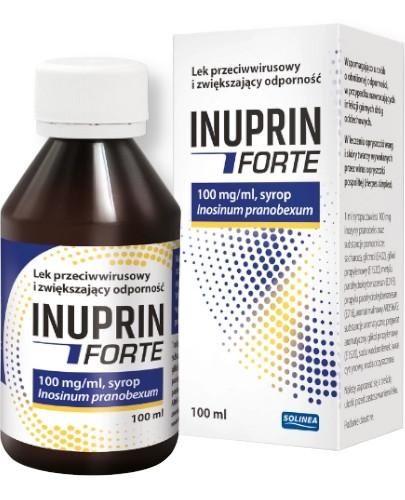
INUPRIN 100 mg /Ml Syrup

Prescription review online
A doctor will review your case and decide whether a prescription is medically appropriate.

Talk to a doctor about this medicine
Discuss your symptoms and possible next steps in a quick online consultation.



How to use Inuprin Forte
Contents of the leaflet
- Package Leaflet: Information for the Patient
- INUPRIN FORTE, 100 mg/ml, Syrup
- What is the medicine and what is it used for
- Important Information Before Using the Medicine
- How to Use the Medicine
- Possible Side Effects
- How to Store the Medicine
- Contents of the Pack and Other Information
Package Leaflet: Information for the Patient
INUPRIN FORTE, 100 mg/ml, Syrup
Inosine Pranobex
Read the package leaflet carefully before using the medicine, as it contains important information for the patient.
This medicine should always be used exactly as described in the package leaflet for the patient or as directed by a doctor or pharmacist.
- Keep this leaflet, you may need to read it again.
- If you need advice or additional information, consult a pharmacist.
- If the patient experiences any side effects, including any possible side effects not listed in the leaflet, they should tell their doctor or pharmacist. See section 4.
- If after 5 to 14 days there is no improvement or the patient feels worse, they should contact their doctor.
Table of Contents of the Leaflet
- 1. What is the medicine and what is it used for
- 2. Important information before using the medicine
- 3. How to use the medicine
- 4. Possible side effects
- 5. How to store the medicine
- 6. Contents of the pack and other information

Not sure if this medicine is right for you?
Discuss your symptoms and treatment with a doctor online.
1. What is the medicine and what is it used for
The medicine contains inosine pranobex as the active substance, which has antiviral and immunostimulating effects.
Indications for Use
The medicine is indicated for use in adults and children over 1 year of age.
- As an adjunct in patients with lowered immunity, in cases of recurrent upper respiratory tract infections.
- In the treatment of herpes labialis and facial skin caused by the herpes simplex virus. The medicine can only be used in patients who have been previously diagnosed with a herpes simplex virus infection.
If after 5 to 14 days there is no improvement or the patient feels worse, they should consult their doctor.
2. Important Information Before Using the Medicine
When Not to Use the Medicine
- If the patient is allergic to inosine pranobex or any of the other ingredients of this medicine (listed in section 6). Symptoms of an allergic reaction may include: rash, itching, difficulty breathing, swelling of the face, lips, tongue, or throat.
- If the patient currently has an acute gout attack (severe joint pain with swelling and redness of the skin or effusion in the large joints) or if tests have shown elevated uric acid levels in the blood.
Warnings and Precautions
Before starting to use the medicine, the patient should discuss it with their doctor or pharmacist.
- If the patient has had gout attacks or elevated uric acid levels in the serum or urine in the past. The medicine may cause transient increases in uric acid levels in the serum and urine.
- If the patient has had kidney or gallstones in the past.
- If the patient has kidney function disorders. In such cases, the doctor will closely monitor the patient. If treatment lasts 3 months or longer, the doctor will order regular blood tests and monitor kidney and liver function. During long-term treatment, kidney stones may form. If symptoms of an allergic reaction occur, such as rash, itching, difficulty breathing, swelling of the face, lips, throat, or tongue, treatment should be stopped immediately and the doctor consulted.
Children
The medicine should not be given to children under 1 year of age.
Medicine Interactions
The patient should tell their doctor or pharmacist about all medicines they are currently taking or have recently taken, as well as any medicines they plan to take.
- Medicines used to treat gout (allopurinol or other medicines);
- Medicines that increase uric acid excretion, including diuretics, such as furosemide, torasemide, etacrynic acid, hydrochlorothiazide, chlortalidone, indapamide;
- Immunosuppressive medicines used in patients after organ transplantation or with atopic dermatitis;
- Medicines used to treat HIV infections (azidothymidine). In these cases, the doctor will assess whether the benefits of using the medicine outweigh the possible risks.
Pregnancy and Breastfeeding
If the patient is pregnant or breastfeeding, thinks they may be pregnant, or plans to have a child, they should consult their doctor or pharmacist before using this medicine.
The medicine should not be taken during pregnancy and breastfeeding, unless the doctor recommends otherwise. The doctor will assess whether the benefits of using the medicine outweigh the possible risks.
Driving and Using Machines
The medicine may affect the ability to drive and use machines. If the patient experiences headache, dizziness, or drowsiness, they should not drive, operate machinery, or perform other activities that require concentration. See also section 4.
Excipients
The medicine contains sucrose, glycerol (E422), propylene glycol (E1520), methyl parahydroxybenzoate (E218), propyl parahydroxybenzoate (E216), and sodium.
The medicine contains sucrose. If the patient has previously been diagnosed with intolerance to some sugars, they should consult their doctor before taking this medicine.
1 ml of the medicine contains 0.65 g of sucrose. This should be taken into account in patients with diabetes.
The medicine contains glycerol (E422). The medicine may cause headache, gastrointestinal disturbances, and diarrhea.
The medicine contains 20.70 mg of propylene glycol (E1520) per 1 ml of syrup.
The medicine contains methyl parahydroxybenzoate (E218) and propyl parahydroxybenzoate (E216). The medicine may cause allergic reactions (possible late reactions).
The medicine contains less than 1 mmol (23 mg) of sodium per 40 ml, which means the medicine is considered "sodium-free".

Started taking the medicine and have questions?
Discuss your symptoms and treatment with a doctor online.
3. How to Use the Medicine
This medicine should always be taken exactly as described in the package leaflet for the patient or as directed by a doctor or pharmacist. If in doubt, the patient should consult their doctor or pharmacist.
The medicine should be taken orally.
The recommended dose is determined based on the patient's body weight. The daily dose should be divided into equal single doses taken several times a day.
Adults, including the elderly (over 65 years)
The recommended daily dose is 50 mg/kg body weight per day (0.5 ml of syrup per 1 kg body weight per day), usually 3 g (i.e., 30 ml of syrup) per day, taken in 3 or 4 divided doses. The maximum dose is 4 g of inosine pranobex per day (i.e., 40 ml of syrup per day).
Do Not Exceed the Maximum Dose of 40 ml per Day.
Children over 1 year of age
The recommended dose is usually 50 mg/kg body weight per day (0.5 ml of syrup per 1 kg body weight per day) in 3 or 4 divided doses per day.
The following table shows the dosing based on the patient's body weight.
*To measure the recommended volume, use the measuring cup provided with the packaging, with a scale of 2.5 ml.
Duration of Treatment
The usual duration of treatment is from 5 to 14 days. It is recommended to continue taking the medicine for 1 to 2 days after the symptoms of the disease have resolved.
Use in Children
The medicine should not be used in children under 1 year of age.
Overdose
There have been no reported cases of overdose. In case of any doubts or discomfort, the patient should immediately consult their doctor.
Missed Dose
| Body Weight | Daily Dosing |
| 10-14 kg | 3 x 2.5 ml syrup* |
| 15-20 kg | 3 x 2.5 to 3.75 ml syrup* |
| 21-30 kg | 3 x 3.75 to 5 ml syrup* |
| 31-40 kg | 3 x 5 to 7.5 ml syrup* |
| 41-50 kg | 3 x 7.5 to 8.75 ml syrup* |
If a dose of the medicine is missed, it should be taken as soon as possible, unless it is close to the time for the next dose. A double dose should not be taken to make up for a missed dose.
Stopping Treatment
If treatment is stopped, the expected therapeutic effect may not be achieved, or the symptoms of the disease may worsen.
If the patient has any further doubts about using this medicine, they should consult their doctor or pharmacist.
4. Possible Side Effects
Like all medicines, this medicine can cause side effects, although not everybody gets them.
Any medicine can cause an allergic reaction, but severe allergic reactions after taking this medicine are very rare.
Stop using the medicine and consult a doctor immediatelyif any of the following symptoms occur:
- sudden wheezing;
- difficulty breathing;
- swelling of the eyelids, face, or lips;
- rash or itching (especially if it affects the whole body).
The following side effects may occur:
Very Common(occurring in more than 1 in 10 patients):
- increased uric acid levels in the blood, increased uric acid levels in the urine.
Common(occurring in less than 1 in 10 patients):
- increased liver enzyme activity, increased urea levels in the blood,
- nausea with or without vomiting,
- discomfort in the upper abdomen,
- itching of the skin,
- skin rash (as the only symptom),
- headache,
- dizziness,
- fatigue or malaise,
- joint pain.
Uncommon(occurring in less than 1 in 100 patients)
- diarrhea,
- constipation,
- nervousness,
- drowsiness or difficulty sleeping (insomnia),
- increased urine output (polyuria).
Frequency Not Known(cannot be estimated from the available data):
- angioedema (a severe allergic reaction that causes swelling of the face, lips, tongue, or throat, which can cause difficulty swallowing and breathing), allergic reaction, urticaria, anaphylactic reaction (a sudden, life-threatening allergic reaction that affects the whole body);
- dizziness;
- redness of the skin (flushing);
- discomfort in the upper abdomen.
Reporting Side Effects
If any side effects occur, including any side effects not listed in the leaflet, the patient should tell their doctor or pharmacist, or nurse. Side effects can be reported directly to the Department of Pharmacovigilance of the Office for Registration of Medicinal Products, Medical Devices, and Biocidal Products:
Al. Jerozolimskie 181C, 02-222 Warsaw
Tel. +48 22 49 21 301
Fax +48 22 49 21 309
Website: https://smz.ezdrowie.gov.pl
Side effects can also be reported to the marketing authorization holder.
Reporting side effects will help to gather more information on the safety of the medicine.
5. How to Store the Medicine
The medicine should be stored out of sight and reach of children.
Store in a temperature below 25°C.
Shelf life after first opening the package: 6 months.
Do not use this medicine after the expiry date stated on the package after "Expiry Date (EXP)".
The expiry date refers to the last day of the month stated.
Medicines should not be disposed of via wastewater or household waste. The patient should ask their pharmacist how to dispose of medicines no longer required. This will help protect the environment.
6. Contents of the Pack and Other Information
What the Medicine Contains
- The active substance of the medicine is inosine pranobex.
- The other ingredients are: sucrose, glycerol (E422), propylene glycol (E1520), methyl parahydroxybenzoate (E218), propyl parahydroxybenzoate (E216), raspberry flavor AR0616/G: flavoring substances, flavoring preparation, propylene glycol (E1520), sodium hydroxide, citric acid, purified water.
Appearance and Contents of the Pack
The medicine is a clear, colorless to light yellow syrup with a raspberry flavor and aroma, available in a brown PET bottle with an HDPE cap and a PP measuring cup with a scale of 2.5 ml.
Package size: One bottle containing 100 ml of syrup.
Marketing Authorization Holder and Manufacturer
Marketing Authorization Holder
Solinea Sp. z o.o.
Elizówka, ul. Szafranowa 6
21-003 Ciecierzyn
Tel. 81 463 48 82
Fax 81 463 48 86
e-mail [email protected]
Manufacturer
Mako Pharma Sp. z o.o.
ul. Kolejowa 231A
05-092 Dziekanów Polski
Tel. 22 256 86 82
e-mail [email protected]
Medicofarma S.A.
ul. Tarnobrzeska 13
26-613 Radom
Date of Last Revision of the Leaflet: 05/2024
- Country of registration
- Dosage formSyrup, 100 mg/ml
- ATC codeJ05AX05
- Active substance
- Prescription requiredNo
- Manufacturer
- ImporterMako Pharma Sp. z o.o. Medicofarma S.A.
- This information is for reference only and does not constitute medical advice. Always consult a doctor before taking any medication. Oladoctor is not responsible for medical decisions based on this content.
- Alternatives to Inuprin ForteDosage form: Syrup, 500 mg/5 mlActive substance: inosine pranobexManufacturer: Zakłady Farmaceutyczne POLPHARMA S.A.Prescription not requiredDosage form: Syrup, 500 mg/5 mlActive substance: inosine pranobexPrescription not requiredDosage form: Syrup, 250 mg/5 mlActive substance: inosine pranobexManufacturer: Zakłady Farmaceutyczne POLPHARMA S.A.Prescription not required
Online doctors for Inuprin Forte
Discuss questions about Inuprin Forte, including use, safety considerations and prescription review, subject to medical assessment and local regulations.









Get Inuprin Forte Prescription Online
Fill in a 2-min form
Tell us your symptoms, history, and what medicine you're requesting.
Pick a doctor or let us assign
Choose a specialist or we'll match you with the next available doctor.
Doctor reviews your case
Usually within 30 minutes. They may ask follow-up questions via chat.
Collect from any pharmacy
Electronic prescription sent to your email — valid across Spain.
Frequently Asked Questions
Inuprin Forte does not require a prescription in Poland. You can check with a doctor online whether this medicine may be appropriate for your situation.
The active ingredient in Inuprin Forte is inosine pranobex. This information helps identify medicines with the same composition but different brand names.
Inuprin Forte is manufactured by Mako Pharma Sp. z o.o. Medicofarma S.A.. Pharmacy brands and packaging may differ depending on the distributor.
Doctors such as Family doctors, Psychiatrists, Dermatologists, Cardiologists, Endocrinologists, Gastroenterologists, Pulmonologists, Nephrologists, Rheumatologists, Hematologists, Infectious disease physicians, Allergists, Geriatricians, Paediatricians, Oncologists may assess whether Inuprin Forte is appropriate, depending on your situation and local regulations. You can book an online consultation to discuss your symptoms and possible next steps.
Spain has a well-developed healthcare infrastructure across major cities such as Madrid, Barcelona, Valencia, and Seville. Pharmacies are widely available and operate under strict regulations, ensuring access to prescribed medications.
You can buy Inuprin Forte in Madrid, Barcelona, Seville, or Valencia at any local pharmacy with a valid prescription.
To obtain a prescription, you can use Oladoctor:
Other medicines with the same active substance (inosine pranobex) include Akvir Forte o smaku malinovim, Akvir Forte o smaku truskavkovim, Akvir o smaku malinovim. These may have different brand names or formulations but contain the same therapeutic ingredient. Always consult a doctor before switching or starting a new medicine.
