


Haemoctin 1000
Ask a doctor about a prescription for Haemoctin 1000




How to use Haemoctin 1000
Leaflet accompanying the packaging: information for the user
Haemoctin 250
Haemoctin 500
Haemoctin 1000
Powder and solvent for solution for injection
Human blood coagulation factor VIII
Read the leaflet carefully before using the medicine, as it contains important information for the patient.
- Keep this leaflet, you may need to read it again.
- In case of any doubts, consult a doctor, pharmacist or nurse.
- This medicine has been prescribed specifically for you. Do not pass it on to others. The medicine may harm another person, even if their symptoms are the same.
- If the patient experiences any side effects, including any not listed in this leaflet, they should tell their doctor, pharmacist or nurse. See section 4.
Table of contents of the leaflet:
- 1. What is Haemoctin and what is it used for
- 2. Important information before using Haemoctin
- 3. How to use Haemoctin
- 4. Possible side effects
- 5. How to store Haemoctin
- 6. Contents of the packaging and other information
1. What is Haemoctin and what is it used for
Haemoctin is a medicine produced from human plasma. It contains factor VIII, a coagulation factor necessary for the proper blood coagulation process. After dissolving the powder in water for injection, the solution is ready for intravenous injection.
Haemoctin is used to treat and prevent bleeding in patients with hemophilia A (congenital factor VIII deficiency).
Haemoctin does not contain von Willebrand factor in pharmacologically effective amounts, and is therefore not intended for the treatment of von Willebrand disease.
2. Important information before using Haemoctin
When not to use Haemoctin
Warnings and precautions
The formation of inhibitors (antibodies) is a known complication that may occur during treatment with all factor VIII medicines. These inhibitors, especially at high concentrations, disrupt proper treatment, and the patient will be closely monitored for the production of these inhibitors. If bleeding in the patient is not properly controlled with Haemoctin, the doctor should be informed immediately.
If the patient has existing risk factors for cardiovascular diseases, treatment with Haemoctin may increase cardiovascular risk. In case of doubts, consult a doctor.
Complications resulting from the introduction of a vascular catheter: If a central venous access device (CVAD) is required, the risk of complications associated with CVAD, including local infections, bacteremia, and thrombosis at the catheter insertion site, should be considered.
Viral safety
When medicinal products are produced from human blood or plasma, certain measures are taken to prevent the transmission of infections to patients. These include:
- careful selection of blood and plasma donors to ensure the exclusion of donors who may be carriers of infections,
- testing of all collected samples and plasma pools for the presence of viruses/infections,
- implementation of virus inactivation or removal steps in the blood or plasma processing. Despite these measures, when administering medicines prepared from human blood or plasma, it cannot be completely ruled out that the transmission of infection is possible. This also applies to unknown or newly discovered viruses or other types of infections.
These measures are considered effective against enveloped viruses, such as human immunodeficiency virus (HIV), hepatitis B virus, and hepatitis C virus, as well as non-enveloped viruses such as hepatitis A virus. The measures taken may have limited effectiveness against non-enveloped viruses, such as parvovirus B19. Parvovirus B19 infection can be hazardous for pregnant women (fetal infection) and for individuals with impaired immune systems or with certain types of anemia (e.g., sickle cell or hemolytic).
The treating doctor may recommend that the patient consider vaccination against hepatitis A and B, if the patient regularly/repeatedly receives products containing factor VIII produced from human plasma.
It is strongly recommended that each time a dose of Haemoctin is administered, the name and batch number of the medicine be recorded, in order to be able to trace the batches used in the future.
Children and adolescents
Warnings and precautions for use listed for adults should also be considered for children and adolescents.
Haemoctin and other medicines
Tell the doctor about all medicines the patient is currently taking or has recently taken, as well as any medicines the patient plans to take.
Interactions between Haemoctin and other medicinal products have not been reported.
Pregnancy, breastfeeding, and fertility
If the patient is pregnant or breastfeeding, thinks they may be pregnant, or plans to have a child, they should consult a doctor before using this medicine.
Due to the rare occurrence of hemophilia A in women, there is a lack of available experience with the use of factor VIII during pregnancy or breastfeeding. No studies have been conducted in animals during pregnancy and breastfeeding.
Driving and using machines
Haemoctin has no influence or negligible influence on the ability to drive and use machines.
Haemoctin contains sodium
Haemoctin 250 contains a maximum of 16.1 mg (0.70 mmol) of sodium (the main component of common salt) per vial. This corresponds to 0.81% of the maximum recommended daily intake of sodium in the diet for adults.
Haemoctin 500/1000 contains a maximum of 32.2 mg (1.40 mmol) of sodium (the main component of common salt) per vial. This corresponds to 1.61% of the maximum recommended daily intake of sodium in the diet for adults.
3. How to use Haemoctin
Haemoctin is intended for intravenous administration (injection into a vein). Treatment should be under the supervision of a doctor experienced in the treatment of hemophilia A. Haemoctin should always be used in accordance with the doctor's recommendations. In case of doubts, consult a doctor again.
The dose and duration of treatment depend on the degree of factor VIII deficiency, the location and extent of bleeding, and the patient's clinical condition. The doctor will determine the dose suitable for the patient.
Sterile working conditions must be ensured during all stages of the procedure.
Fig. 1a
Fig. 1b
Fig. 1c
Fig. 2
Fig. 3
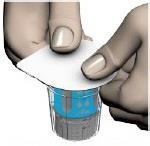
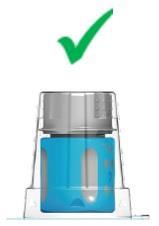
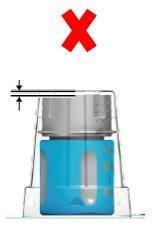
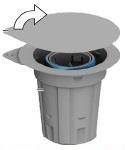
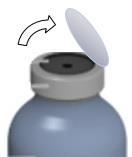
Fig. 4
Fig. 5
Fig. 6
Fig. 7
Fig. 8
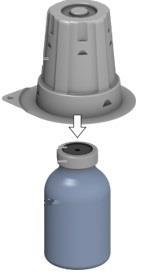
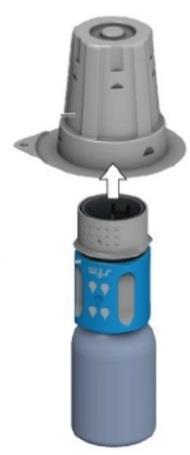
Dissolving the concentrate:
- Bring the solvent (water for injection) and the product to room temperature in unopened vials. When using a water bath for heating, be very careful not to let the water come into contact with the vial caps or stoppers. Otherwise, the medicine may become contaminated.
- Very importantfor proper use of the transfer system: before opening, make sure that the white lower part of the transfer system is seated directly on the blister base (Fig. 1a: correct / Fig. 1b: incorrect). If incorrect: press the transfer system down into the blister until the white lower part of the transfer system is seated directly on the blister base (Fig. 1c).
- Remove the caps from the solvent vial and product vial, exposing the central parts of the rubber stoppers (Fig. 2). Clean the rubber stoppers of the product and solvent vials with a disinfectant.
- Pull off the top of the transfer system packaging (Fig. 3).
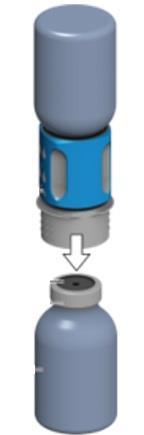
- Place the solvent vial on a flat surface. Place the blue part of the transfer system in the blister straight onto the upright solvent vial (Fig. 4). Do not twist the transfer system!
- Pull off the remaining part of the blister from the transfer system. Do not squeeze the blister! Now the white part of the transfer system is exposed (Fig. 5).
- Place the product vial on a flat surface.
- Turn the connected transfer system and solvent vial upside down. Press the spike of the white adapter part vertically down through the stopper of the product vial (Fig. 6). The vacuum in the product vial causes the solvent to flow into the product vial.
- Gentle rocking of the product vial helps to dissolve the powder. Do not shake vigorously, to avoid foaming! The solution is clear or slightly opalescent.
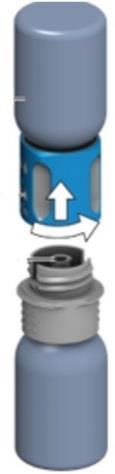
- Then unscrew the blue part of the transfer system together with the solvent vial in the direction opposite to the clockwise direction (Fig. 7). Discard the solvent vial with the attached blue part of the transfer system. Now the luer-lock connector is visible.
The ready-to-use solution should be used immediately after reconstitution. Do not use solutions that are cloudy or contain solid particles.
Injection:
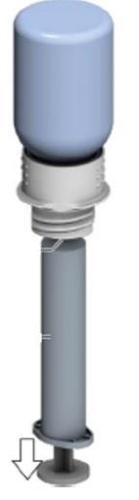
- After reconstituting the powder as described above, attach the provided syringe to the luer-lock connector of the product vial with the white part of the transfer system (Fig. 8). This will allow easy withdrawal of the reconstituted medicine into the syringe. A separate filter is not necessary, as the transfer system is equipped with an integrated filter.
- Carefully detach the product vial with the white part of the transfer system from the syringe. Slowly inject the product intravenously using the provided butterfly needle. It is recommended not to administer more than 2-3 ml/minute.
- After using the butterfly needle, it can be secured with a protective cap.
Using a higher dose of Haemoctin than recommended
If the patient thinks they have received too high a dose of Haemoctin, they should consult a doctor, who will decide on further treatment.
Missing a dose of Haemoctin
In such a case, the treating doctor will decide whether further treatment is necessary.
Stopping the use of Haemoctin
Do not stop using Haemoctin without consulting a doctor.
In case of any further doubts regarding the use of this medicine, consult a doctor or pharmacist.
4. Possible side effects
Like all medicines, this medicine can cause side effects, although not everybody gets them.
In case of observing any of the following symptoms, inform a doctor immediately:
- redness of the skin,
- feeling of burning and stinging at the injection site,
- chills,
- sudden redness of the face,
- headache,
- hives,
- low blood pressure,
- drowsiness,
- nausea,
- restlessness,
- rapid heartbeat,
- chest tightness,
- tingling,
- vomiting,
- wheezing. This may be an allergic reaction or a severe allergic reaction (anaphylactic shock) or hypersensitivity reaction.
The following side effects have been observed with the use of Haemoctin
Unknown: frequency cannot be estimated from the available data
- anaphylactic shock, allergic reaction
- redness of the skin, itching, hives
In children not previously treated with factor VIII medicines, inhibitory antibodies (see section 2) may develop very frequently (more than 1 in 10 patients). However, in patients who have previously been treated with factor VIII (more than 150 days of treatment), the risk is not very common (less than 1 in 100 patients). If this happens, the patient's medicines may stop working properly, and the patient may experience persistent bleeding. If this happens, consult a doctor immediately.
Side effects in children and adolescents
Except for the formation of inhibitors (antibodies), it is expected that side effects in children are the same as in adults.
Reporting side effects
If side effects occur, including any not listed in the leaflet, tell a doctor, pharmacist, or nurse. Side effects can be reported directly to the Department of Drug Safety, Office for Registration of Medicinal Products, Medical Devices, and Biocidal Products
Al. Jerozolimskie 181C
02 222 Warsaw
Phone: +48 22 49 21 301
Fax: +48 22 49 21 309
Website: https://smz.ezdrowie.gov.pl
Side effects can also be reported to the marketing authorization holder.
Reporting side effects will help to gather more information on the safety of this medicine.
5. How to store Haemoctin
Keep the medicine out of the sight and reach of children.
Store the vials in the outer packaging to protect from light.
Do not store above 25°C. Do not freeze.
Do not use this medicine after the expiry date stated on the vial label and outer packaging after: Expiry date.
Any unused product or waste material should be disposed of in accordance with local requirements. Medicines should not be disposed of via wastewater or household waste. Ask a pharmacist how to dispose of medicines that are no longer needed. This will help protect the environment.
6. Contents of the packaging and other information
What Haemoctin contains
- The active substance of the medicine is: human coagulation factor VIII.
- The other ingredients are: glycine, sodium chloride, sodium citrate, and calcium chloride.
- The solvent vial contains water for injection.
What Haemoctin looks like and what the packaging contains
Haemoctin is provided as a lyophilized powder (lyophilisate). Water for injection is used as a solvent. The reconstituted product is clear or slightly opalescent.
Haemoctin 250 contains 1 vial with 250 IU and 1 vial with 5 ml of water for injection (50 IU/ml)
Haemoctin 500 contains 1 vial with 500 IU and 1 vial with 5 ml of water for injection (100 IU/ml)
Haemoctin 1000 contains 1 vial with 1000 IU and 1 vial with 5 ml of water for injection (200 IU/ml)
Each package contains
- one single-use syringe
- one transfer system with an integrated filter
- one butterfly needle
Marketing authorization holder and manufacturer:
Biotest Pharma GmbH
Landsteinerstrasse 5
63303 Dreieich
Germany
Phone: +49 6103 801-0
Fax: +49 6103 801-150
Email: [email protected]
Date of last revision of the leaflet: 12/2022.
Information intended for healthcare professionals only:
Monitoring of treatment
To determine the dose to be administered and the frequency of repeated infusions, it is recommended to appropriately determine the factor VIII levels during treatment. Individual patients may differ in their response to factor VIII, showing different half-lives and different recovery levels. The dose based on body weight may need to be adjusted in patients who are underweight or overweight. Especially in the case of major surgical procedures, precise control of substitution therapy through coagulation testing (factor VIII activity in plasma) is necessary.
In the case of using a one-stage in vitro coagulation test based on activated partial thromboplastin time (aPTT) to determine factor VIII activity in patient blood samples, both the type of aPTT reagent and the reference standard used in the test may have a significant impact on the results of factor VIII activity measurements in plasma. There may also be significant differences between the results of the one-stage aPTT test and the chromogenic test according to the European Pharmacopoeia. This is particularly important in the case of changes in the laboratory and/or reagents used in the test.
Dosing
The dose and duration of substitution therapy depend on the degree of factor VIII deficiency, the location and extent of bleeding, and the patient's clinical condition.
The amount of factor VIII administered is expressed in international units (IU), referring to the current WHO standard for factor VIII concentrates. Factor VIII activity in plasma is expressed either as a percentage (relative to normal human plasma) or better in international units (relative to the international standard for factor VIII in plasma).
One international unit (IU) of factor VIII activity corresponds to the amount of factor VIII in one milliliter of normal human plasma.
On-demand treatment
The calculation of the required dose of factor VIII is based on the empirical observation that 1 international unit (IU) of factor VIII per 1 kg of body weight increases the factor VIII activity in plasma by 1 to 2% of normal activity. The required dose is determined based on the following formula:
Required units = body weight (kg) × desired factor VIII increase (%) × 0.5
The required amount to be administered and the frequency of administration should always be adjusted to the clinical effectiveness in individual cases.
In the case of the following types of bleeding, factor VIII activity in plasma should not fall below the specified level of activity (% of normal) during the relevant period. To determine the dose depending on the type of bleeding and surgical procedure, the following table can be used:
Bleeding severity /
Type of surgical procedure
Required factor VIII level (%)
Dose frequency (hours) /
Duration of therapy (days)
Bleeding
Early bleeding into joints,
muscles or bleeding from the mouth
- 20 - 40 Repeat every 12-24 hours. At least 1 day, until the pain caused by bleeding subsides or until the wound heals. More severe bleeding into joints, muscles or life-threatening bleeding
- 30 - 60 Repeat every 12-24 hours for 3-4 days or longer until the pain and acute disability subside. Life-threatening bleeding
- 60 - 100 Repeat every 8-24 hours until the threat subsides.
Surgical procedures
Minor surgical procedure
including tooth extraction
- 30 - 60 Every 24 hours, at least 1 day, until wound healing. Major surgical procedure
- 80 - 100 (pre- and post-operative) Repeat every 8-24 hours until adequate wound healing is achieved, and then continue for at least 7 days to maintain factor VIII activity at 30-60%.
Prophylaxis
In long-term prophylaxis of bleeding in patients with severe hemophilia A, the usual doses of factor VIII are 20-40 IU/kg body weight at intervals of 2-3 days. In some cases, especially in younger patients, shorter intervals between doses or higher doses may be necessary.
Method of administration:
Intravenous administration. It is recommended not to administer more than 2-3 ml/minute.
Only the provided infusion set should be used, as adsorption of factor VIII onto the inner surfaces of some infusion sets may lead to treatment failure.
Haemoctin must not be mixed with other medicinal products.
- Country of registration
- Active substance
- Prescription requiredYes
- Manufacturer
- ImporterBiotest Pharma GmbH
- This information is for reference only and does not constitute medical advice. Always consult a licensed doctor before taking any medication. Oladoctor is not responsible for medical decisions based on this content.
- Alternatives to Haemoctin 1000Dosage form: Powder, 1000 IUActive substance: coagulation factor VIIIManufacturer: CSL Behring GmbHPrescription requiredDosage form: Powder, 2000 IUActive substance: coagulation factor VIIIManufacturer: CSL Behring GmbHPrescription requiredDosage form: Powder, 250 IUActive substance: coagulation factor VIIIManufacturer: CSL Behring GmbHPrescription required
Alternatives to Haemoctin 1000 in other countries
The best alternatives with the same active ingredient and therapeutic effect.
Alternative to Haemoctin 1000 in Hiszpania
Alternative to Haemoctin 1000 in Ukraina
Online doctors for Haemoctin 1000
Discuss dosage, side effects, interactions, contraindications, and prescription renewal for Haemoctin 1000 – subject to medical assessment and local rules.

Get updates and exclusive offers
Be the first to know about new services, marketplace updates, and subscriber-only promos.

