


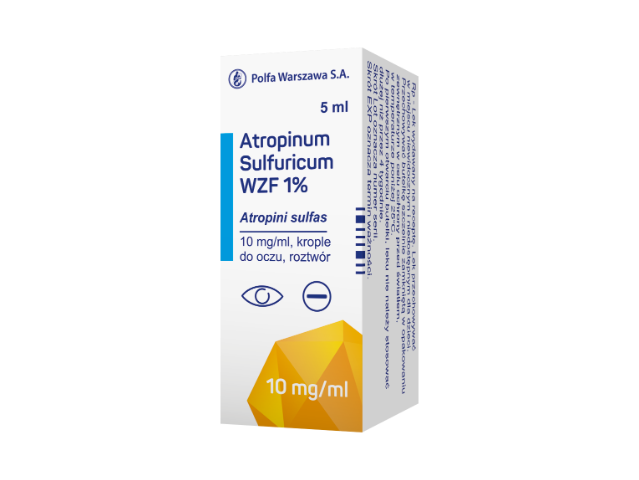



How to use Atropinum sulfuricum Vzf 1%
Leaflet attached to the packaging: patient information
Atropinum Sulfuricum WZF 1%, 10 mg/ml, eye drops, solution
Atropine sulfate
Read the leaflet carefully before using the medicine, as it contains important information for the patient.
- Keep this leaflet, you may need to read it again.
- If you have any further questions, ask your doctor or pharmacist.
- This medicine has been prescribed for you only. Do not pass it on to others. It may harm them, even if their symptoms are the same as yours.
- If you experience any side effects, including any not listed in this leaflet, please tell your doctor or pharmacist. See section 4.
Table of contents of the leaflet
- 1. What is Atropinum Sulfuricum WZF 1% and what is it used for
- 2. Important information before using Atropinum Sulfuricum WZF 1%
- 3. How to use Atropinum Sulfuricum WZF 1%
- 4. Possible side effects
- 5. How to store Atropinum Sulfuricum WZF 1%
- 6. Contents of the packaging and other information
1. What is Atropinum Sulfuricum WZF 1% and what is it used for
The medicine contains atropine, which, when applied locally to the eye, dilates the pupil and paralyzes the eye's accommodation (ability to adapt to sharp vision of objects at different distances).
The medicine is used:
- for long-term dilation of the pupil, in diagnostic eye exams and refraction tests (performed to determine vision defects) in young children;
- to treat uveitis and to prevent complications called synechiae.
2. Important information before using Atropinum Sulfuricum WZF 1%
When not to use Atropinum Sulfuricum WZF 1%:
- if you are allergic to atropine sulfate or other substances with similar action (called anticholinergics), or any of the other ingredients of this medicine (listed in section 6);
- if you have primary glaucoma (increased pressure in the eyes) with a tendency to angle closure;
- if you have glaucoma with a narrow angle.
Warnings and precautions
Before starting to use Atropinum Sulfuricum WZF 1%, discuss it with your doctor or pharmacist.
- After using atropine, protect your eyes from light.
- The drops, due to the type of active substance, may temporarily worsen vision.
- Due to the risk of inducing high fever, atropine should be used with great caution when the ambient temperature is high or the patient has a fever.
- Caution should be exercised in patients with tachycardia (accelerated heart rate).
- In elderly patients, side effects may occur or worsen.
- Pupil dilation may accelerate a glaucoma attack in people over 60 years old.
Children
In children under 6 years of age, it is recommended to use a medicine containing atropine in a lower concentration.
Particular caution is recommended when using atropine in infants and young children, as side effects may occur or worsen.
Atropinum Sulfuricum WZF 1% and other medicines
Tell your doctor or pharmacist about all medicines you are taking, or have recently taken, and about medicines you plan to use.
The action of atropine is enhanced by medicines with anticholinergic action, such as amitriptyline (an antidepressant), haloperidol and chlorpromazine (medicines used in psychiatric disorders), hydroxyzine, clemastine (antihistamines of the first generation) and some medicines used in Parkinson's disease.
When atropine and physostigmine, neostigmine or pilocarpine (medicines used, for example, in the treatment of glaucoma) are used together, their actions are mutually neutralized.
Pregnancy and breastfeeding
If you are pregnant or breastfeeding, think you may be pregnant or plan to have a child, consult your doctor or pharmacist before using this medicine.
The medicine may be used during pregnancy only if, in the doctor's opinion, the benefit to the mother outweighs the potential risk to the fetus.
It is not known whether atropine passes into breast milk; the use of the medicine in a breastfeeding woman requires caution.
Driving and using machines
Atropine causes long-lasting vision disturbances (even up to 5-7 days after use).
During the use of the medicine and the persisting vision disturbances after its use, do not drive vehicles and do not operate machines.
Atropinum Sulfuricum WZF 1% contains benzalkonium chloride
The medicine contains 0.1 mg of benzalkonium chloride in each ml of solution. Benzalkonium chloride may be absorbed by soft contact lenses and change their color. Contact lenses should be removed before instillation and not put back for at least 15 minutes. Benzalkonium chloride may also cause eye irritation, especially in people with dry eye syndrome or corneal disorders (the transparent layer at the front of the eye). If abnormal sensations in the eye, stinging or pain in the eye occur after using the medicine, consult a doctor.
3. How to use Atropinum Sulfuricum WZF 1%
This medicine should always be used exactly as your doctor or pharmacist has told you. If you are not sure, ask your doctor or pharmacist.
In the case of ophthalmic examinations, the dosage is determined by the doctor.
Usually, the medicine is used as described below.
Eye refraction test in children:
- from 6 years of age: 1 drop of the medicine 2 times a day for 3 days. An additional dose may be given directly before the ophthalmic examination.
- under 6 years of age, it is recommended to use a medicine containing atropine in a lower concentration.
Therapeutically, one drop is administered into the conjunctival sac, up to 2 times a day.
Method of administration
Atropinum Sulfuricum WZF 1% is intended for external use - it should be applied locally to the eye (eyes).
Do not touch the dropper tip to the eye, eyelids, or any other surfaces, as this may cause infection. Using infected drops can lead to dangerous complications, even vision loss. When instilling, be very careful not to get the medicine into your mouth.
- 1. Before instilling the medicine, wash your hands thoroughly.
- 2. Unscrew the cap on the bottle.
- 3. Tilt your head back and pull the lower eyelid down to create a pocket between the eyelid and the eyeball.
- 4. Turn the bottle upside down and gently press the thumb or index finger on the wall until one drop of the medicine falls into the eye. Do not touch the dropper tip to the eye or eyelids. If the drop did not get into the eye, instill the next one.
- 5. Immediately after instilling the medicine, gently press the inner corner of the eye for about 1 minute. This will help reduce the risk of systemic side effects.
- 6. If the doctor has prescribed instillation of the medicine into the other eye, repeat the actions from points 3, 4, and 5.
- 7. The dropper is designed to accurately measure drops, so do not enlarge the opening in the dropper.
- 8. After instillation, screw the bottle cap back on. However, do not screw it too tightly.
- 9. After using the drops, wash your hands thoroughly.
Using more than the recommended dose of Atropinum Sulfuricum WZF 1%
In case of absorption into the general circulation of an excessive amount of atropine sulfate, symptoms such as: balance disorders, behavioral disorders, dizziness, accelerated heart rate, arrhythmia (change in normal heart rhythm), fever, hallucinations (visual, auditory), rash, bloating (in infants), increased thirst, dryness in the mouth, drowsiness, fatigue, weakness, dry skin, urinary retention may occur. The following may also occur: skin rash (as a sign of hypersensitivity), severe generalized reactions with decreased blood pressure and worsening respiratory disorders. If the above symptoms occur or the medicine has been used incorrectly (e.g., it has been drunk), the patient should immediately contact a doctor who will provide appropriate treatment.
Missing a dose of Atropinum Sulfuricum WZF 1%
If a dose of the medicine is missed, it should be administered as soon as possible. If it is almost time for the next dose, skip the missed dose and use the next one according to the established schedule. Do not use a double dose to make up for the missed dose.
4. Possible side effects
Like all medicines, this medicine can cause side effects, although not everybody gets them.
If you experience allergic reactions, including rash, swelling of the face, lips, tongue, and/or
throat, which may cause difficulty breathing or swallowing, or other serious side effects, stop using
Atropinum Sulfuricum WZF 1% and contact your doctor or the Emergency Department of the nearest hospital immediately.
The frequency of side effects is not known (cannot be determined from available data). The following may occur:
- vision and accommodation disorders, increased intraocular pressure, especially in patients with glaucoma with a narrow (closing) angle, conjunctivitis (symptoms: feeling of a foreign body under the eyelids, stinging, burning, presence of discharge), itching, eyelid swelling, tearing, hypersensitivity to light (when the pupils are dilated, protect your eyes from bright light). Local irritation, transient burning, hyperemia, swelling, and conjunctivitis occur after prolonged use of the medicine.
- skin rash (as a sign of hypersensitivity);
- severe ataxia (motor incoordination), anxiety, agitation, and hallucinations, especially in infants and elderly patients;
- dry mouth, difficulty swallowing and speaking, redness and dryness of the skin, transient bradycardia (slow heart rate) turning into tachycardia (accelerated heart rate), palpitations, and arrhythmia (change in heart rhythm), decreased bronchial secretion, urinary urgency, and urinary retention, as well as constipation;
- confusional state - severe consciousness disorders (especially in older people), nausea, vomiting, and dizziness.
During the use of the medicine, general side effects may occur and the symptoms listed above may appear (see the section "Using more than the recommended dose of Atropinum Sulfuricum WZF 1%").
Reporting side effects
If you experience any side effects, including any not listed in this leaflet, please tell your doctor or pharmacist, or nurse. Side effects can be reported directly to the Department of Pharmacovigilance of the Office for Registration of Medicinal Products, Medical Devices, and Biocidal Products
Al. Jerozolimskie 181C
02-222 Warsaw
Phone: +48 22 49 21 301
Fax: +48 22 49 21 309
Website: https://smz.ezdrowie.gov.pl
Side effects can also be reported to the marketing authorization holder.
By reporting side effects, you can help provide more information on the safety of this medicine.
5. How to store Atropinum Sulfuricum WZF 1%
Store the bottle tightly closed in the outer packaging to protect from light, at a temperature below 25°C.
Keep the medicine out of the sight and reach of children.
After opening the bottle, do not use the medicine for more than 4 weeks.
Do not use this medicine after the expiry date stated on the carton and bottle.
The expiry date stated is the last day of the month.
The inscription on the packaging after the abbreviation EXP means the expiry date, and after the abbreviation Lot means the batch number.
Medicines should not be disposed of via wastewater or household waste. Ask your pharmacist how to dispose of medicines no longer required. This will help protect the environment.
6. Contents of the packaging and other information
What does Atropinum Sulfuricum WZF 1% contain
- The active substance of the medicine is atropine sulfate. Each ml of solution contains 10 mg of atropine sulfate.
- The other ingredients are: hydroxyethyl cellulose, boric acid, disodium edetate, benzalkonium chloride solution, 10% hydrochloric acid (to adjust pH), purified water.
What Atropinum Sulfuricum WZF 1% looks like and what the packaging contains
Atropinum Sulfuricum WZF 1% is a sterile eye drop solution in the form of a clear, colorless or yellow liquid.
The medicine is available in polyethylene bottles containing 5 ml of solution, packed in a cardboard box.
Marketing authorization holder
Zakłady Farmaceutyczne POLPHARMA S.A.
ul. Pelplińska 19, 83-200 Starogard Gdański
phone: +48 22 364 61 01
Manufacturer
Warszawskie Zakłady Farmaceutyczne Polfa S.A.
ul. Karolkowa 22/24; 01-207 Warsaw
Date of last revision of the leaflet:
- Country of registration
- Active substance
- Prescription requiredYes
- Manufacturer
- ImporterWarszawskie Zakłady Farmaceutyczne POLFA S.A.
- This information is for reference only and does not constitute medical advice. Always consult a licensed doctor before taking any medication. Oladoctor is not responsible for medical decisions based on this content.
- Alternatives to Atropinum sulfuricum Vzf 1%Dosage form: Drops, 100 mcg/mlActive substance: atropineManufacturer: Jadran-Galenski laboratorij d.d.Prescription requiredDosage form: Drops, 10 mg/mlActive substance: cyclopentolateDosage form: Solution, (0.2 mg + 3.1 mg + 10 mg)/mlActive substance: tropicamide, combinationsManufacturer: Delpharm Tours Laboratoires THEAPrescription required
Alternatives to Atropinum sulfuricum Vzf 1% in other countries
The best alternatives with the same active ingredient and therapeutic effect.
Alternative to Atropinum sulfuricum Vzf 1% in Ukraina
Alternative to Atropinum sulfuricum Vzf 1% in Hiszpania
Online doctors for Atropinum sulfuricum Vzf 1%
Discuss dosage, side effects, interactions, contraindications, and prescription renewal for Atropinum sulfuricum Vzf 1% – subject to medical assessment and local rules.

Get updates and exclusive offers
Be the first to know about new services, marketplace updates, and subscriber-only promos.

