


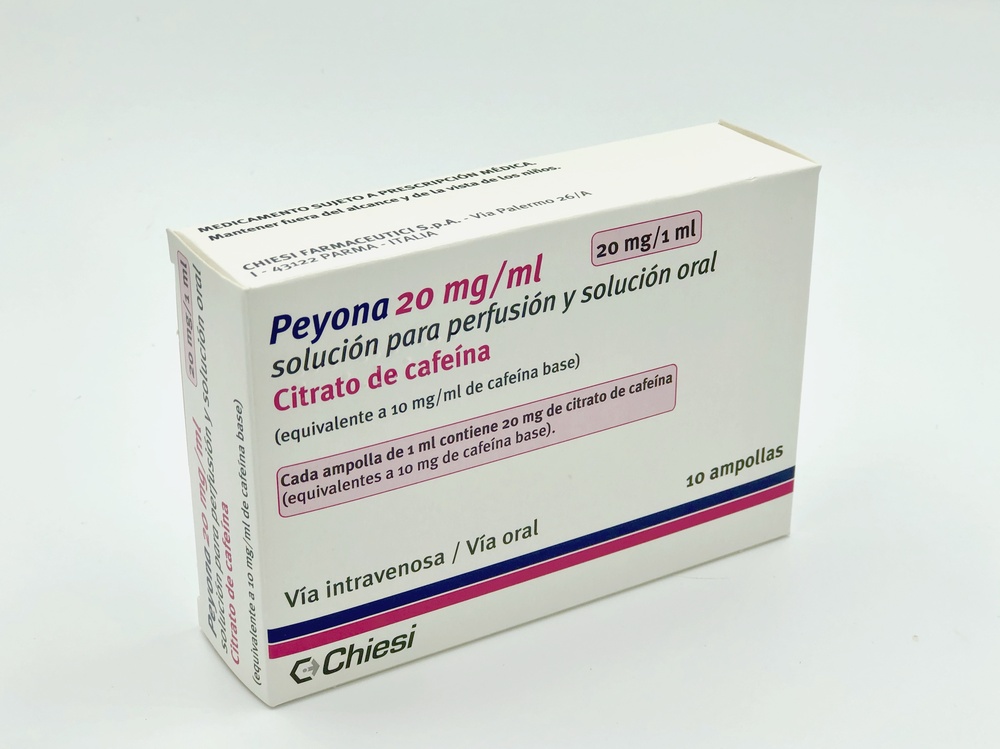
Peyona 20 mg/ml solución para perfusión and solución oral

Prescription review online
A doctor will review your case and decide whether a prescription is medically appropriate.

Talk to a doctor about this medicine
Discuss your symptoms and possible next steps in a quick online consultation.



How to use PEYONA 20 mg/ml SOLUTION FOR INFUSION AND ORAL SOLUTION
Contents of the leaflet
- Introduction
- What is Peyona and what is it used for
- What you need to know before your child starts treatment with Peyona
- How to use Peyona
- Possible side effects
- Storage of Peyona
- Package contents and further information
Introduction
Package Leaflet: Information for the User
Peyona 20mg/mL solution for infusion and oral solution
caffeine citrate
Read all of this leaflet carefully before your child starts using this medicine because it contains important information for them.
- Keep this leaflet, you may need to read it again.
- If you have any further questions, ask your child's doctor.
- If your child experiences any side effects, consult your child's doctor, even if they are not listed in this leaflet. See section 4.
Contents of the package leaflet
- What is Peyona and what is it used for
- What you need to know before your child starts treatment with Peyona
- How to use Peyona
- Possible side effects
- Storage of Peyona
- Package contents and further information
1. What is Peyona and what is it used for
Peyona contains the active substance caffeine citrate, which is a central nervous system stimulant belonging to a group of medicines called methylxanthines.
Peyona is used to treat apnea of prematurity (primary apnea of premature infants).
These brief periods during which premature infants stop breathing are due to the fact that the child's respiratory center is not fully developed.
It has been observed that this medicine reduces the number of apnea episodes in premature infants.

Not sure if this medicine is right for you?
Discuss your symptoms and treatment with a doctor online.
2. What you need to know before your child starts treatment with Peyona
Do not use Peyona
- if your newborn is allergic to caffeine citrate or any of the other components of this medicine (listed in section 6).
Warnings and precautions
Consult your child's doctor before starting treatment with Peyona.
Before starting treatment for apnea of prematurity with Peyona, your child's doctor should have ruled out or adequately treated other causes of apnea.
Peyona should be used with caution. Inform your child's doctor:
- if your child has a history of seizures
- if your child has heart disease
- if your child has kidney or liver problems
- if your child has frequent regurgitation
- if your child produces more urine than normal
- if your child does not show sufficient weight gain or does not eat enough
- if you (the mother) consumed caffeine before childbirth
Other medicines and Peyona
Tell your child's doctor if they are taking, have recently taken, or might take any other medicines.
Tell your child's doctor if they have been previously treated with theophylline.
Do not use the following medicines during treatment with Peyona without talking to your child's doctor first. The doctor may need to adjust the dose or change one of the medicines:
- theophylline (used to treat respiratory difficulties)
- doxapram (used to treat respiratory difficulties)
- cimetidine (used to treat stomach diseases)
- ketoconazole (used to treat fungal infections)
- phenobarbital (used to treat epilepsy)
- phenytoin (used to treat epilepsy)
This medicine may increase the risk of severe intestinal disease with bloody stools (necrotizing enterocolitis) when administered with certain medications used to treat stomach diseases (such as H2 receptor antagonists or proton pump inhibitors that reduce gastric acid secretion).
Pregnancy and breastfeeding
If you (the mother) are breastfeeding while your child is being treated with Peyona, you should not drink coffee or take other products with high caffeine content, as caffeine passes into breast milk.
Peyona contains sodium
This medicine contains less than 1 mmol (23 mg) of sodium per dose; it is essentially "sodium-free".
3. How to use Peyona
Peyona should only be used in a neonatal intensive care unit with adequate facilities for patient observation and monitoring. Treatment should be initiated under the supervision of a doctor with experience in neonatal intensive care.
Dose
Your child's doctor will prescribe the correct amount of Peyona based on your child's weight.
The initial dose is 20 mg per kg of body weight (equivalent to 1 mL per kg of body weight).
The maintenance dose is 5 mg per kg of body weight (equivalent to 0.25 mL per kg of body weight) every 24 hours.
Route and method of administration
Peyona should be administered by controlled intravenous infusion using a infusion pump with syringe or other volumetric infusion device. This method is also known as "drip".
Some doses (maintenance doses) may be administered orally.
It may be necessary for your child's doctor to monitor caffeine concentrations through periodic blood tests throughout treatment to avoid toxicity.
Duration of treatment
Your child's doctor will decide exactly how long your child should be treated with Peyona. If your child remains apnea-free for 5 to 7 days, the doctor will discontinue treatment.
If your child receives more Peyona than they should
Your child may experience fever, rapid breathing (tachypnea), nervousness, muscle tremors, vomiting, elevated blood sugar (hyperglycemia), low potassium levels (hypokalemia), elevated blood levels of certain chemicals (urea), and increased white blood cell count (leukocytosis) and seizures if they receive more caffeine citrate than they should.
In these cases, treatment with Peyona should be discontinued immediately and your child's doctor will need to treat the overdose.
If you have any further questions about the use of this medicine, ask your child's doctor.

Started taking the medicine and have questions?
Discuss your symptoms and treatment with a doctor online.
4. Possible side effects
Like all medicines, this medicine can cause side effects, although not everybody gets them. However, it is difficult to distinguish them from the frequent complications that occur in premature infants and from the complications of the disease itself.
Your child may experience some of the following reactions during treatment with Peyona:
Serious side effects
Side effectswhose frequency cannot be estimated from the available data.
- severe intestinal disease with bloody stools (necrotizing enterocolitis).
The following other side effects may also be considered serious by your child's doctor in the context of the overall clinical assessment.
Other side effects
Side effects observed frequently(may affect up to 1 in 10 people)
- local inflammatory reactions at the infusion site
- heart disorders such as rapid heart rate (tachycardia)
- changes in blood sugar or serum levels (hyperglycemia)
Side effects observed infrequently(may affect up to 1 in 100 people)
- central nervous system stimulation, such as seizures
- heart disorders such as irregular heart rhythm (arrhythmia)
Side effects observed rarely(may affect up to 1 in 1,000 people)
- allergic reactions
Side effectswhose frequency cannot be estimated from the available data:
- blood infection (sepsis)
- changes in blood sugar or serum levels (hypoglycemia), growth delay, feeding intolerance
- central nervous system stimulation, such as irritability, nervousness, and restlessness; brain injury
- hearing loss
- regurgitation, increased aspiration of stomach contents
- increased urine output, increased levels of certain components in the urine (sodium and calcium)
- changes in blood tests (reduced hemoglobin after prolonged treatment and decreased thyroid hormone at the start of treatment)
Reporting of side effects
If your newborn experiences any side effects, consult your doctor, even if they are not listed in this leaflet. You can also report them directly through the Spanish Medicines Agency's online reporting system: https://www.notificaram.es. By reporting side effects, you can help provide more information on the safety of this medicine.
5. Storage of Peyona
Keep this medicine out of the sight and reach of children.
Do not use this medicine after the expiry date which is stated on the label. The expiry date is the last day of the month stated.
This medicine does not require any special storage conditions.
All parenteral solution ampoules should be inspected visually for particulate matter and discoloration prior to administration. Once the ampoule is opened, the medicine should be used immediately.
6. Package contents and further information
Composition of Peyona
The active substance is caffeine citrate.
Each mL contains 20 mg of caffeine citrate (equivalent to 10 mg/mL of caffeine base).
Each 1 mL ampoule contains 20 mg of caffeine citrate (equivalent to 10 mg of caffeine base).
Each 3 mL ampoule contains 60 mg of caffeine citrate (equivalent to 30 mg of caffeine base).
The other ingredients are citric acid, sodium citrate, and water for injections.
Appearance and package contents
Peyona is a solution for infusion and oral solution.
Peyona is a clear and colorless solution presented in glass ampoules. Each carton contains 10 ampoules.
Marketing authorisation holder
Chiesi Farmaceutici S.p.A.
Via Palermo 26/A
43122 Parma
Italy
Manufacturer (batch release)
Alfasigma S.p.A.
Via Enrico Fermi 1
Alanno (PE)
Italy
Chiesi Pharmaceuticals GmbH,
Gonzagagasse 16/16,
A-1010 Wien
Austria
You can obtain further information on this medicine by contacting the local representative of the marketing authorisation holder:
Spain Chiesi España, S.A.U. Tel: + 34 93 494 8000 |
Date of last revision of this leaflet: December 2021
Detailed information on this medicine is available on the European Medicines Agency website: http://www.ema.europa.eu.
-------------------------------------------------------------------------------------------------------------------------
This information is intended for healthcare professionals only:
If you require detailed information, consult the Summary of Product Characteristics (SPC) for PEYONA attached.
- Country of registration
- Dosage formORAL/INJECTABLE SOLUTION/SUSPENSION PERFUSION
- ATC codeN06BC01
- Active substance
- Prescription requiredYes
- Manufacturer
- CompositionCITRATO DE SODIO (E-331) (0 - mg)
- This information is for reference only and does not constitute medical advice. Always consult a doctor before taking any medication. Oladoctor is not responsible for medical decisions based on this content.
- Alternatives to PEYONA 20 mg/ml SOLUTION FOR INFUSION AND ORAL SOLUTIONDosage form: MODIFIED-RELEASE CAPSULE, 300 mgActive substance: caffeineManufacturer: Anotaciones Farmaceuticas, S.L.Prescription not requiredDosage form: INJECTABLE PERFUSION, 10 mg/mLActive substance: caffeineManufacturer: Gennisium PharmaPrescription requiredDosage form: CAPSULE, 10 mgActive substance: atomoxetineManufacturer: Laboratorios Rubio S.A.Prescription required
Online doctors for PEYONA 20 mg/ml SOLUTION FOR INFUSION AND ORAL SOLUTION
Discuss questions about PEYONA 20 mg/ml SOLUTION FOR INFUSION AND ORAL SOLUTION, including use, safety considerations and prescription review, subject to medical assessment and local regulations.









Frequently Asked Questions
PEYONA 20 mg/ml SOLUTION FOR INFUSION AND ORAL SOLUTION requires a prescription in Spain. You can check with a doctor online whether this medicine may be appropriate for your situation.
The active ingredient in PEYONA 20 mg/ml SOLUTION FOR INFUSION AND ORAL SOLUTION is caffeine. This information helps identify medicines with the same composition but different brand names.
PEYONA 20 mg/ml SOLUTION FOR INFUSION AND ORAL SOLUTION is manufactured by Chiesi Farmaceutici S.P.A.. Pharmacy brands and packaging may differ depending on the distributor.
Doctors such as Family doctors, Psychiatrists, Dermatologists, Cardiologists, Endocrinologists, Gastroenterologists, Pulmonologists, Nephrologists, Rheumatologists, Hematologists, Infectious disease physicians, Allergists, Geriatricians, Paediatricians, Oncologists may assess whether PEYONA 20 mg/ml SOLUTION FOR INFUSION AND ORAL SOLUTION is appropriate, depending on your situation and local regulations. You can book an online consultation to discuss your symptoms and possible next steps.
The prescription is issued by a doctor after assessing your health. In Spain, PEYONA 20 mg/ml SOLUTION FOR INFUSION AND ORAL SOLUTION is then dispensed in pharmacies with that prescription. An online consultation does not guarantee that a prescription will be issued: the decision always rests with the doctor.
To request a review, you can use Oladoctor:
Other medicines with the same active substance (caffeine) include DURVITAN 300 mg PROLONGED-RELEASE HARD CAPSULES, GENCEBOK 10 mg/ml SOLUTION FOR INFUSION, ATAMAX 10 mg HARD CAPSULES. These may have different brand names or formulations but contain the same therapeutic ingredient. Always consult a doctor before switching or starting a new medicine.
