


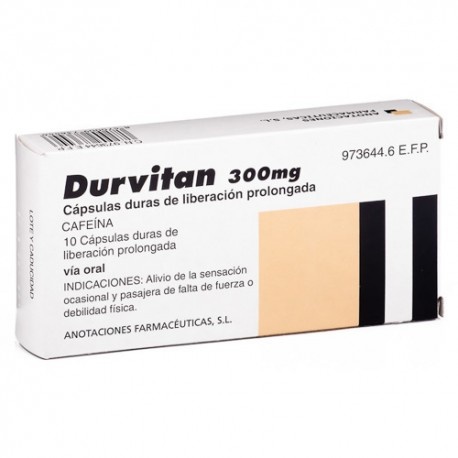
Durvitan 300 mg prolonged-release cápsulas duras

Prescription review online
A doctor will review your case and decide whether a prescription is medically appropriate.

Talk to a doctor about this medicine
Discuss your symptoms and possible next steps in a quick online consultation.



How to use DURVITAN 300 mg PROLONGED-RELEASE HARD CAPSULES
Contents of the leaflet
- Introduction
- What is Durvitan 300 mg and what is it used for
- Before taking Durvitan 300 mg
- Be especially careful with Durvitan 300 mg
- Use of other medications
- Pregnancy
- How to Take Durvitan 300 mg
- Possible Side Effects
- Storage of DURVITAN 300 mg
- ADDITIONAL INFORMATION
Introduction
Package Leaflet: Information for the User
DURVITAN 300 mg
Hard Capsules of Prolonged Release
(Caffeine)
Read all of this leaflet carefully because it contains important information for you.
This medication can be obtained without a prescription. To get the best results, it should be used properly.
- Keep this leaflet because you may need to read it again.
- If you need advice or more information, consult your pharmacist.
- If symptoms worsen or persist after 7 days, you should consult a doctor.
- If you consider that any of the adverse effects you are suffering from is serious, or if you notice any adverse effect not mentioned in this leaflet, inform your doctor or pharmacist.
Contents of the Package Leaflet:
- What DURVITAN 300 mg is and what it is used for.
- Before taking DURVITAN 300 mg.
- How to take DURVITAN 300 mg.
- Possible side effects.
- Storage of DURVITAN 300 mg.
- Additional information.
1. What is Durvitan 300 mg and what is it used for
Caffeine has a stimulating effect on the nervous system.
It is indicated for the relief of the occasional and transient feeling of lack of strength or physical weakness.

Not sure if this medicine is right for you?
Discuss your symptoms and treatment with a doctor online.
2. Before taking Durvitan 300 mg
Do not take Durvitan 300 mg
- In cases of allergy (hypersensitivity) to caffeine (or its derivatives, aminophylline, theophylline...) or to any of the other components of this medication.
- In mental disorders that involve nervous excitement, epilepsy, anxiety states, and insomnia (sleep problems).
In severe liver, heart, stomach ulcer, duodenum, or high blood pressure disorders.
Be especially careful with Durvitan 300 mg
- If you have any liver, thyroid, or stomach disease, you should consult your doctor before taking this medication.
- You should consult your doctor before taking this medication if you have or have had heart diseases (cardiac arrhythmia, myocardial ischemia, angina pectoris,...), especially when engaging in physical exercise or being in high-altitude areas.
- If you are diabetic, you should be aware that caffeine can raise blood sugar levels.
- If you are sensitive to other xanthines, such as theophylline or aminophylline, you should consult your doctor before taking this medication.
- You should not take this medication in the 6 hours prior to going to sleep.
- This medication should not replace normal sleep or rest.

Started taking the medicine and have questions?
Discuss your symptoms and treatment with a doctor online.
Use of other medications
Tell your doctor or pharmacist if you are using or have recently used any other medication, including those purchased without a prescription.
In particular, if you are using any of the following medications, it may be necessary to modify the dose of some of them or even interrupt treatment:
- Antibiotics of the quinolone group (e.g., oxolinic acid, ciprofloxacin), linezolid, and erythromycin.
- Oral contraceptives.
- Antidepressants, such as monoamine oxidase inhibitors (MAOIs) or lithium.
- Barbiturics (used as hypnotics for sleep disorders, sedatives, and anticonvulsants).
- Adrenergic bronchodilators and theophylline (used to combat bronchial asthma).
- Cimetidine (used for the treatment of excessive gastric secretion and stomach ulcers).
- Disulfiram (used in treatments for alcohol detoxification).
- Phenytoin (used for the treatment of epilepsy).
- Furazolidone (antidiarrheal).
- Iron (used for the treatment of anemia).
- Mexiletine used for heart rhythm disorders (cardiac arrhythmias).
- Procarbazine (anticancer).
- Selegiline (used for the treatment of Parkinson's disease).
- Thyroxine (used for the treatment of thyroid diseases).
Interference with diagnostic tests:
If you are going to undergo any diagnostic test (blood test, urine test,...), inform your doctor that you are taking this medication, as it may alter the results of these tests.
Additionally, diabetic patients should be aware that caffeine can increase blood glucose levels.
Taking Durvitan 300 mg with food and beverages.
Limit the consumption of beverages that contain caffeine (coffee, tea, chocolate, and cola drinks) while taking this medication.
Pregnancy
Consult your doctor or pharmacist before using any medication.
Important for Women If you are pregnant or think you may be pregnant, consult your doctor before taking this medication. The use of medications during pregnancy can be hazardous to the embryo or fetus and should be monitored by your doctor. |
Breastfeeding
Consult your doctor or pharmacist before using any medication.
Durvitan 300 mg intake should be avoided, as although caffeine passes into breast milk in small amounts (around 1%), it can accumulate in the infant.
Use in Children
Do not use this medication in children under 12 years of age.
Driving and Using Machines
No effects on the ability to drive or use machinery have been described at the recommended doses.
Important Information about Some of the Components of Durvitan 300 mg
This medication contains sucrose. If your doctor has told you that you have an intolerance to certain sugars, consult with them before taking this medication.
3. How to Take Durvitan 300 mg
Follow these instructions, unless your doctor has given you different ones. Consult your doctor or pharmacist if you have doubts.
The patient should be aware that there are other sources of caffeine (coffee, tea, chocolate, cola drinks) that can produce a similar effect to this medication. Therefore, it is recommended to moderate the consumption of these beverages while taking Durvitan 300 mg.
Oral route.
- Over 12 years:
Take 1 capsule with water or some food. If necessary, up to 3 capsules can be taken per day, spacing out the intake of each capsule by at least 6 hours.
Do not take the last dose in the 6 hours prior to bedtime to avoid possible insomnia.
Do not take more than 3 capsules per day, divided into several doses.
- Children under 12 years: this medication should not be used in this population.
- Patient with liver disease: they should consult their doctor before taking this medication.
If you notice that symptoms worsen or persist for more than 7 days, you should consult a doctor.
If you take more Durvitan 300 mg than you should:
If you have taken more Durvitan 300 mg than you should, consult your doctor or pharmacist immediately.
The symptoms of overdose are characterized by an initial phase of excitement, followed by dizziness, vomiting, diarrhea, abdominal pain, and convulsions. The treatment of overdose is more effective if performed within the first 4 hours after ingestion of this medication.
In case of overdose or accidental ingestion, go to your doctor or call the Toxicological Information Service (telephone: 91.5620420), indicating the medication and the amount ingested.
4. Possible Side Effects
Like all medications, Durvitan 300 mg can have side effects, although not everyone experiences them.
Very frequently (in more than 1 in 10 patients), the following may occur: insomnia, restlessness, and excitement.
Frequently (in less than 1 in 10 but more than 1 in 100 patients), the following may occur: nausea, vomiting, diarrhea, stomach pain, headache, ringing in the ears, disorientation, heart rhythm disorders, irritability, hot flashes, rapid breathing, and excessive urine elimination.
With high doses, anxiety and anguish may appear.
In some cases, hyperglycemia or hypoglycemia (increase or decrease in blood glucose) may also occur.
Treatment should be suspended immediately if the patient experiences any episode of dizziness or palpitations.
If you consider that any of the side effects you are suffering from is serious or if you notice any side effect not mentioned in this leaflet, inform your doctor or pharmacist.
5. Storage of DURVITAN 300 mg
Keep out of the reach and sight of children.
No special storage conditions are required.
Expiration Date
Do not use this medication after the expiration date shown on the packaging. The expiration date is the last day of the month indicated.
Medications should not be disposed of through wastewater or household waste. Ask your pharmacist how to dispose of the packaging and medications you no longer need. This will help protect the environment.
6. ADDITIONAL INFORMATION
Composition of Durvitan 300 mg
- Each hard capsule of prolonged release contains 300 milligrams of caffeine as the active principle.
- The other components (excipients) are: cornstarch, sucrose, povidone, Shellac lacquer, and talc.
Appearance of the Product and Packaging Content
They are hard capsules of prolonged release.
It is presented in boxes containing 1 blister pack with 10 hard capsules of prolonged release.
Marketing Authorization Holder
Anotaciones Farmacéuticas, S.L. Carretera de Sant Cugat a Rubí, km1 1.
08174 Sant Cugat del Vallés. Barcelona (Spain)
Manufacturer
Sincrofarm, S.L.
C/ Mercurio, 10. Pol. Ind. Almeda
08940 - Cornellá de Llobregat. Barcelona (Spain).
This leaflet was approved in: April 2007
- Country of registration
- Dosage formMODIFIED-RELEASE CAPSULE, 300 mg
- ATC codeN06BC01
- Active substance
- Prescription requiredNo
- Manufacturer
- CompositionSACAROSA (59,2 mg mg)
- This information is for reference only and does not constitute medical advice. Always consult a doctor before taking any medication. Oladoctor is not responsible for medical decisions based on this content.
- Alternatives to DURVITAN 300 mg PROLONGED-RELEASE HARD CAPSULESDosage form: INJECTABLE PERFUSION, 10 mg/mLActive substance: caffeineManufacturer: Gennisium PharmaPrescription requiredActive substance: caffeineManufacturer: Chiesi Farmaceutici S.P.A.Prescription requiredDosage form: CAPSULE, 10 mgActive substance: atomoxetineManufacturer: Laboratorios Rubio S.A.Prescription required
Online doctors for DURVITAN 300 mg PROLONGED-RELEASE HARD CAPSULES
Discuss questions about DURVITAN 300 mg PROLONGED-RELEASE HARD CAPSULES, including use, safety considerations and prescription review, subject to medical assessment and local regulations.









Frequently Asked Questions
DURVITAN 300 mg PROLONGED-RELEASE HARD CAPSULES does not require a prescription in Spain. You can check with a doctor online whether this medicine may be appropriate for your situation.
The active ingredient in DURVITAN 300 mg PROLONGED-RELEASE HARD CAPSULES is caffeine. This information helps identify medicines with the same composition but different brand names.
DURVITAN 300 mg PROLONGED-RELEASE HARD CAPSULES is manufactured by Anotaciones Farmaceuticas, S.L.. Pharmacy brands and packaging may differ depending on the distributor.
Doctors such as Family doctors, Psychiatrists, Dermatologists, Cardiologists, Endocrinologists, Gastroenterologists, Pulmonologists, Nephrologists, Rheumatologists, Hematologists, Infectious disease physicians, Allergists, Geriatricians, Paediatricians, Oncologists may assess whether DURVITAN 300 mg PROLONGED-RELEASE HARD CAPSULES is appropriate, depending on your situation and local regulations. You can book an online consultation to discuss your symptoms and possible next steps.
The prescription is issued by a doctor after assessing your health. In Spain, DURVITAN 300 mg PROLONGED-RELEASE HARD CAPSULES is then dispensed in pharmacies with that prescription. An online consultation does not guarantee that a prescription will be issued: the decision always rests with the doctor.
To request a review, you can use Oladoctor:
Other medicines with the same active substance (caffeine) include GENCEBOK 10 mg/ml SOLUTION FOR INFUSION, PEYONA 20 mg/ml SOLUTION FOR INFUSION AND ORAL SOLUTION, ATAMAX 10 mg HARD CAPSULES. These may have different brand names or formulations but contain the same therapeutic ingredient. Always consult a doctor before switching or starting a new medicine.
