


Paracodina 2 mg/ml solución oral

Prescription review online
A doctor will review your case and decide whether a prescription is medically appropriate.

Talk to a doctor about this medicine
Discuss your symptoms and possible next steps in a quick online consultation.



How to use PARACODINA 2.4 mg/ml SYRUP
Contents of the leaflet
- Introduction
- What is Paracodina and what is it used for
- What you need to know before taking Paracodina
- How to take Paracodina
- Possible side effects
- Storage of Paracodina
- Package Contents and Additional Information
Introduction
Package Leaflet: Information for the Patient
Paracodina 2.4 mg/ml Syrup
Dihydrocodeine Bitartrate
Read this package leaflet carefully before starting to take this medicine, as it contains important information for you.
- Keep this package leaflet, as you may need to read it again.
- If you have any further questions, ask your doctor or pharmacist.
- This medicine has been prescribed for you only. Do not pass it on to others, as it may harm them, even if their symptoms are the same as yours.
- If you experience any side effects, talk to your doctor or pharmacist. This includes any possible side effects not listed in this package leaflet. See section 4.
Contents of the Package Leaflet:
- What is Paracodina and what is it used for
- What you need to know before taking Paracodina
- How to take Paracodina
- Possible side effects
- Storage of Paracodina
- Package Contents and Additional Information
1. What is Paracodina and what is it used for
Paracodina is presented in the form of a syrup containing dihydrocodeine bitartrate as the active ingredient. Dihydrocodeine belongs to the group of medicines called antitussives, which are used to treat cough.
This medicine is indicated for the symptomatic treatment of dry cough (not accompanied by mucus).

Not sure if this medicine is right for you?
Discuss your symptoms and treatment with a doctor online.
2. What you need to know before taking Paracodina
Do not take Paracodina
- If you are allergic to dihydrocodeine and its salts or to any of the other components of this medicine (listed in section 6).
- If you have respiratory problems such as Chronic Obstructive Pulmonary Disease (COPD), respiratory depression (slow or insufficient breathing) or acute asthma attacks.
- If you are in a coma (severe state of loss of consciousness).
- If you are in the third trimester of pregnancy (see section "Pregnancy and Breastfeeding").
- During breastfeeding (see section "Pregnancy and Breastfeeding").
- In children under 2 years of age.
Warnings and Precautions
Consult your doctor or pharmacist before starting to take Paracodina.
It is not recommended to use:
- If you have diseases that involve respiratory problems,
- If you have problems with consciousness or increased intracranial pressure (high pressure inside the head) or have a history of epileptic seizures, as respiratory depression (slow or insufficient breathing) may increase,
- If you are in the first four months of pregnancy (see section "Pregnancy and Breastfeeding"),
- If you have chronic constipation or are at risk of or have paralytic ileus (paralysis of intestinal movement),
- If you have diarrhea associated with pseudomembranous colitis (inflammation of the colon) caused by antibiotics or in diarrhea caused by intoxication until the toxic material has been eliminated from the gastrointestinal tract,
- If you are dependent on opioids.
It should be administered with caution:
- In elderly people, as they may be more sensitive to the effects of this medicine,
- If you have liver or kidney problems,
- If you have prostatic hypertrophy (enlargement of the prostate), urethral stenosis (abnormal narrowing of the urethra),
- If you have gallbladder conditions,
- If you have chronic ulcerative colitis (inflammation and ulceration of the colon and rectum).
Do not take this medicine if you know you metabolize codeine or dihydrocodeine very quickly, as there may be a risk of greater side effects.
Prolonged administration of Paracodina is not recommended, as it may produce physical and psychological dependence (addiction) and tolerance. If the cough persists for more than three days, you should consult your doctor again.
Children
Since this medicine is contraindicated in case of bronchial asthma, it should be taken into account that chronic cough in children could be a symptom of bronchial asthma.
Use of Paracodina with other medicines
Tell your doctor or pharmacist if you are taking, have recently taken, or may take any other medicine.
The following medicines may interfere and should not be taken with Paracodina without first consulting your doctor:
- Medicines used to treat depression called MAOIs (monoamine oxidase inhibitors) or if you have taken this type of medicine in the last two weeks.
- Central Nervous System Depressants (medicines that act on the brain and produce drowsiness), such as sleep aids, antihistamines (used to treat allergies), medicines used to treat anxiety, medicines used to treat certain mental disorders, certain pain relievers or general anesthetics.
- Tricyclic antidepressants.
- Cimetidine and other drugs that influence hepatic metabolism.
Taking Paracodina with food, drinks, and alcohol
Do not drink alcoholic beverages while taking this medicine. The administration of dihydrocodeine with Central Nervous System Depressants such as alcohol may cause a reduction in coordination, as well as prolonged reaction time and recent memory impairment.
Pregnancy and Breastfeeding
If you are pregnant or breastfeeding, think you may be pregnant, or plan to become pregnant, consult your doctor or pharmacist before using this medicine.
Pregnancy
Do not take Paracodina if you are in the third trimester of pregnancy. Use near delivery and at high doses may cause slow or insufficient breathing in the newborn.
This medicine is not recommended during the first and second trimester of pregnancy, unless your doctor considers it strictly necessary.
Breastfeeding
This medicine passes into breast milk. For this reason, you should not take Paracodina during breastfeeding. If it is essential, breastfeeding should be interrupted.
Driving and using machines
Ask your doctor if you can drive or use machines during treatment with Paracodina. It is essential that before driving or using machines, you observe how this medicine affects you. Do not drive or use machines if you feel drowsy, dizzy, have blurred vision or double vision, or have difficulty concentrating. Be especially careful at the start of treatment and/or when taking it in combination with other medicines.
Alcohol can potentiate drowsiness, so you should not drink alcoholic beverages during treatment.
Use in athletes
Athletes are informed that this medicine contains a component that may produce a positive result in doping tests.
Paracodina contains sucrose
This medicine contains sucrose. If your doctor has told you that you have an intolerance to certain sugars, consult with them before taking this medicine.
Patients with diabetes mellitus should note that this medicine contains 2.4 g of sucrose per 5 ml dose.
It may cause cavities.
3. How to take Paracodina
Follow the administration instructions of this medicine exactly as indicated by your doctor. If in doubt, consult your doctor or pharmacist again.
Your doctor will indicate the dose you should take of this medicine and the duration of the treatment. It is essential to use the smallest dose that controls the symptoms. This medicine should not be taken for more than 3 days. If after three days you do not have relief from the cough, you should consult your doctor again.
The administration of the medicine is subject to the appearance of symptoms, so the dose can be reduced as they disappear.
The recommended dose is:
Adults and adolescents over 12 years:5 to 10 ml of syrup (1 to 2 5 ml spoons) up to three times a day.
Do not exceed the maximum dose of 72 mg of dihydrocodeine per day (30 ml of syrup per day).
Children 6-12 years:1 to 2 ml of syrup up to three times a day.
Do not exceed the maximum dose of 15 mg of dihydrocodeine per day, which corresponds to 6.25 ml of this syrup.
Children 2-5 years:1 ml of syrup up to three times a day.
Do not exceed the maximum dose of 7.5 mg of dihydrocodeine per day, which corresponds to 3.125 ml of this syrup.
Children under 2 years should not take this medicine, it is contraindicated.
Important note: For safety reasons, with the aim of administering the correct dose in the case of children under 12 years, the use of a dosing syringe is recommended.
Consult your pharmacist about which device is most suitable for administering the dose indicated by your doctor.
If you think the effect of this medicine is too strong or too weak, tell your doctor or pharmacist.
If you take more Paracodina than you should
Taking very high doses can cause initial excitement, anxiety, insomnia, and later, in certain cases, drowsiness, lack of reflexes that progresses to stupor or coma, headache, contraction of the pupil, changes in blood pressure, arrhythmias (irregular heartbeats), dry mouth, allergic reactions, cold and viscous skin, decrease or increase in heart rate, convulsions, gastrointestinal disorders, nausea, vomiting, and respiratory depression (slow or insufficient breathing). In severe poisoning, apnea (pauses in breathing or shallow breathing), circulatory collapse (loss of basal tone of blood vessel walls, insufficient blood return to the heart), cardiac arrest, and death may occur.
If you have taken more Paracodina than you should, consult your doctor or pharmacist immediately or the Toxicology Information Service, phone 91 562 04 20. If severe poisoning has occurred, the doctor will take the necessary measures.
If you forget to take Paracodina
Do not take a double dose to make up for forgotten doses.
If you stop taking Paracodina
Administration should be gradually suspended after prolonged use, as physical and psychological dependence (addiction) and tolerance may occur with repeated administration of this drug.
If you have any further questions about the use of this medicine, ask your doctor or pharmacist.

Started taking the medicine and have questions?
Discuss your symptoms and treatment with a doctor online.
4. Possible side effects
Like all medicines, this medicine can cause side effects, although not everybody gets them.
The assessment of the frequency of adverse reactions is based on the following criteria: Very common (may affect more than 1 in 10 patients), common (may affect up to 1 in 10 patients), uncommon (may affect up to 1 in 100 patients), rare (may affect up to 1 in 1,000 patients), very rare (may affect up to 1 in 10,000 patients).
- The following side effects have been observed, whose frequency has not been established: stomach upset, constipation, vomiting, nausea, fatigue, drowsiness, dizziness, inability to urinate, breathing problems (dyspnea), respiratory depression.
- Rare side effects: headache, itching, hives.
- Very rare side effects: euphoria, allergic skin reaction known as Quincke's edema, contraction of the pupil of the eye, loss of vision, circulation problems, angina pectoris.
Reporting of side effects
If you experience any side effects, talk to your doctor, pharmacist, or nurse, even if it is a possible side effect not listed in this package leaflet. You can also report them directly through the Spanish Medicines and Health Products Agency (AEMPS) website: www.notificaram.es. By reporting side effects, you can help provide more information on the safety of this medicine.
5. Storage of Paracodina
Keep this medicine out of the sight and reach of children.
Do not store above 25°C.
Do not use this medicine after the expiry date stated on the package after CAD. The expiry date is the last day of the month indicated.
Medicines should not be disposed of via wastewater or household waste. Place the package and any unused medicine in the pharmacy's SIGRE collection point. If in doubt, ask your pharmacist how to dispose of the package and any unused medicine. This will help protect the environment.
6. Package Contents and Additional Information
Composition of Paracodina
- The active ingredient is dihydrocodeine bitartrate. Each 5 ml of syrup (one spoon) contains approximately 12 mg of dihydrocodeine bitartrate.
- The other ingredients are: glycerol (E-422), sucrose, benzoic acid (E-210), cherry flavor, and purified water.
Appearance of the product and package contents
Paracodina is presented in the form of a slightly yellowish syrup. Each package contains 125 ml of syrup.
Marketing Authorization Holder and Manufacturer
Marketing Authorization Holder:
TEOFARMA S.r.l. Via F.lli Cervi, 8 Valle Salimbene (Pavia).
Manufacturer:
Teofarma S.r.l. Viale Certosa, 8/A Pavia, Italy.
Date of the last revision of this package leaflet: July 2020
Detailed and updated information on this medicine is available on the website of the Spanish Agency for Medicines and Health Products (AEMPS) (http://www.aemps.es/).
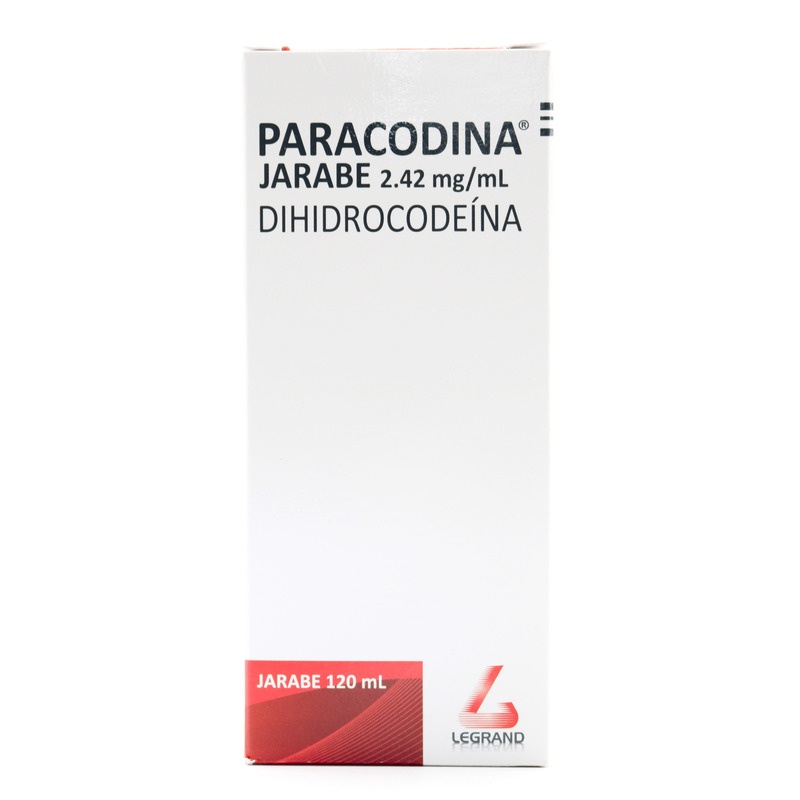
- Country of registration
- Dosage formORAL SOLUTION/SUSPENSION, 2 mg/ml
- ATC codeN02AA08
- Active substance
- Prescription requiredYes
- Manufacturer
- CompositionACIDO BENZOICO (E210) (0,2 g mg), GLICEROL (E 422) (10 g mg), SACAROSA (40 g mg)
- This information is for reference only and does not constitute medical advice. Always consult a doctor before taking any medication. Oladoctor is not responsible for medical decisions based on this content.
- Alternatives to PARACODINA 2.4 mg/ml SYRUPDosage form: ORAL SOLUTION/SUSPENSION DROPS, 10 mgActive substance: dihydrocodeineManufacturer: Laboratorio De Aplicaciones Farmacodinamicas S.A.Prescription requiredDosage form: TABLET, 100 mg / 15 mg / 10 mgActive substance: codeine, combinations with psycholepticsManufacturer: Farmalider S.A.Prescription requiredDosage form: MODIFIED-RELEASE TABLET, 10 mg/5 mgActive substance: oxycodone and naloxoneManufacturer: Neuraxpharm Spain S.L.Prescription required
Online doctors for PARACODINA 2.4 mg/ml SYRUP
Discuss questions about PARACODINA 2.4 mg/ml SYRUP, including use, safety considerations and prescription review, subject to medical assessment and local regulations.









Frequently Asked Questions
PARACODINA 2.4 mg/ml SYRUP requires a prescription in Spain. You can check with a doctor online whether this medicine may be appropriate for your situation.
The active ingredient in PARACODINA 2.4 mg/ml SYRUP is dihydrocodeine. This information helps identify medicines with the same composition but different brand names.
PARACODINA 2.4 mg/ml SYRUP is manufactured by Teofarma S.R.L.. Pharmacy brands and packaging may differ depending on the distributor.
Doctors such as Family doctors, Psychiatrists, Dermatologists, Cardiologists, Endocrinologists, Gastroenterologists, Pulmonologists, Nephrologists, Rheumatologists, Hematologists, Infectious disease physicians, Allergists, Geriatricians, Paediatricians, Oncologists may assess whether PARACODINA 2.4 mg/ml SYRUP is appropriate, depending on your situation and local regulations. You can book an online consultation to discuss your symptoms and possible next steps.
The prescription is issued by a doctor after assessing your health. In Spain, PARACODINA 2.4 mg/ml SYRUP is then dispensed in pharmacies with that prescription. An online consultation does not guarantee that a prescription will be issued: the decision always rests with the doctor.
To request a review, you can use Oladoctor:
Other medicines with the same active substance (dihydrocodeine) include TOSIDRIN 10 mg/ml ORAL DROPS IN SOLUTION, DOLODENS 100 mg/15 mg/10 mg FILM-COATED TABLETS, DUOXONA 10 mg/5 mg PROLONGED-RELEASE TABLETS. These may have different brand names or formulations but contain the same therapeutic ingredient. Always consult a doctor before switching or starting a new medicine.
