


Ozurdex 700 Micrograms Ophthalmic Implant

Prescription review online
A doctor will review your case and decide whether a prescription is medically appropriate.

Talk to a doctor about this medicine
Discuss your symptoms and possible next steps in a quick online consultation.



How to use OZURDEX 700 micrograms INTRAVITREAL IMPLANT IN APPLICATOR
Contents of the leaflet
- Introduction
- What OZURDEX is and what it is used for
- What you need to know before you use OZURDEX
- How to use OZURDEX
- Possible side effects
- Storage of OZURDEX
- Contents of the pack and other information
Introduction
Package Leaflet: Information for the Patient
OZURDEX 700micrograms intravitreal implant in applicator
dexamethasone
Read all of this leaflet carefully before you start using this medicine because it contains important information for you.
- Keep this leaflet, you may need to read it again.
- If you have any further questions, ask your doctor.
- If you get any side effects, talk to your doctor. This includes any possible side effects not listed in this leaflet. See section 4.
Contents of the pack
- What OZURDEX is and what it is used for
- What you need to know before you use OZURDEX
- How to use OZURDEX
- Possible side effects
- Storage of OZURDEX
- Contents of the pack and other information
1. What OZURDEX is and what it is used for
The active substance of OZURDEX is dexamethasone. Dexamethasone belongs to a group of medicines called corticosteroids.
OZURDEX is used to treat adult patients with:
- Vision loss due to diabetic macular edema (DME), if you have already had cataract surgery, or if you have not responded to other types of treatment or if they are not suitable for you. Diabetic macular edema is an inflammation of the light-sensitive layer at the back of the eye called the macula. DME is a disease that affects some people with diabetes.
- Vision loss in adults caused by a blockage of the veins in the eye. This blockage causes a buildup of fluid that leads to inflammation in the area of the retina (a light-sensitive layer at the back of the eye) called the macula.
The inflammation of the macula can cause damage that affects your central vision, which is used for tasks such as reading. OZURDEX works by reducing this macular inflammation, helping to reduce or prevent further damage to the macula.
- Inflammation of the back of the eye. This inflammation causes a reduction in vision and/or the presence of floaters in the eye (black dots or fine lines that move across the field of vision). OZURDEX reduces this inflammation.

Not sure if this medicine is right for you?
Discuss your symptoms and treatment with a doctor online.
2. What you need to know before you use OZURDEX
Do not use OZURDEX
- if you are allergic to dexamethasone or any of the other ingredients of this medicine (listed in section 6);
- if you have any type of infection in or around the eye (bacterial, viral or fungal);
- if you have glaucoma or high pressure in the eye that cannot be controlled with the medicines you are taking;
- if the eye to be treated has no lens or if the back of the lens capsule is broken;
- if the eye to be treated has had cataract surgery and has an artificial lens implanted in the front chamber of the eye (anterior chamber intraocular lens), or if it is fixed to the white of the eye (sclera) or the colored part of the eye (iris), and if the back of the lens capsule is broken.
Warnings and precautions
Before your injection of OZURDEX, tell your doctor if:
- you have had cataract surgery, iris surgery (the colored part of the eye that controls the amount of light that enters the eye), or surgery to remove the gel (called vitreous) from the inside of the eye;
- you are taking any medicine to thin the blood;
- you are taking any steroid or non-steroid anti-inflammatory medicine by mouth or by application to the eye; or
- you have had a herpes simplex infection in your eye in the past (a long-standing ulcer in the eye, or a wound in the eye).
Sometimes, the injection of OZURDEX can cause infection, pain, or redness inside the eye, or even a detachment or tear of the retina. It is important to identify and treat these problems as soon as possible. Tell your doctor immediately if after the injection you develop more pain or discomfort in the eye, worsening of red eyes, flashes, and a sudden increase in floaters, partially blocked vision, decreased vision, or increased sensitivity to light.
In some patients, the pressure in the eye may increase, with possible development of glaucoma. You may not notice it, so your doctor will perform regular check-ups and, if necessary, provide treatment to reduce eye pressure.
In most patients who have not had cataract surgery, cataract formation may occur after repeated treatment with OZURDEX, which would reduce your vision and probably require cataract surgery. Your doctor will help you decide the best time for this surgery, but you should know that until you are ready for surgery, you may have poor vision or worse than before starting OZURDEX injections.
The implant can move from the back to the front of the eye in patients with a tear in the back of the lens capsule and/or in those with an opening in the iris. This movement can cause swelling of the clear layer in the front of the eye and blurred vision. If it continues for a long time and is not treated, it may eventually require tissue transplantation.
OZURDEX injection has not been studied in both eyes at the same time, and therefore, it is not recommended. Your doctor should not inject OZURDEX in both eyes at the same time.
Children and adolescents
OZURDEX has not been studied in children and adolescents, so it is not recommended.
Other medicines and OZURDEX
Tell your doctor if you are using or have recently used any other medicines, including those obtained without a prescription.
Pregnancy and breastfeeding
There is no experience with the use of OZURDEX in pregnant or breastfeeding women. OZURDEX should not be used during pregnancy or breastfeeding, unless your doctor considers it absolutely necessary. If you are pregnant or breastfeeding, think you may be pregnant, or plan to become pregnant, consult your doctor before using OZURDEX treatment. Consult your doctor before using any medicine.
Driving and using machines
After treatment with OZURDEX, your vision may be reduced for a short period. If this effect occurs, do not drive or use tools or machines until your vision improves.
3. How to use OZURDEX
All OZURDEX injections must be administered by a qualified eye doctor.
The recommended dose is the administration of one implant injected into the eye. If the effect of this injection disappears and your doctor recommends it, another implant can be injected into the eye.
Your doctor will tell you to use an antibiotic eye drop every day for 3 days before and after each injection to prevent the appearance of an eye infection. Follow these instructions carefully.
On the day of the injection, your doctor may use an antibiotic eye drop to prevent infections. Before the injection, your doctor will clean your eye and eyelid. Your doctor will also administer local anesthesia to reduce or prevent any pain caused by the injection. You may hear a "click" during the OZURDEX injection, which is normal.
The package of the medicine provides detailed instructions for your doctor on how to inject OZURDEX.
If you have any further questions on the use of this medicine, ask your doctor.

Started taking the medicine and have questions?
Discuss your symptoms and treatment with a doctor online.
4. Possible side effects
Like all medicines, this medicine can cause side effects, although not everybody gets them.
The following side effects may occur with OZURDEX:
Very common(may affect more than 1 in 10 people):
- increase in eye pressure
- clouding of the lens (cataracts), bleeding on the surface of the eye*
Common(may affect up to 1 in 10 people):
- high pressure in the eye
- clouding of the back of the lens
- bleeding inside the eye*
- worsening of vision*
- difficulty seeing clearly
- detachment of the gel inside the eye from the light-sensitive layer at the back of the eye (vitreous detachment)*
- sensation of spots in front of the eye (including floaters)*
- sensation of fog*
- inflammation of the eyelid
- eye pain*
- seeing flashes of light*
- swelling of the layer covering the white of the eye*
- redness of the eye*
- headache
Uncommon(may affect up to 1 in 100 people):
- a severe inflammation of the back of the eye (usually due to viral infection)
- severe infection or inflammation inside the eye*
- glaucoma (an eye disease in which high pressure in the eye is associated with damage to the optic nerve)
- detachment of the light-sensitive layer from the back of the eye* (retinal detachment)
- tear of the light-sensitive layer of the back of the eye (retinal tear)*
- decrease in eye pressure associated with a leak of the gel (vitreous) from the inside of the eye*
- inflammation inside the front of the eye*
- increase in proteins and cells in the front of the eye due to inflammation*
- abnormal sensation in the eye*
- itching of the eyelid
- redness of the white of the eye*
- migration of the OZURDEX implant from the back to the front of the eye causing blurred vision or worsening of vision, which may or may not cause swelling of the clear layer of the eye (cornea)*
- accidental incorrect placement of the OZURDEX implant*
- migraine
*These side effects may be caused by the injection procedure and not by the OZURDEX implant. The more injections you receive, the higher the likelihood of these side effects.
Reporting of side effects
If you experience any side effects, talk to your doctor, even if it is possible side effects not listed in this leaflet. You can also report side effects directly through the national reporting system listed in Appendix V. By reporting side effects, you can help provide more information on the safety of this medicine.
5. Storage of OZURDEX
Keep this medicine out of the sight and reach of children.
Do not use OZURDEX after the expiry date which is stated on the carton and on the pouch after “EXP”. The expiry date refers to the last day of the month shown.
This medicine does not require any special storage conditions.
Medicines should not be disposed of via wastewater or household waste. Ask your pharmacist how to dispose of medicines no longer required. This will help protect the environment.
6. Contents of the pack and other information
What OZURDEX contains
- The active substance is dexamethasone.
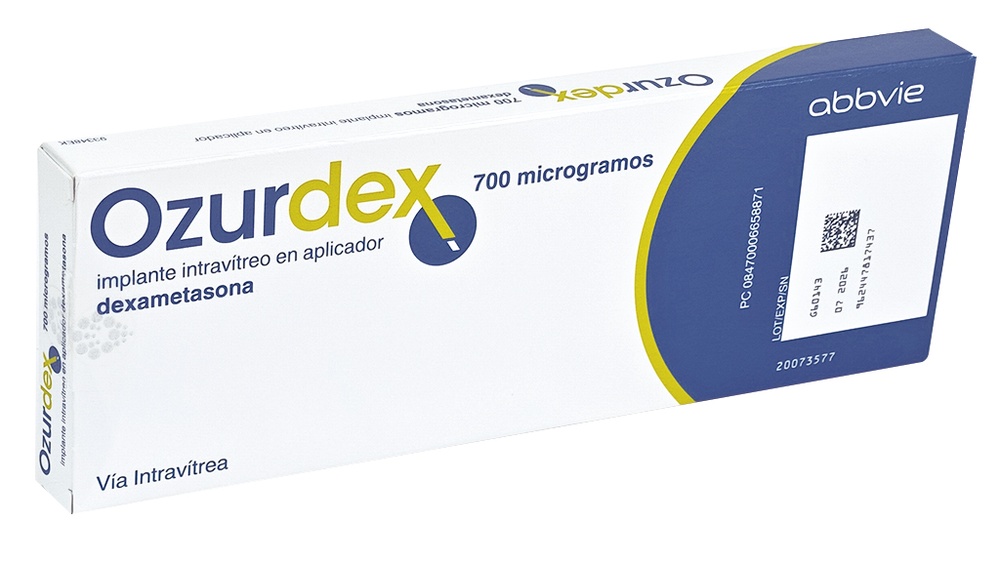
- Each implant contains 700 micrograms of dexamethasone.
- The other ingredients are: 50:50 poly D,L-lactide-co-glycolide in ester form and
50:50 poly D,L-lactide-co-glycolide in acid form.
Appearance of OZURDEX and pack contents
OZURDEX is a rod-shaped implant inside the needle of an applicator. A sealed laminated pouch, inside a carton, contains the applicator and a package of desiccant material. A carton contains one applicator with one implant, which will be used once and discarded.
Marketing authorisation holder
AbbVie Deutschland GmbH & Co. KG
Knollstrasse
67061 Ludwigshafen
Germany
You can request more information about this medicine from the local representative of the marketing authorisation holder:
België/Belgique/Belgien/ Luxembourg/Luxemburg/ Nederland Allergan n.v Tél/Tel: +32 (0)2 351 24 24 | Latvija Allergan Baltics UAB Tel: +371 676 60 831 |
| Lietuva Allergan Baltics UAB Tel: +37052 072 777 |
Ceská republika Allergan CZ s.r.o. Tel: +420 800 188 818 | Magyarország Allergan Hungary Kft. Tel.: +36 80 100 101 |
Danmark Allergan Norden AB Tlf: + 4580884560 | Norge Allergan Norden AB Tlf: +47 80 01 04 97 |
Deutschland Pharm-Allergan GmbH Tel: +49 69 92038 1050 | Österreich Pharm-Allergan GmbH Tel: +43 1 99460 6355 |
Eesti Allergan Baltics UAB Tel: + 37 2634 6109 | Polska Allergan Sp. z o.o. Tel.: +48 22 256 3700 |
Ελλ?δα/Κ?προς Allergan Hellas Pharmaceuticals S.A. Τηλ: +30 210 74 73 300 | Portugal Profarin Lda. Tel: + 351 21 425 3242 |
España AbbVie Spain, S.L.U. Tel: +34 913840910 | România Allergan S.R.L. Tel: +40 21 301 53 02 |
France Allergan France SAS Tél: +33 (0)1 49 07 83 00 | Slovenija Ewopharma d.o.o. Tel: + 386 (0) 590 848 40 |
Hrvatska Ewopharma d.o.o. Tel: +385 1 6646 563 | Slovenská republika Allergan SK s.r.o. Tel: +800 221 223 |
Ireland/Malta Allergan Pharmaceuticals Ireland Tel: 1800 931 787 (IE) +356 27780331 (MT) | Suomi/Finland Allergan Norden AB Puh/Tel: + 358 800 115 003 |
Ísland Actavis Pharmaceuticals Iceland ehf. Sími: +354 550 3300 | Sverige Allergan Norden AB Tel: + 46859410000 |
Italia Allergan S.p.A Tel: + 39 06 509 562 90 | United Kingdom Allergan Ltd Tel: +44 (0) 1628 494026 |
Date of last revision of this leaflet MM/YYYY
Detailed information on this medicine is available on the European Medicines Agency website: http://www.ema.europa.eu/.
To request a copy of this leaflet in large print, contact the local representative of the marketing authorisation holder.
--------------------------------------------------------------------------------------------------------------------
- Country of registration
- Dosage formOPHTHALMIC IMPLANT
- ATC codeS01BA01
- Active substance
- Prescription requiredYes
- Manufacturer
- This information is for reference only and does not constitute medical advice. Always consult a doctor before taking any medication. Oladoctor is not responsible for medical decisions based on this content.
- Alternatives to OZURDEX 700 micrograms INTRAVITREAL IMPLANT IN APPLICATORDosage form: EYEDROP, 1 mg/mlActive substance: dexamethasoneManufacturer: Pharmaselect International Beteiligungs GmbhPrescription requiredDosage form: EYE DROP, 0.1 %Active substance: dexamethasoneManufacturer: Fidia Farmaceutici S.P.A.Prescription requiredDosage form: EYEDROP, 1mg/mlActive substance: dexamethasoneManufacturer: Laboratoires TheaPrescription required
Online doctors for OZURDEX 700 micrograms INTRAVITREAL IMPLANT IN APPLICATOR
Discuss questions about OZURDEX 700 micrograms INTRAVITREAL IMPLANT IN APPLICATOR, including use, safety considerations and prescription review, subject to medical assessment and local regulations.









Frequently Asked Questions
OZURDEX 700 micrograms INTRAVITREAL IMPLANT IN APPLICATOR requires a prescription in Spain. You can check with a doctor online whether this medicine may be appropriate for your situation.
The active ingredient in OZURDEX 700 micrograms INTRAVITREAL IMPLANT IN APPLICATOR is dexamethasone. This information helps identify medicines with the same composition but different brand names.
OZURDEX 700 micrograms INTRAVITREAL IMPLANT IN APPLICATOR is manufactured by Abbvie Deutschland Gmbh & Co. Kg. Pharmacy brands and packaging may differ depending on the distributor.
Doctors such as Family doctors, Psychiatrists, Dermatologists, Cardiologists, Endocrinologists, Gastroenterologists, Pulmonologists, Nephrologists, Rheumatologists, Hematologists, Infectious disease physicians, Allergists, Geriatricians, Paediatricians, Oncologists may assess whether OZURDEX 700 micrograms INTRAVITREAL IMPLANT IN APPLICATOR is appropriate, depending on your situation and local regulations. You can book an online consultation to discuss your symptoms and possible next steps.
The prescription is issued by a doctor after assessing your health. In Spain, OZURDEX 700 micrograms INTRAVITREAL IMPLANT IN APPLICATOR is then dispensed in pharmacies with that prescription. An online consultation does not guarantee that a prescription will be issued: the decision always rests with the doctor.
To request a review, you can use Oladoctor:
Other medicines with the same active substance (dexamethasone) include AMEXXINE 1 mg/ml EYE DROPS SOLUTION, COLIRCUSI DEXAMETHASONE 1 mg/ml eye drops solution, DEXAFREE 1 mg/ml EYE DROPS IN SOLUTION IN SINGLE-DOSE CONTAINERS. These may have different brand names or formulations but contain the same therapeutic ingredient. Always consult a doctor before switching or starting a new medicine.
