


NIMOTOP 10 mg /50 Ml Injectable Perfusion





How to use NIMOTOP 0.2 mg/ml SOLUTION FOR INFUSION
Translated with AI
This page provides general information and does not replace a doctor’s consultation. Always consult a doctor before taking any medication. Seek urgent medical care if symptoms are severe.
Show originalContents of the leaflet
Introduction
Package Leaflet: Information for the User
NIMOTOP0.2 mg/mlsolution for infusion
nimodipine
Read all of this leaflet carefully before you start using this medicine because it contains important information for you.
|
Contents of the package leaflet
- What is Nimotop and what is it used for
- What you need to know before you use Nimotop
- How to use Nimotop
- Possible side effects
- Storage of Nimotop
- Contents of the pack and other information
1. What is Nimotop and what is it used for
Nimodipine belongs to the group of peripheral vasodilators and has, essentially, a vasodilating effect (dilates the heart's arteries) and anti-ischemic cerebral effect (improves oxygen supply to the brain). Research in patients with cerebral circulatory disorders has shown that nimodipine increases cerebral blood flow.
Nimotop is indicated for the prevention of neurological deterioration caused by cerebral vasospasm secondary to subarachnoid hemorrhage, a type of cerebral hemorrhage, due to rupture of an aneurysm (abnormal enlargement or bulging of a portion of an artery, resulting in weakness in the wall of the blood vessel).

2. What you need to know before you use Nimotop
Do not use Nimotop
- if you are allergic (hypersensitive) to nimodipine or any of the other ingredients of this medicine (listed in section 6).
- if you have severe liver disease (e.g., cirrhosis).
Warnings and precautions
Consult your doctor, pharmacist, or nurse before starting to use Nimotop.
- if you have blood pressure disorders or are being treated to lower your blood pressure, especially in patients with systolic blood pressure below 100 mmHg.
- if you have cerebral edema (generalized brain swelling) or if there is marked intracranial hypertension, although treatment with nimodipine has not been associated with increases in intracranial pressure.
- if you have kidney disease.
- if you have suffered a cerebral trauma that has caused an intracranial hemorrhage.
- if you have unstable angina (a disease in which the heart does not receive enough blood flow and oxygen and can lead to a heart attack) or if you have had an acute myocardial infarction four weeks ago, in these circumstances your doctor will assess the possible benefit versus the risk.
- if you have heart problems such as cardiac arrhythmias and heart failure (a disease in which the heart is unable to pump enough blood to meet the body's needs), in these circumstances your doctor will perform periodic checks.
Using Nimotop with other medicines
Tell your doctor, pharmacist, or nurse if you are using, have recently used, or might use any other medicines, including those obtained without a prescription.
Certain medicines may interact with nimodipine; in these cases, your doctor will adjust the dose or interrupt treatment with one of the medicines. This is especially important when taking:
- Cimetidine (a medicine used to treat stomach ulcers) or valproic acid (used to treat epilepsy), as they may potentiate the hypotensive effect of nimodipine.
- Antihypertensive medicines (used to treat high blood pressure), as they may potentiate the hypotensive effect of nimodipine.
- Antiretroviral medicines (used to treat HIV infection) such as zidovudine.
- Other calcium antagonists (e.g., nifedipine, diltiazem, or verapamil) or with alpha-methyldopa. However, if it is essential to administer this combination, the patient's blood pressure will be monitored, especially.
- Potentially nephrotoxic medicines (those that damage the kidneys, e.g., aminoglycosides, cephalosporins, furosemide), kidney function may deteriorate. In these cases, kidney function will be carefully monitored, and if deterioration is observed, treatment will be considered for suspension.
- The simultaneous intravenous administration of beta-blockers (used to treat hypertension and heart problems, e.g., atenolol, propranolol, carvedilol) may cause an additional decrease in blood pressure and a mutual potentiation of the negative inotropic effect, which could lead to decompensation of pre-existing heart failure.
- Medicines incompatible with alcohol, since this medicine contains a volume percentage of alcohol of 23.7%, i.e., up to 50 g per daily dose (250 ml).
- The antidepressants fluoxetine and nortriptyline.
Pregnancy, breastfeeding, and fertility
If you are pregnant or breastfeeding, think you may be pregnant, or plan to become pregnant, consult your doctor or pharmacist before using this medicine.
Nimotop is contraindicated during pregnancy and breastfeeding, unless prescribed by a doctor.
If it is necessary to administer nimodipine during pregnancy, your doctor will carefully assess the potential benefits and risks based on the severity of the clinical condition.
Driving and using machines
It is unlikely that you will be able to perform these activities while receiving nimodipine infusion.
Nimotop contains alcohol
This medicine contains 23.7% ethanol (alcohol); this corresponds to an amount of 1.89 g per hour of infusion, equivalent to 50 ml of beer or 20 ml of wine. It is unlikely that the amount of alcohol in this medicine will have any noticeable effect in adults or adolescents. It may have some effects in small children, such as drowsiness.
The alcohol content should be taken into account in the case of pregnant or breastfeeding women, children, and high-risk groups, such as patients with liver disease or epilepsy. The amount of alcohol in this medicine may alter the effects of other medicines. Consult your doctor or pharmacist if you are taking other medicines. Since this medicine is administered slowly through continuous infusion, the effects of alcohol may be reduced.
If you have an alcohol addiction, consult your doctor or pharmacist before taking this medicine.
Nimotop contains sodium
This medicine contains 23.46 mg of sodium (the main component of table salt) per 50 ml vial. This is equivalent to 1.17% of the maximum recommended daily intake of sodium for an adult.
3. How to use Nimotop
Nimotop is a hospital medicine, so it will be administered to you in a hospital by the corresponding healthcare personnel.
Follow exactly the administration instructions of this medicine indicated by your doctor, pharmacist, or nurse. If in doubt, ask your doctor, pharmacist, or nurse.
The usual treatment period is to administer the infusion solution for 5-14 days, followed by administration of 2 tablets of 30 mg, 6 times a day (6 x 60 mg of nimodipine) for approximately 7 more days.
Use in children and adolescents
The use of nimodipine is not recommended in children under 18 years of age, as its safety and efficacy have not been established.
If you have been given too much Nimotop
The symptoms you may experience are: marked decrease in blood pressure, increase or decrease in heart rate.
In case of overdose or accidental ingestion, consult your doctor, pharmacist, or nurse immediately or call the Toxicology Information Service, phone 91 562 04 20, indicating the medicine and the amount ingested.
If you missed using Nimotop
Since this medicine is for hospital use due to its indications, this information does not apply.

4. Possible side effects
Like all medicines, this medicine can cause side effects, although not everybody gets them.
The following side effects have been described with the following frequencies:
Common: may affect up to 1 in 10 people
Uncommon: may affect up to 1 in 100 people
Rare: may affect up to 1 in 1,000 people
Very rare: may affect up to 1 in 10,000 people
Not known: frequency cannot be estimated from the available data
Blood and lymphatic system disorders
- Thrombocytopenia (decrease in platelet count) is uncommon.
Immune system disorders
- Acute hypersensitivity reactions include mild or moderate allergic reactions, which are uncommon.
- Clinical symptoms associated with them are related to the skin (uncommon rash).
Nervous system disorders
- Unspecific cerebrovascular symptoms include uncommon headaches.
Cardiac disorders
- Changes in heart rate (unspecific cardiac arrhythmias): tachycardia (increased heart rate) is uncommon and bradycardia (decreased heart rate) is rare.
Vascular disorders
- Unspecific cardiovascular symptoms, such as hypotension (decrease in blood pressure) and vasodilation, are uncommon.
Respiratory, thoracic, and mediastinal disorders
- Low oxygen levels in body tissues, frequency not known.
Gastrointestinal disorders
- Unspecific gastrointestinal and abdominal symptoms include uncommon nausea.
- Rarely, ileus (intestinal obstruction) has been reported.
Hepatobiliary disorders
- Hepatic reactions consist of a transient and rare increase in liver enzymes (including increased transaminases, alkaline phosphatase, and γ-GT).
General disorders and administration site conditions
- Reactions at the infusion site and injection site are rare (including thrombophlebitis at the infusion site, when a clot forms in a vein).
If you experience side effects, consult your doctor, pharmacist, or nurse, even if it is a possible side effect not listed in this leaflet.
Reporting of side effects:
If you experience any side effects, consult your doctor, pharmacist, or nurse, even if it is a possible side effect not listed in this leaflet. You can also report them directly through the Spanish Pharmacovigilance System for Human Use Medicines: https://www.notificaram.es. By reporting side effects, you can help provide more information on the safety of this medicine.
5. Storage of Nimotop
Keep this medicine out of the sight and reach of children.
Store in the original package.
Protect from direct sunlight, if the vial is removed from its packaging.
Do not use this medicine after the expiry date which is stated on the packaging after EXP. The expiry date is the last day of the month indicated.
Medicines should not be disposed of via wastewater or household waste. Ask your pharmacist how to dispose of medicines no longer required. This will help protect the environment.
6. Contents of the pack and other information
Composition of Nimotop
- The active substance is nimodipine. Each ml of the solution contains 0.2 mg.
- The other ingredients are ethanol 96%, macrogol 400, sodium citrate, citric acid, and water for injections.
Appearance of the product and pack contents
Nimotop is presented in a vial in the form of a slightly yellowish solution. Each pack contains 20 vials of 50 ml (Clinical Pack).
Marketing authorization holder and manufacturer
The marketing authorization holder is:
Laboratoire X.O
170 Bureaux de la Colline
92213 Saint-Cloud Cedex
France
The manufacturer is:
Bayer AG
Kaiser-Wilhelm-Allee
51368 Leverkusen
Germany
You can request more information about this medicine by contacting the local representative of the marketing authorization holder:
Beatriz López Pascual
C/ Las artes, 13, 5°D,
33402-Avilés (Asturias)
Spain
Phone: +34 626 028 201
Email: [email protected]
Date of last revision of this leaflet:September 2024
Detailed information on this medicine is available on the website of the Spanish Agency for Medicines and Health Products (AEMPS) http://www.aemps.gob.es/
-------------------------------------------------------------------------------------------------------------------------
This information is intended only for healthcare professionals.
NIMOTOP0.2 mg/ml, solution for infusion
Instructions for use and handling
The medicine should be administered by continuous intravenous infusion through a central catheter connected to an infusion pump using a 3-way valve along with a 5% glucose solution, 0.9% sodium chloride solution, Ringer's lactate, Ringer's lactate with magnesium, dextran 40, or 6% hydroxyethyl starch solution in a ratio of approximately 1:4 (Nimotop: co-infusion). Mannitol, albumin, or human blood are also suitable for simultaneous infusion.
Nimotop solution should not be added to an infusion bag or bottle and should not be mixed with other medicines. The solution should be withdrawn from the vial using a syringe (do not withdraw directly with an infusion pump). Then, place the syringe without a needle in a syringe infusion pump and connect it to the 3-way valve using the polyethylene tube supplied in the package (do not use standard PVC tubes). In turn, connect the co-infusion tube and the central catheter to the 3-way valve. Nimotop administration will continue during anesthesia, surgery, and cerebral angiography.
In patients in whom the administration of an additional volume of fluids is not recommended or may be contraindicated, the preparation can be used directly through a central catheter without using a co-infusion.
Intracisternal instillation:
During surgery, a freshly prepared diluted solution of Nimotop (1 ml of Nimotop solution and 19 ml of Ringer's solution) warmed to blood temperature can be instilled into the cisterns. This diluted Nimotop solution should be used immediately after preparation.
Posology
As a general rule, the treatment regimen starts with the intravenous administration of nimodipine followed by oral administration, as specified below:
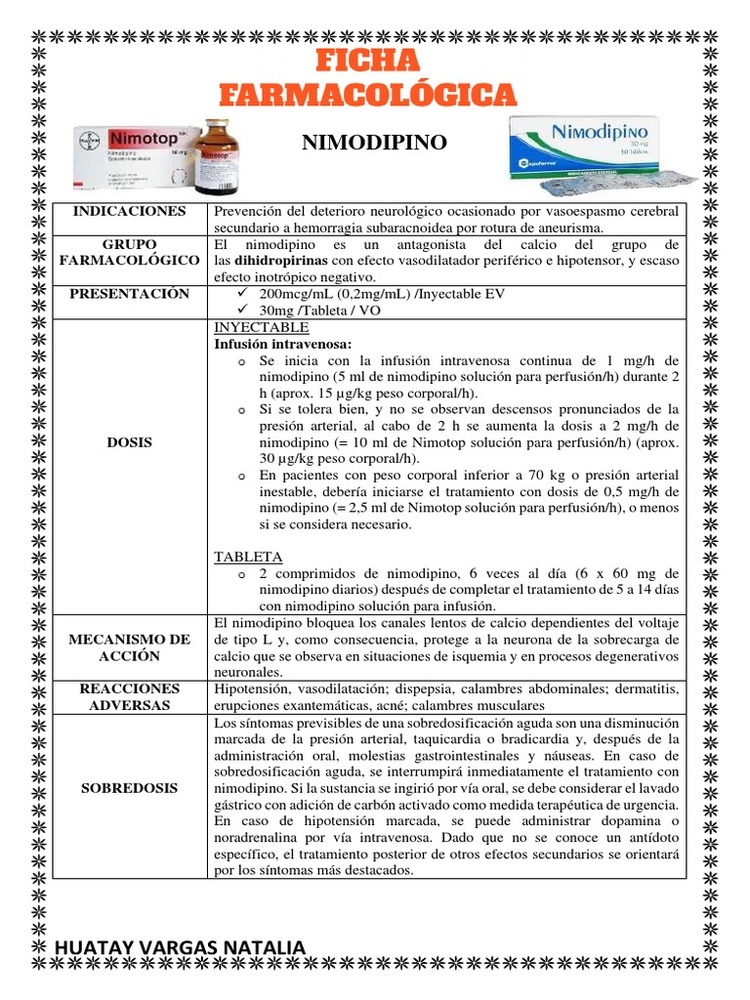
Treatment is initiated with the continuous intravenous infusion of 1 mg/h of nimodipine (= 5 ml nimodipine solution/h for 2 h (approximately 15 µg/kg/h). If well tolerated, and no marked decreases in blood pressure are observed, after 2 h the dose is increased to 2 mg/h of nimodipine (= 10 ml nimodipine solution/h) (approximately 30 µg/kg/h). In patients with a body weight below 70 kg or unstable blood pressure, treatment should be started with a dose of 0.5 mg/h of nimodipine (= 2.5 ml of nimodipine solution/h), or less if considered necessary.
- Country of registration
- Dosage formINJECTABLE PERFUSION, 10 mg nimodipine/50 ml
- ATC codeC08CA06
- Active substance
- Prescription requiredYes
- Manufacturer
- CompositionALCOHOL ETILICO (ETANOL) (10 g mg), CITRATO DE SODIO (E-331) (0,1 g mg)
- This information is for reference only and does not constitute medical advice. Always consult a doctor before taking any medication. Oladoctor is not responsible for medical decisions based on this content.
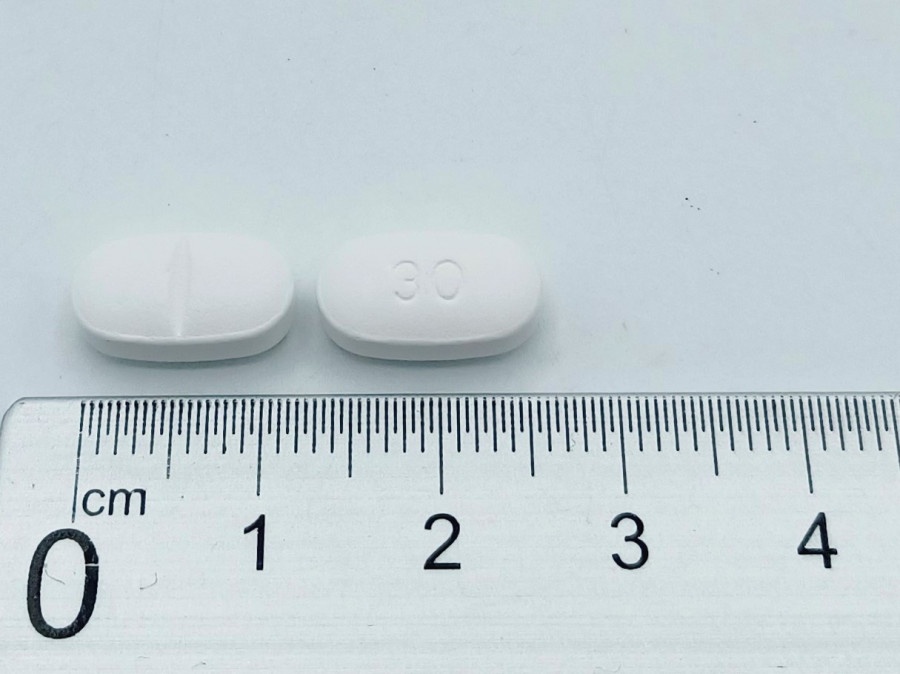
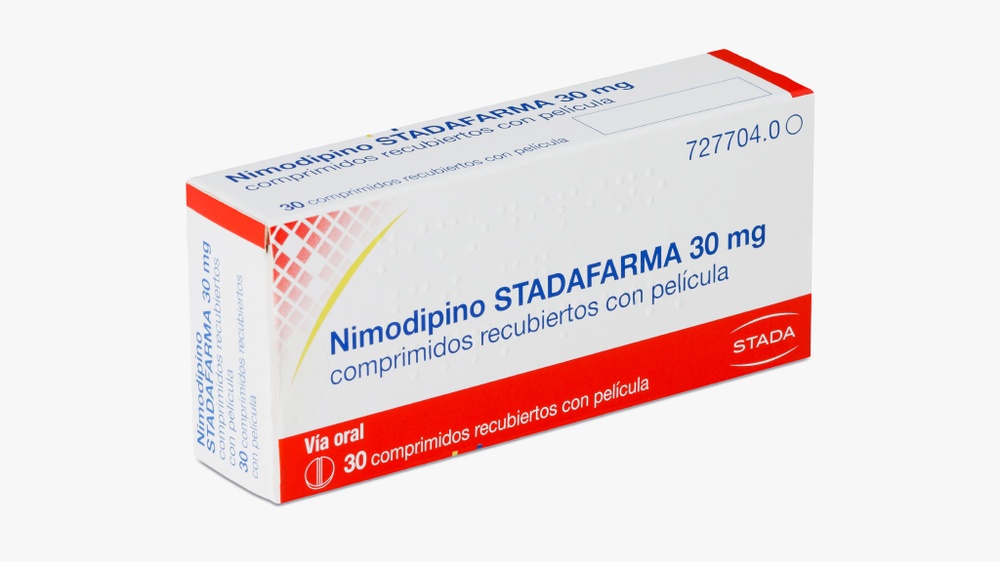
- Alternatives to NIMOTOP 0.2 mg/ml SOLUTION FOR INFUSIONDosage form: TABLET, 30 mg nimodipineActive substance: nimodipineManufacturer: Aristo Pharma Iberia S.L.Prescription requiredDosage form: INJECTABLE PERFUSION, 0.2 mg nimodipine/mlActive substance: nimodipineManufacturer: Altan Pharmaceuticals SaPrescription requiredDosage form: TABLET, 30 mgActive substance: nimodipineManufacturer: Laboratorio Stada S.L.Prescription required
Online doctors for NIMOTOP 0.2 mg/ml SOLUTION FOR INFUSION
Discuss questions about NIMOTOP 0.2 mg/ml SOLUTION FOR INFUSION, including use, safety considerations and prescription review, subject to medical assessment and local regulations.
Get NIMOTOP 0.2 mg/ml SOLUTION FOR INFUSION Prescription Online
Fill in a 2-min form
Tell us your symptoms, history, and what medicine you're requesting.
Pick a doctor or let us assign
Choose a specialist or we'll match you with the next available doctor.
Doctor reviews your case
Usually within 30 minutes. They may ask follow-up questions via chat.
Collect from any pharmacy
Electronic prescription sent to your email — valid across Spain.
Frequently Asked Questions
Is a prescription required for NIMOTOP 0.2 mg/ml SOLUTION FOR INFUSION?
NIMOTOP 0.2 mg/ml SOLUTION FOR INFUSION requires a prescription in Spain. You can check with a doctor online whether this medicine may be appropriate for your situation.
What is the active substance in NIMOTOP 0.2 mg/ml SOLUTION FOR INFUSION?
The active ingredient in NIMOTOP 0.2 mg/ml SOLUTION FOR INFUSION is nimodipine. This information helps identify medicines with the same composition but different brand names.
Who manufactures NIMOTOP 0.2 mg/ml SOLUTION FOR INFUSION?
NIMOTOP 0.2 mg/ml SOLUTION FOR INFUSION is manufactured by Laboratoire X.O. Pharmacy brands and packaging may differ depending on the distributor.
Which doctors can assess the use of NIMOTOP 0.2 mg/ml SOLUTION FOR INFUSION online?
Doctors such as Family doctors, Psychiatrists, Dermatologists, Cardiologists, Endocrinologists, Gastroenterologists, Pulmonologists, Nephrologists, Rheumatologists, Hematologists, Infectious disease physicians, Allergists, Geriatricians, Paediatricians, Oncologists may assess whether NIMOTOP 0.2 mg/ml SOLUTION FOR INFUSION is appropriate, depending on your situation and local regulations. You can book an online consultation to discuss your symptoms and possible next steps.
How to buy NIMOTOP 0.2 mg/ml SOLUTION FOR INFUSION in Spain?
Spain has a well-developed healthcare infrastructure across major cities such as Madrid, Barcelona, Valencia, and Seville. Pharmacies are widely available and operate under strict regulations, ensuring access to prescribed medications.
You can buy NIMOTOP 0.2 mg/ml SOLUTION FOR INFUSION in Madrid, Barcelona, Seville, or Valencia at any local pharmacy with a valid prescription.
To obtain a prescription, you can use Oladoctor:
What are the alternatives to NIMOTOP 0.2 mg/ml SOLUTION FOR INFUSION?
Other medicines with the same active substance (nimodipine) include BRAINAL 30 mg FILM-COATED TABLETS, Nimodipine Altan 0.2 mg/ml Solution for Infusion, NIMODIPINE STADAFARMA 30 mg FILM-COATED TABLETS. These may have different brand names or formulations but contain the same therapeutic ingredient. Always consult a doctor before switching or starting a new medicine.
