






How to use MST CONTINUS 200 mg PROLONGED-RELEASE TABLETS
Translated with AI
This page provides general information and does not replace a doctor’s consultation. Always consult a doctor before taking any medication. Seek urgent medical care if symptoms are severe.
Show originalContents of the leaflet
Introduction
Package Leaflet: Information for the User
MST CONTINUS 200 mg prolonged-release tablets
Morphine sulfate
Read all of this leaflet carefully before you start taking this medicine because it contains important information for you.
- Keep this leaflet, you may need to read it again.
- If you have any further questions, ask your doctor or pharmacist.
- This medicine has been prescribed for you only. Do not pass it on to others. It may harm them, even if their signs of illness are the same as yours.
- If you get any side effects, talk to your doctor or pharmacist. This includes any possible side effects not listed in this leaflet. See section 4.
Contents of the pack and other information:
- What is MST CONTINUS and what is it used for
- What you need to know before you take MST CONTINUS
- How to take MST CONTINUS
- Possible side effects
- Storing MST CONTINUS
- Contents of the pack and further information
1. What is MST CONTINUS and what is it used for
These tablets have been prescribed for you by your doctor to relieve severe pain over a period of 12 hours. They contain the active substance morphine, which belongs to a group of medicines called strong painkillers.

2. What you need to know before you take MST CONTINUS
Do not take this medicine
- if you are allergic to the active substance or to any of the other ingredients of this medicine (listed in section 6);
- if you have severe breathing problems, such as severe chronic obstructive pulmonary disease, severe respiratory depression, or acute and/or severe bronchial asthma. Symptoms may include difficulty breathing, coughing, or slower and weaker breathing than expected;
- if you have a head injury that causes severe headache or dizziness. This is because the tablets may make these symptoms worse or mask the extent of the injury;
- if you have a condition where your small intestine does not work properly (paralytic ileus), your stomach empties more slowly than it should (delayed gastric emptying), or you have severe abdominal pain (acute abdomen);
- if you have a blue-tinged skin or mucous membranes;
- if you have recently had liver disease;
- if you are taking a type of medicine known as monoamine oxidase inhibitors (such as tranylcypromine, phenelzine, isocarboxazid, moclobemide, and linezolid), or if you have taken this type of medicine in the last two weeks;
- if the patient is under one year of age.
Tolerance, dependence, and addiction
This medicine contains morphine, which is an opioid. Repeated use of opioids can lead to a lower effectiveness of the medicine (getting used to it, also known as tolerance). Repeated use of this medicine can also lead to dependence, abuse, and addiction, which could result in a potentially life-threatening overdose. The risk of these side effects may be greater with a higher dose and longer use.
Dependence or addiction can cause a lack of control over the amount of medicine you use or how often you use it.
The risk of dependence or addiction varies from person to person. You may have a greater risk of dependence or addiction to this medicine if:
- You or a family member have abused or been dependent on alcohol, prescription medicines, or illegal drugs ("addiction").
- You smoke.
- You have had problems with your mood (depression, anxiety, or personality disorder) or have been treated by a psychiatrist for other mental health problems.
If you notice any of the following symptoms while taking this medicine, it could be a sign of dependence or addiction:
- You need to take the medicine for longer than recommended by your doctor.
- You need to take a higher dose than recommended.
- You are using the medicine for reasons other than those prescribed, for example, "to feel calm" or "to help you sleep".
- You have made repeated unsuccessful attempts to stop using the medicine or control your use.
- You feel unwell when you stop using the medicine, and you feel better once you start taking it again ("withdrawal symptoms").
If you notice any of these symptoms, consult your doctor to determine the best course of treatment for you, including when it is appropriate to stop the medicine and how to do so safely (see section 3 "If you stop treatment with MST CONTINUS").
If you are going to have an operation, please tell your doctor that you are taking these tablets.
Warnings and precautions
Consult your doctor or pharmacist before starting to take this medicine.
Before starting treatment with these tablets, tell your doctor or pharmacist if you:
- have low thyroid activity (hypothyroidism);
- have severe kidney or liver problems, as you may need a dose reduction;
- have severe headache or dizziness, as this may indicate increased pressure in your skull;
- have breathing problems such as chronic obstructive pulmonary disease, severe lung injury, or reduced respiratory capacity. Symptoms may include difficulty breathing and coughing;
- have any blockage of the intestine or an inflammatory bowel disorder;
- have constipation;
- have low blood pressure (hypotension);
- have a severe heart problem after a long lung disease (cor pulmonale);
- have inflammation of the pancreas (which can cause severe abdominal and back pain) or problems with your gallbladder;
- have adrenal insufficiency (a disorder of the adrenal glands in the kidneys);
- have prostate problems;
- have had fits, seizures, or convulsions;
- have symptoms of withdrawal such as agitation, anxiety, palpitations, tremors, or sweating when you stop taking alcohol or drugs.
It has been reported that acute generalized exanthematous pustulosis (AGEP) is associated with the use of this medicine. Symptoms usually occur within the first 10 days of treatment. Inform your doctor if you have ever suffered from a severe skin rash, skin peeling, blisters, and/or sores in the mouth after taking morphine or other opioids. Stop using this medicine and seek medical attention immediately if you notice any of the following symptoms: blisters, widespread skin peeling, or pus-filled spots (pustules) along with fever.
Sleep-related breathing disorders
This medicine may cause sleep-related breathing problems such as sleep apnea (pauses in breathing during sleep) and sleep-related low blood oxygen levels, or worsen existing breathing problems. Symptoms may include pauses in breathing during sleep, waking up at night due to difficulty breathing, difficulty staying asleep, or excessive daytime sleepiness. If you or someone else notices these symptoms, contact your doctor. Your doctor may consider reducing the dose.
Tell your doctor or pharmacist if you experience any of the following symptoms while taking this medicine:
- Weakness, tiredness, decreased appetite, nausea, vomiting, or low blood pressure. This could indicate that your adrenal glands are not producing enough cortisol hormone and you may need to take hormone supplements.
- Loss of sex drive, impotence, or stopping of menstrual periods. This could be due to a lower production of sex hormones.
- If you have a history of alcohol or drug abuse. Also, inform your doctor if you think you are starting to depend on this medicine while using it. You may have started to think too much about when you can take the next dose, even if you don't need it for pain.
- Withdrawal symptoms or dependence. The most common withdrawal symptoms are described in section 3. If they appear, your doctor may change your medicine or modify the interval between doses.
Contact your doctor if you experience severe abdominal pain that may radiate to your back, nausea, vomiting, or fever, as these may be symptoms associated with pancreatitis and bile duct problems.
This medicine should be used with caution when taking medicines that depress the central nervous system (see "Taking MST CONTINUS with other medicines").
You may experience an increased sensitivity to pain due to taking increasing doses of these tablets (hyperalgesia). Your doctor will decide if you need a change in your dose or a switch to another strong painkiller.
Use in athletes
This medicine contains morphine, which may produce a positive result in doping tests.
Other medicines and morphine
Tell your doctor or pharmacist if you are taking, have recently taken, or might take any other medicines.
It is particularly important that you tell your doctor if you are taking:
- Medicines to help you sleep or stay calm (such as tranquilizers, hypnotics, or sedatives).
- Medicines for depression.
- Medicines for psychiatric or mental disorders (such as phenothiazines or neuroleptics).
- Other strong painkillers.
- Muscle relaxants.
- Medicines for high blood pressure.
- Cimetidine may increase the effect of morphine (a medicine for stomach ulcers, indigestion, or heartburn).
- Medicines to prevent or treat allergic reactions (antihistamines).
- Medicines for the treatment of tuberculosis (rifampicin) reduce the effect of morphine.
- Some medicines used to treat blood clots (such as clopidogrel, prasugrel, ticagrelor) may have a delayed and reduced effect when taken with morphine.
- Ritonavir for the treatment of HIV.
- Medicines for the treatment of Parkinson's disease.
- Gabapentin or pregabalin for the treatment of epilepsy and nerve pain (neuropathic pain).
Also, tell your doctor if you have recently been treated with an anesthetic.
Do not take this medicine at the same time as a type of medicine for depression called monoamine oxidase inhibitors (MAOIs) or within two weeks of stopping them (see section 2 "Do not take...").
The concomitant use of morphine and sedative medicines such as benzodiazepines or related medicines increases the risk of drowsiness, breathing difficulties (respiratory depression), coma, and can put your life at risk. Due to this, concomitant use should only be considered when other treatment options are not possible.
However, if your doctor prescribes morphine with sedative medicines, your doctor will limit the dose and duration of concomitant treatment.
Tell your doctor about all sedative medicines you are taking and follow the recommended dose carefully as advised by your doctor.
It may be helpful to inform friends or family members who are aware of the signs and symptoms mentioned above. Contact your doctor when you experience such symptoms.
Taking this medicine with food and alcohol
Drinking alcohol while taking this medicine may make you feel more drowsy or increase the risk of serious side effects such as shallow breathing with the risk of stopping breathing, and loss of consciousness. It is recommended not to drink alcohol while taking this medicine.
Pregnancy and breastfeeding
If you are pregnant or breastfeeding, think you may be pregnant, or plan to become pregnant, consult your doctor or pharmacist before using this medicine.
The tablets of this medicine should be avoided whenever possible in patients who are pregnant or breastfeeding.
If this medicine is used for a prolonged period during pregnancy, there is a risk that the newborn baby will have withdrawal symptoms that need to be treated by a doctor.
Driving and using machines
These tablets may cause a number of side effects such as drowsiness, which could affect your ability to drive or use machines (see section 4 for a full list of side effects). These effects are more noticeable when you start treatment with the tablets or when your dose is increased. If you are affected, do not drive or use machines.
3. How to take MST CONTINUS
Follow exactly the administration instructions of this medicine given by your doctor. In case of doubt, consult your doctor or pharmacist again.
Before starting treatment and periodically during treatment, your doctor will explain what you can expect from the use of this medicine, when and for how long you need to take it, when to contact your doctor, and when to stop it (see also the section "If you stop treatment with MST CONTINUS").
The tablets should be swallowed whole and not chewed with a glass of water.
Do not chew, crush, or dissolve them.
The tablets of this medicine are designed to work properly over 12 hours when swallowed whole. If the tablet is broken, crushed, dissolved, or chewed, the entire 12-hour dose may be absorbed quickly by your body. This can be dangerous, causing serious problems such as overdose, which can be fatal.
You must always take the tablets by mouth. The tablets should never be crushed or injected, as this can lead to serious side effects with a fatal outcome.
Do not increase the dose prescribed by your doctor. If you do, you risk taking too much opioid (see section 4. Possible side effects).
There is a risk of tolerance (needing more doses to relieve pain) and addiction with strong opioid painkillers.
If you think the effect of this medicine is too strong or too weak, tell your doctor or pharmacist.
You should take your tablets every 12 hours. Therefore, if you take a tablet at 8 am, you should take the next one at 8 pm.
Severe chronic pain:
Adults:
The usual starting dose is one 30 mg tablet every 12 hours.
This dose will depend on the intensity of your pain, your age, and your previous history with pain relief therapy. Your doctor will decide the number of tablets you should take.
Patients treated with other oral morphine preparations who switch to a treatment with morphine prolonged-release tablets should receive the same total daily dose of morphine, but divided into two doses (one in the morning and one in the evening).
Children:
In case of severe and chronic pain, an initial dose of 0.2 to 0.8 mg/kg every 12 hours is recommended.
Elderly patients (over 65 years): It is recommended to reduce the dose.
Post-operative pain:
Adults: It is not recommended to use this medicine in the first 24 hours after surgery; afterwards and always at the doctor's discretion, the following dosing schedule is suggested:
20 mg tablets every 12 hours in patients weighing less than 70 kg.
30 mg tablets every 12 hours in patients weighing more than 70 kg.
Children: It is not recommended to use this medicine for the treatment of post-operative pain in children.
Elderly patients (over 65 years): It is recommended to reduce the dose.
If you take more MST CONTINUS than you should
Inform your doctor immediately or go to your hospital. When you need medical attention, make sure to bring this leaflet and any remaining tablets with you to show your doctor.
The signs of overdose and morphine toxicity are: pinpoint pupils, difficulty breathing, aspiration pneumonia, and low blood pressure. In more severe cases, circulatory failure and eventually deep coma may occur.
People who have taken an overdose may suffer from a brain disorder (known as toxic leucoencephalopathy) and may experience inhalation pneumonia or aspiration of foreign particles; symptoms may include shortness of breath, coughing, and fever.
People who have taken an overdose may also experience breathing difficulties that can lead to loss of consciousness or even death.
If you have taken too many tablets, under no circumstances should you put yourself in a situation that requires you to be alert, such as driving a car.
In case of overdose or accidental ingestion, consult the Toxicology Information Service, phone 915 620 420, indicating the medicine and the amount taken.
If you forget to take MST CONTINUS
If you forget to take a dose within 4 hours of the scheduled time, take a tablet as soon as possible. Take your next tablet at the usual time. If the delay in taking the dose is more than 4 hours, consult your doctor or pharmacist.
Do not take a double dose to make up for forgotten doses.
If you stop treatment with MST CONTINUS
Do not stop treatment with this medicine unless your doctor advises you to do so. If you want to stop treatment, ask your doctor how to gradually reduce the dose to avoid withdrawal symptoms. Withdrawal symptoms may include general pain, tremors, diarrhea, stomach pain, nausea, flu-like symptoms, palpitations, and dilated pupils. Psychological symptoms include a deep feeling of dissatisfaction, anxiety, and irritability.
If you have any further questions on the use of this medicine, ask your doctor or pharmacist.

4. Possible Adverse Effects
Like all medicines, this medicine can cause adverse effects, although not all people suffer from them.
All medicines can cause allergic reactions, although serious allergic reactions are rarely reported. Inform your doctor immediately if you suffer from:
- a severe allergic reaction that causes difficulty breathing or dizziness, sudden wheezing, swelling of the eyelids, face or lips, rash or itching of the skin, especially if it covers your entire body.
- severe skin reaction with blisters, generalized peeling of the skin, pus-filled spots (pustules) along with fever. It could be a disease called acute generalized exanthematous pustulosis (AGEP).
The most serious adverse effect, although rare, is when your breathing becomes slower or weaker than normal (respiratory depression, a typical risk of opioid overdose).
Like all strong analgesics, there is a risk of addiction or physical and psychological tolerance to these tablets.
Very Common Adverse Effects
(May affect more than 1 in 10 patients)
- Constipation (your doctor will prescribe a laxative to treat this problem)
- Nausea
Common Adverse Effects
(May affect up to 1 in 10 patients)
- Drowsiness (which is more common when you start taking this medicine or when the dose is increased, but it should disappear in a few days)
- Dry mouth, loss of appetite, abdominal pain or discomfort
- Vomiting (should disappear after a few days, however, your doctor may prescribe a medicine to prevent it if the problem continues)
- Dizziness, headache, confusion, insomnia
- Involuntary muscle contractions
- Feeling of weakness, fatigue, malaise
- Skin rash or skin itching
- Sweating
Uncommon Adverse Effects
(May affect up to 1 in 100 patients)
- Difficulty breathing or wheezing
- Situations where the intestine does not function properly (ileus)
- Altered taste, indigestion
- Agitation, mood changes, hallucinations, feeling of extreme happiness
- Feeling of dizziness or fainting, seizures, attacks or convulsions
- Blurred vision
- Vertigo
- Unusual muscle stiffness, muscle spasms
- Numbness or tingling
- Difficulty urinating
- Low blood pressure, facial flushing
- Urticaria
- Elevated liver enzymes (seen in blood tests)
- Swelling of hands, knees, and feet
- Hypersensitivity
Frequency Not Known
(Cannot be estimated from the available data)
- Anaphylactic reaction
- Anaphylactoid reaction
- Feeling of general malaise, abnormal thoughts
- Increased sensitivity to pain or abnormal pain perception
- Reduced pupil size
- Decreased cough reflex
- Impotence, decreased sexual desire, absence of menstruation
- Withdrawal symptoms or dependence (see section 3 "If you stop treatment with MST CONTINUS"), tolerance to the medicine
- Withdrawal syndrome in newborns
- Sleep apnea (pauses in breathing during sleep)
- Symptoms associated with inflammation of the pancreas (pancreatitis) and the biliary system, for example, severe upper abdominal pain that may radiate to the back, nausea, vomiting, or fever.
Reporting of Adverse Effects:
If you experience any type of adverse effect, consult your doctor or pharmacist, even if it is an adverse effect that is not listed in this leaflet. You can also report them directly through the Spanish Pharmacovigilance System for Human Use Medicines: www.notificaRAM.es. By reporting adverse effects, you can contribute to providing more information on the safety of this medicine.
5. Storage of MST CONTINUS
Keep this medicine out of the sight and reach of children.
Do not use this medicine after the expiration date that appears on the blister pack and carton, after CAD. The expiration date is the last day of the month indicated.
Keep the container perfectly closed to protect it from light and moisture. Store in the original packaging. Do not store at a temperature above 25°C.
Medicines should not be thrown away through wastewater or household waste. Deposit the packaging and medicines you no longer need at the SIGRE Point of the pharmacy. In case of doubt, ask your pharmacist how to dispose of the packaging and medicines you no longer need. This way, you will help protect the environment.
6. Package Contents and Additional Information
Composition of MST CONTINUS
The active ingredient is morphine sulfate.
Each tablet contains 200 mg of morphine sulfate.
The other components are:
- Tablet core: hydroxyethylcellulose, cetostearyl alcohol, magnesium stearate, purified talc.
- Tablet coating: Opadry 06B21168 (contains: hypromellose, titanium dioxide (E-171), macrogol 400, brilliant blue (E-133) and quinoline (E-104)), macrogol 400.
Appearance of MST CONTINUS and Package Contents
Film-coated tablets, biconvex, greenish-blue in color, with one face smooth and the concentration "200" marked on the other face.
Carton packages containing 30 tablets in PVC/PVDC-Al blisters.
Marketing Authorization Holder
Mundipharma Pharmaceuticals, S.L.
Bahía de Pollensa, 11
28042 Madrid
Spain
Phone: 913 821 870
Manufacturer
Mundipharma DC B.V.
Leusderend 16
3832 RC Leusden
Netherlands
Date of the Last Revision of this Leaflet:November 2024
Detailed information about this medicine is available on the website of the Spanish Agency for Medicines and Health Products (AEMPS) (http://www.aemps.gob.es/)
-

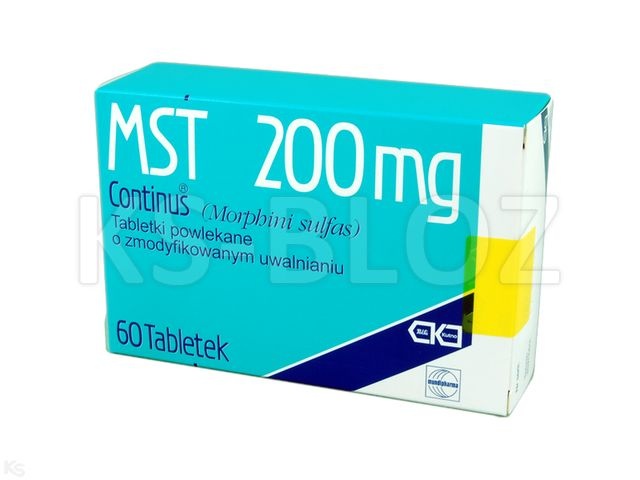
- Country of registration
- Dosage formMODIFIED-RELEASE TABLET, 200 mg
- ATC codeN02AA01
- Average pharmacy price59.12 EUR
- Active substance
- Prescription requiredYes
- Manufacturer
- This information is for reference only and does not constitute medical advice. Always consult a doctor before taking any medication. Oladoctor is not responsible for medical decisions based on this content.
- Alternatives to MST CONTINUS 200 mg PROLONGED-RELEASE TABLETSDosage form: INJECTABLE, 1 mg/mlActive substance: morphineManufacturer: B Braun Medical S.A.Prescription requiredDosage form: INJECTABLE, 10 mgActive substance: morphineManufacturer: B Braun Medical S.A.Prescription requiredDosage form: INJECTABLE, 20 mg/mlActive substance: morphineManufacturer: B Braun Medical S.A.Prescription required

Online doctors for MST CONTINUS 200 mg PROLONGED-RELEASE TABLETS
Discuss questions about MST CONTINUS 200 mg PROLONGED-RELEASE TABLETS, including use, safety considerations and prescription review, subject to medical assessment and local regulations.









Get MST CONTINUS 200 mg PROLONGED-RELEASE TABLETS Prescription Online
Fill in a 2-min form
Tell us your symptoms, history, and what medicine you're requesting.
Pick a doctor or let us assign
Choose a specialist or we'll match you with the next available doctor.
Doctor reviews your case
Usually within 30 minutes. They may ask follow-up questions via chat.
Collect from any pharmacy
Electronic prescription sent to your email — valid across Spain.
Frequently Asked Questions
MST CONTINUS 200 mg PROLONGED-RELEASE TABLETS requires a prescription in Spain. You can check with a doctor online whether this medicine may be appropriate for your situation.
The active ingredient in MST CONTINUS 200 mg PROLONGED-RELEASE TABLETS is morphine. This information helps identify medicines with the same composition but different brand names.
The average pharmacy price for MST CONTINUS 200 mg PROLONGED-RELEASE TABLETS is around 59.12 EUR. Prices may vary depending on the manufacturer and dosage form.
MST CONTINUS 200 mg PROLONGED-RELEASE TABLETS is manufactured by Mundipharma Pharmaceuticals S.L.. Pharmacy brands and packaging may differ depending on the distributor.
Doctors such as Family doctors, Psychiatrists, Dermatologists, Cardiologists, Endocrinologists, Gastroenterologists, Pulmonologists, Nephrologists, Rheumatologists, Hematologists, Infectious disease physicians, Allergists, Geriatricians, Paediatricians, Oncologists may assess whether MST CONTINUS 200 mg PROLONGED-RELEASE TABLETS is appropriate, depending on your situation and local regulations. You can book an online consultation to discuss your symptoms and possible next steps.
Spain has a well-developed healthcare infrastructure across major cities such as Madrid, Barcelona, Valencia, and Seville. Pharmacies are widely available and operate under strict regulations, ensuring access to prescribed medications.
You can buy MST CONTINUS 200 mg PROLONGED-RELEASE TABLETS in Madrid, Barcelona, Seville, or Valencia at any local pharmacy with a valid prescription.
To obtain a prescription, you can use Oladoctor:
Other medicines with the same active substance (morphine) include MORPHINE B. BRAUN 1 mg/mL INJECTABLE SOLUTION, MORPHINE B. BRAUN 10 mg/ml INJECTABLE SOLUTION, MORPHINE B. BRAUN 20 mg/mL Injectable Solution in Vial. These may have different brand names or formulations but contain the same therapeutic ingredient. Always consult a doctor before switching or starting a new medicine.
