



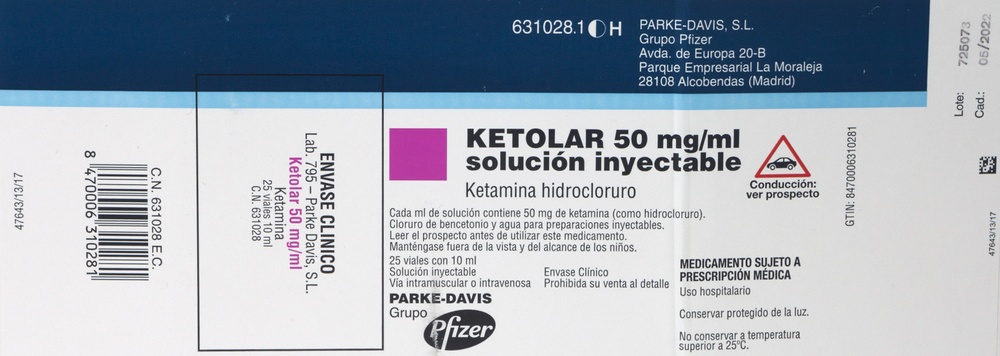
KETOLAR 50 mg /Ml Injectable Solution

Prescription review online
A doctor will review your case and decide whether a prescription is medically appropriate.

Talk to a doctor about this medicine
Discuss your symptoms and possible next steps in a quick online consultation.



How to use KETOLAR 50 mg/ml INJECTABLE SOLUTION
Contents of the leaflet
- Introduction
- What Ketolar 50 mg/ml Solution for Injection is and what it is used for
- What you need to know before you use Ketolar 50 mg/ml Solution for Injection
- How to use Ketolar 50 mg/ml Solution for Injection
- Possible side effects
- Storage of Ketolar 50 mg/ml Solution for Injection
- Contents of the pack and further information
- Composition of Ketolar 50 mg/ml Solution for Injection
Introduction
Package Leaflet: Information for the User
Ketolar 50 mg/ml Solution for Injection
Ketamine Hydrochloride
Read all of this leaflet carefully before you start taking this medicine because it contains important information for you.,as it contains important information for you.
- Keep this leaflet, as you may need to read it again.
- If you have any further questions, ask your doctor or pharmacist.
- This medicine has been prescribed for you only. Do not pass it on to others. It may harm them, even if their signs of illness are the same as yours.
- If you get any side effects, talk to your doctor or pharmacist. This includes any possible side effects not listed in this leaflet. See section 4.
Contents of the pack
- What Ketolar 50 mg/ml Solution for Injection is and what it is used for.
- What you need to know before you use Ketolar 50 mg/ml Solution for Injection.
- How to use Ketolar 50 mg/ml Solution for Injection.
- Possible side effects.
- Storage of Ketolar 50 mg/ml Solution for Injection.
Contents of the pack and further information.
1. What Ketolar 50 mg/ml Solution for Injection is and what it is used for
Ketolar belongs to a group of medicines called anesthetics, which are used to put you to sleep during an operation. The active ingredient is ketamine. Ketolar can be used alone or in combination with other anesthetics.

Not sure if this medicine is right for you?
Discuss your symptoms and treatment with a doctor online.
2. What you need to know before you use Ketolar 50 mg/ml Solution for Injection
Do not use Ketolar
- If you are allergic to ketamine or any of the other ingredients of this medicine (listed in section 6)
- If you are in a situation or have a disease in which an increase in blood pressure can pose a serious danger
- If you have a severe complication of pregnancy called pre-eclampsia, characterized by high blood pressure, edema (swelling due to fluid retention), and protein loss in the urine, or if you have convulsions or coma during pregnancy, childbirth, or shortly after giving birth (eclampsia)
Warnings and precautions
Consult your doctor or pharmacist before starting to use Ketolar
- If you regularly consume excessive amounts of alcohol or are intoxicated
- If you have liver disease
- If you have high blood pressure inside the skull
- If you have high blood pressure inside the eye (increased intraocular pressure)
- If you have a mental illness
- If you have a hereditary metabolic disorder called acute intermittent porphyria
- If you have had seizures before
- If you have hyperthyroidism (an excess of hormones produced by the thyroid) or are receiving thyroid hormones (see Use with other medicines)
- If you have a lung or upper respiratory tract infection
- If you have a head or eye injury or trauma
- If you are dehydrated or have a decrease in blood volume (hypovolemia)
- If you have heart disease, especially if your heart does not receive enough oxygen (coronary artery disease), if your heart is not able to pump blood properly to the rest of the body (heart failure), if your heart beats irregularly (arrhythmias), or if you have high blood pressure
- If you have a history of drug abuse or have developed dependence on drugs
You should be aware that some patients, during recovery from anesthesia, may have some type of reaction that can vary in severity between pleasant states similar to sleep, vivid images, hallucinations, nightmares, and delirium (often with a feeling of being outside the body or floating). Sometimes, it can be accompanied by confusion, excitement, and irrational behavior, being remembered by some patients as an unpleasant experience. Normally, it only lasts a few hours, although in some cases, it has recurred up to 24 hours after the operation has finished. It is not known that the use of ketamine causes psychological sequelae. If necessary, your doctor will take the appropriate measures to reduce these reactions.
Long-term use
Ketolar is not indicated or recommended for long-term use.
Urinary tract infection, sometimes accompanied by bleeding, and liver problems, particularly with long-term use (>3 days) or drug abuse, have been reported. See section 4 Possible side effects.
Drug abuse and dependence
If used daily for several weeks, dependence and tolerance can develop, particularly in people with a history of drug abuse and dependence. Other side effects have also been reported: see "Long-term use".
Using Ketolar with other medicines
Tell your doctor or pharmacist that you are using or have recently used or may need to use any other medicine.
Certain medicines can interact with each other. It is especially important that you inform your doctor if you are taking any of the following medicines:
- Barbiturates and/or opioid agonists
- Diazepam (a medicine with tranquilizing, sedating, muscle-relaxing, and anticonvulsant effects)
- Neuromuscular blockers such as atracurium and tubocurarine
- Central nervous system depressant medicines, such as ethanol, phenothiazines, sedating H1 receptor antagonists, and muscle relaxants
- Medicines for the treatment of anxiety and insomnia
- Halogenated anesthetics, thiopental (medicines used for anesthesia)
- Thyroid hormones (medicines used when the thyroid is not able to produce hormones in sufficient quantity)
- Antihypertensive medicines (medicines used in the treatment of high blood pressure)
- Sympathomimetic medicines and vasopressin
- Ergometrine (vasoconstrictor)
- Theophylline and aminophylline (medicine used to dilate the bronchi)
Using Ketolar with food and drinks
It is recommended that you do not eat or drink for at least 6 hours before anesthesia. Ketolar will normally be administered when your stomach is empty. However, Ketolar can still be used if this is not possible in an emergency.
Pregnancy, breastfeeding, and fertility
If you are pregnant or breastfeeding, think you may be pregnant, or plan to become pregnant, consult your doctor or pharmacist before you are given this medicine.
Pregnancy
Ketamine crosses the placental barrier easily. Cases have been reported of newborns who, after receiving ketamine from their mother during childbirth, have presented respiratory problems and a low score on the Apgar test, requiring resuscitation.
High doses of ketamine have caused increases in blood pressure and uterine tone in the mother. The safety of ketamine during pregnancy has not been established, so its use is not recommended.
Breastfeeding
The safe use of ketamine during breastfeeding has not been established, so its use is not recommended.
Driving and using machines
Do not drive or use tools or machines after receiving Ketolar, as this medicine can affect your reaction ability. Your doctor will tell you how long you should wait before driving or using machines (usually 24 hours).
3. How to use Ketolar 50 mg/ml Solution for Injection
This medicine will only be administered in hospitals by an anesthesiologist or by an intensive care physician.
Ketolar is not indicated or recommended for long-term use.
Before the operation, you may be given other medicines (to reduce saliva secretion or to reduce the risk of reactions during recovery from anesthesia).
The dose you receive will depend on the type of intervention you are undergoing and varies from person to person.
When injected directly into a vein at a dose of 2 mg per kilogram of body weight, Ketolar produces a state of unconsciousness in 30 seconds, and the effect lasts from 5 to 10 minutes. As it acts very quickly, it is essential to be lying down at the time of administration.
When administered into a muscle, at a dose of 10 mg per kilogram of body weight, the anesthetic effect takes longer to appear (3-4 minutes), but lasts from 12 to 25 minutes. Recovery of consciousness occurs gradually.
Do not leave the healthcare facility until you have fully recovered from the anesthesia. If you are discharged on the same day as the operation, you must be accompanied by another adult (see Driving and using machines).
Use in children and adolescents
Intramuscular doses of 9-13 mg/kg usually produce a state of unconsciousness in 3-4 minutes after injection, and the effect lasts from 12 to 25 minutes.
Method of use and route of administration
Ketolar can be administered by intramuscular or intravenous route.
Ketolar can be administered as a single anesthetic, as a complement to other general or local anesthetics, or before administering other general anesthetics.
If you use more Ketolar than you should
In case of overdose or accidental ingestion, contact your doctor or pharmacist or the emergency service of your hospital immediately. You can also contact the Toxicology Information Service. Telephone 91 562 04 20.
Ketolar has a wide safety margin. Several cases of accidental administration of up to 10 times the normally required dose have been reported, and they recovered completely, although it took them a long time to do so.
In case of Ketolar overdose, or too rapid administration, respiratory depression can occur, requiring assisted ventilation, and mechanical ventilation is preferred.
If you have any further questions about the use of this medicine, ask your doctor or pharmacist.

Started taking the medicine and have questions?
Discuss your symptoms and treatment with a doctor online.
4. Possible side effects
Like all medicines, Ketolar can cause side effects, although not everybody gets them.
Common side effects(may affect up to 1 in 10 people)
- hallucinations, abnormal dreams, nightmares, confusion, agitation, abnormal behavior
- involuntary and uncontrolled eye movements (nystagmus), double vision (diplopia)
- increased muscle tone (hypertonia), involuntary movements similar to convulsions (clonic-tonic movements)
- nausea, vomiting
- redness of the skin (erythema), rash similar to measles
- increased blood pressure, increased heart rate, increased respiratory rate
Uncommon side effects(may affect up to 1 in 100 people)
- respiratory depression, laryngospasm
- low blood pressure (hypotension), slow heart rate (bradycardia), irregular heart rate (arrhythmia)
- loss of appetite (anorexia), anxiety
- pain and/or rash at the injection site
Rare side effects(may affect up to 1 in 1,000 people)
- severe allergic reaction throughout the body (anaphylactic reaction)
- obstruction of the airways, interruption of breathing (apnea)
- delirium, repeated hallucinations (flashbacks), emotional or mood changes (dysphoria), difficulty sleeping (insomnia), disorientation
- excessive salivation
- bladder inflammation (cystitis), bladder inflammation with blood in the urine (hemorrhagic cystitis)
Side effects of unknown frequency(cannot be estimated from the available data)
- increased pressure inside the eye
- abnormal liver function test results, liver damage in cases of prolonged use (more than 3 days) or drug abuse
Reporting of side effects
If you experience any side effects, talk to your doctor, pharmacist, or nurse. This includes any possible side effects not listed in this leaflet. You can also report side effects directly through the Spanish Pharmacovigilance System for Human Use Medicines: https://www.notificaram.es. By reporting side effects, you can help provide more information on the safety of this medicine.
5. Storage of Ketolar 50 mg/ml Solution for Injection
Keep this medicine out of the sight and reach of children.
This medicine does not require any special storage temperature. Store in the original packaging. Store the vial in the outer packaging to protect it from light. Do not freeze.
Do not use this medicine after the expiry date which is stated on the packaging after EXP. The expiry date is the last day of the month shown.
Medicines should not be disposed of via wastewater or household waste.
The disposal of unused medicine and all materials
6. Contents of the pack and further information
Composition of Ketolar 50 mg/ml Solution for Injection
- The active ingredient is ketamine. Each vial, which contains 10 ml of solution, contains 500 mg of ketamine (50 mg of ketamine per ml of solution).
- The other ingredients are benzethonium chloride and water for injections.
Appearance and packaging
Ketolar is presented in transparent glass vials, with 10 ml of solution. Each vial is closed with a bromobutyl stopper and an aluminum seal. Each pack contains 1 vial.
Marketing authorization holder and manufacturer
Marketing authorization holder:
Pfizer, S.L.
Avda. de Europa, 20 B.
Parque Empresarial La Moraleja
28108 Alcobendas (Madrid).
Manufacturer:
Siegfried Hameln GmbH
Langes Feld 13
31789 Hameln, Germany
Date of last revision of this leaflet:November 2023
Detailed and updated information on this medicine is available on the website of the Spanish Agency for Medicines and Health Products (AEMPS) http://www.aemps.gob.es/
-------------------------------------------------------------------------------------------------------------------
Instructions for use and handling directed to the healthcare professional
Ketolar should only be used in hospitals by, or under the supervision of, medical experts or qualified professionals in the administration of general anesthetics, as well as in the maintenance of airways and control of respiration.
It is recommended to have a resuscitation equipment ready for use.
It is recommended to administer the intravenous dose of ketamine over a period of about 60 seconds. Faster administration can cause respiratory depression or apnea and an increase in pressor response.
Single-dose container. After opening: From a microbiological point of view, the product should be used immediately, unless the opening method prevents the risk of microbial contamination. Discard the unused product after opening.
Parenteral medicines should be inspected visually for particles and discoloration before administration, whenever the solution and container allow.
Store the vial in the outer packaging to protect it from light. The color of the solution may vary from colorless to very slightly yellowish and may darken if exposed to light for a long time. Although darkening of the solution does not affect the potency of the medicine, it should not be used if signs of precipitation are observed.
Ketamine and barbiturates should not be mixed in the same syringe, as their chemical incompatibility leads to the formation of precipitates.
Ketamine and diazepam should not be mixed in the same syringe or infusion bottle. If you want to supplement the dose of ketamine with diazepam, the two medicines should be administered separately.
- Country of registration
- Dosage formINJECTABLE, 50 mg/ml
- ATC codeN01AX03
- Active substance
- Prescription requiredYes
- Manufacturer
- This information is for reference only and does not constitute medical advice. Always consult a doctor before taking any medication. Oladoctor is not responsible for medical decisions based on this content.
- Alternatives to KETOLAR 50 mg/ml INJECTABLE SOLUTIONDosage form: PULMONARY INHALATION, 50% / 50% v/vActive substance: nitrous oxide, combinationsManufacturer: Sociedad Española De Carburos Metalicos S.A.Prescription requiredDosage form: INJECTABLE, 1% propofolActive substance: propofolManufacturer: Aspen Pharma Trading LimitedPrescription requiredDosage form: INJECTABLE, 20 mg propofol/ mlActive substance: propofolManufacturer: Aspen Pharma Trading LimitedPrescription required
Online doctors for KETOLAR 50 mg/ml INJECTABLE SOLUTION
Discuss questions about KETOLAR 50 mg/ml INJECTABLE SOLUTION, including use, safety considerations and prescription review, subject to medical assessment and local regulations.









Get KETOLAR 50 mg/ml INJECTABLE SOLUTION Prescription Online
Fill in a 2-min form
Tell us your symptoms, history, and what medicine you're requesting.
Pick a doctor or let us assign
Choose a specialist or we'll match you with the next available doctor.
Doctor reviews your case
Usually within 30 minutes. They may ask follow-up questions via chat.
Collect from any pharmacy
Electronic prescription sent to your email — valid across Spain.
Frequently Asked Questions
KETOLAR 50 mg/ml INJECTABLE SOLUTION requires a prescription in Spain. You can check with a doctor online whether this medicine may be appropriate for your situation.
The active ingredient in KETOLAR 50 mg/ml INJECTABLE SOLUTION is ketamine. This information helps identify medicines with the same composition but different brand names.
KETOLAR 50 mg/ml INJECTABLE SOLUTION is manufactured by Pfizer S.L.. Pharmacy brands and packaging may differ depending on the distributor.
Doctors such as Family doctors, Psychiatrists, Dermatologists, Cardiologists, Endocrinologists, Gastroenterologists, Pulmonologists, Nephrologists, Rheumatologists, Hematologists, Infectious disease physicians, Allergists, Geriatricians, Paediatricians, Oncologists may assess whether KETOLAR 50 mg/ml INJECTABLE SOLUTION is appropriate, depending on your situation and local regulations. You can book an online consultation to discuss your symptoms and possible next steps.
Spain has a well-developed healthcare infrastructure across major cities such as Madrid, Barcelona, Valencia, and Seville. Pharmacies are widely available and operate under strict regulations, ensuring access to prescribed medications.
You can buy KETOLAR 50 mg/ml INJECTABLE SOLUTION in Madrid, Barcelona, Seville, or Valencia at any local pharmacy with a valid prescription.
To obtain a prescription, you can use Oladoctor:
Other medicines with the same active substance (ketamine) include ACTYNOX 50%/50% MEDICINAL COMPRESSED GAS, DIPRIVAN 10 mg/ml Injectable Emulsion for Infusion, DIPRIVAN 20 mg/ml EMULSION FOR INFUSION. These may have different brand names or formulations but contain the same therapeutic ingredient. Always consult a doctor before switching or starting a new medicine.
