



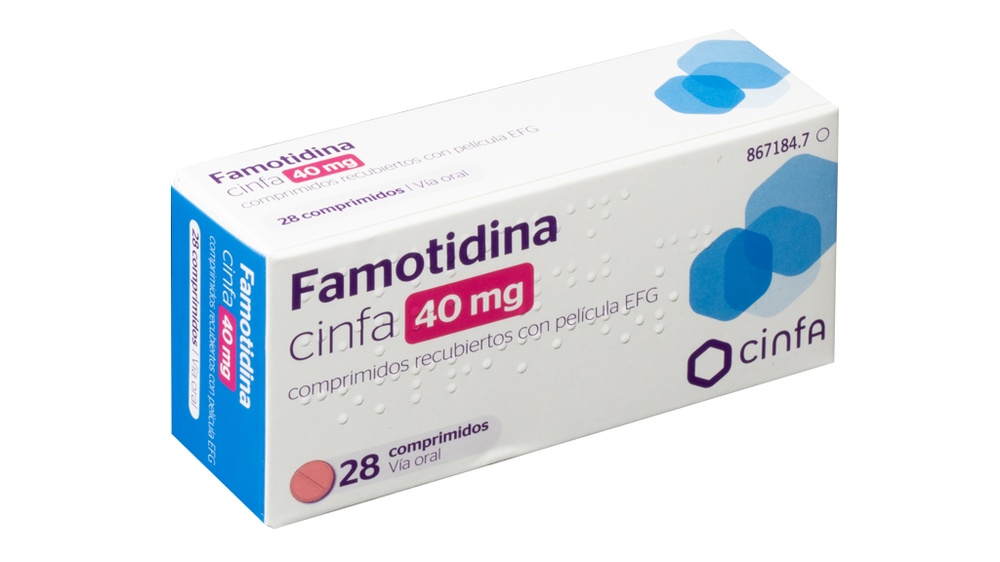
FAMOTIDINA 40 mg Film-Coated Tablets

Prescription review online
A doctor will review your case and decide whether a prescription is medically appropriate.

Talk to a doctor about this medicine
Discuss your symptoms and possible next steps in a quick online consultation.



How to use FAMOTIDINE CINFA 40 mg FILM-COATED TABLETS
Contents of the leaflet
- Introduction
- What is famotidine cinfa and what is it used for
- What you need to know before taking famotidine cinfa
- How to take famotidine cinfa
- Possible side effects
- Storage of famotidine cinfa
- Contents of the pack and further information
Introduction
Package Leaflet: Information for the User
famotidine cinfa 40 mg film-coated tablets EFG
Read the package leaflet carefully before starting to take this medication, as it contains important information for you.
- Keep this package leaflet, as you may need to read it again.
- If you have any questions, consult your doctor or pharmacist.
- This medication has been prescribed to you only, and you should not give it to others, even if they have the same symptoms as you, as it may harm them.
- If you experience side effects, consult your doctor or pharmacist, even if they are not listed in this package leaflet. See section 4.
Contents of the Package Leaflet
- What is famotidine cinfa and what is it used for.
- What you need to know before taking famotidine cinfa.
- How to take famotidine cinfa.
- Possible side effects.
- Storage of famotidine cinfa.
- Contents of the pack and further information.
1. What is famotidine cinfa and what is it used for
famotidine cinfa is a medication that belongs to the group of drugs called H2 receptor antagonists or H2 blockers. These medications are used to treat diseases associated with stomach acid production.
famotidine cinfa is indicated for:
- Treatment and relapse of duodenal and gastric ulcers.
- Treatment of Zollinger-Ellison syndrome.
- Treatment of heartburn and acid reflux.
- Treatment of esophageal inflammation (reflux esophagitis).
- Prevention of reflux esophagitis (irritation and inflammation of the esophagus).

Not sure if this medicine is right for you?
Discuss your symptoms and treatment with a doctor online.
2. What you need to know before taking famotidine cinfa
Do not take famotidina cinfa
- If you are allergic to famotidine or any other component of this medication (listed in section 6).
- If you are allergic to other H2 receptor antagonists.
If you are unsure whether you should take famotidine, consult your doctor.
Warnings and precautions
Before starting treatment, your doctor should rule out the presence of more serious diseases. If your doctor has not ruled out the presence of gastric neoplasia before starting treatment with famotidine, relief of gastric ulcer symptoms during treatment does not exclude the presence of a malignant ulcer.
Consult your doctor or pharmacist before starting to take famotidine cinfa and in the following cases:
- If you have moderate or severe kidney or liver disease. Adverse reactions on the central nervous system have been reported in patients with moderate or severe renal insufficiency. Your doctor will indicate the lowest administration frequency or the lowest dose you should take.
- If you are an elderly person, as you may have renal insufficiency.
If you have been taking famotidine for a long time, your doctor will probably perform regular check-ups. During visits to your doctor, you should inform them of any new or unusual symptoms or circumstances.
Children
The safety and efficacy of famotidine cinfa have not been established in the pediatric population.
Elderly
Consult your doctor for dose selection, and it may be useful to monitor kidney function. Patients over 65 years of age only require dose adjustment in case of moderate or severe renal insufficiency.
Other medications and famotidine cinfa
Inform your doctor or pharmacist if you are taking, have recently taken, or may need to take any other medication.
- Calcium carbonate, when used to treat high blood phosphorus levels (hyperphosphatemia) in patients on dialysis.
- Famotidine may decrease the effect of the oral suspension of posaconazole (a medication used to prevent and treat certain fungal infections).
- Famotidine may decrease the effect of dasatinib, erlotinib, gefitinib, or pazopanib (medications used to treat cancer).
Taking famotidine cinfa with food and drinks
Famotidine does not alter its absorption when administered with meals.
Pregnancy and breastfeeding
Consult your doctor or pharmacist before using any medication.
Pregnancy
Treatment with famotidine is not recommended during pregnancy. If you are pregnant or breastfeeding, think you may be pregnant, or plan to become pregnant, consult your doctor or pharmacist before using this medication.
Breastfeeding
Famotidine is excreted in human milk. Breastfeeding mothers should discontinue treatment with famotidine or stop breastfeeding.
Driving and using machines
Although no effects are expected, if dizziness occurs, do not drive or use hazardous machinery.
Interference with laboratory tests
If you are going to undergo any diagnostic tests, inform your doctor that you are using this medication, as it may alter the results.
famotidine cinfa contains sodium
This medication contains less than 1 mmol of sodium (23 mg) per tablet; it is essentially "sodium-free".
3. How to take famotidine cinfa
Follow the administration instructions of this medication indicated by your doctor or pharmacist exactly. In case of doubt, consult your doctor or pharmacist again. Remember to take your medication.
Your doctor will prescribe the appropriate dose and for how long, depending on your condition. Take only the amount prescribed by your doctor.
Treatment of duodenal ulcer
The recommended dose is 1 tablet (40 mg of famotidine) at night. It can also be administered as half a tablet (20 mg of famotidine) every 12 hours. Treatment should be maintained for 4 to 8 weeks.
Treatment of gastric ulcer(benign)
The recommended dose is 1 tablet (40 mg of famotidine) at night. Treatment should be maintained for 4 to 8 weeks.
Maintenance treatment of duodenal or gastric ulcer
The recommended dose to prevent the recurrence of peptic ulcers is half a tablet (20 mg of famotidine) administered at night. Your doctor will indicate how long you should take the medication.
Treatment of gastroesophageal reflux disease (GERD)
The recommended dose is half a tablet (20 mg of famotidine) twice a day. If there is no improvement after 4-8 weeks, consult your doctor.
Healing of ulcer associated with gastroesophageal reflux
The recommended dose is 1 tablet (40 mg of famotidine) twice a day. If there is no improvement after 4-8 weeks, consult your doctor.
Zollinger-Ellison syndrome
Treatment usually starts with a dose of half a tablet (20 mg of famotidine) every 6 hours. Your doctor will then adjust the dose according to the needs of each patient.
Dose adjustment in patients with moderate or severe renal insufficiency
Your doctor will decide if a dose adjustment is necessary, either by reducing it by half or increasing the time between doses to 36-48 hours, depending on your response.
Elderly patients only require dose adjustment in case of renal insufficiency.
If you think the effect of famotidine is too strong or too weak, inform your doctor or pharmacist.
Method of administration
Swallow the tablet whole with a little water. Your doctor will indicate how many tablets to take per day and for how long.
The score line is only for breaking the tablet if you find it difficult to swallow it whole.
If you take more famotidine cinfa than you should
Adverse reactions in cases of overdose are similar to those found in normal clinical experience.
In case of overdose or accidental ingestion, consult your doctor or pharmacist immediately or call the Toxicology Information Service, phone 91 562 04 20, indicating the medication and the amount ingested.
If you forget to take famotidine cinfa
If you forget to take a dose, take it as soon as possible unless the time for the next dose is near. In this case, skip the missed dose and take the next tablets as usual. Do not take a double dose to make up for missed doses.
If you stop taking famotidine cinfa
Do not stop treatment abruptly or prematurely, as symptoms may worsen. Discontinuation of treatment should always be gradual and according to your doctor's instructions to avoid relapse.
If you have any other questions about the use of this medication, ask your doctor or pharmacist.

Started taking the medicine and have questions?
Discuss your symptoms and treatment with a doctor online.
4. Possible side effects
Like all medications, this medication can cause side effects, although not everyone experiences them.
Common side effects (may affect up to 1 in 10 people)
- Nervous system disorders: headache, dizziness.
- Gastrointestinal disorders: constipation, diarrhea.
Uncommon side effects (may affect up to 1 in 100 people)
- General disorders and administration site conditions: persistent loss of appetite, fatigue.
- Gastrointestinal disorders: nausea, vomiting, abdominal discomfort or distension (inflammation of the abdomen), dry mouth, excess gas.
- Skin and subcutaneous tissue disorders: rash, pruritus (itching or skin irritation).
- Musculoskeletal and connective tissue disorders: joint pain, muscle cramps.
- Psychiatric disorders: reversible mental disorders including depression, anxiety disorders, agitation, confusion, and hallucinations.
Rare side effects (may affect up to 1 in 1,000 people)
- General disorders and administration site conditions: anaphylaxis (unusual or exaggerated allergic reaction), angioedema (severe allergic reaction with inflammation of the face, lips, tongue, throat, and possibly limbs, with difficulty swallowing or breathing).
- Skin and subcutaneous tissue disorders: urticaria (skin patches).
- Hepatobiliary disorders: cholestatic jaundice (yellowing of the skin).
Very rare side effects (may affect up to 1 in 10,000 people)
- Skin and subcutaneous tissue disorders: toxic epidermal necrolysis (skin peeling) and hair loss.
- Investigations: abnormalities in liver enzymes.
Reporting of side effects
If you experience any of the side effects, consult your doctor or pharmacist, even if it is a possible side effect not listed in this package leaflet. You can also report them directly through the Spanish Medicines and Healthcare Products Agency's website: https://www.notificaram.es. By reporting side effects, you can help provide more information on the safety of this medication.
5. Storage of famotidine cinfa
Keep this medication out of the sight and reach of children.
Do not store above 30°C.
Do not use this medication after the expiration date stated on the packaging after CAD. The expiration date is the last day of the month indicated.
Medications should not be disposed of via wastewater or household waste. Place the packaging and any unused medication in the SIGRE collection point at your pharmacy. If in doubt, consult your pharmacist on how to dispose of the packaging and any unused medication. This will help protect the environment.
6. Contents of the pack and further information
Composition of famotidine cinfa
- The active ingredient is famotidine. Each film-coated tablet contains 40 mg of famotidine.
- The other ingredients are:
- Core of the tablet: croscarmellose sodium, talc, microcrystalline cellulose, and magnesium stearate.
- Coating of the tablet: yellow iron oxide (E-172), red iron oxide (E-172), and Opadry-Y-1-7000 (titanium dioxide (E-171), hypromellose, and macrogol 400).
Appearance of the product and pack contents
Orange-brown, cylindrical, biconvex, film-coated tablets, scored on one side and with the code "FA40" on the other side.
They are presented in PVC/Aluminum blisters. Each pack contains 10, 14, or 28 film-coated tablets.
Not all pack sizes may be marketed.
Marketing authorization holder and manufacturer
Laboratorios Cinfa, S.A.
Carretera Olaz-Chipi, 10. Polígono Industrial Areta.
31620 Huarte (Navarra) - Spain
Date of the last revision of this package leaflet:August 2023
Detailed information on this medication is available on the website of the Spanish Agency for Medicines and Healthcare Products (AEMPS) http://www.aemps.gob.es
You can access detailed and updated information on this medication by scanning the QR code included in the package leaflet and packaging with your smartphone. You can also access this information at the following internet address: https://cima.aemps.es/cima/dochtml/p/63317/P_63317.html
QR code to: https://cima.aemps.es/cima/dochtml/p/63317/P_63317.html
- Country of registration
- Dosage formTABLET, 40 mg famotidine
- ATC codeA02BA03
- Average pharmacy price2.5 EUR
- Active substance
- Prescription requiredYes
- Manufacturer
- CompositionCROSCARMELOSA SODICA (4 mg mg)
- This information is for reference only and does not constitute medical advice. Always consult a doctor before taking any medication. Oladoctor is not responsible for medical decisions based on this content.
- Alternatives to FAMOTIDINE CINFA 40 mg FILM-COATED TABLETSDosage form: TABLET, 20 mgActive substance: famotidineManufacturer: Aristo Pharma Iberia S.L.Prescription requiredDosage form: TABLET, 40 mgActive substance: famotidineManufacturer: Aristo Pharma Iberia S.L.Prescription requiredDosage form: TABLET, 20 mg famotidineActive substance: famotidineManufacturer: Laboratorios Cinfa S.A.Prescription required
Online doctors for FAMOTIDINE CINFA 40 mg FILM-COATED TABLETS
Discuss questions about FAMOTIDINE CINFA 40 mg FILM-COATED TABLETS, including use, safety considerations and prescription review, subject to medical assessment and local regulations.









Get FAMOTIDINE CINFA 40 mg FILM-COATED TABLETS Prescription Online
Fill in a 2-min form
Tell us your symptoms, history, and what medicine you're requesting.
Pick a doctor or let us assign
Choose a specialist or we'll match you with the next available doctor.
Doctor reviews your case
Usually within 30 minutes. They may ask follow-up questions via chat.
Collect from any pharmacy
Electronic prescription sent to your email — valid across Spain.
Frequently Asked Questions
FAMOTIDINE CINFA 40 mg FILM-COATED TABLETS requires a prescription in Spain. You can check with a doctor online whether this medicine may be appropriate for your situation.
The active ingredient in FAMOTIDINE CINFA 40 mg FILM-COATED TABLETS is famotidine. This information helps identify medicines with the same composition but different brand names.
The average pharmacy price for FAMOTIDINE CINFA 40 mg FILM-COATED TABLETS is around 2.5 EUR. Prices may vary depending on the manufacturer and dosage form.
FAMOTIDINE CINFA 40 mg FILM-COATED TABLETS is manufactured by Laboratorios Cinfa S.A.. Pharmacy brands and packaging may differ depending on the distributor.
Doctors such as Family doctors, Psychiatrists, Dermatologists, Cardiologists, Endocrinologists, Gastroenterologists, Pulmonologists, Nephrologists, Rheumatologists, Hematologists, Infectious disease physicians, Allergists, Geriatricians, Paediatricians, Oncologists may assess whether FAMOTIDINE CINFA 40 mg FILM-COATED TABLETS is appropriate, depending on your situation and local regulations. You can book an online consultation to discuss your symptoms and possible next steps.
Spain has a well-developed healthcare infrastructure across major cities such as Madrid, Barcelona, Valencia, and Seville. Pharmacies are widely available and operate under strict regulations, ensuring access to prescribed medications.
You can buy FAMOTIDINE CINFA 40 mg FILM-COATED TABLETS in Madrid, Barcelona, Seville, or Valencia at any local pharmacy with a valid prescription.
To obtain a prescription, you can use Oladoctor:
Other medicines with the same active substance (famotidine) include FAMOTIDINE ARISTO 20 mg TABLETS, FAMOTIDINE ARISTO 40 mg TABLETS, FAMOTIDINE CINFA 20 mg FILM-COATED TABLETS. These may have different brand names or formulations but contain the same therapeutic ingredient. Always consult a doctor before switching or starting a new medicine.
