



ETALPHA 2 mcg/ml INJECTABLE SOLUTION

Prescription review online
A doctor will review your case and decide whether a prescription is medically appropriate.

Talk to a doctor about this medicine
Discuss your symptoms and possible next steps in a quick online consultation.



How to use ETALPHA 1 microgram INJECTABLE SOLUTION
Contents of the leaflet
- Introduction
- What is Etalpha and what is it used for
- What you need to know before you are given Etalpha
- How Etalpha is used
- Possible side effects
- Storage of Etalpha
- Contents of the pack and further information
- Date of last revision of this leaflet: January 2022
Introduction
Package Leaflet: Information for the User
Etalpha 1 microgram solution for injection
alfacalcidol
Read all of this leaflet carefully before you start using this medicine because it contains important information for you.
- This medicine will be administered to you by a healthcare professional.
- Keep this leaflet, you may need to read it again.
- If you have any further questions, ask your doctor or pharmacist.
- If you experience any side effects, talk to your doctor or pharmacist, even if they are not listed in this leaflet. See section 4.
Contents of the package leaflet
- What is Etalpha and what is it used for
- What you need to know before you are given Etalpha
- How Etalpha is used
- Possible side effects
- Storage of Etalpha
- Contents of the pack and further information
1. What is Etalpha and what is it used for
Etalpha belongs to a group of medicines called vitamin D analogues that regulate calcium and phosphorus levels in your body.
The active substance of Etalpha is alfacalcidol. Alfacalcidol works by being converted into calcitriol (the active form of vitamin D) in the liver.
This medicine is indicated in situations where there is an alteration of calcium and phosphorus metabolism due to reduced production of 1,25-dihydroxyvitamin D in patients undergoing long-term haemodialysis.

Not sure if this medicine is right for you?
Discuss your symptoms and treatment with a doctor online.
2. What you need to know before you are given Etalpha
Do not use Etalpha
- if you are allergic to alfacalcidol or any of the other ingredients of this medicine (listed in section 6).
- if you have high levels of calcium in your blood (hypercalcaemia).
As during treatment with Etalpha, high levels of calcium in your blood (hypercalcaemia) may appear, you should know the following signs and symptoms of hypercalcaemia:
- loss of appetite (anorexia)
- fatigue
- nausea
- vomiting
- constipation or diarrhoea
- increased urine production
- sweating
- headache
- thirst
- high blood pressure
- drowsiness
- dizziness
Warnings and precautions
Talk to your doctor or pharmacist before you start using Etalpha.
Be particularly careful with Etalpha if:
- you have arteriosclerosis, cardiac valve sclerosis or kidney stones (nephrolithiasis). These conditions may worsen if you have high levels of calcium in your blood (hypercalcaemia).
- you suffer from lung tissue calcification.
- you have renal bone disease or any kidney disorder. To maintain acceptable serum phosphorus levels, phosphorus binders may be used.
- you suffer from inflammatory diseases such as sarcoidosis. These conditions have the potential to increase sensitivity to Etalpha.
- if you are being treated with heart medications (cardiac glycosides). If your blood calcium levels rise too high (hypercalcaemia), the use of these medications can cause changes in your heart rhythm.
During treatment, your doctor will perform blood tests to monitor your calcium and phosphorus levels.
Using Etalpha with other medicines
Tell your doctor or pharmacist if you are using, have recently used or might use any other medicines.
It is particularly important that you tell your doctor if:
- you are being treated with diuretics, calcium-containing preparations or other vitamin D-containing preparations, as these may increase the risk of elevated calcium levels in your blood (hypercalcaemia).
- you are being treated with anti-epileptic medications (barbiturates, phenytoin, carbamazepine or primidone). You may need a higher dose of Etalpha.
- you are taking antacids that contain magnesium, as they may increase the risk of high magnesium levels in your blood (hypermagnesaemia).
- you are being treated with preparations that contain aluminium (such as aluminium hydroxide or sucralfate), as they may increase aluminium absorption.
Pregnancy and breastfeeding
If you are pregnant or breastfeeding, think you may be pregnant or are planning to have a baby, ask your doctor or pharmacist for advice before using this medicine.
Etalpha may be used during pregnancy and breastfeeding only when your doctor considers it essential.
Ask your doctor or pharmacist for advice before using any medicine.
Driving and using machines
Etalpha has no or negligible influence on the ability to drive and use machines.
However, dizziness may occur during treatment, which you should take into account if you drive or use machines.
Etalpha contains ethanol, propylene glycol and sodium
This medicine contains up to 160 mg of ethanol per dose (which corresponds to 4 micrograms of alfacalcidol), equivalent to 10% ethanol (alcohol). The amount in each dose of this medicine is equivalent to 4 ml of beer or 1.7 ml of wine.
The small amount of alcohol in this medicine does not produce any noticeable effect.
This medicine contains 415 mg of propylene glycol per millilitre, equivalent to 20.75 mg/kg/day (which corresponds to 0.1 micrograms/kg/day of alfacalcidol).
If the baby is less than 4 weeks old, talk to your doctor or pharmacist, especially if the baby has been given other medicines that contain propylene glycol or alcohol.
This medicine contains less than 23 mg (1 mmol) of sodium per millilitre, so it is essentially "sodium-free".
3. How Etalpha is used
Etalpha will be administered to you by a healthcare professional via intravenous injection.
Adults and children over 20 kg in weight:
The initial dose is 1 microgram (0.5 ml) per day.
Children under 20 kg in weight:
The initial dose is 0.05 micrograms (0.025 ml) per kilogram of body weight per day.
The maintenance dose is usually between 0.25 and 2 micrograms (0.125 to 1 ml) per day.
The ampoules should be shaken well before use.
Your doctor may adjust these doses according to your needs. To do this, your doctor will perform blood tests or may request other diagnostic tests.
When administered to patients undergoing dialysis, the initial dose for adults is 1 microgram (0.5 ml) per dialysis. The maximum recommended dose is 6 micrograms (3 ml) per dialysis and no more than 12 micrograms (6 ml) per week.
If you receive more Etalpha than you should
If you receive more Etalpha than you should, it may cause an increase in calcium levels in your blood, which is controlled by discontinuing treatment.
If your blood calcium levels are very high, you may need to be given a diuretic and intravenous fluids or you may be given corticosteroids.
In case of overdose or accidental ingestion, contact the Toxicology Information Service. Telephone 91 562 04 20, stating the medicine and the amount used.
If you miss your treatment with Etalpha
Talk to your doctor as soon as possible so that they can tell you what to do in these cases.
If you stop treatment with Etalpha
Your doctor will tell you how long you need to use Etalpha. Do not stop treatment before then, as it may be harmful to your health.
If you have any further questions about the use of this medicine, ask your doctor or pharmacist.

Started taking the medicine and have questions?
Discuss your symptoms and treatment with a doctor online.
4. Possible side effects
Like all medicines, this medicine can cause side effects, although not everybody gets them.
Common side effects (may affect up to 1 in 10 people):
- high levels of calcium in the blood
- excessive phosphorus in the blood
- abdominal pain and discomfort
- skin rash
- itching
- excess calcium in the urine
Uncommon side effects (may affect up to 1 in 100 people):
- confusion
- headache
- diarrhoea
- vomiting
- constipation
- nausea
- muscle pain
- worsening of kidney function (including acute kidney failure)
- kidney stones
- calcium deposits in the kidneys
- fatigue
- tiredness
- discomfort
- calcium deposits in non-osseous tissues
Rare side effects (may affect up to 1 in 1,000 people):
- dizziness
Reporting of side effects:
If you experience any side effects, talk to your doctor or pharmacist, even if they are not listed in this leaflet. You can also report them directly to the Spanish Medicines and Healthcare Products Agency (AEMPS) via the website: https://www.notificaram.es. By reporting side effects, you can help provide more information on the safety of this medicine.
5. Storage of Etalpha
Keep this medicine out of the sight and reach of children.
Store in a refrigerator (between 2°C and 8°C).
Keep the ampoules in the outer packaging to protect them from light.
Do not use this medicine after the expiry date which is stated on the packaging after EXP. The expiry date is the last day of the month stated.
Medicines should not be disposed of via wastewater or household waste. Ask your pharmacist how to dispose of medicines no longer required. This will help protect the environment.
6. Contents of the pack and further information
Composition of Etalpha
- The active substance is alfacalcidol.
1 ml of solution for injection contains 2 micrograms of alfacalcidol. Each ampoule contains 1 microgram of alfacalcidol in 0.5 ml of solution for injection.
- The other ingredients are ethanol, citric acid monohydrate, sodium citrate, propylene glycol and water for injections.
Appearance and packaging of the product
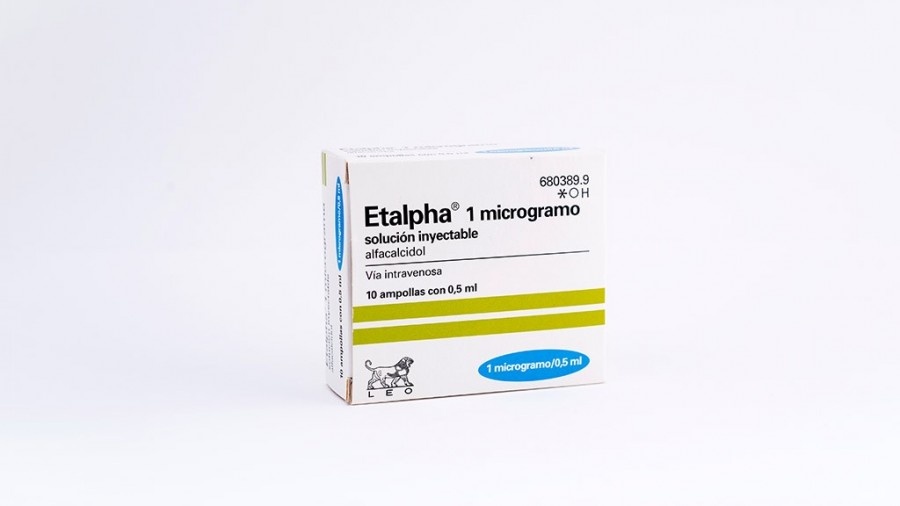
Etalpha 1 microgram is presented as a solution for injection, colourless and transparent, for intravenous administration, in amber glass ampoules. Each pack contains 10 ampoules.
Marketing authorisation holder
CHEPLAPHARM Arzneimittel GmbH
Ziegelhof 24
17489 Greifswald
Germany
Manufacturer
CENEXI SAS
Rue Marcel et Jacques Gaucher,
94120 Fontenay-sous-Bois (France)
You can obtain further information on this medicine by contacting the local representative of the marketing authorisation holder:
Laboratorios Rubió, S.A.
Industria, 29 - Pol. Ind. Comte de Sert
08755 Castellbisbal (Barcelona)
Spain
Date of last revision of this leaflet: January 2022
Detailed and up-to-date information on this medicine is available on the website of the Spanish Agency for Medicines and Healthcare Products (AEMPS) http://www.aemps.gob.es/.
- Country of registration
- Dosage formINJECTABLE, 2 mcg/ml
- ATC codeA11CC03
- Active substance
- Prescription requiredYes
- Manufacturer
- CompositionALCOHOL ETILICO (ETANOL) (80,00 mg mg), CITRATO DE SODIO (E-331) (6,80 mg mg), PROPILENGLICOL (415,0 mg mg)
- This information is for reference only and does not constitute medical advice. Always consult a doctor before taking any medication. Oladoctor is not responsible for medical decisions based on this content.
- Alternatives to ETALPHA 1 microgram INJECTABLE SOLUTIONDosage form: ORAL SOLUTION/SUSPENSION DROPS, 2 mcgActive substance: alfacalcidolManufacturer: Cheplapharm Arzneimittel GmbhPrescription requiredDosage form: INJECTABLE, 2 mcg alfacalcidol/mlActive substance: alfacalcidolManufacturer: Cheplapharm Arzneimittel GmbhPrescription requiredDosage form: CAPSULE, 25,000 IUActive substance: colecalciferolManufacturer: Laboratorios Alter S.A.Prescription required
Online doctors for ETALPHA 1 microgram INJECTABLE SOLUTION
Discuss questions about ETALPHA 1 microgram INJECTABLE SOLUTION, including use, safety considerations and prescription review, subject to medical assessment and local regulations.









Get ETALPHA 1 microgram INJECTABLE SOLUTION Prescription Online
Fill in a 2-min form
Tell us your symptoms, history, and what medicine you're requesting.
Pick a doctor or let us assign
Choose a specialist or we'll match you with the next available doctor.
Doctor reviews your case
Usually within 30 minutes. They may ask follow-up questions via chat.
Collect from any pharmacy
Electronic prescription sent to your email — valid across Spain.
Frequently Asked Questions
ETALPHA 1 microgram INJECTABLE SOLUTION requires a prescription in Spain. You can check with a doctor online whether this medicine may be appropriate for your situation.
The active ingredient in ETALPHA 1 microgram INJECTABLE SOLUTION is alfacalcidol. This information helps identify medicines with the same composition but different brand names.
ETALPHA 1 microgram INJECTABLE SOLUTION is manufactured by Cheplapharm Arzneimittel Gmbh. Pharmacy brands and packaging may differ depending on the distributor.
Doctors such as Family doctors, Psychiatrists, Dermatologists, Cardiologists, Endocrinologists, Gastroenterologists, Pulmonologists, Nephrologists, Rheumatologists, Hematologists, Infectious disease physicians, Allergists, Geriatricians, Paediatricians, Oncologists may assess whether ETALPHA 1 microgram INJECTABLE SOLUTION is appropriate, depending on your situation and local regulations. You can book an online consultation to discuss your symptoms and possible next steps.
Spain has a well-developed healthcare infrastructure across major cities such as Madrid, Barcelona, Valencia, and Seville. Pharmacies are widely available and operate under strict regulations, ensuring access to prescribed medications.
You can buy ETALPHA 1 microgram INJECTABLE SOLUTION in Madrid, Barcelona, Seville, or Valencia at any local pharmacy with a valid prescription.
To obtain a prescription, you can use Oladoctor:
Other medicines with the same active substance (alfacalcidol) include ETALPHA 2 micrograms/ml ORAL DROPS IN SOLUTION, ETALPHA 2 micrograms INJECTABLE SOLUTION, ALDEXINA 25,000 IU HARD CAPSULES. These may have different brand names or formulations but contain the same therapeutic ingredient. Always consult a doctor before switching or starting a new medicine.
