



EMBLAVEO 1.5 G/0.5 G Injectable Perfusion

Prescription review online
A doctor will review your case and decide whether a prescription is medically appropriate.

Talk to a doctor about this medicine
Discuss your symptoms and possible next steps in a quick online consultation.



How to use EMBLAVEO 1.5 G/0.5 G POWDER FOR CONCENTRATE FOR SOLUTION FOR INFUSION
Contents of the leaflet
- Introduction
- What is Emblaveo and what is it used for
- What you need to know before you are given Emblaveo
- How to use Emblaveo
- Possible side effects
- Storage of Emblaveo
- Container contents and additional information
Introduction
Package Leaflet: Information for the User
Emblaveo 1.5 g/0.5 g powder for concentrate for solution for infusion
aztreonam/avibactam
Read all of this leaflet carefully before you start using this medicine because it contains important information for you.
- Keep this leaflet, you may need to read it again.
- If you have any further questions, ask your doctor or nurse.
- If you get any side effects, talk to your doctor or nurse. This includes any possible side effects not listed in this leaflet. See section 4.
Contents of the pack
- What is Emblaveo and what is it used for
- What you need to know before you are given Emblaveo
- How to use Emblaveo
- Possible side effects
- Storage of Emblaveo
- Contents of the pack and other information
1. What is Emblaveo and what is it used for
What is Emblaveo
Emblaveo is an antibiotic that contains two active substances: aztreonam and avibactam.
- Aztreonam belongs to a group of antibiotics called “monobactams”. It can kill certain types of bacteria (called gram-negative bacteria).
- Avibactam is a “beta-lactamase inhibitor” that helps aztreonam to eliminate some bacteria that it cannot eliminate on its own.
What is Emblaveo used for
Emblaveo is used in adults to treat:
- complicated abdominal infections (stomach and intestine) when the infection has spread through the abdominal cavity (space inside the abdomen).
- hospital-acquired pneumonia (bacterial infection of the lungs that is acquired in the hospital) including ventilator-associated pneumonia (pneumonia that develops in patients connected to a ventilator).
- complicated urinary tract infections (difficult to treat because they have spread to other parts of the body or the patient has other conditions), including pyelonephritis (kidney infection).
- infections caused by gram-negative bacteria that other antibiotics cannot eliminate.

Not sure if this medicine is right for you?
Discuss your symptoms and treatment with a doctor online.
2. What you need to know before you are given Emblaveo
You should not be given Emblaveo if:
- you are allergic to aztreonam or avibactam or any of the other ingredients of this medicine (listed in section 6).
- you have ever had a severe allergic reaction (inflammation of the face, hands, feet, lips, tongue or throat; or difficulty swallowing or breathing; or a severe skin reaction) to other antibiotics belonging to the groups of penicillins, cephalosporins or carbapenems.
Warnings and precautions
Tell your doctor or nurse before you start using Emblaveo if:
- you have ever had an allergic reaction (even if it is only a skin rash) to other antibiotics. The signs of an allergic reaction include itching, skin rash or difficulty breathing.
- you have kidney problems or if you are taking medicines that affect kidney function, such as other antibiotics known as aminoglycosides (streptomycin, neomycin, gentamicin). If your kidney function is impaired, your doctor may give you a lower dose of Emblaveo and perform regular blood tests during treatment to monitor your kidney function. Additionally, you may have a higher risk of developing serious side effects that affect the nervous system, such as encephalopathy (a brain disorder that can be caused by disease, injury, medication or chemicals) due to increased blood levels of Emblaveo unless the dose is reduced. The symptoms of encephalopathy include confusion, seizures and altered mental function (see section 3: If you use more Emblaveo than you should).
- you have any liver problems. Your doctor may want to perform regular blood tests during treatment to assess your liver function, as increased liver enzymes have been observed during the use of Emblaveo.
- you are taking medicines known as anticoagulants (a medicine that prevents blood from clotting). Emblaveo may affect blood clotting. Your doctor will monitor your blood levels to check if it is necessary to change your anticoagulant dose during treatment with Emblaveo.
Tell your doctor if you experience:
- severe, prolonged or bloody diarrhea. This can be a sign of intestinal inflammation. If this happens, do not take medicines that stop or slow down bowel movements (see section 4: Possible side effects).
- other infections. There is a small chance that you may contract a different infection caused by another bacterium during or after treatment with Emblaveo.
Lab tests
Tell your doctor that you are taking Emblaveo if you are going to have any tests. This is because you may get an abnormal result with a test called “Coombs test” direct or indirect. This test looks for antibodies that fight against your red blood cells.
Children and adolescents
Emblaveo should not be used in pediatric or adolescent patients under 18 years of age. This is because it is not known if the medicine is safe in this age group.
Other medicines and Emblaveo
Tell your doctor if you are using, have recently used or might use any other medicines.
Tell your doctor before using Emblaveo if you are taking any of the following medicines:
- A medicine for gout known as probenecid.
Pregnancy and breastfeeding
If you are pregnant or breastfeeding, think you may be pregnant or are planning to have a baby, ask your doctor for advice before using this medicine.
This medicine may harm your unborn baby. It should only be used during pregnancy if your doctor thinks it is necessary and only if the benefit to the mother outweighs the risk to the baby.
This medicine may pass into breast milk. If you are breastfeeding, you should decide whether to stop breastfeeding or stop the treatment after considering the benefit of breastfeeding to the baby and the benefit of the treatment to the mother.
Driving and using machines
Emblaveo may cause side effects such as dizziness, which may affect your ability to drive and use machines. Do not drive or use tools or machines if you experience side effects such as dizziness (see section 4: Possible side effects).
Emblaveo contains sodium
This medicine contains approximately 44.6 mg of sodium (main component of cooking/table salt) per vial. This is equivalent to 2.2% of the maximum daily intake of sodium recommended for an adult.
3. How to use Emblaveo
A doctor or nurse will give you Emblaveo.
How much to use
Emblaveo is given as a drip directly into a vein (“intravenous infusion”). The usual dose is one vial (which contains 1.5 g of aztreonam and 0.5 g of avibactam) every 6 hours. The first dose is higher (2 g of aztreonam and 0.67 g of avibactam). The infusion lasts 3 hours. The treatment usually lasts between 5 and 14 days, depending on the type of infection you have and your response to treatment.
People with kidney problems
If you have kidney problems, your doctor may reduce the dose and increase the time between doses. This is because Emblaveo is eliminated from the body by the kidneys. If your kidney function is impaired, your blood levels of Emblaveo may be increased.
If you are given more Emblaveo than you should
A doctor or nurse will give you Emblaveo, so it is unlikely that you will receive more doses of this medicine than you should. However, if you have side effects or think you have been given too much Emblaveo, tell your doctor or nurse immediately. You should tell your doctor if you experience confusion, altered mental function, movement problems or seizures.
If you miss a dose of Emblaveo
If you think you have missed a dose, tell your doctor or nurse immediately.
If you have any other questions about the use of this medicine, ask your doctor or nurse.

Started taking the medicine and have questions?
Discuss your symptoms and treatment with a doctor online.
4. Possible side effects
Like all medicines, this medicine can cause side effects, although not everybody gets them.
Serious side effects
See a doctor immediately if you experience any of the following serious side effects, as you may need urgent medical attention:
- Swelling of the face, lips, eyes, tongue and/or throat, hives and difficulty swallowing or breathing. These can be signs of an allergic reaction or angioedema that can be life-threatening.
- Severe, prolonged or bloody diarrhea (which may be associated with stomach pain or fever). This can occur during or after treatment with antibiotics and can be a sign of severe intestinal inflammation. If this happens, do not take medicines that stop or slow down bowel movements.
- Sudden appearance of a severe skin rash or blisters or peeling of the skin, possibly accompanied by high fever or joint pain (can be signs of more serious medical conditions such as toxic epidermal necrolysis, exfoliative dermatitis or erythema multiforme).
These serious side effects are uncommon (may affect up to 1 in 100 people).
Other side effects
Tell your doctor or nurse if you notice any of the following side effects:
Common:(may affect up to 1 in 10 people)
- Decrease in red blood cell count, which is reflected in blood tests.
- Change in the count of certain types of blood cells (called “platelets”), which is observed in blood tests.
- Confusion.
- Dizziness.
- Diarrhea.
- Nausea or vomiting.
- Stomach pain.
- Increased levels of certain liver enzymes in blood tests.
- Rash.
- Inflammation of a vein.
- Inflammation of a vein associated with a blood clot.
- Pain or swelling at the injection site.
- Fever.
Uncommon:(may affect up to 1 in 100 people)
- Increased count of some types of white blood cells (called “eosinophils” and “leukocytes”), which is reflected in blood tests.
- Difficulty sleeping.
- Encephalopathy (brain disease that causes altered mental function and confusion).
- Headache.
- Decreased sensitivity to touch, pain and temperature in the mouth.
- Altered sense of taste.
- Extra heartbeats.
- Bleeding.
- Decreased blood pressure.
- Flushing of the face.
- Excessive contraction of the muscles of the airways that causes difficulty breathing.
- Stomach bleeding.
- Sores in the mouth.
- Increased levels of some substances in the blood (gamma-glutamyltransferase, alkaline phosphatase in blood, creatinine).
- Itching.
- Purple spots like bruises, small red spots.
- Excessive sweating.
- Chest pain.
- Weakness.
Rare:(may affect up to 1 in 1,000 people)
- Vaginal fungal infection.
- Low levels of blood cells (pancytopenia).
- Significant decrease in the type of white blood cells (called “neutrophils”) used to fight infections, which is observed in blood tests.
- Prolongation of the time it takes for a cut to stop bleeding.
- Spontaneous bruising.
- Abnormal result in a test called “Coombs test” direct or indirect. This test looks for antibodies that fight against red blood cells.
- Seizures.
- Sensations such as numbness, tingling or prickling.
- Double vision.
- Feeling that everything is spinning.
- Ringing or buzzing in the ears.
- Difficulty breathing.
- Abnormal breathing sounds (wheezing).
- Sneezing.
- Stuffy nose (nasal congestion).
- Bad breath.
- Liver inflammation.
- Yellowing of the skin and eyes.
- Muscle pain.
- Breast tenderness.
- Feeling of general discomfort.
Frequency not known:(cannot be estimated from the available data)
- Superinfection (a new infection that occurs after receiving treatment for the current infection).
Sudden chest painhas been observed, which can be a sign of a potentially serious allergic reaction called Kounis syndrome, which has occurred with other medicines of the same type. If this happens, talk to a doctor or nurse immediately.
Reporting of side effects
If you experience any side effects, talk to your doctor, pharmacist or nurse, even if it is possible side effects not listed in this leaflet. You can also report side effects directly through the Spanish Pharmacovigilance System for Human Use Medicines: www.notificaRAM.es. By reporting side effects, you can help provide more information on the safety of this medicine.
5. Storage of Emblaveo
Keep this medicine out of the sight and reach of children.
Do not use this medicine after the expiry date which is stated on the label of the vial and on the carton after “EXP”. The expiry date is the last day of the month shown.
Store in a refrigerator (between 2°C and 8°C).
Store in the original package to protect from light.
Medicines should not be disposed of via wastewater or household waste. Ask your pharmacist how to dispose of medicines no longer required. This will help protect the environment.
6. Container contents and additional information
Composition of Emblaveo
- The active ingredients are aztreonam and avibactam. Each vial contains 1.5 g of aztreonam and avibactam sodium equivalent to 0.5 g of avibactam (see section 2: Emblaveo contains sodium).
- The other component is arginine.
Appearance of the product and container contents
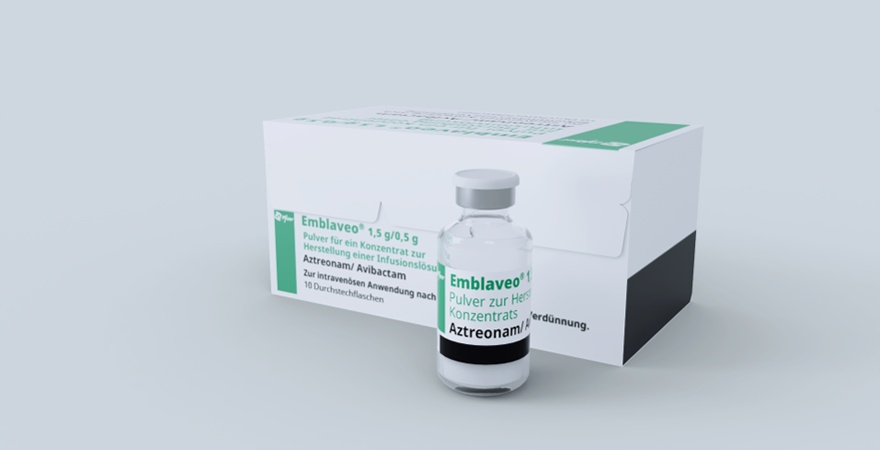
Emblaveo is a white to slightly yellow powder for concentrate for solution for infusion, packaged in a glass vial with a rubber stopper and an aluminum seal with an easy-open cap.
It is available in packs of 10 vials.
Marketing authorization holder
Pfizer Europe MA EEIG
Boulevard de la Plaine 17
1050 Brussels
Belgium
Manufacturer
Pfizer Service Company BV
Hoge Wei 10
1930, Zaventem
Belgium
For further information on this medicinal product, please contact the local representative of the marketing authorization holder:
België/Belgique/Belgien Luxembourg/Luxemburg Pfizer NV/SA Tel: +32 (0)2 554 62 11 | Lietuva Pfizer Luxembourg SARL filialas Lietuvoje Tel: +370 5 251 4000 |
| Magyarország Pfizer Kft. Tel.: +36 1 488 37 00 |
Ceská republika Pfizer, spol. s r.o. Tel: +420 283 004 111 | Malta Vivian Corporation Ltd. Tel: +356 21344610 |
Danmark Pfizer ApS Tlf.: +45 44 20 11 00 | Nederland Pfizer bv Tel: +31 (0)800 63 34 636 |
Deutschland PFIZER PHARMA GmbH Tel: +49 (0)30 550055-51000 | Norge Pfizer AS Tlf: +47 67 52 61 00 |
Eesti Pfizer Luxembourg SARL Eesti filiaal Tel: +372 666 7500 | Österreich Pfizer Corporation Austria Ges.m.b.H. Tel: +43 (0)1 521 15-0 |
Ελλάδα Pfizer Ελλάς A.E. Τηλ: +30 210 6785800 | Polska Pfizer Polska Sp. z o.o. Tel.: +48 22 335 61 00 |
España Pfizer, S.L. Tel: +34 91 490 99 00 | Portugal Laboratórios Pfizer, Lda. Tel: +351 21 423 5500 |
France Pfizer Tél: +33 (0)1 58 07 34 40 | România Pfizer Romania S.R.L. Tel: +40 (0) 21 207 28 00 |
Hrvatska Pfizer Croatia d.o.o. Tel: +385 1 3908 777 | Slovenija Pfizer Luxembourg SARL Pfizer, podružnica za svetovanje s podrocja farmacevtske dejavnosti, Ljubljana Tel: +386 (0)1 52 11 400 |
Ireland Pfizer Healthcare Ireland Unlimited Company Tel: +1800 633 363 (toll free) Tel: +44 (0)1304 616161 | Slovenská republika Pfizer Luxembourg SARL, organizacná zložka Tel: + 421 2 3355 5500 |
Ísland Icepharma hf. Sími: +354 540 8000 | Suomi/Finland Pfizer Oy Puh/Tel: +358 (0)9 430 040 |
Italia Pfizer S.r.l. Tel: +39 06 33 18 21 | Sverige Pfizer AB Tel: +46 (0)8 550 520 00 |
Κύπρος Pfizer Ελλάς Α.Ε. (Cyprus Branch) Τηλ: +357 22817690 | |
Latvija Pfizer Luxembourg SARL filiale Latvija Tel: + 371 670 35 775 |
Date of last revision of this leaflet:02/2025.
Other sources of information
Detailed information on this medicinal product is available on the European Medicines Agency website: https://www.ema.europa.eu
--------------------------------------------------------------------------------------------------------------
This information is intended solely for healthcare professionals:
Important: Consult the summary of product characteristics or the package leaflet before prescribing.
This medicinal product must not be mixed with other medicinal products except for sodium chloride injection solution (0.9%), glucose injection solution (5%), or Ringer's lactate solution as mentioned below.
The powder must be reconstituted with sterile water for injection and the resulting concentrate must be diluted immediately before use. The reconstituted solution is a clear, colorless to yellow solution without visible particles.
Emblaveo (aztreonam/avibactam) is a combination product; each vial contains 1.5 g of aztreonam and 0.5 g of avibactam in a fixed ratio of 3:1.
Standard aseptic techniques must be used for the preparation and administration of the solution. Doses must be prepared in an infusion bag of suitable size.
Parenteral medicinal products must be inspected visually for particles before administration.
Each vial is for single use only.
The total time between the start of reconstitution and the completion of preparation of the intravenous infusion must not exceed 30 minutes.
Instructions for preparation of doses for adults in an INFUSION BAG:
NOTE: The following procedure describes the steps to prepare an infusion solution with a final concentration of 1.5-40 mg/ml of aztreonamand 0.50-13.3 mg/ml of avibactam. All calculations must be completed before starting these steps.
- Prepare the reconstituted solution(131.2 mg/mlof aztreonam and 43.7 mg/mlof avibactam):
- Insert the needle through the vial stopper and inject 10 ml of sterile water for injection.
- Remove the needle and gently shake the vial to obtain a clear, colorless to yellow solution without visible particles.
- Prepare the final solutionfor infusion (the final concentration must be 1.5-40 mg/mlof aztreonam and 0.50-13.3 mg/mlof avibactam):
Infusion bag: for further dilution, transfer a suitably calculated volume of the reconstituted solution to an infusion bag containing any of the following: sodium chloride injection solution (0.9%), glucose injection solution (5%), or Ringer's lactate solution.
Refer to Table 1 below:
Table 1. Preparation of Emblaveo for adult doses in an INFUSION BAG | ||
Total dose (aztreonam/avibactam) | Volume to withdraw from the reconstituted vial(s) | Final volume after dilution in infusion baga,b |
2000 mg/667 mg | 15.2 ml | 50 ml to 250 ml |
1500 mg/500 mg | 11.4 ml | 50 ml to 250 ml |
1350 mg/450 mg | 10.3 ml | 50 ml to 250 ml |
750 mg/250 mg | 5.7 ml | 50 ml to 250 ml |
675 mg/225 mg | 5.1 ml | 50 ml to 250 ml |
All other doses | Volume (ml) calculated based on the required dose: Dose (mg aztreonam) ÷ 131.2 mg/ml of aztreonam or Dose (mg avibactam) ÷ 43.7 mg/ml of avibactam | The volume (ml) will vary depending on the size of the infusion bag available and the preferred final concentration (must be 1.5 - 40 mg/ml of aztreonam and 0.50 - 13.3 mg/ml of avibactam) |
a Dilute to a final concentration of aztreonam of 1.5-40 mg/ml (final concentration of avibactam of 0.50-13.3 mg/ml) for in-use stability of up to 24 hours between 2°C-8°C, followed by up to 12 hours below 30°C for infusion bags containing sodium chloride injection solution (0.9%) or Ringer's lactate solution. b Dilute to a final concentration of aztreonam of 1.5-40 mg/ml (final concentration of avibactam of 0.50-13.3 mg/ml) for in-use stability of up to 24 hours between 2°C-8°C, followed by up to 6 hours below 30°C for infusion bags containing glucose injection solution (5%). |
From a microbiological point of view, the product should be used immediately, unless reconstitution and dilution are performed under controlled and validated aseptic conditions. If not used immediately, in-use storage times and conditions before administration are the responsibility of the user and should not exceed those mentioned above.
Disposal of unused medicinal product and all materials that have come into contact with it should be done in accordance with local regulations.
- Country of registration
- Dosage formINJECTABLE PERFUSION, 1.5/0.5 g
- ATC codeJ01DF51
- Availability in pharmaciesSupply issue reported
- Active substance
- Prescription requiredYes
- Manufacturer
- This information is for reference only and does not constitute medical advice. Always consult a doctor before taking any medication. Oladoctor is not responsible for medical decisions based on this content.
- Alternatives to EMBLAVEO 1.5 G/0.5 G POWDER FOR CONCENTRATE FOR SOLUTION FOR INFUSIONDosage form: INJECTABLE, 1 g aztreonamActive substance: aztreonamManufacturer: Galenicum Derma S.L.U.Prescription requiredActive substance: aztreonamManufacturer: Gilead Sciences Ireland Unlimited CompanyPrescription requiredDosage form: INJECTABLE, 1 gActive substance: meropenemManufacturer: Medochemie Iberia S.A.Prescription required
Online doctors for EMBLAVEO 1.5 G/0.5 G POWDER FOR CONCENTRATE FOR SOLUTION FOR INFUSION
Discuss questions about EMBLAVEO 1.5 G/0.5 G POWDER FOR CONCENTRATE FOR SOLUTION FOR INFUSION, including use, safety considerations and prescription review, subject to medical assessment and local regulations.









Get EMBLAVEO 1.5 G/0.5 G POWDER FOR CONCENTRATE FOR SOLUTION FOR INFUSION Prescription Online
Fill in a 2-min form
Tell us your symptoms, history, and what medicine you're requesting.
Pick a doctor or let us assign
Choose a specialist or we'll match you with the next available doctor.
Doctor reviews your case
Usually within 30 minutes. They may ask follow-up questions via chat.
Collect from any pharmacy
Electronic prescription sent to your email — valid across Spain.
Frequently Asked Questions
EMBLAVEO 1.5 G/0.5 G POWDER FOR CONCENTRATE FOR SOLUTION FOR INFUSION requires a prescription in Spain. You can check with a doctor online whether this medicine may be appropriate for your situation.
The active ingredient in EMBLAVEO 1.5 G/0.5 G POWDER FOR CONCENTRATE FOR SOLUTION FOR INFUSION is Monobactams. This information helps identify medicines with the same composition but different brand names.
EMBLAVEO 1.5 G/0.5 G POWDER FOR CONCENTRATE FOR SOLUTION FOR INFUSION is manufactured by Pfizer Europe Ma Eeig. Pharmacy brands and packaging may differ depending on the distributor.
Doctors such as Family doctors, Psychiatrists, Dermatologists, Cardiologists, Endocrinologists, Gastroenterologists, Pulmonologists, Nephrologists, Rheumatologists, Hematologists, Infectious disease physicians, Allergists, Geriatricians, Paediatricians, Oncologists may assess whether EMBLAVEO 1.5 G/0.5 G POWDER FOR CONCENTRATE FOR SOLUTION FOR INFUSION is appropriate, depending on your situation and local regulations. You can book an online consultation to discuss your symptoms and possible next steps.
Spain has a well-developed healthcare infrastructure across major cities such as Madrid, Barcelona, Valencia, and Seville. Pharmacies are widely available and operate under strict regulations, ensuring access to prescribed medications.
You can buy EMBLAVEO 1.5 G/0.5 G POWDER FOR CONCENTRATE FOR SOLUTION FOR INFUSION in Madrid, Barcelona, Seville, or Valencia at any local pharmacy with a valid prescription.
To obtain a prescription, you can use Oladoctor:
Other medicines with the same active substance (Monobactams) include AZACTAM 1g POWDER FOR INJECTABLE SOLUTION, CAYSTON 75 mg POWDER AND SOLVENT FOR SOLUTION FOR NEBULIZER INHALATION, ARCHIFAR 1G POWDER FOR INJECTABLE SOLUTION AND FOR INFUSION. These may have different brand names or formulations but contain the same therapeutic ingredient. Always consult a doctor before switching or starting a new medicine.
